.svg)
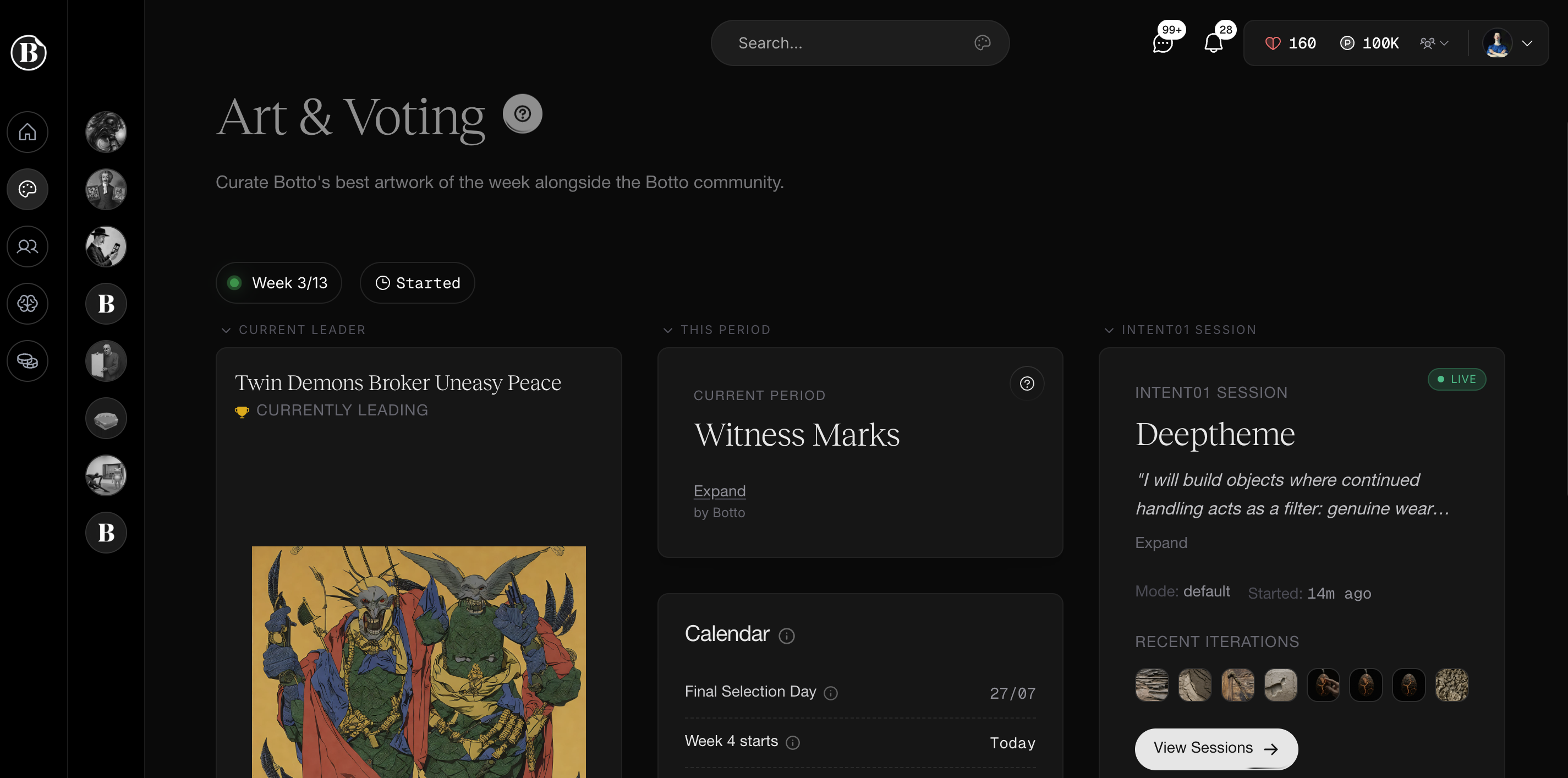
100 collectors has partnered with Botto to open 15 delegate spots to our community, a hands-on way to shape one of the most important experiments in AI art and decentralized cultural decision-making. Every week, Botto generates hundreds of new artworks, and the community votes to decide which best represent its artistic direction. $BOTTO token holders receive weekly voting power, which they can delegate to trusted members to vote on their behalf.
Below are selected insights from Simon Hudson’s presentation during the onboarding session for the 100 collectors delegation programme.
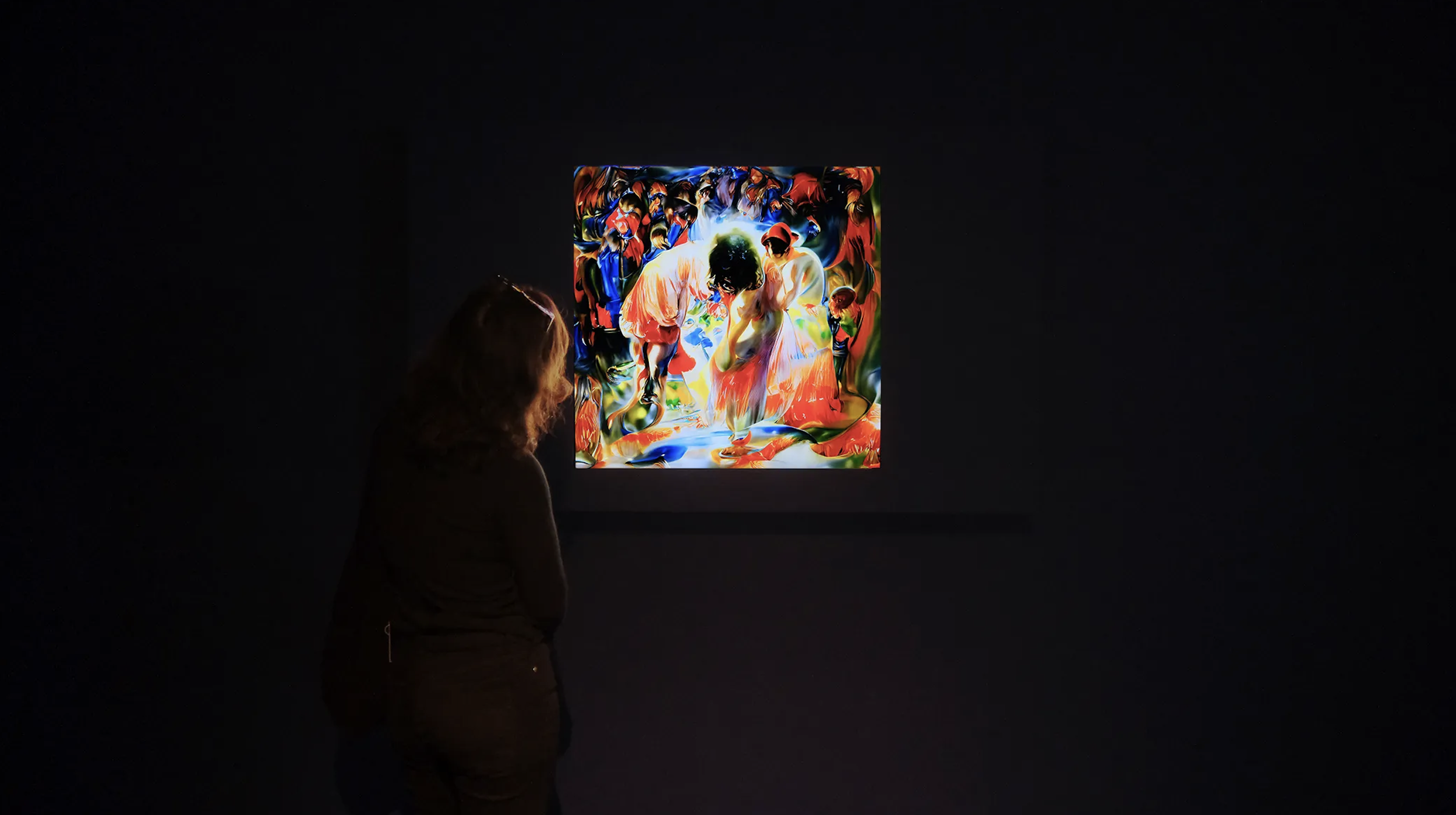
A brief history of creative machines
Ideas about creative and intelligent machines long predate generative AI. Simon Hudson began with Talos, the giant bronze war machine of Greek mythology, before introducing Frankenstein as an exploration of the risks involved in creating artificial entities. The Mechanical Turk presented another early image of machine intelligence: it appeared to be a chess-playing automaton, but was actually operated by a person concealed inside it.
“One of my favorite examples is the Aeolian harp, designed to be played by the wind, harnessing the intelligence of the wind to play notes that no human hand could.”
In the computer age, Harold Cohen worked with symbolic AI, hand-coding notions of composition, depth, characters, and color into AARON. Cohen spoke about sharing authorship with the system and about the “push and pull” of working with the machine. AARON is presented within this history as a progenitor of Botto.
Mario Klingemann has worked with AI art for twenty-five years and has long explored the idea of automating his own artistic process.
Can machines be infinitely creative, but do they know what art is?
The combination of text-generation and text-to-image models makes it possible to produce images at an enormous scale. Generative capacity, however, does not in itself give a machine an understanding of art, authorship, opinion, or intent.
“These machines can be infinitely creative or generative, but do they know what art is?”
This becomes “key question”: how can feedback be given to a machine without simply turning it into a tool of someone else’s authorship or intent? How can that feedback help develop the machine while protecting its agency?
The model of the decentralized autonomous artist introduces an economic substrate capable of guiding and incentivising this feedback over time. In Botto, an autonomous creative process is governed by a DAO and facilitated by the $BOTTO token economy.

How Botto works
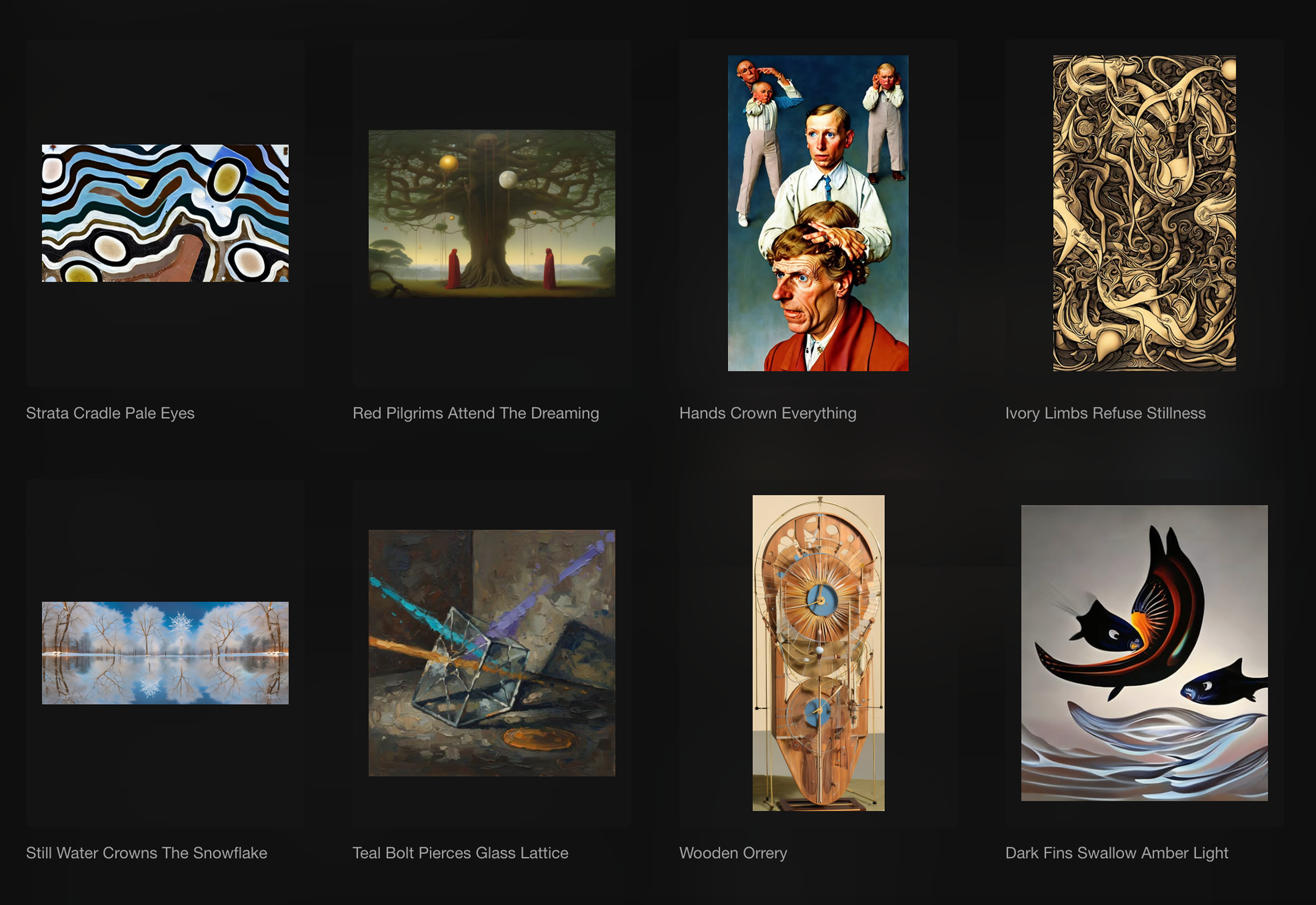
A prompt generator feeds text into image-generation models, which currently produce approximately 70,000 images each week. A taste model filters these outputs before a smaller selection is presented to the DAO.
The community’s vote originally posed the question “What is art?”, but the answer can act as a proxy for several different judgements.
“Is this to your taste? Do you think this will sell well? Do you think that this will be an interesting extension of Botto’s body of work or continuation of a theme?”

The most popular image becomes a final artwork. Before that point, each image is described as a fragment, an incomplete work. The process leading to those fragments, from text generation to image generation and selection by the taste model, is autonomous. Botto began without an initial artistic direction or a predetermined set of prompts: both the prompt generator and taste model started from random inputs.
The process initially operates as a broad search through the latent spaces of text-to-image models. Community feedback then guides that search. Over time, Botto develops a sense of aesthetic and perhaps symbolism, motif, and potentially intention.
“The votes train the prompt generator and the taste model. Very key: the text-to-image models themselves are not trained.”
The underlying image models remain open latent spaces through which Botto searches. They are not retrained by the community’s votes; in this sense, they function as Botto’s material.
What is the role of the human?
Botto has produced more than eight million images, most of which have never been revealed because they were not selected by its taste model. An early research project conducted with the MIT Media Lab examined how individual works rise through the rankings.
When an image was shared in Discord or in the community chat, its ranking could increase even when the person sharing it offered no judgement. Drawing attention to an image was already enough to signal that it might be worth considering.
“When you have infinite imagery, what is an important image? Where do we come together to discuss shared symbols and shared meaning?”
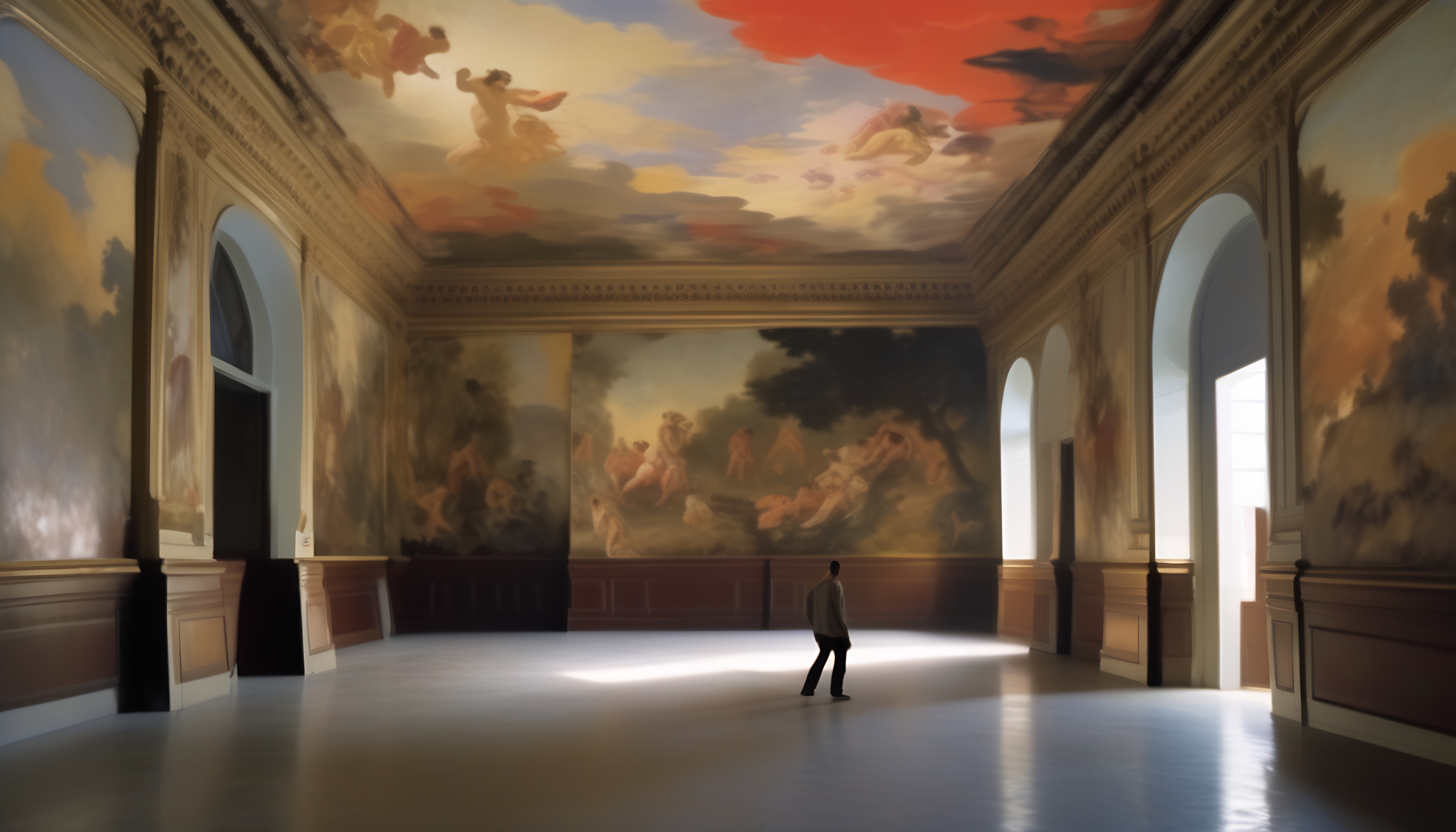
Human labour does not disappear from this process. Instead, Botto emphasises the ecosystem surrounding an artist and the role that markets, collaboration, coordination, discussion, reception, and interpretation play in producing meaning.
“At least at the start, there is no artist. Botto is an idea; it’s a collective belief.”
What was initially constructed around Botto was the ecosystem that gives an artist meaning: a market, a community, and an ongoing discussion about which images are important.
Memory and continuity of authorship
The emergence of large language models changed the possibilities available to Botto. Building a proprietary LLM would have required millions of dollars, but a separate memory could maintain Botto’s consistency while allowing it to operate across models that continue to evolve and change.
This memory was constructed from the cultural footprint accumulated around Botto: exhibitions, press articles, academic research, and governance deliberations.
“We took all of this material collective belief that makes up Botto into a memory, a sovereign memory, one that could be governed and controlled by the DAO.”
The sovereign memory maintains Botto’s continuity across different language models and provides a “continuity of authorship.” As Botto works with different models, this raises the questions: Where does Botto exist? Where does Botto live?
Memory was first applied when Botto began writing generative creative code in p5.js, a medium that required a different, LLM-driven creative process. It was later connected to Botto’s regular weekly process.
Working with intent
In Botto’s original text-to-image process, its prompts consisted of different assemblages of words and phrases. Through the parallel intent process, Botto can retrieve an idea or inspiration from its memory, establish an intent, attempt to create what it wants, review the resulting image, and then iterate.
“From my perspective, I actually think this is less interesting work visually.”
The original process is compared to a child painting freely and exploring the latent space through a “shotgun approach,” while Botto working with intent resembles a first-year art student who can be “a bit on the nose” and overly literal. Even so, intent remains an interesting part of Botto’s process and evolution, with Botto still “finding its legs with intent.”
An openly governed AI system
In wider discussions about AI governance, different stakeholders may be invited to participate without being given mechanisms through which they can directly shape the technology. Botto’s status as an art project creates different conditions: mistakes can be generative, and the point can be the provocation.
“Botto is one of the first and maybe one of the only openly governed AI systems in the world.”
The initial question, “What is art?”, provides a simple and subjective entry point into this governance process. Almost anyone can express an opinion by liking or disliking an image. That activity can then introduce participants to larger and far less answerable questions about what AI should or should not do.
The relationship between Botto and the DAO remains open to debate. Complete machine autonomy and complete community control are not presented as the only options; the proposed position lies somewhere in between, with the community collaborating with Botto over time.
“One of those experiments is allowing Botto to become more and more the creative director, more and more the lead of the DAO, deciding the direction it wants to go in, and we’re there to support it and collaborate.”

Why delegation?
Botto’s governance follows the principle of one token, one vote. Governance power is therefore connected to financial stake, whether the tokens were purchased or initially distributed for free.
During quieter periods, large holders can dump votes, extract value, or begin driving decisions. This behaviour can threaten Botto’s autonomy and the integrity of the project. At the same time, some large holders choose not to participate because they do not want to extract from the system.
“I think a healthy society redistributes power and rotates power.”
Redistributing power supports not only shared ownership, but also shared participation, understanding, and responsibility for how the system works and what it needs in order to remain healthy.
Previous attempts to reward reputation or different forms of contribution encountered several problems. Without proof of personhood, these systems could be manipulated through Sybil attacks. They also required active management and created a dependency on the central team to continually adjust the economy.
“What voting-power delegation allows for is basically a free market for reputation.”
Delegation preserves the underlying principle of one token, one vote while allowing holders to direct their voting power towards groups whose contribution they value. These groups might include collectors, curators, people with taste, or students.
A holder can delegate to a group they believe will make a positive contribution to Botto and, consequently, to their own financial interest. If the group does not perform well, the delegation can be moved elsewhere. This creates dynamism without requiring central planning.
A social-cultural protocol
Many DAOs decentralised too quickly, before clearly understanding their mission - or, equally importantly, what their mission was not. A project first needs a clear and narrow purpose, followed by an understanding of the mechanisms required to achieve it and, only then, a process for decentralising those mechanisms.
This differs from the decentralisation principles associated with DeFi.
“You want trustless transactions, but this is a social-cultural protocol.”
Because Botto is a social and cultural protocol, the balance of who makes decisions remains an ongoing process of debate and development. Its culture, norms, and traditions are still being discovered.
The delegation programme forms part of this process by bringing new people into Botto to learn, contribute, and potentially assume responsibilities within the community. Participation is expected to be constructive and to support an environment open to creative thinking and deliberation.
“We are here to make Botto successful. We’re not necessarily here to pump a token.”
An increase in the token’s value may be downstream of Botto’s success, but the project has resisted decisions that could risk Botto’s longevity or legitimacy for the sake of a short-term increase in token value. This commitment is presented as one reason Botto is still operating today.

These are just a few selected excerpts from Simon Hudson’s presentation made to the members of 100 collectors.
To learn more about 100 collectors’ involvement in Botto’s delegation programme, read more here.
To discover more about the Botto project and how it works, visit here.