.svg)
An exploration of Protocol Art at Palazzo Diedo
I felt a particular vertigo when walking through the Strange Rules exhibition, currently on view at Palazzo Diedo in Venice. Curated by Mat Dryhurst, Holly Herndon and Hans Ulrich Obrist with Adriana Rispoli, Strange Rules is the first museum-scale attempt to inaugurate Protocol Art as both a curatorial and a theoretical category —foreshadowing a field I have been exploring for over a decade.
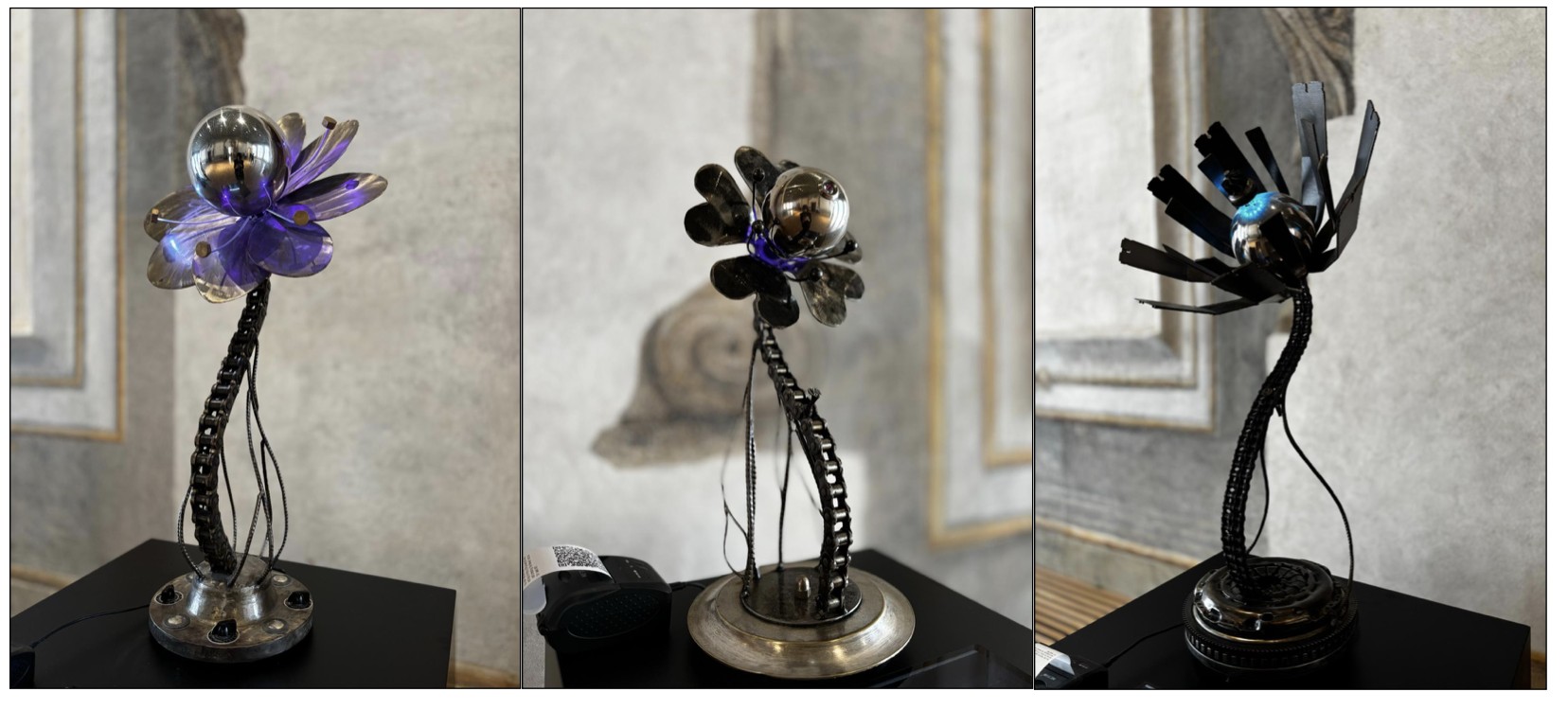
In fact, I have the privilege to be one of the artists exhibited in the show. Four of my Plantoids —these blockchain-based lifeforms I have been developing since 2014— sit in one of the upstairs rooms as one of the historical anchors of this field. Hence, I write this piece not as an external critic, but as an insider of a field that is being defined in part around my practice. That is a strange place from which to review this exhibition, but it is, perhaps, also the most honest place to write from.
The cerebral samba (and beyond)
In The Cerebral Samba, published in Le Random a few days after Strange Rules opened, Peter Bauman maps the emerging field of Protocol Art along a sliding scale between two cerebral hemispheres: the protocolic left brain that tries to formalize everything into rules, and the worlding right brain that tries to instigate reality as a living environment. Bauman identifies three distinct archetypes along this axis: protocol instantiators who define rules that others can instantiate, protocol critics who analyse the protocols that influence our lives, and worldbuilders who create emergent environments from loosely defined protocols. In his piece, Bauman references me as an archetypical example of protocol instantiators, because “every instance of Plantoids is a new productive work, which does not reproduce the protocol but instantiates it.”
This is—or was—my own (narrow) definition of Protocol Art. Yet, walking the three floors of Palazzo Diedo made me realise that the exhibition is in fact embracing a much broader understanding of protocol art. The artists exhibited in the show relate to protocols in at least three distinct ways:
- some artists create artworks that may themselves be regarded as protocols, i.e. codified sets of rules that other humans or machines can later instantiate;
- others make artworks that works with protocols, as their ground or compositional media;
- while others make artworks that are about protocols, exposing and critically describing the hidden rules and structures that orchestrate our life.
Three prepositions, each representing a different way to embody protocol art. And this show— perhaps more than any text written so far—makes this plurality legible.
Protocols as art
Harold Cohen constitutes the earliest historical anchor of the show. In the early 1970s, Cohen started working on AARON, one of the first computational protocols capable of making drawings —which he continued to refine until his death in 2016. AARON was programmed to instantiate Cohen’s artistic decisions about line, composition and figure, to create works that went beyond Cohen’s own drawings. This is a demonstration that protocol art comes with its own genealogy, which predates blockchain and generative AI by half a century.
Ken Stanley's Picbreeder is a slightly more recent instantiation of Protocol Art. As a neuro-evolutionary researcher, Stanley designed a protocol for evolutionary discovery, where images evolve through user input and selection, letting the protocol find things he could not have specified in advance. Through this protocol, he showed that the most interesting results emerged organically from open-ended novelty search, rather than from clear goals and objectives.

Moving into the blockchain realm, we encounter a work from Terra-0, who designed a protocol by which a forest could own itself. Back in 2016, the duo implemented a smart contract that represents the interests of a forest, with the ability to sell timber rights to accumulate capital, and use that capital to acquire more land. The artwork does not reside in the forest, but rather in the blockchain protocol that the forest operates from. There is no representational object to look at, only a set of technological and legal rules—along with the world that these rules produce.
My own Plantoids belong in this lineage as well. Each Plantoid is a metallic sculpture with its own crypto wallet it can receive funds to, and when it accumulates enough cryptocurrency from human pollinators, it initiates the process of commissioning new artists for producing the next generation of Plantoids. Here, again, the artwork is not the sculpture in the room, it is the protocol that the Plantoids execute. Every Plantoid is an instance of that protocol, and every newborn Plantoid is a new production of my work—regardless of who created it—not a reproduction of my previous works.
Fabien Giraud extends this principle to a new timescale. Conceived as a thousand-year project (2025–3025), The Feral is a single-channel video that is generated continuously by generative AI systems. Epoch 1, which we see at Palazzo Diedo, is the first of many epochs that the protocol is expected to produce over a millennium. With the Feral, Giraud has written a protocol intended to run for many centuries, extending his authorial gesture beyond his own lifespan.
What unites these works is the withdrawal of their authors. The artists produce the protocol and then step out of the way. What the protocol produces—be these drawings, images, videos or sculptures—is determined, but not (necessarily) produced by the artist. These artists are, in a sense, the writers of a score that will keep being played long after they have left the room.
Art with protocols
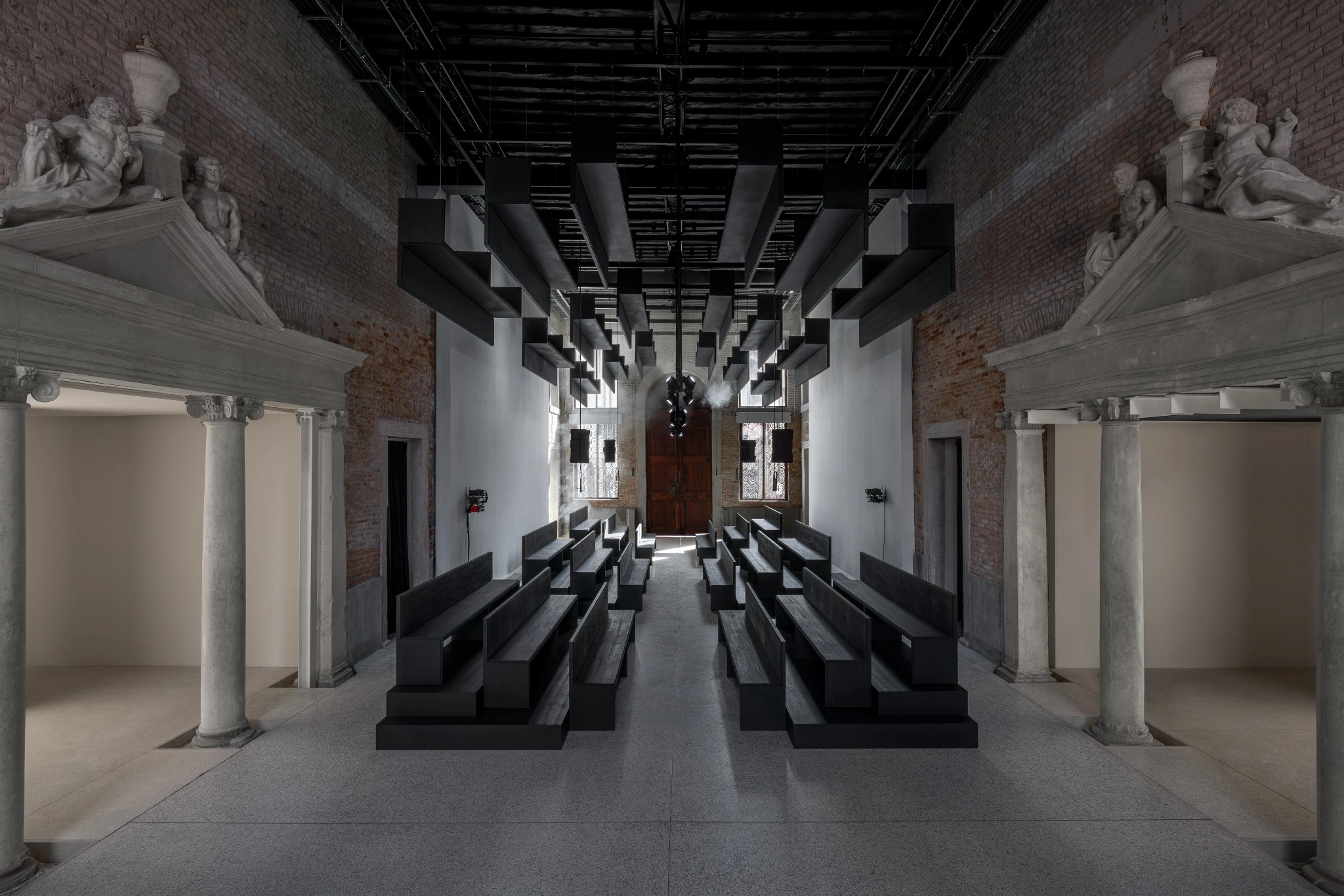
On the ground floor of Palazzo Diedo, we can experience Mat Dryhurst and Holly Herndon's newly commissioned artwork, realised in partnership with the architecture studio SUB. Herndon and Dryhurst have been building protocols for many years as part of their artistic practice, often using these protocols as both compositional and political media. Back in 2019 they created Spawn (a neural network trained on Holly's voice) and Holly+ (a platform featuring the vocal twin of Holly Herndon) enabling anyone to use Holly’s voice in their own musical works—an archetypical example of art as protocol. Here, they take a slightly different approach, taking over the main hall of Palazzo Diedo with an installation made of dark steel benches surrounded by microphones and speakers, collecting all the conversations of the room and processing them through a multiplicity of AI agents who are constantly monitoring and reflecting upon what is being said in the room. These agents will then translate their sentiments and opinions into a never-ending musical piece that the audience can enjoy in real-time. In this case, the artists are not creating a protocol that can be instantiated by others, but rather chose to work with new music-making protocols in order to make music with properties that older protocols of music-making did not have.
Another example of an artist working with protocols is Agnieszka Kurant, whose practice consistently treats systems as the material she composes with rather than the object she depicts. Her piece for Strange Rules, Phantomatics, was made in collaboration with the computational linguist Gašper Beguš from UC Berkeley. Kurant used a language-generation protocol to evolve a hundred synthetic languages from existing ones, and presented them as disembodied speech against subtitles on a coloured screen. Standing before these voices, the visitor is no longer simply looking at an artwork but listening into a system that is still in the making. The work also probes an evolutionary question: could any of these AI-generated languages keep developing on its own, and eventually be adopted by humans or machines?
Working with protocols is closer to traditional art practice than designing protocols as art, because the artist remains the author of the ultimate art piece. Yet, by working with protocols as their main medium of expression, artists are changing the way in which people can interact with their work—not by merely observing or interacting with them, but by becoming part of the system that these protocols enact.
Art about protocols
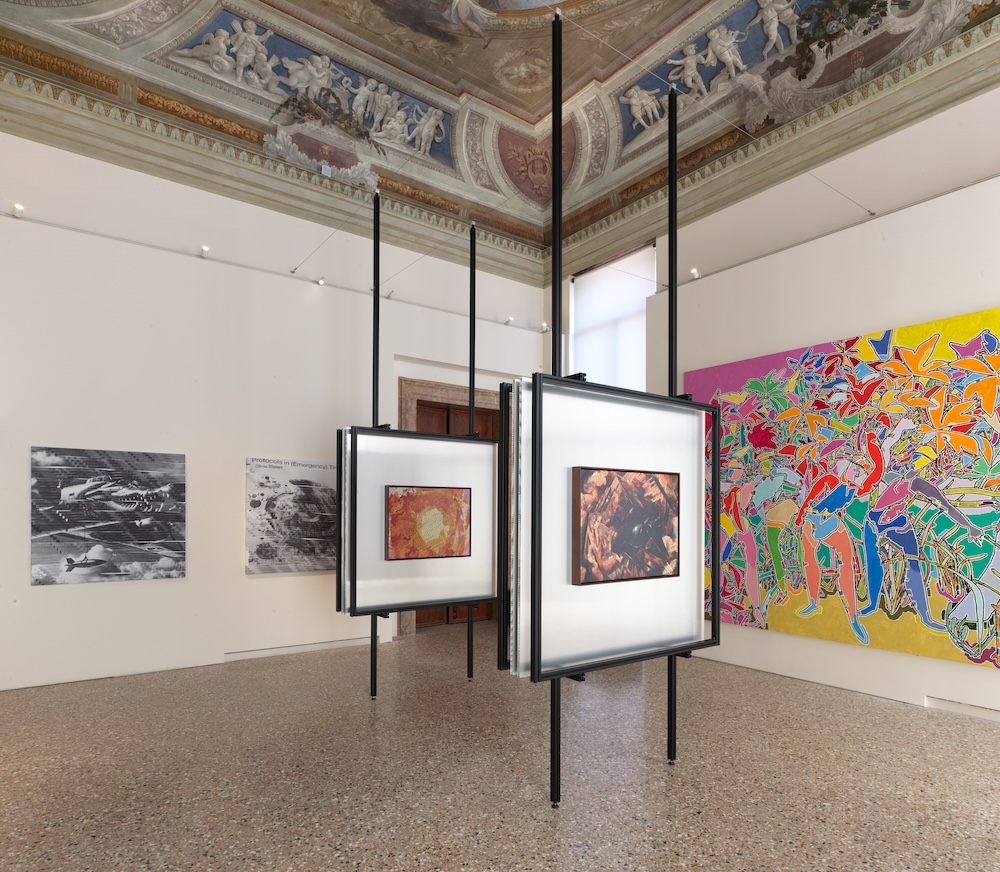
A third modality of protocol art introduces a critical undercurrent to the exhibition. Simon Denny has spent years making art to shed light onto the protocols that increasingly structure economic and political life, from crypto-mining to speculative trading and plutocratic governance. For this exhibition, Denny collaborated with media theorist Venkatesh Rao to showcase Monsters Between Worlds, paintings created through mechanical plotters that reflect upon the way protocols shape society at scale.
Trevor Paglen works in a similar register, albeit focusing more on the protocols of machine perception. For years, Paglen has made visible the infrastructures intended to remain invisible: classified satellites, undersea surveillance cables, and, more recently, the classification systems through which AI is taught to see the world. At Palazzo Diedo, Paglen presented Voyager, an immersive hypnosis installation that responds in real time to the visitor's spoken answers and heart rate. There is no screen and no image to look at, only the participant's own mind steered by an AI-generated voice. What Voyager puts on display is, once again, the underlying protocol—that of an adaptive system whose primary goal is to influence the audience’s own mind—which can be experienced first-hand, rather than being observed from the outside.
I am sometimes resistant to describe these artistic practices as "protocol art" in the strictest sense of term, because here the protocol is the subject rather than the substance of the work. A painting about the Internet would not be regarded as a digital work, just like a song about the blockchain would not be regarded as crypto-art.
Yet, the curators of the show hold a valid point: if the exhibition only showed artworks made as or with protocols, it would miss the critical and political dimension of protocol art. Protocols are neither good nor bad, nor are they neutral in the way they affect our society. To make these protocols visible is also a form of art-making that helps us experience the world differently.
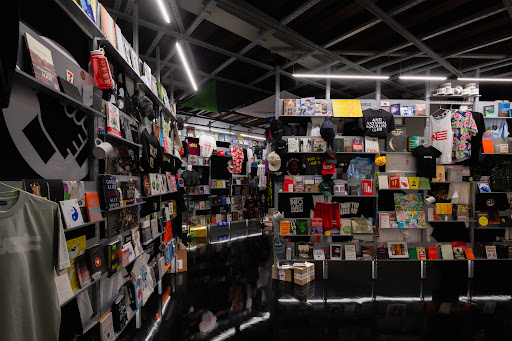
This is also the territory of Joshua Citarella, who spent the past decade studying how political identities are formed online—i.e. how memes, recommendation algorithms, and platform architectures operate as protocols that channel people into ideological communities. His installation, done in collaboration with the research collective New Models, is The Online Marketplace of Ideas, a room filled with books and merchandising from a particular subset of Internet-native ideologies, treating the attention economy not as a backdrop but as an active formatting system that shapes belief itself.
The biological frontier
Perhaps the most provocative contribution to the show is that of Michael Levin. Levin is not an artist in the conventional sense, he is a biologist at Tufts who is mostly known for his research on planaria worms and their regenerative capacities. Levin discovered that, when cut into pieces, worms who have the ability to reassemble themselves into whole worms can be instructed—via bioelectric and chemical signalling—to regenerate two heads, instead of a head and a tail. For the curators of the show, this represents a novel inquiry into biological protocols.
This extends the reach of protocols beyond the shaping of culture and politics, towards the structuring of biology itself. Alongside Terra-0's protocol for forest emancipation and, to a lesser extent, my own Plantoids protocol for mechanical reproduction, this suggests that protocol art should not be limited to purely computational artefacts. Every aspect of life can be a protocol—be it either an organic or synthetic protocol.
Strange Rules’ contribution to the field of Protocol Art
Strange Rules represents the first comprehensive curatorial statement about Protocol Art. That is an important institutional recognition for this artistic practice that has existed for many years now, but has, until now, been distributed across multiple genres: from conceptual art to generative art and cryptoart—without a common framework to sit in.
But the show is only the beginning of a much longer journey. The forthcoming publication, intended as the first comprehensive account of protocol art as a field of practice, is being prepared to be revealed towards the end of the show. A live programme of artistic interventions (with Sougwen Chung, Operator, Dustin Yellin, Hito Steyerl, and others) unfolds alongside the permanent exhibition.
Together, the publication and the exhibition will set the tone of what comes afte—providing a prototypical definition of Protocol Art by showing multiple examples of it, and anchoring a few selected artists into the lineage of Protocol Art, while leaving room for critics and curators to discover additional artists that also belong to that lineage.
Walking out of Palazzo Diedo, I had the sense of being part of an experiment trying to bring a new concept into being, not through theory but through practice, not by defining what Protocol Art is, but by inviting the audience to experience it first hand. Strange Rules has the rare distinction of being a museum exhibition that is also a protocol—a set of initial conditions that invites others to instantiate the field it has only begun to define.
Strange Rules is on view at Palazzo Diedo, Venice, until 22 November 2026.