
Since 2021, Art Blocks, the leading platform for generative art, has gathered its community each October in Marfa, a small town in the high desert of West Texas. Generative art is made by a system the artist designs, usually written in code, that produces a different result each time it runs.
Since then, Marfa Weekend has become an annual gathering for artists, collectors, developers, and enthusiasts connected by a shared interest in generative art. This October, Art Blocks celebrates its sixth edition, from October 22 to 25, 2026, with four days of exhibitions, talks, screenings, and community gatherings.
For a community whose artistic experiences and relationships often develop online, Marfa offers something different: a physical place to meet, encounter artworks, and exchange ideas beyond the screen.
But Marfa's history as an artistic destination began long before NFTs, blockchain, or Art Blocks.
Decades before the arrival of the generative art community, this remote town had already established itself as one of the most distinctive places in contemporary art. Its transformation was largely shaped by American artist Donald Judd, whose decision to work in Marfa in the 1970s challenged conventional ideas about how and where art should be experienced.
To understand why Marfa has become such a meaningful destination for generative art today, we must first understand how it became an art destination in the first place.

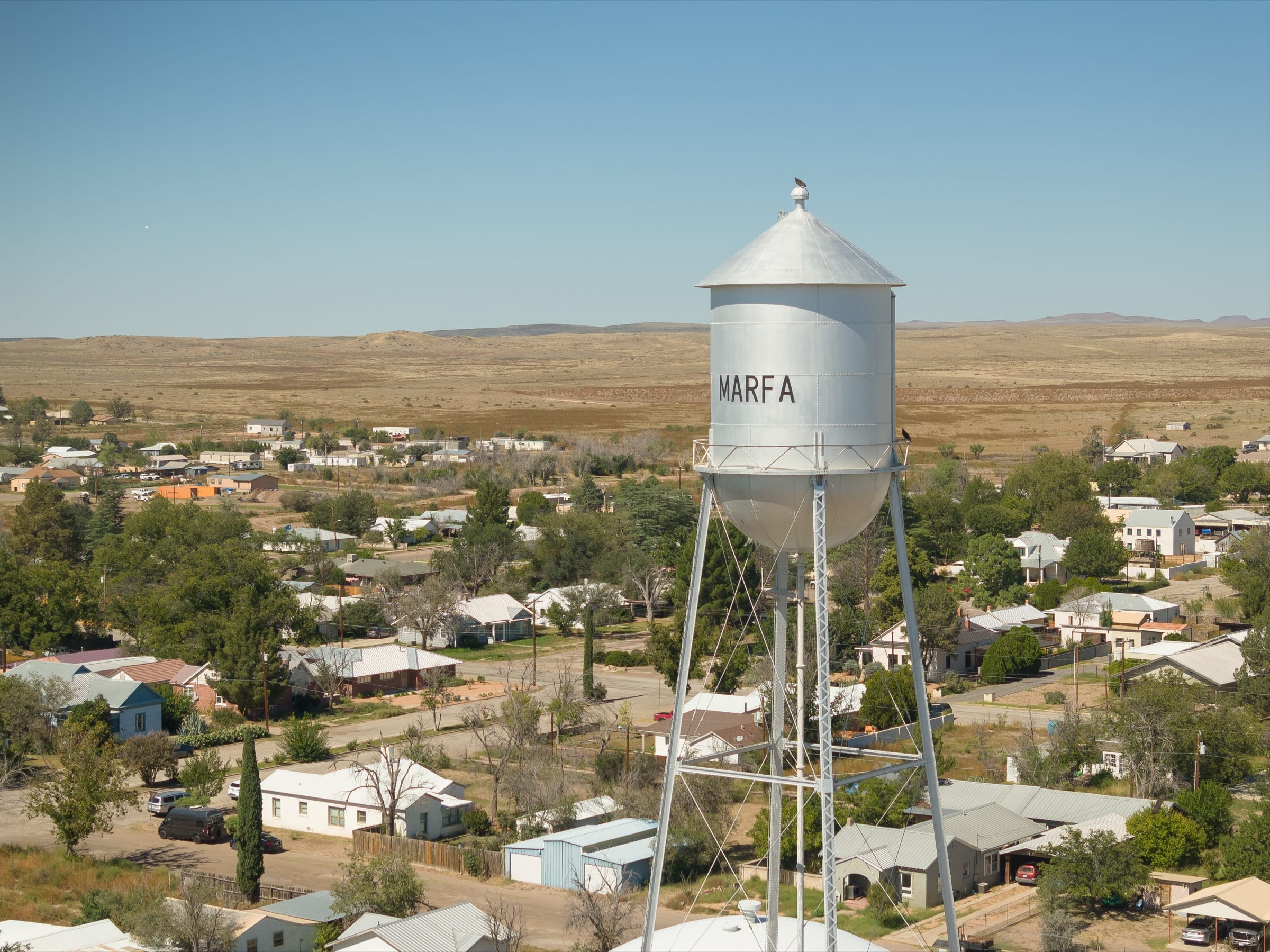
Marfa is located in the Trans-Pecos region of West Texas, within the northern Chihuahuan Desert, surrounded by vast plains, mountain ranges, and expansive skies. Its geographic isolation has become central to its identity, but the town's history extends well beyond its contemporary reputation as an art destination.
Marfa originated in 1881 as a railroad water stop and freight station along the Southern Pacific Railroad. By 1883, it had acquired an official post office, and during the following decades it developed as a regional center for ranching, commerce, and military activity.
The town's history is also closely connected to the Mexican and Mexican American communities of the border region. One important historical landmark is the Blackwell School, established in 1909, which served Marfa's Mexican and Mexican American children during an era of educational segregation. Today, it is preserved as a National Historic Site, documenting a history that predates the town's emergence on the international art map.
It was within this existing community, surrounded by the expansive landscape of West Texas, that the minimalist artist Donald Judd would begin developing an entirely different vision for contemporary art.
Donald Judd and the Search for a Different Kind of Space

In 1971, American artist Donald Judd (1928–1994) began establishing a presence in Marfa, searching for a place where he could live and work outside New York.
By then, Judd was already an influential figure in contemporary art, closely associated with Minimalism, although he resisted the term as a description of his practice. His work had moved away from traditional painting and sculpture toward three-dimensional objects characterized by geometric forms, industrial materials, repetition, and a rigorous attention to space.
His decision to look beyond New York was both artistic and practical. He was increasingly interested in creating and installing works that required more space than conventional galleries could offer, while also becoming dissatisfied with aspects of the New York art world.
Marfa offered available buildings, expansive surroundings, and the possibility of developing installations according to his own artistic intentions.
During his first visit, Judd rented a small house, beginning a relationship with the town that would shape the remainder of his life and career. Over the following years, he acquired and adapted properties, including former military and industrial buildings, transforming them into spaces for living, working, and exhibiting art.
For Judd, the environment surrounding an artwork was never simply a neutral container. The proportions of a room, the architecture of a building, the movement of natural light, and the relationship between an object and its surroundings were essential to how the work was experienced.
Marfa gave him the opportunity to put that philosophy into practice on an unprecedented scale.
The Chinati Foundation: Art, Architecture, and Land
In 1978, with financial support from the Dia Art Foundation, Judd began renovating buildings at the former Fort D. A. Russell military complex in Marfa, transforming the site into a space for large-scale artistic installations. In 1986, he established the Chinati Foundation, which opened to the public as an independent nonprofit museum in 1987.
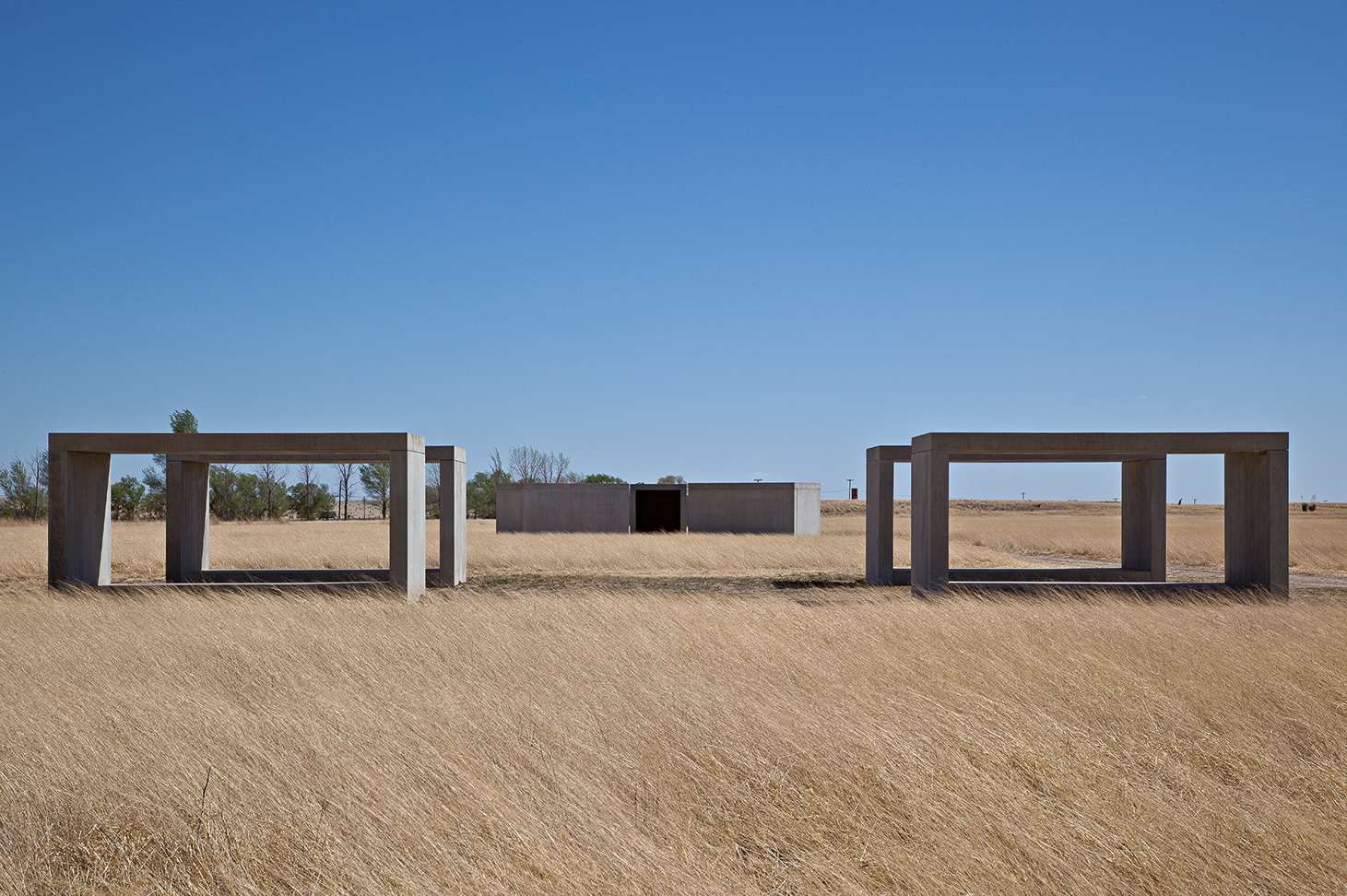
Occupying approximately 340 acres, The Chinati Foundation was conceived around an unusual proposition: art, architecture, and land should be experienced as a coherent whole. Rather than continuously changing exhibitions, the institution would allow visitors to experience major works in environments specifically conceived or adapted for them. At the center of the collection are two monumental bodies of work by Judd.
The first, 15 untitled works in concrete (1980–1984), consists of fifteen large-scale works installed outdoors along the boundary of Chinati's property. Constructed from concrete units sharing the same dimensions, the works explore repetition, proportion, and the relationship between geometric structures and the surrounding landscape.
The second, 100 untitled works in mill aluminum (1982–1986), occupies two former artillery sheds that Judd adapted specifically for the installation.
Each of the one hundred aluminum objects has the same external dimensions, but each possesses a unique internal configuration. The buildings were modified with extensive windows that allow natural light to enter, changing the appearance of the reflective aluminum surfaces throughout the day.
Chinati also became home to major installations by other artists. Dan Flavin developed a project using colored fluorescent light across six former military barracks, transforming the perception of architectural space. John Chamberlain's sculptures, made from compressed and assembled metal, found a home in a renovated wool warehouse in downtown Marfa.
The collection expanded to include works by Richard Long, Roni Horn, Ilya Kabakov, and others. Following Judd's death in 1994, Chinati continued developing projects consistent with his vision, including Robert Irwin's untitled (dawn to dusk), completed in 2016.
Chinati is more than a museum founded by an artist. It is an experiment in rethinking the institution itself, allowing artworks to exist in close relationship with the architecture and environment around them.
Beyond the Museum: Marfa and the Legacy of Land Art
Marfa's transformation belongs to a broader movement in American art during the 1960s and 1970s, when artists increasingly questioned the traditional boundaries of museums and galleries.
During this period, Land Art, also known as Earth Art, emerged as an approach in which the landscape itself became an essential component of artistic practice. One of the most recognizable examples of Land Art is Robert Smithson's Spiral Jetty (1970), a monumental spiral constructed from rock and earth extending into Utah's Great Salt Lake. The work cannot be understood independently from its location: changes in water levels, light, and environmental conditions are integral to its experience.
Judd's approach in Marfa was different. Rather than using the landscape itself as his primary sculptural material, he explored the relationship between precisely constructed objects, existing architecture, and their surrounding environment. Yet these practices shared a fundamental concern: the idea that an artwork's meaning and experience could be inseparable from its location.
Artists such as Robert Smithson, Michael Heizer, and Walter De Maria developed ambitious projects outside conventional exhibition spaces, often in remote environments. Marfa's significance in the Land Art movement lies specifically in the development of site-specific installations and alternative models of presenting contemporary art.
A New Generation of Contemporary Art Institutions

Over the following decades, Marfa's artistic identity expanded beyond Donald Judd's legacy.
In 2003, Virginia Lebermann and Fairfax Dorn founded Ballroom Marfa, a nonprofit contemporary art institution housed in a converted 1920s ballroom.
Unlike Chinati, whose collection is centered on long-term installations, Ballroom Marfa developed a program of changing exhibitions, new commissions, performances, music, and experimental projects, bringing new generations of artists into dialogue with the particular cultural and geographic conditions of West Texas.
One of the most recognizable artworks associated with this new chapter is Prada Marfa (2005), created by the artist duo Elmgreen & Dragset and produced by Art Production Fund in collaboration with Ballroom Marfa. Located near Valentine, approximately 37 miles west of Marfa, the installation resembles a small Prada boutique standing alone beside a desert highway. Despite its appearance, it is not a functioning store. The door is sealed, and the shoes and handbags displayed inside cannot be purchased. The installation plays with the visual language of luxury retail, questioning consumer culture, branding, and the relationship between commercial architecture and its surroundings.
Another significant project followed in 2018, when Ballroom Marfa commissioned stone circle by British artist Haroon Mirza. Installed in the desert grasslands east of Marfa, the work consists of nine stone elements inspired by ancient megalithic monuments. Eight contain LED lights and speakers, while a ninth incorporates solar panels that provide energy for a sound and light composition activated during the full moon. The installation connects ancient architectural forms with contemporary technologies, transforming solar energy into an audiovisual experience.
By the time Art Blocks arrived, Marfa had developed a distinctive artistic ecosystem of museums, public installations, experimental institutions, and international visitors. Beyond these internationally recognized institutions, Marfa also supports local galleries, artist-run initiatives, studios, and residency programs. Its artistic identity is sustained not only by major permanent installations but also by the work of artists and organizations active in the town today.
Marfa as a Place to Gather
There is another important aspect of Marfa's history that connects directly to the contemporary generative art community: the tradition of gathering around art.
In October 1987, Donald Judd inaugurated what became known as Chinati Weekend, inviting the local community and visitors to experience the foundation's collection through open viewings, exhibitions, conversations, and music. The event became an annual tradition, bringing local, national, and international audiences to Marfa.
Long before the NFT community began gathering in West Texas, Marfa had already established a culture in which the experience of art extended beyond the exhibition itself. Traveling to the town, spending time with artists, and participating in conversations became part of the artistic experience.
At the same time, Marfa has never been exclusively an art destination. Its longstanding residents, businesses, and cultural traditions form an essential part of the town's identity. The international art community is one chapter in a much longer local history, rather than its starting point.
Why Art Blocks Chose Marfa in Texas
When Erick Calderon, known as Snowfro, founded Art Blocks in 2020, he created a platform that would become central to generative art on the Ethereum blockchain.
On Art Blocks, an artist writes the code for a project, and that code includes an element of chance. The artwork does not exist until a collector buys it. At the moment of purchase, the code runs and produces a new, unique output, which is recorded as an NFT. Collectors cannot choose what their work will look like when they buy it; they discover it as it is generated. To own a specific output, they can however buy it afterwards from another collector, on what is called the secondary market.
The decision to establish a physical presence in Marfa was not accidental. In October 2021, Art Blocks published an article explaining the reasoning behind its choice of location. At the center of that explanation was Donald Judd. According to Art Blocks, Calderon's encounter with Judd's 100 untitled works in mill aluminum had a profound impact on his thinking about variation and the artistic potential of systems. The installation demonstrated how objects sharing the same external structure could produce dramatically different experiences through variations in their internal configurations.
The connection is fascinating because it establishes a dialogue between artistic practices separated by decades and developed through entirely different technologies. Judd was not creating generative art in the computational sense. His sculptures were physically manufactured according to carefully determined specifications, rather than produced through algorithms or randomized processes. Nevertheless, the underlying artistic questions resonate with those explored by generative artists.
What happens when an artist establishes a consistent system but allows variation within it? How can repetition produce difference? How much of an artwork's identity resides in the individual object, and how much in the structure that defines its possibilities?
Yet Art Blocks' arrival in Marfa was not universally welcomed. As Rachel Monroe reported in The New Yorker in January 2022, a public meeting held during the platform's first Marfa gathering revealed tensions between the emerging NFT community and some members of the town's established art scene. Artists questioned the artistic value of NFTs, while others expressed concern about the speculative market surrounding them.
The comparison with Donald Judd was particularly contested. Flavin Judd, the artist's son and artistic director of the Judd Foundation, rejected the suggestion that his father's artistic philosophy could be directly associated with blockchain-based art, emphasizing the importance of material objects and their physical context to his practice.
These disagreements reveal an important distinction: while Judd's work genuinely inspired Snowfro, this does not establish a direct artistic lineage between Minimalism and generative art. Instead, it illustrates how artistic ideas can acquire new interpretations across generations, even when those interpretations remain contested.
The questions raised by Calderon's interpretation also belong to a much longer history of generative art, from the early experiments of computer art pioneers such as Vera Molnár, Georg Nees, Frieder Nake, and A. Michael Noll to contemporary artists working with blockchain technology.
Art Blocks did not invent generative art, but it introduced a new model for its creation, distribution, and collection, connecting an established artistic tradition with the possibilities of blockchain.
Marfa, with its history of artistic experimentation, offered a particularly meaningful context for this development.
Art Blocks Marfa Weekend: A New Chapter
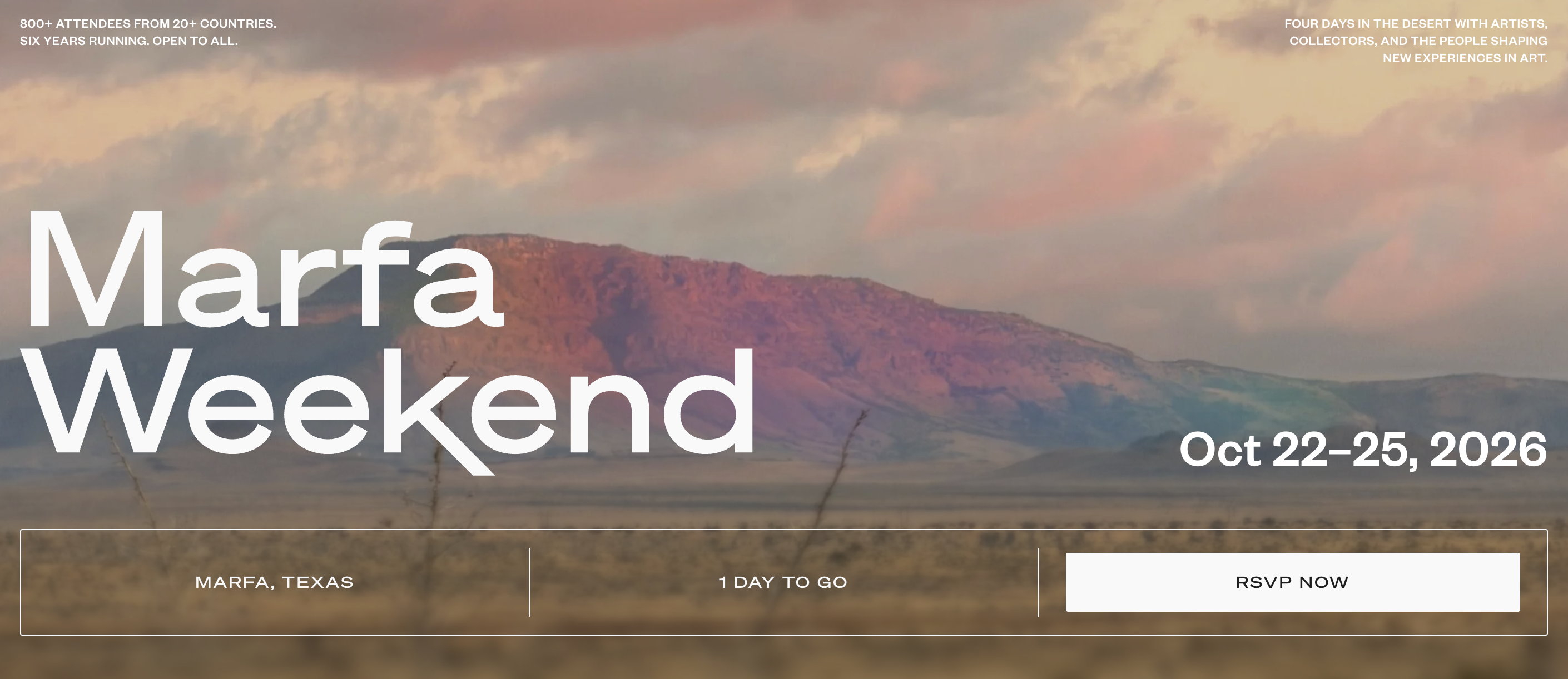
In 2021, Art Blocks established its physical presence in Marfa, opening a space dedicated to on-chain generative art alongside the pioneering computer-based practices that preceded it. That same year marked the beginning of Art Blocks Marfa Weekend, which has since developed into an international gathering for artists, collectors, and the wider digital art community.
Over the following years, Marfa Weekend evolved alongside the generative art community itself. Writing about the 2024 edition in Artforum, artist Mitchell F. Chan observed a noticeable shift from the speculative atmosphere of 2021 toward a broader engagement with contemporary artistic practices.
The event, which welcomed approximately 550 visitors in 2024, extended beyond digital only artworks to include video, performance, participatory projects, and physical installations. At GlitchMarfa Gallery, Joe Pease presented video works, while artist Maya Man invited participants to engage with an artist-designed version of the fortune-telling game MASH. Art Blocks also exhibited generative works that incorporated physical objects, including Michael Kozlowski's algorithmically designed Bokeh Lamps.
For Chan, these developments reflected a community increasingly interested in material artworks and artistic experimentation beyond the blockchain. Artists associated with the generative art movement were also gaining recognition from established museums and institutions, suggesting a growing dialogue between digital practices and the wider contemporary art world.
For the 2026 edition, taking place October 22–25, Art Blocks anticipates more than 800 participants from over 20 countries, with a program of exhibitions, conversations, screenings, and shared experiences across the town.
The relationship between Art Blocks and Marfa has also expanded beyond the annual weekend. In October 2024, Art Blocks and OpenSea announced a joint artist residency program, offering generative artists the opportunity to spend several weeks living and working in Marfa and developing projects inspired by its cultural and geographic environment. The program's first resident, jiwa, developed DDUST, a generative collection informed by the dust, rhythms, and artistic history of West Texas. The residency has since provided a framework for artists to translate their experiences of Marfa into new forms of generative expression.
Alongside, a local scene keeps digital art present in Marfa all year. GlitchMarfa Gallery, "an analog gallery for internet objects", opened in 2022 during that year’s Marfa Weekend, at 108 East El Paso Street. It is run by Marfa-based owners and hosts exhibitions and events throughout the year, as well as its own residency, 30 Days in Marfa, in which digital artists spend a month making work inside the gallery and then release what they created. Past residents include diewiththemostlikes, Joe Pease and, in 2025, Snowfro himself. Next door, Otherside, the gallery’s adjoining cocktail bar, extends the space into the evening and displays Latido de Luz, a red neon heart by Chihuahua-based artist Miguel Valverde Castillo.
There Will Be Signs: Travis LeRoy Southworth in Marfa
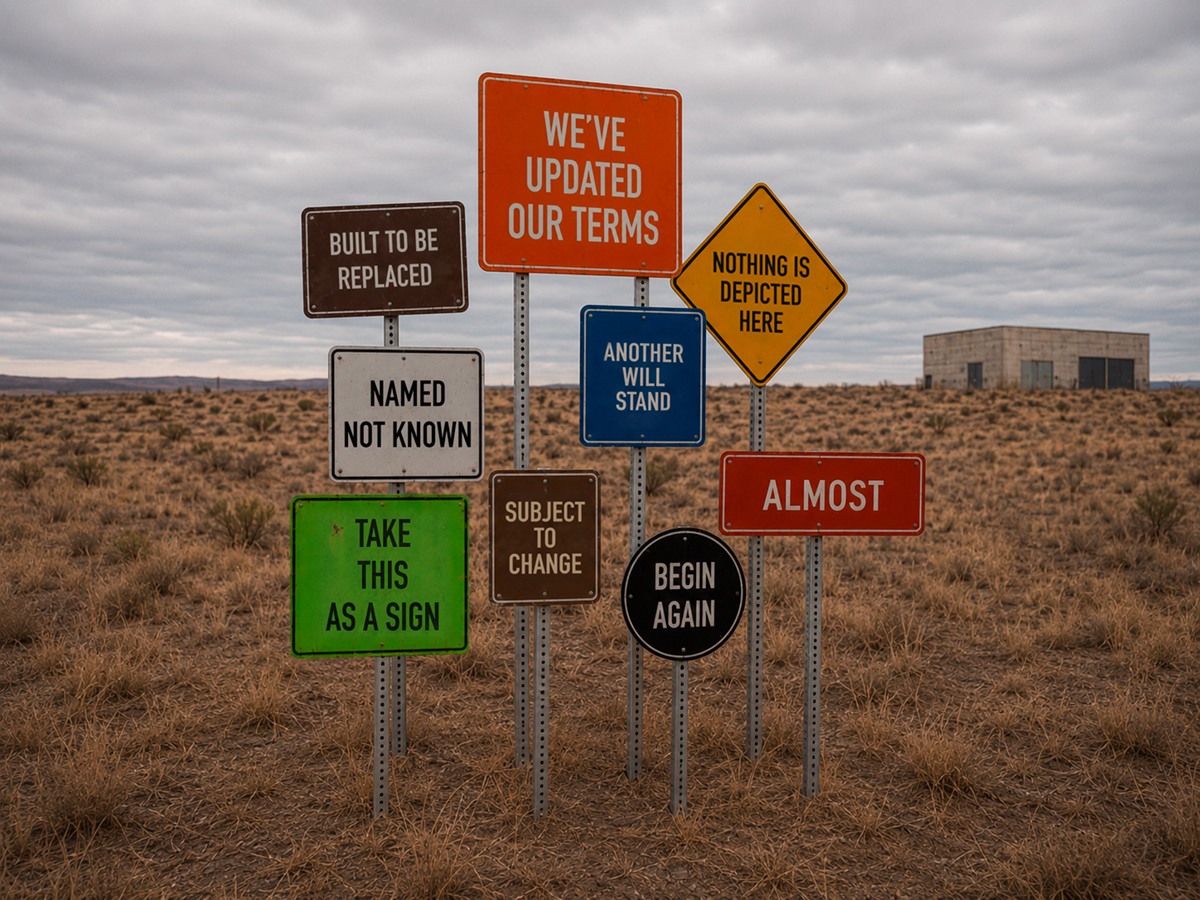
For the 2026 Art Blocks × OpenSea residency, American conceptual artist Travis LeRoy Southworth developed There Will Be Signs: Signifiers for an Uncertain World, a project that brings together generative code, fabricated signs, and public space.
Southworth has worked across different artistic media since the 1990s, with an interest in the relationship between digital processes and physical experience. In Marfa, he turned his attention to a familiar element of the American landscape: the roadside sign.
Signs are designed to communicate quickly and authoritatively. They direct movement, indicate boundaries, announce destinations, and tell us how to behave. Their visual conventions are so familiar that we often recognize their authority before consciously reading their content.
Southworth's project questions that relationship.
Using a custom generative system written in p5.js, an open-source coding library widely used by artists, he creates compositions that resemble warnings, directions, or public notices. Fields of symbols, smaller text, and graphic elements accumulate beneath larger declarative phrases. From a distance, the works appear recognizable and authoritative; closer inspection reveals ambiguous messages, contradictions, and competing voices.
The resulting images borrow the visual vocabulary of signage while withholding the clarity that signs are ordinarily expected to provide.
Developed during his time in Marfa, the project draws directly from the town's existing signage, architecture, landscape, and changing light. Southworth translates these observations into generative works that also take physical form as fabricated aluminum signs.
For Marfa Weekend, There Will Be Signs extends across twelve locations, including galleries, local businesses, and public spaces. Visitors encounter the installations while moving through town, turning an ordinary walk into a sequence of unexpected visual encounters.
The project also exists as on-chain generative editions, with a collecting format that connects individual digital outputs to physical signs.
In this movement between code, image, object, and location, Southworth explores how digital systems can enter everyday physical environments and change the way we perceive them.
The work feels particularly connected to Marfa because it was developed from observing the place itself. Its roads, buildings, visual language, and surrounding landscape are not incidental settings but sources of the project's artistic vocabulary.
More than five decades after Donald Judd began working in West Texas, Marfa continues to offer artists opportunities to develop new relationships between their practices and the environment around them.
With There Will Be Signs, Southworth contributes a distinctly contemporary chapter to that history, bringing generative art into the streets and everyday spaces of a town that has long invited artists to reconsider where and how art can be experienced.
Find out more about There Will Be Signs by Travis Southworth >
Some Suggested Readings about Marfa
On Art Blocks Marfa Weekend 2024 by Mitchell F. Chan - Art Forum
On Art Installations and Institutions in Marfa - Visit Marfa
Art Blocks Marfa Weekend Official Page - Art Blocks
Milestones: A History of Generative Breakthroughs on Art Blocks by Kate Vass - Kate Vass Galerie
When N.F.T.s Invade an Art Town by Rachel Monroe - New Yorker