.svg)
I've been thinking about what it means to be looked at by something that doesn't have eyes like ours.
Not in an uncanny valley way. More like, what happens when another kind of perception lands on you. One that doesn't share your assumptions about what matters.
The octopus is completely colour-blind, yet it changes colour with extraordinary precision, matching its environment in ways that still puzzle scientists. It sees through polarised light, communicates through it, in a language we haven't decoded yet. It perceives a version of the world that is simply not available to us, one that is just different. Just different.
Patrick Tresset would say his robots have eyes, and he's right. And he's right. They look at you. They look at you, registering the specific weight of your face, the way light falls across your shoulder, the small asymmetries that make you you. Over twenty minutes, they draw. Slowly. Deliberately. Over twenty minutes, they draw slowly and deliberately, creating very different portraits of you, with a different perception and their own personality and style.
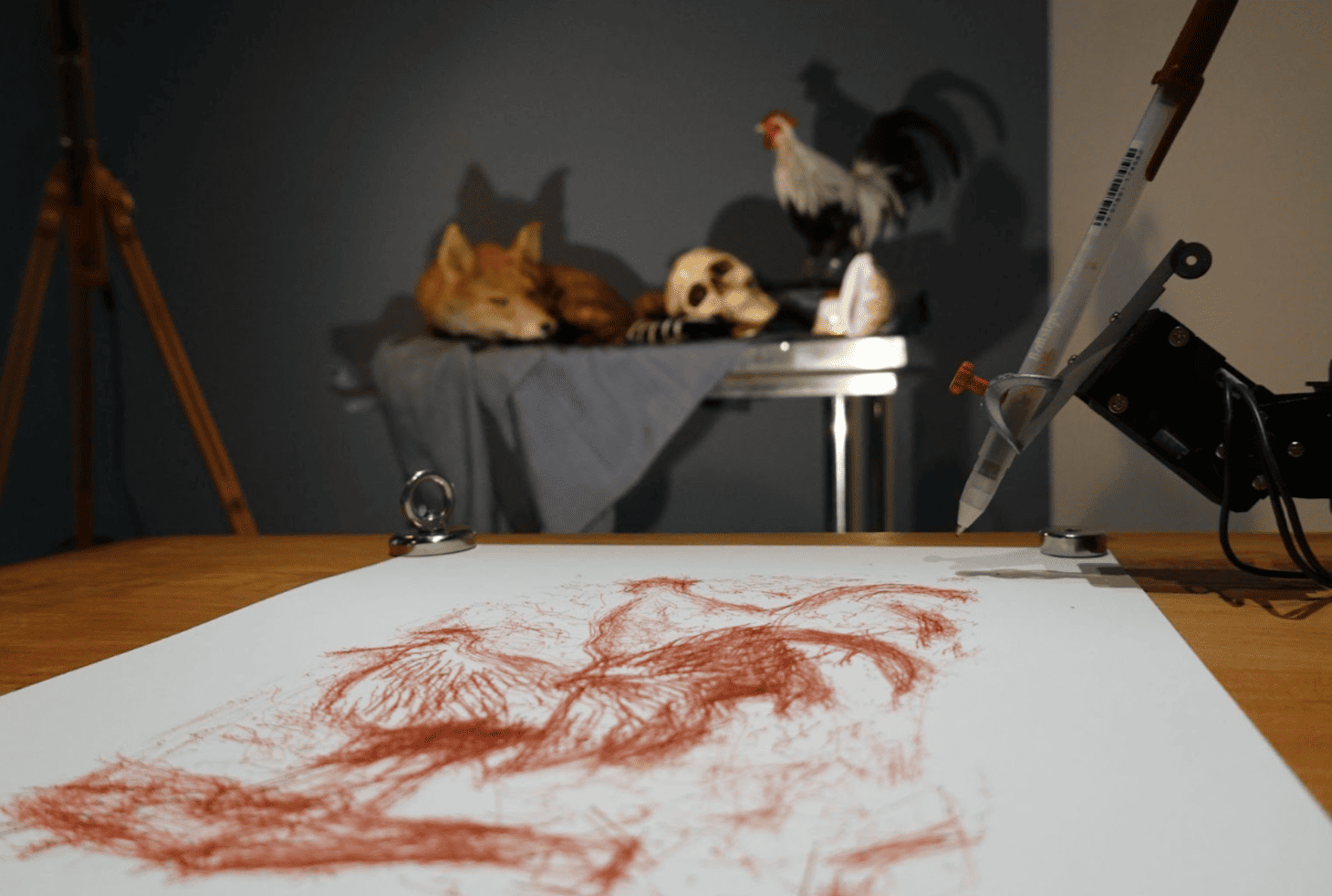
The drawing is an interpretation made by something that perceives you differently from how you perceive yourself. That gap, between what the machine sees and what we think we show, is where the exhibition I curated begins.
PERCEPTION LOOPS brings together aurèce vettier and Patrick Tresset at Galerie MO11 in Cannes, for one evening during EthCC[9], organised by [Not Crypto] Art Nights, and produced by Brian Beccafico.
Two artists, and between them, a loop that keeps opening. What happens when humans, machines, and the living world start observing each other, and generate a new type of ecosystem?
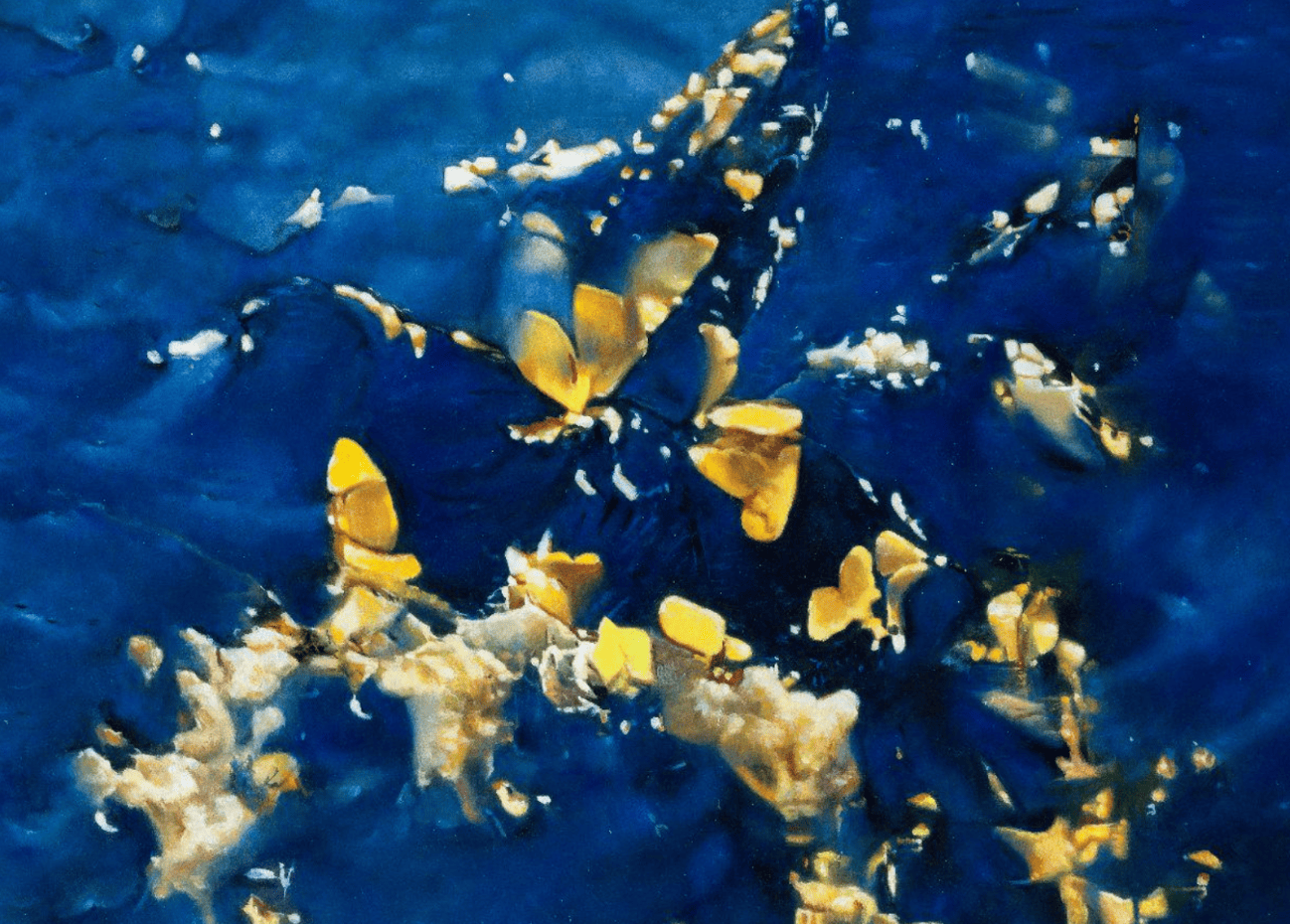
Dreams, memories, fragments of a life are fed into algorithms developed around aurèce vettier’s own archives. The machine doesn't interpret these as data; it generates them. Images that sit somewhere between the plausible and the impossible. A butterfly carrying galaxies on its wings. A figure walking at the edge of a forest.

They don't belong to any known species. His paintings carry the same quality. An impromptu encounter in a hemp field feels slightly displaced from any reality you could locate. Still-life, unidentified creature borrows the language of natural history and then refuses to complete the gesture. Unidentified. The creature exists. It simply doesn't fit any existing category.
And then something interesting happens. Those images come back to him. He looks at what the algorithm produced from his inner life, and he makes decisions. What to paint. What to cast in bronze. What to set with sapphires and emeralds and pink tourmaline.
The loop goes from data to material, from algorithm to craft.
There is a tradition in Western painting called Vanitas. Skulls, flowers, hourglasses, half-eaten fruit. Objects arranged to remind the viewer of transience, of the futility of pleasure, of death as the only certainty. The genre flourished in the Dutch Golden Age at a moment when mercantile wealth and Calvinist anxiety existed simultaneously.
With Human Study #2, Patrick Tresset asked one of his robots to look at Vanitas from another angle, an angle that is far from its original intention as the robot does not understand mortality. It does not understand concepts of time, pleasure or abundance. And yet the image it produces still carries the weight the genre has always carried. Which raises a question the Dutch painters never had to ask: does meaning live in the artistic intention, or in the observer's perception?

The Birth of Venus extends this into a series of over 120 works, all depicting flowers, produced through a guided generative system seeded by a text-to-image model. These still-lifes are dark, lush, and slightly overripe and, of course, recall directly the Dutch still-life flower paintings of the 17th- and 18th-century. As it was the case back then, the bouquets produced by Patrick Tresset’s robots carry hidden meanings that only the machine would know.
The loop goes between observer, machine, and image.
This is what PERCEPTION LOOPS generate when they run long enough. Not harmony. Not resolution. A field of images that observe each other, and us, from angles we didn't choose.
I'm not sure what to call it. A new kind of landscape, maybe. One made of robot arms and bronze butterflies, of dreams that passed through machines, of flowers no one planted. Matter that began as data. Data that ended as matter. We've been thinking about ecosystems as natural things. But maybe that boundary was always more porous than we assumed.