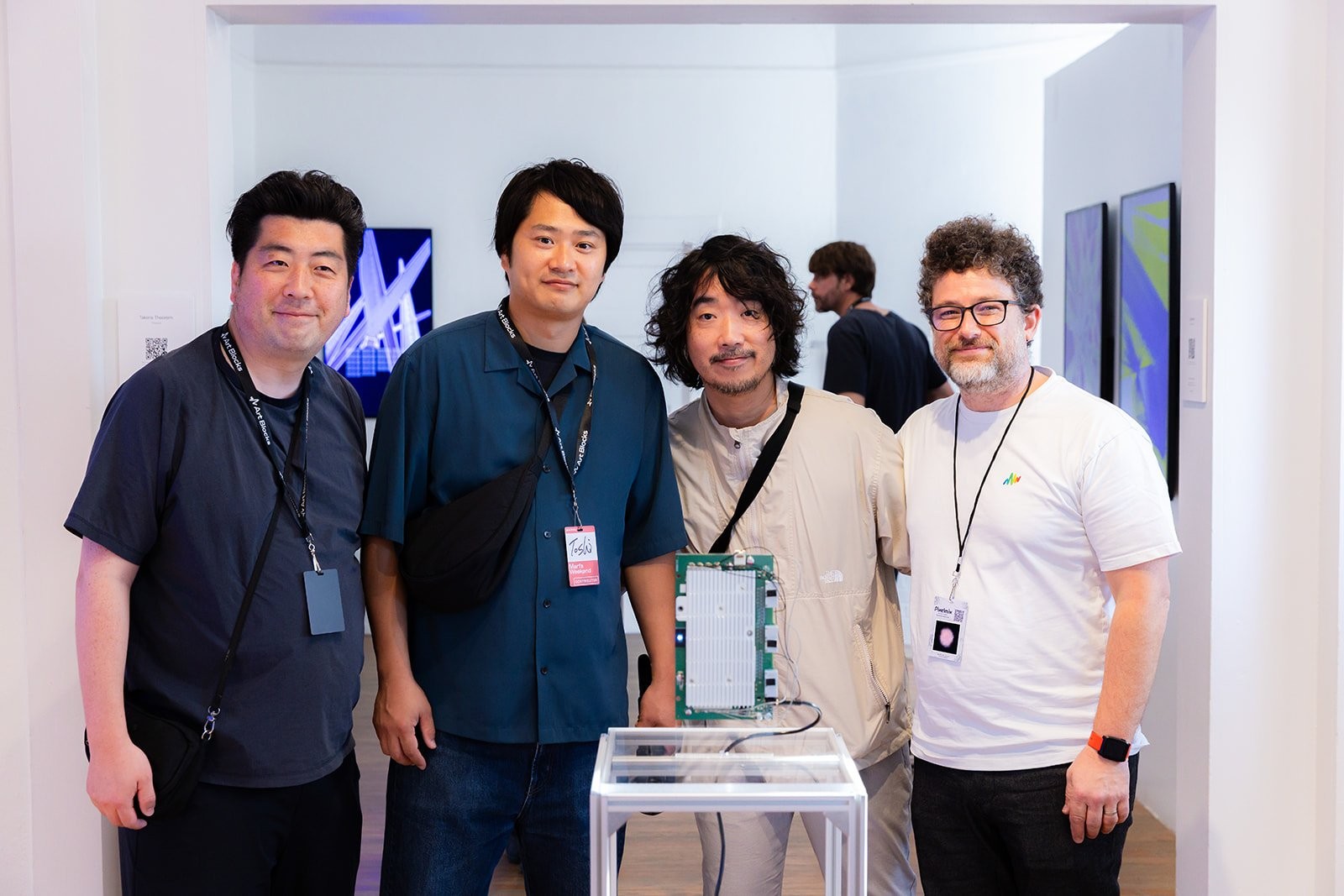
In Marfa, a desert town in Texas, NEORT++ took over the Art Blocks Gallery for a single day and opened "Quietus Machine," an exhibition built around three machines. This piece is a look back at that day , and also the record of a journey in search of an answer to one question: what should we do next?
Going to Marfa. What is out there in the Texas desert? This was my first time, and until then the place existed for me only in imagination and photographs. Every year Art Blocks holds its gathering here, drawing generative artists and collectors from around the world. Into that setting, we brought an exhibition that returns digital "death" to physical machines.
The Journey: The Desert and Judd's World
Ten hours from Tokyo to LA, three hours from LA to El Paso. From there, we drove, nervously adjusting to the right side of the road. Once past the city limits, desert, road, blue sky, and clouds stretch on without end. Mountains, sky, clouds, the occasional oncoming car . Then, in the middle of that monotonous grandeur, the installation modeled on a PRADA storefront suddenly appears, just as I had heard. My first impression was that this is a work only land this vast could make possible.
As it happens, Donald Judd also flew to El Paso, in November 1971, and drove from there into the Big Bend region. More than half a century apart, I had been following the same road.
The Chinati Foundation: Viewing from the Outside
Right after checking into our Airbnb, I squeezed into the Chinati Foundation's Donald Judd tour, the two-hour tour starting at 2 p.m. The buildings housing 100 untitled works in mill aluminum were closed for roof renovation, so we could only see them from outside. Even so, looking through the windows and comparing what I saw with drawings and photographs, I tried to imagine the world Judd had built. A way of viewing that fills in what cannot be seen with imagination: by coincidence, it shared the same structure as the exhibition we were about to open.
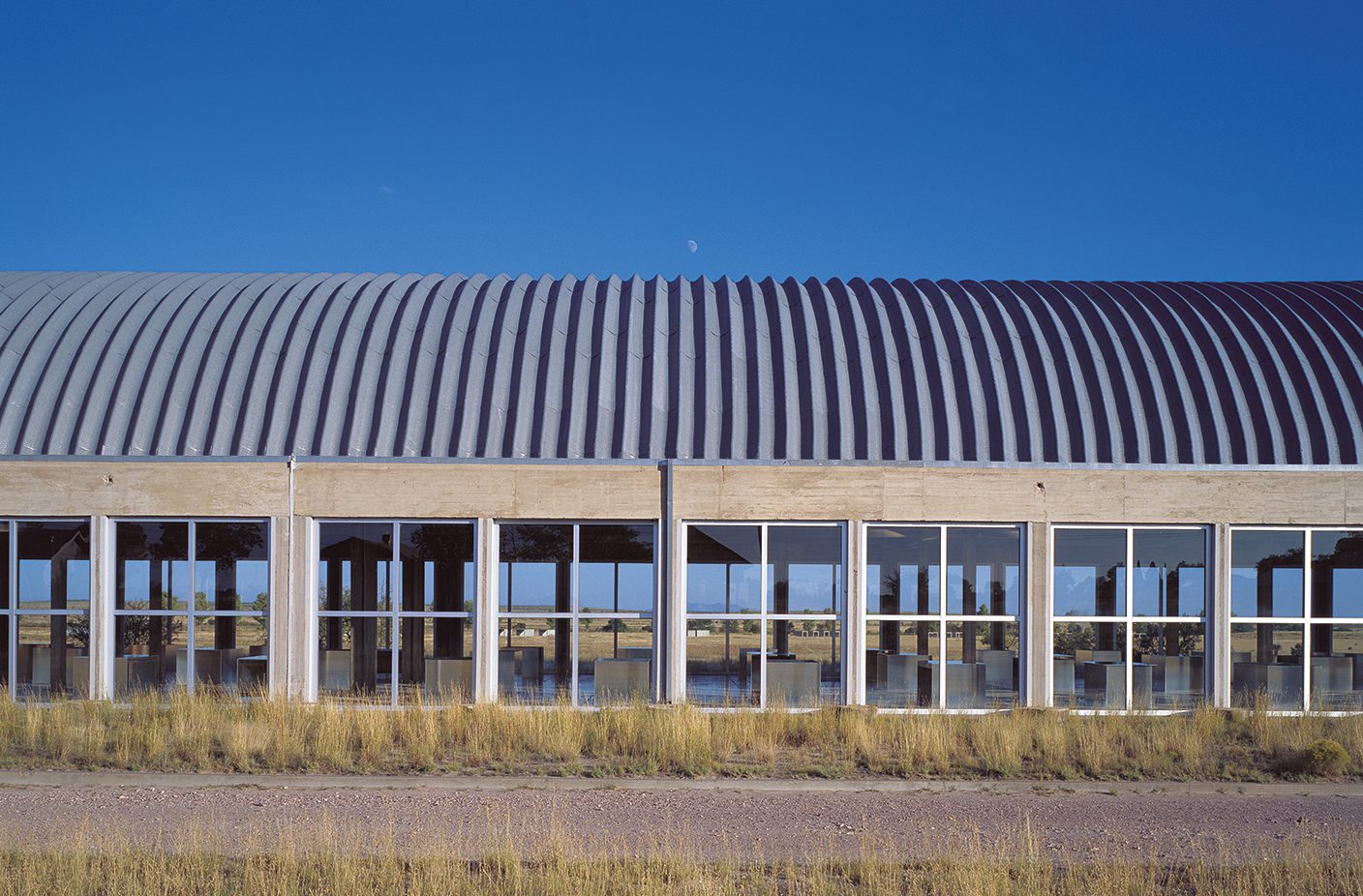
Judd's works hold up as an experience whether or not anyone is there. They call into question the very premise that art exists to be looked at by people. Within the natural algorithms of wind, light and rain, buildings and objects coexist, and you are made to feel that people are only one part of it. Judd's insistence on site specificity and permanence lingers as a presence in every corner of the space. The works speak to you first. That is the overwhelming thing about Marfa.
"So You're a Crypto Person"
The tour guide asked where I was from. Tokyo, I said. "Are you here for the Art Blocks festival?" When I nodded, he replied, "So you're a crypto person." Perhaps he took me for someone just passing through out of curiosity.
In America, asking questions, and asking good ones, is a measure of how interested you are. So I kept honestly asking about whatever caught my attention in the world of Judd and the artists around him. I may have been taken for a curious passerby at first, but in the end it became a wonderful time, full of conversation with the guide and, through their works, with Judd and many other artists. This feeling of being drawn in, of wanting to know, turned out to be the entry point to what I will later call "care."
Richard Long, ROCKS RIVER: Same Distance, Different Length
The tour moves across the vast grounds, from Judd's 15 untitled works in concrete outdoors to Carl Andre, John Chamberlain, Robert Irwin and Ilya Kabakov. Of everything on it, the work that caught me most was Richard Long's ROCKS RIVER.
Since the mid-1960s, Long has placed walking at the center of his practice. His materials are stones, wood, water, mud and grass, and also distance, time and place themselves. In 1967, as an art student in London, he walked back and forth across a field and photographed the single line that appeared in the trampled grass: A Line Made by Walking. The movement of a body became sculpture, and the distance walked and the time elapsed became measures of a work, just as height and width are.
ROCKS RIVER consists of two works that Long installed himself in Chinati's galleries. On the south side, he laid a single line of stones gathered in the Chinati Mountains, about thirty miles from the site, the range from which Judd took the foundation's name. On the north side is a "river" line, drawn by hand, improvisationally, in clay mixed with water. The two lines nearly match in distance. Yet their lengths do not.
Why is the distance the same, and the length different? My reading is this. Distance is a fact on a map; length is the amount of body and time it took to trace it. A straight line of stones, and a meandering river line. Even joining the same two points, the length changes with how you pass between them. To the question that came to me during the tour, "Is it experience, or time?", Long seemed to answer that both are the measure of the work.
For Long, a work's lifespan changes with its material, the act and the circumstances. A line walked in grass soon disappears, but walked again and again, the path grows stronger. He has described this as adding one more layer on top of thousands of layers. Judd bought Long's Sea Lava Circles in 1988 and counted him among the best artists in Europe. In that work, volcanic stones from Iceland lie in concentric circles; the arrangement stays as it is, while only weather and light keep changing the stones and the ground.
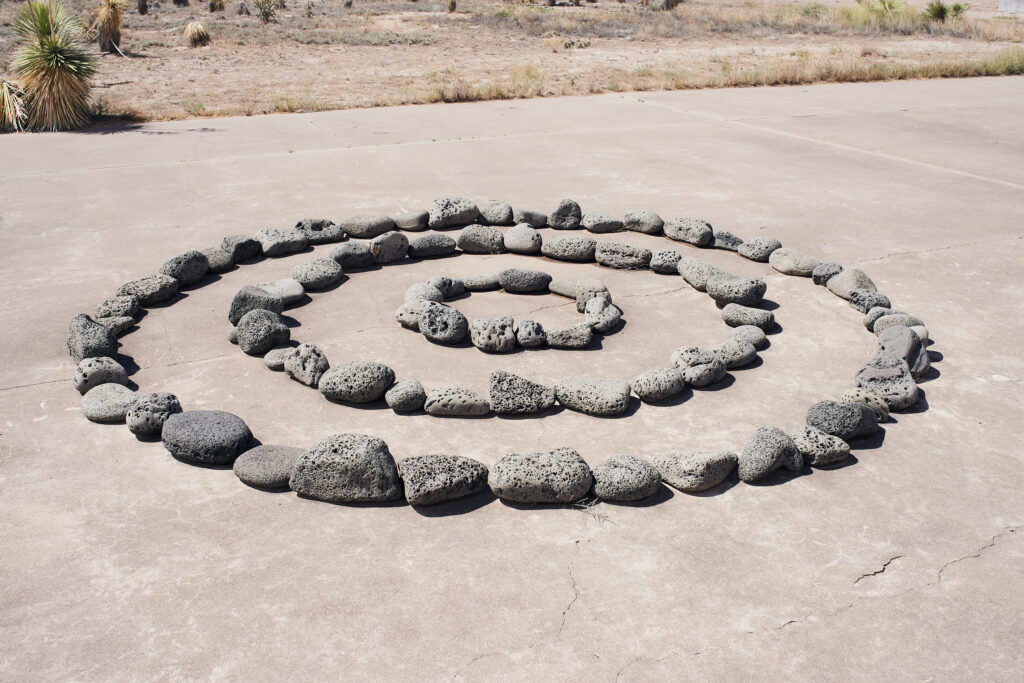
Here, Long connects unexpectedly with the three machines we brought to Marfa. Long's line grows stronger the more it is walked; Aizawa's memory crumbles the more it is read. Traces of walking piled up in layers, and characters struck over again and again. rudxane picks up the "traces of passage" left by visitors' heat and radio signals. Long wrote, "Time passes, a place remains." Quietus Machine may have been an exhibition that tried to place the very moment when time passes inside a machine.
Overall Review: Quietus Machine
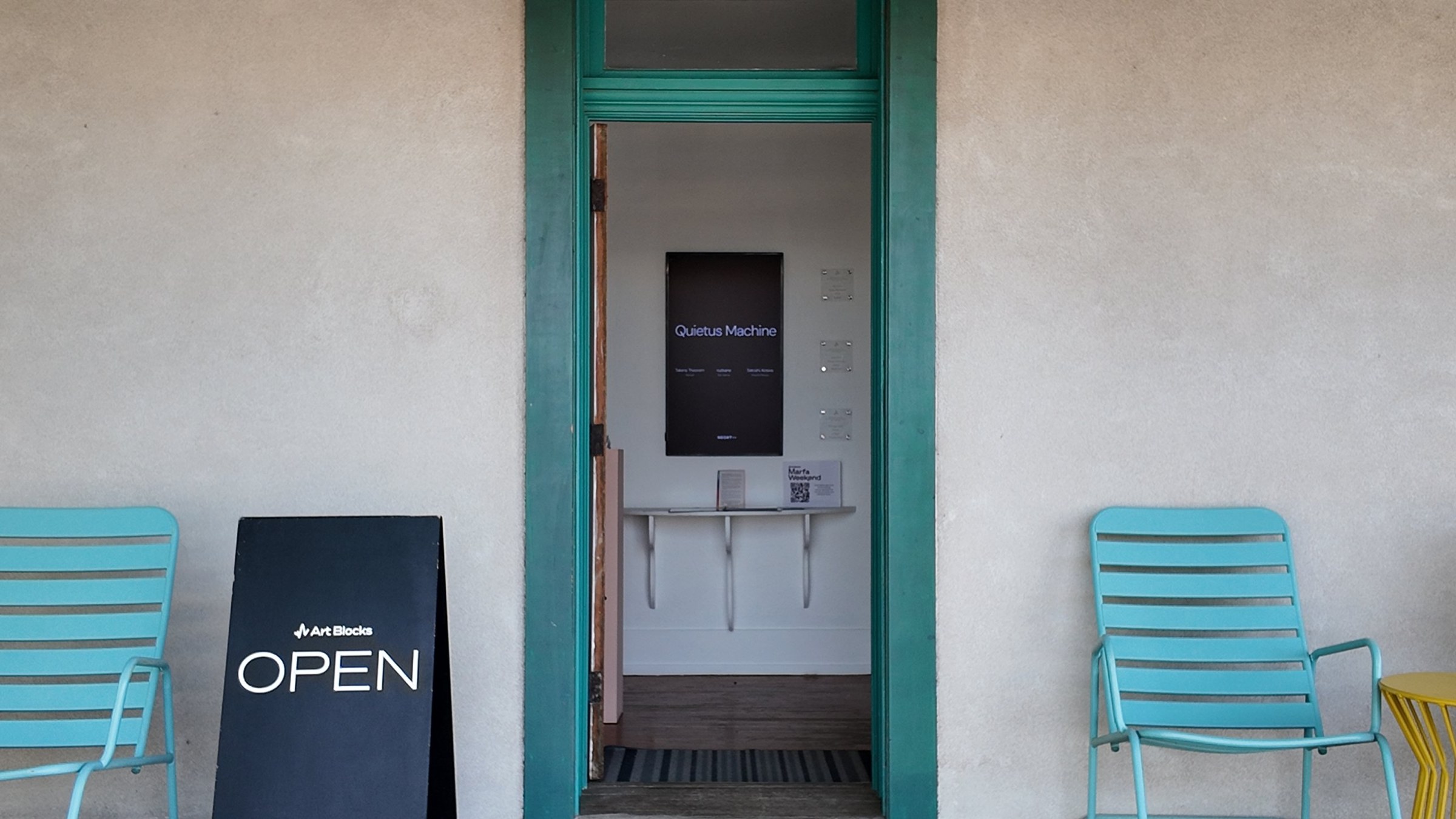
Quietus means death, a release from life: the end of a life, its final moment. By gaining a physical body, the digital has also gained the possibility of dying. That is what this exhibition set out to express.
The idea grows out of the lineage of Auto-Destructive Art, as proposed by Gustav Metzger. Imagine, for example, circuits slowly wearing down under heat, and the work's expression changing along with them. Digital art, too, can die. Three machines that compute without pause. Each edition is a memory of the time its machine lived. Three works, sixty-four editions each: 192 in total.
Digital death, and death by the digital. Without a physical object in front of us, it has become hard even to imagine. That is why we placed the processors that generate the works on aluminum-frame stands with acrylic cubes, in front of the screens on the walls. The lineage we drew on was Hans Haacke's Condensation Cube (1963–65) and Trevor Paglen and Jacob Appelbaum's Autonomy Cube (2014). Water inside a cube responded to the room; a computer inside a cube relayed the world's communications. And in 2026, the machine inside the cube computes itself, until it eventually falls quiet.
We designed the exhibition as a set of layers. The machines keep running whether or not anyone engages with them; they are simply there. When people arrive, they respond and grow more intense. Their output appears on screen in real time. Then, after some time, each work draws attention on Art Blocks and receives on-chain bids. People's interest itself accumulates as a record.
Takens Theorem, Timescale: The Chip's Fixed Appearance Is an Illusion
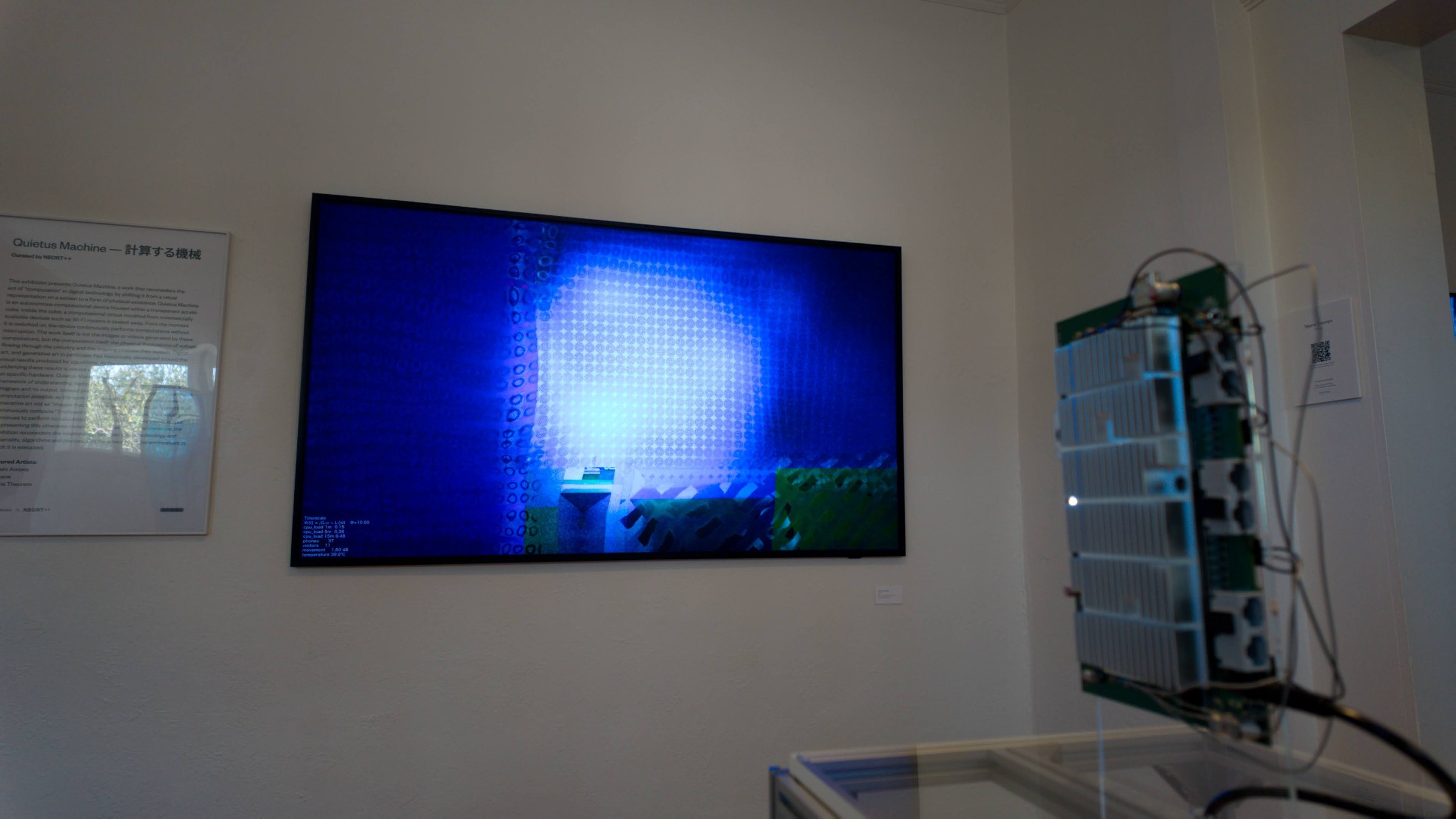
In this work, the CPU load of a repurposed router board (GL-MT6000) becomes an image moment by moment. Its starting point is the die shot, a photograph taken after opening up a microchip. A die shot captures structure. What it cannot capture is the work that structure performs over time.
The piece is driven by the one-, five- and fifteen-minute CPU load averages; Φ(t), the difference between them accumulated over time, generates an undulating, multi-frequency structure. The number of nearby smartphones, the number of people connected to the Wi-Fi, fluctuations in radio signals, and the chip temperature amplify the effect. Creation usually moves from concept to reality. This work runs the other way: the concept rises out of a physical substrate. After visualizing Bitcoin's history in the_coin and imagining a "small machine" that lives forever on chain in Perpetual, Takens Theorem has finally given that machine a body.
rudxane, Here with me: That Someone Is There
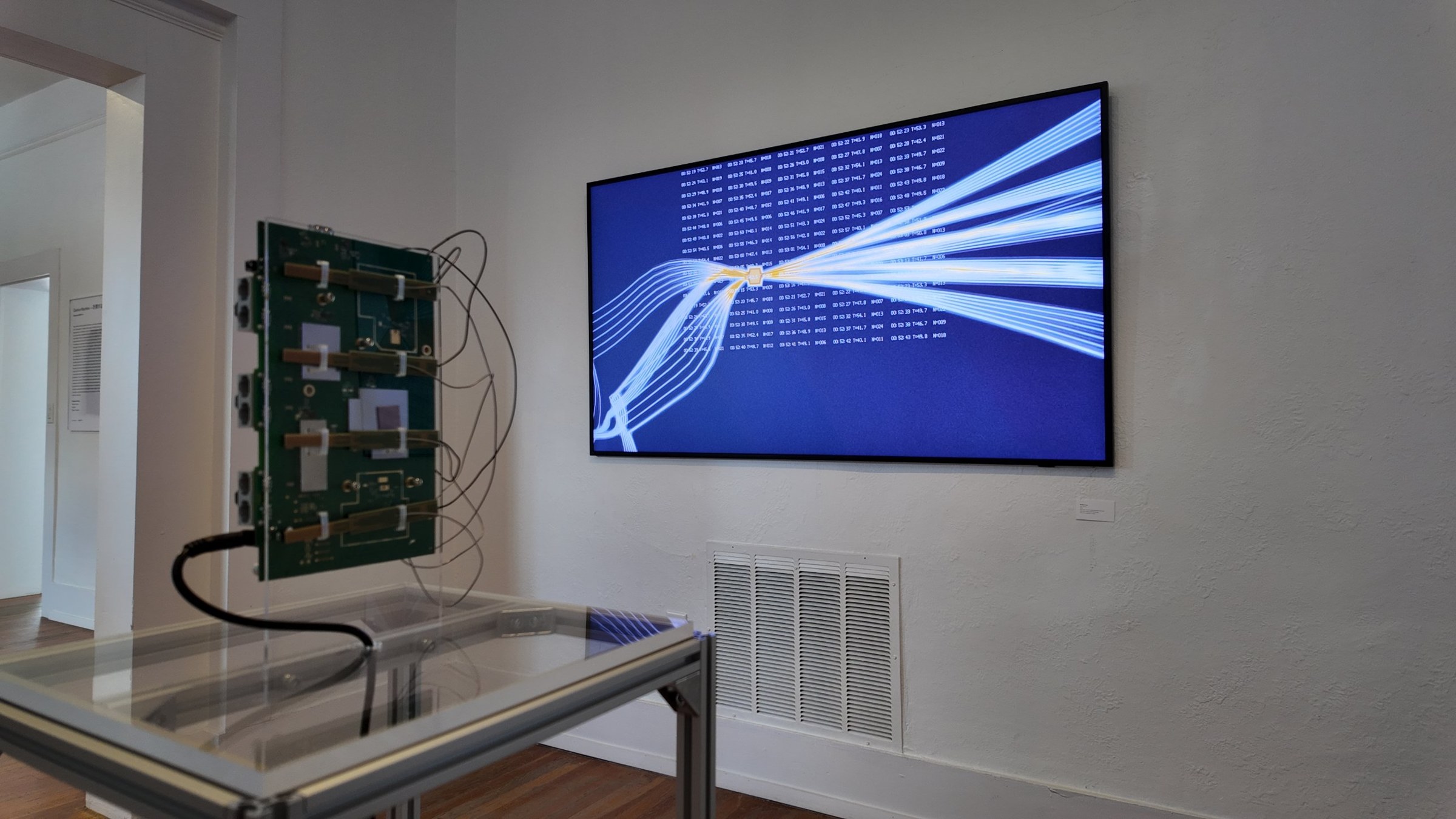
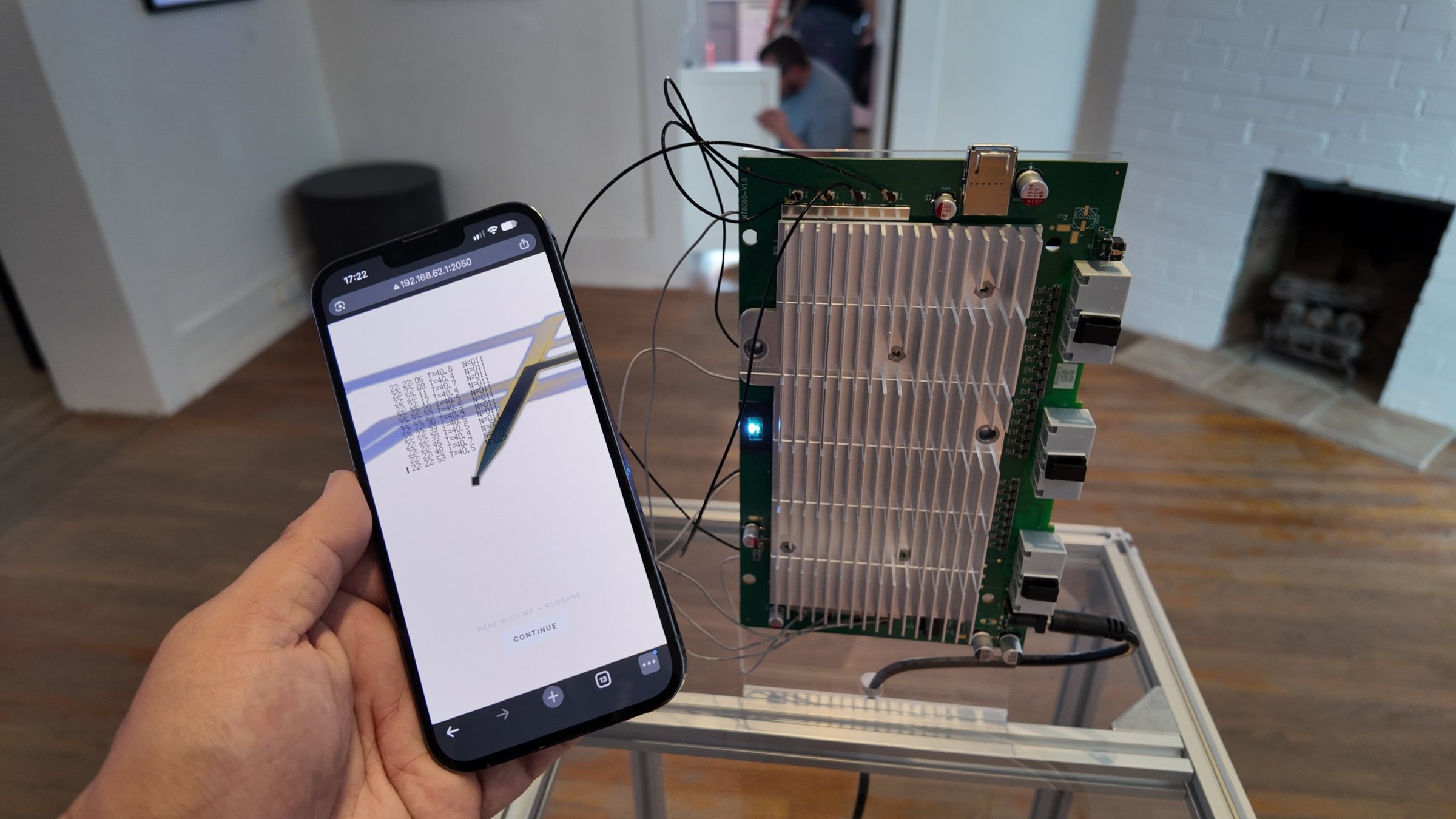
The subject is simply the presence of people around the machine. When someone enters the room, their body warms the air, and their smartphone sends out signals searching for a connection. The machine reads these two faint traces, heat and radio waves, and turns them into the source of generation.
When the room is empty, the screen is still. As people gather, the air warms and the signals multiply. No touching, no talking: just being in the same space becomes the work. Connect to the machine's Wi-Fi, and the work is drawn live on your own phone as well. Having moved the physical "fold" into digital form in Fold and hand-drawn marks in Encore, rudxane here reverses the direction. Bodies in a real room become the source of the image.
Satoshi Aizawa, Disturbed Memory: Reading Itself, Wearing Itself Away
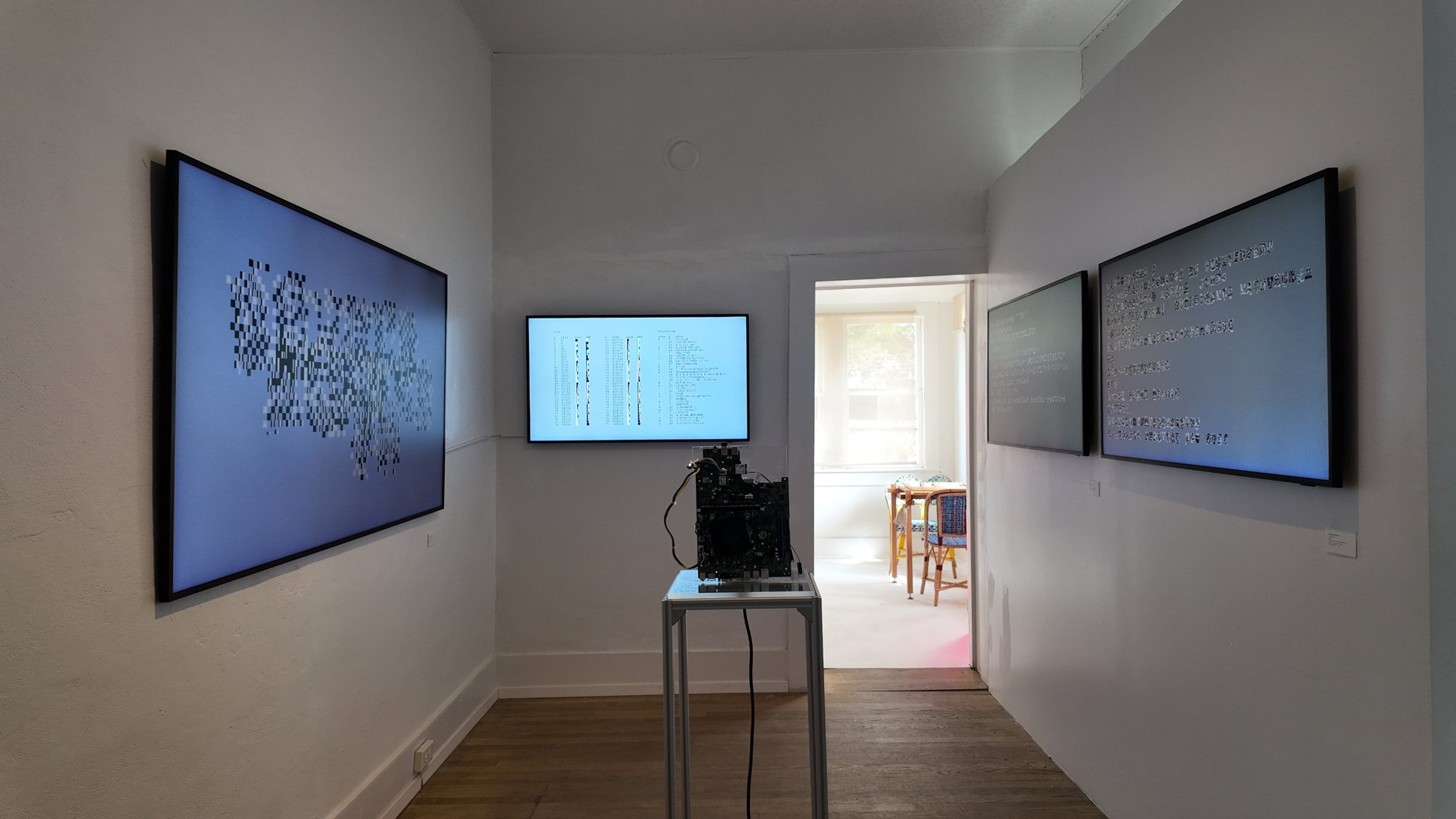
In the center of the room stands the artist's own PC, stripped down to the bare board. The machine places eleven lines of Linux commands that inspect itself into memory as a 256-byte source text, and keeps reading it back. When a memory row is held open, charge leaks from neighboring cells, and somewhere a bit flips. With each flip a character changes, and the new character is struck over the old one, like overstrike on a typewriter.
Wi-Fi signal strength, shifting with people's positions and movements in the room, decides which line breaks down. The final line, the command to cut the power, is placed as "udo poweroff," missing its leading "s," and even that was beginning to dissolve under the overstrikes. A machine's memory of itself, read back so many times it is becoming unreadable. Walking between the screens on three walls, visitors circle a memory that is being disturbed at that very moment. Having made lines that endlessly redraw themselves in Path, and an image that holds together only at a single scale in Grey Path, Aizawa now carries that fragility into the machine itself.
Reflections: Care, and What Comes After Novelty
Viewing as Care
Throughout this trip, when I asked myself what matters most in art, the word that surfaced was "care." I do not mean it in the sense of welfare. Is what the artist made beautiful or ugly? How was it made? Why did they make it? Where does their obsession lie? Being drawn in like this, wanting to know more, wanting to feel more, wanting to think more: that, to me, is care.
There is a reason to use this word in Marfa. In his 1985 essay "Marfa, Texas," Judd wrote of Alfredo Mediano, the man who looked after the works, that he
"takes care of the art, a serious matter not sufficiently so regarded by those reputedly interested in art." — Donald Judd, "Marfa, Texas" (1985) © Judd Foundation
Caring for art is serious work, and yet those supposedly interested in art do not give it its due. What Judd pointed out forty years ago may not have changed at all.
The presence I sensed in Judd's spaces and the gazes directed at the three machines of Quietus Machine were of the same kind. And the bids placed on each work on Art Blocks are also traces of care, inscribed on chain. Whoever wins the auction receives the accumulated trail of attention, together with the output, as a token.
What Came After the Peak of the 1960s
When platforms, artists and galleries are forging a new path and the novelty begins to fade, what should they do? This moment looks to me like the history of computer art from its peak in the 1960s until 3DCG and games emerged in the 1970s. New things became harder to produce, and the same exhibitions were repeated. Even as personal computers, 3DCG and plotters arrived, they may have broadened adoption, but whether the players themselves could keep finding it exciting was another matter.
Hiroshi Kawano built his own system; Harold Cohen built AARON. The sense that computers would take work away from people also resonates with today. But the pace of development is many times faster. If progress is now outrunning human thought, perhaps it has simply become impossible to grasp everything. Perhaps the human-centered world is beginning to crumble. People are part of nature and society, and by accepting that, we may be able to depict a world further ahead. Judd's works, which keep shining whether or not anyone is there, and three machines that keep computing whether or not anyone is there, stood at the two ends of that question.
On a personal note, I had been feeling worn out by the city lately. But maybe it was not the city that tired me; maybe I simply lacked nature. Nature, machines, people. I, at least, may be searching for a balance between them. This trip and this exhibition let me feel that, and it stopped me in my tracks. Seen that way, the desert and landscape of Marfa begin to look a little different.
Looking Back: What Should We Do Next?
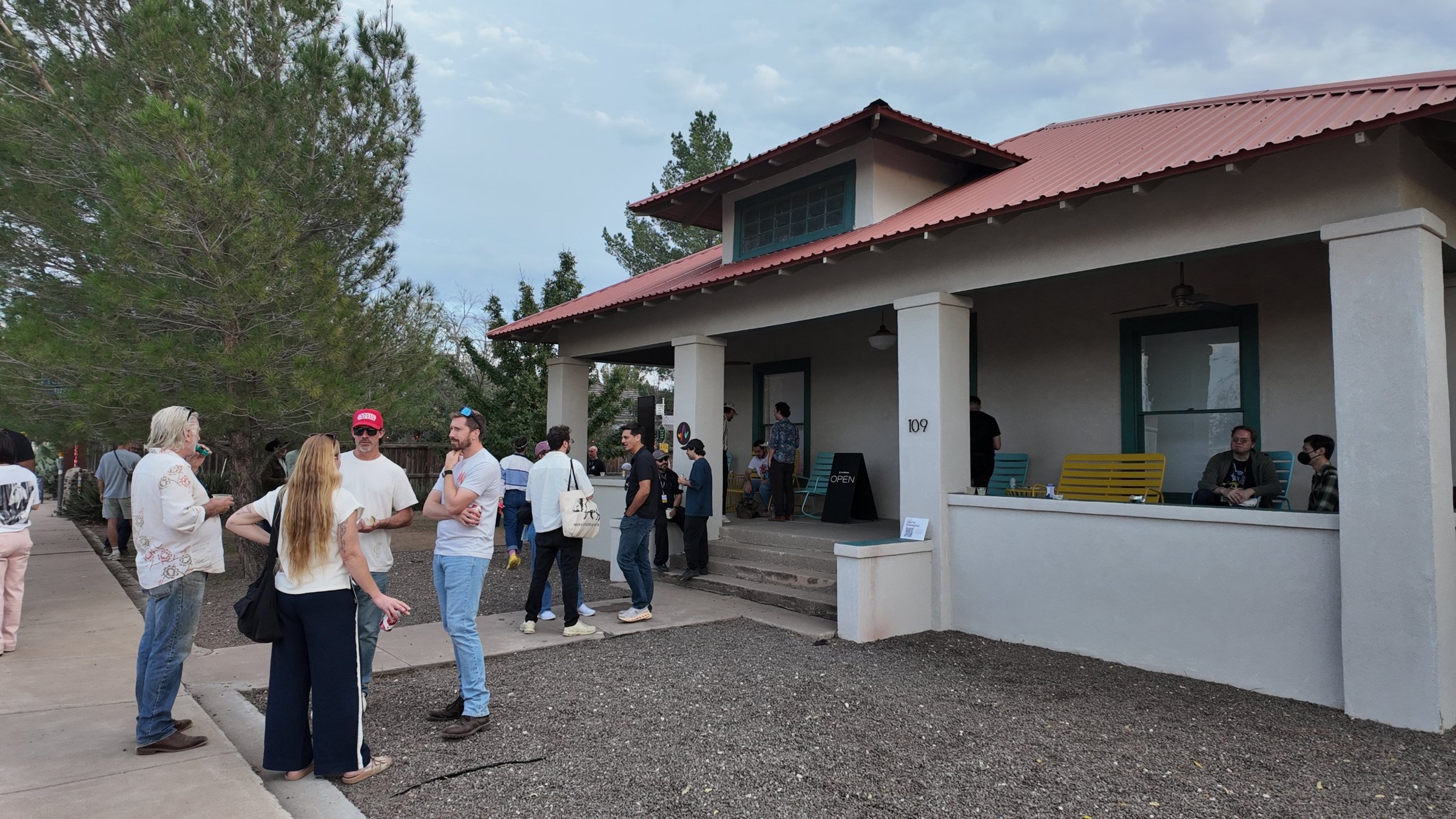
How did the exhibition go? Many visitors came. What we wanted to do and what we wanted to say did reach them. By always asking what kind of exhibition, what perspective and what point of view this present moment calls for, we start to see what comes next.
Parties are an output, and they are fun. Bringing different directions and perspectives into them helps more people understand and be convinced. What do we want to leave behind? What do we want to pass on? What do we want to financialize? Designing with those questions in mind shows us the way forward. I feel we have entered that phase.
By financialize, I do not mean turning works into commodities. Judd himself admitted as much in the same essay:
"It's a lot easier to make art than to finance and make the space that houses it." — Donald Judd, "Marfa, Texas" (1985) © Judd Foundation
Making art is far easier than building, and continuing to sustain, the place that holds it. How do we design the places and systems that let works keep existing, funding included? Marfa itself was Judd's answer to that question.
Taking part in festivals and fairs to win people's attention, and making the effort to reach them, matters. Let us keep doing that. At the same time, we need to draw our own vision and bring the technology, passion and care to carry it out. I believe that is what is being asked of us now. In that sense, the fact that people gathered from all over the world in a place as remote as Marfa was a real encouragement.
Next year, NEORT will push forward with initiatives focused on generative art. That is exactly why I came away with renewed respect for Art Blocks, which keeps this gathering going year after year. The three machines will one day fall quiet. But the record of care directed at them will remain on the chain.
To design how our work, which may one day disappear, can be left behind, and to keep creating. That kind of uncompromising world was there in Marfa.