.svg)
On the final evening of Art Basel Week 2026, 100 collectors gathered at Basel Social Club for something a little different. Not a cocktail reception. Not a panel. A question: if we could build a collection together, for one evening, what would it contain?
The Collection We Would Have Built Together was a participatory project conceived by 100 collectors for Art Basel 2026, a temporary collection assembled not through acquisition, but through conversation, imagination, and individual choice.
On Friday, June 19, 2026, members, invited collectors, artists, curators, and gallerists came together at Basel Social Club from 7:00 to 9:00 PM. Each guest received an envelope and a card. The ask was simple: choose one artwork from Basel week and explain why. Not the most expensive. Not the most talked about. The one that stayed with you.
The emphasis was never on market value or investment logic. It was on the personal motivations that quietly drive collecting: curiosity, emotion, memory, admiration, intellectual pull, a feeling you cannot quite name. Works did not need to be available, purchasable, or even realistic choices. The project was about desire, taste, and perspective.
As the evening unfolded, something genuine took shape. Responses were folded, deposited into a collecting box, and the room filled with the kind of conversation that only happens when people are asked to be honest about what they actually love.
The contributions gathered that night have been assembled into a collective experimentation, existing only through documentation and shared imagination: a portrait of what a specific group of people, active across contemporary and digital art, were paying attention to during Basel 2026.
The project touches on ideas central to 100 collectors: that collecting is a form of storytelling, that attachment matters as much as ownership, that collections are shaped by encounters as much as transactions, and that a collection built collectively can be as meaningful as one built alone.
In many ways, the evening was a temporary manifestation of the club itself, a collection assembled through shared attention, open dialogue, and genuine exchange.
The Full Collection
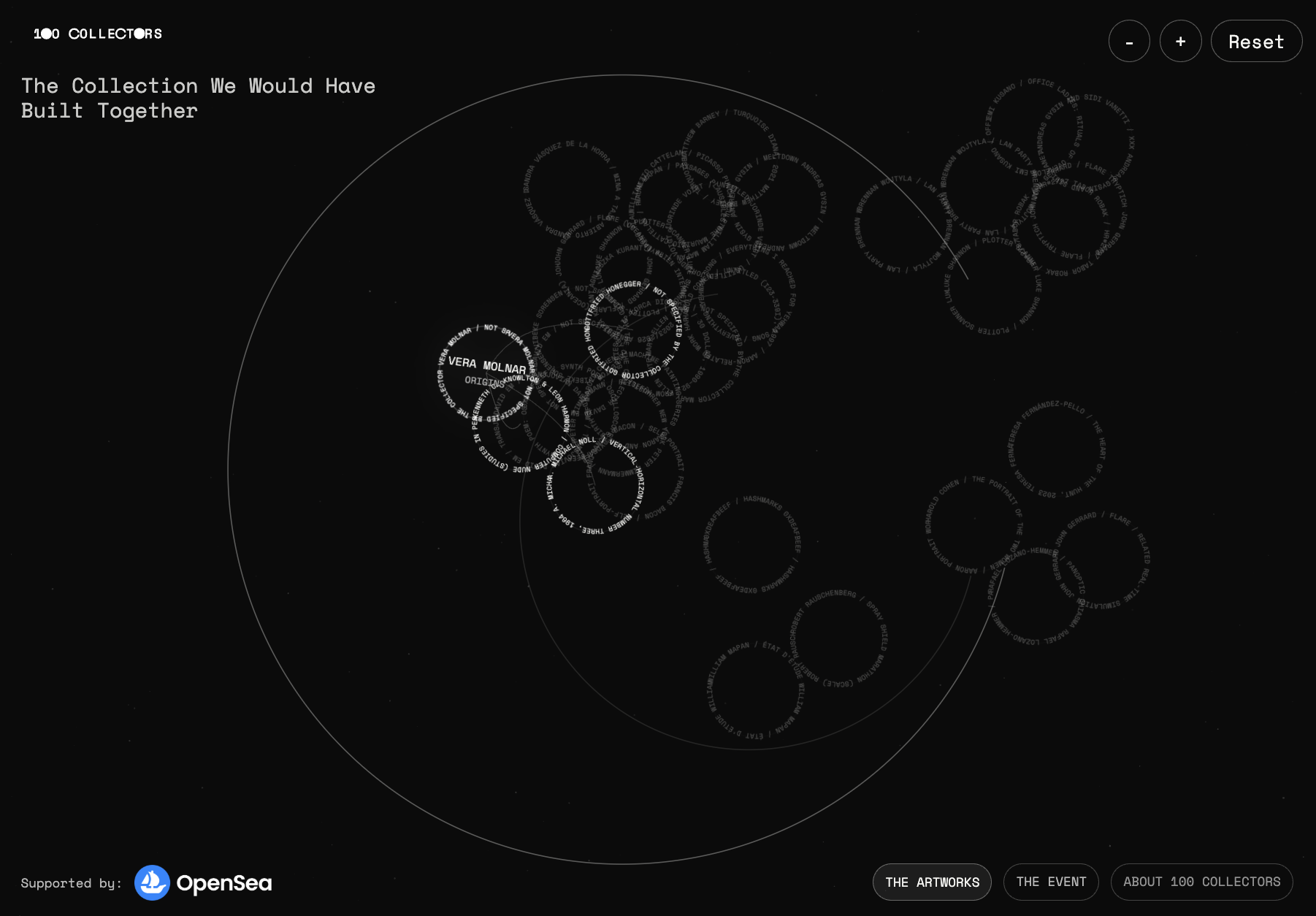
Explore the full collection as an interactive map →
The visual above plots every contribution across two axes, from emotion to knowledge and from personal to cultural, offering a graph of where this particular room's attention actually landed on the night.
The Artworks
1. Flare by John Gerrard
Fellowship, Zero 10, Art Basel
"Epic, tech, expensive."
"Inspirational."
Gerrard's Flare works are not filmed but simulated: a gas flare burning in the shape of a flag, rendered continuously in real time and keyed to the local time zone of the site it depicts, near Tonga in the South Pacific, based on photographs of the heating waters taken by activist and artist Uili Lousi. Built from decades of game-engine development, the piece sits within Gerrard's wider practice of using simulation to examine energy, extraction, and environmental change, running as a quiet, durational loop.
2. Machine Painting Series by Harold Cohen
Gazelli Art House, Zero 10, Art Basel
"AI usage in the 90's."
"A masterpiece that tells a story of how Harold's body of work over the years. One of only few canvas work, the size and colors leave you speechless."
"The idea that a digital software is capable to create emotional portraits fascinates me."
Cohen began developing AARON, one of the first programs built to make original drawings, in the early 1970s at Stanford's Artificial Intelligence Lab. By the 1990s, through what he called his Painting Machine, AARON was applying colour to canvas independently for the first time. Gazelli Art House's Art Basel booth ran live AARON code alongside historical works, including rare unique canvases like Untitled (i23-339I), where the robotic system applied colour directly under Cohen's supervision. Unlike the plotter drawings AARON is best known for, these paintings sit at the point where Cohen's decades-long collaboration with his own code became physical, singular, and irreproducible.
3. Reiseführer New York by Peter Zimmermann
Nagel Draxler, Art Basel
"It's colorful, smart, a joke. Vintage. Representing a time where people travelled without being permanently connected to the internet."
Zimmermann's work translates found printed material, guidebooks, covers, everyday ephemera, into saturated, high-gloss paintings. Reiseführer New York takes its cue from a vintage travel guide, holding onto the particular, pre-connected texture of a moment when getting somewhere meant carrying a book rather than a signal.
4. Spray Shield Marathon (Scale) by Robert Rauschenberg
Gladstone Gallery, Art Basel
"Huge size and all in."
Rauschenberg spent his career collapsing the distinction between painting and object, folding photography, print, and found material into a single surface. This large-scale spray work carries that same appetite for scale and material risk into his late practice.
5. Self-Portrait by Francis Bacon
Nahmad Contemporary, Art Basel
"Seminal for art history."
Bacon's self-portraits sit among the most psychologically charged images in postwar painting: distorted, isolated figures rendered with a rawness that resists easy resolution. A Bacon self-portrait remains, for many collectors, a touchstone for what figurative painting can carry emotionally.
6. Paysages Plausibles by William Mapan
Art Blocks, Zero 10, Art Basel
"W. Mapan bridges the logic of contemporary image algorithm in the world of painting."
"I like the aesthetics."
Mapan's Paysages Plausibles body of work was shown with Art Blocks in Basel's Zero 10 sector. Mapan writes his own code to assemble shapes, textures and colour into constructed landscapes, then moves between screen, plotter, and canvas, letting the algorithm introduce randomness only within the limits he sets.
7. Untitled by Jorinde Voigt
David Nolan Gallery, Zero 10, Art Basel
"More than loving her practice, she is memory of a magic moment with a collector in DF."
Voigt translates music, movement, and perception into dense notational drawings, built from repeated lines, numbers, and diagrams that function almost like a score. For this collector, the piece carries a personal memory as much as a visual one.
8. Everything I Reached For by Yehwan Song
Office Impart, Basel Social Club
"Incredibly insightful, with a great sense of humor."
Office Impart presented two works by Yehwan Song as part of Basel Social Club. Her practice examines the web not as a neutral space, but as an infrastructure shaped by power, governance, and extraction. Through subtle disruptions in interfaces and digital systems, she makes visible how the role of the user is continuously redefined.
9. 30 Dollar, 1990–92, from Hustlers series by Philip-Lorca diCorcia
Perrotin, Art Basel
"Because of the emotion this photography brings to me. It's everything but nothing at the same time. The tiredness in the eyes and the focal point on the Pepsi. Simple, but a moment frozen in time. It brings me hope and makes me feel seen and validated."
diCorcia's Hustlers series, shot on Santa Monica Boulevard in the early 1990s, staged photographs of male sex workers, each titled with a number, a name, and the price paid for the sitter's time. Decades on, it remains one of the artist's most significant and most quietly devastating bodies of work.
10. Human Resources by Tabor Robak
Danae, Basel Social Club
"One of my favourite pfp projects by far, love those physical editions."
Robak revives the 10,000-piece PFP format from the 2021 NFT boom and fills it not with cartoon avatars but with corporate headshots, mapping the full organizational chart of TabCorp, a fictional conglomerate running from interns to executives, baristas to bot farm overseers, golfers to false-flag operatives. Generated through a pipeline of AI and digital collage, and limited entirely to a white male mannequin, the series turns the PFP format back on the corporate structures it satirizes, a mass-produced monument to office work made on the possible eve of that work being automated away.
11. Plotter Scanner by Luke Shannon
Heft, Basel Social Club
"Strongest philosophical context."
"I love Luke."
The plotter-scanner is a tool of simultaneous surveillance and witness. While the scanner suggests a clinical and impersonal perspective, the act of making images requires total closeness with the verical scanner presented for the first time in Basel. Shannon likens this to being online: an expansive presence stretched across windows and gridded feeds, pieced together from fragmentary, constantly updating views. Shannon’s engagement with the machine becomes a new form of self-portraiture: durational, ephemeral, and mirroring the artist’s own presence.
12. LAN Party by Brennan Wojtyla
Tick Tack, Basel Social Club
"10 person Counter-Strike LAN party, love that you can play with and against the people at the table."
"Social sculpture."
LAN is a site-dependent participatory installation built around a 10-person local area network. Originally developed for Wojtyla's solo exhibition at TICK TACK, Antwerp (2025), and subsequently presented at The Infinite Now, Kraftwerk Berlin (2026), the work now arrives at Basel Social Club, each iteration adapting to its specific architectural and social context. For Basel, participants play Counter-Strike: Source (2004).
13. Panoptic Chiasma by Rafael Lozano-Hemmer
Bitforms Gallery, Zero 10, Art Basel
"As a vision computing enthusiast and real-time video processing nerd, I love what he did!"
Lozano-Hemmer has spent decades building interactive works that fold surveillance technology, facial recognition, and biometric data back onto the viewer, turning the act of looking into something the artwork looks back at. Panoptic Chiasma continues that long interest in implicating its audience as participant rather than spectator.
14. Vertical-Horizontal Number Three, 1964 by A. Michael Noll
ArtMeta, Zero 10, Art Basel
"Historical and personal love for the artist, was so excited to see!"
Made by Noll at Bell Labs, this is one of the earliest computer-generated images ever exhibited as art: a field of lines whose endpoints were placed by a program using random probability, then alternated to build vertical and horizontal structure. Shown at the Howard Wise Gallery in 1965, alongside the very first wave of computer art, and now held in the collection of the Victoria and Albert Museum.
15. Synth Poem: Oscilloscope by 0xDEAFBEEF
Asprey Studio, Zero 10, Art Basel
"Synth Poems is one of the first pieces I wanted to mint back in 2021, and seeing it in this steampunk format makes me want to collect it."
Each Synth Poem is generated from a unique hash and paired with a forged-iron oscilloscope built by the artist himself, hammer marks left visible on purpose. The presentation also nods to Ben Laposky's 1950s oscilloscope photographs, placing DEAFBEEF's on-chain practice inside a longer, less familiar lineage of electronic image-making.
16. Hashmarks by 0xDEAFBEEF
Asprey Studio, Zero 10, Art Basel
"Metalworking, cryptography, experience, adventure, seriality, generative, experimentation, community, brightmoments, NFT, Tyler."
One hundred hand-forged iron talismans, each cryptographically linked to a digital token, made for a site-specific gathering in Patagonia in 2023. The physical object and its NFT are designed to stay together: the digital image fades over a ten-year period unless refreshed using a key engraved on the back of the sculpture, tying the object's permanence to the collector's care of it.
17. Office Ladies: Rituals of Overflow by Emi Kusano
BYGRIDA, Basel Social Club
"For women; strong messages."
For Basel Social Club 2026’s “Office” edition, Gallery BYGRIDA presents Emi Kusano’s Office Ladies in partnership with Art on Tezos, conjuring a nonexistent world through familiar nostalgia to reveal gendered labor, repetition, and machine vision. This year’s theme was “Office”, a whole vacant office building near Basel SBB, turned into a temporary stage for art. Bringing office ladies into a real office felt like the series arriving where it always belonged. AI doubles made from Emi Kusano’s own face and body, endlessly typing, sorting, serving tea, applying makeup, standing in formation. Small, ordinary gestures repeated through AI, they start to look like rituals.
18. Alien Internet II, 2023/2026 by Agnieszka Kurant
Marian Goodman Gallery, Zero 10, Art Basel
"Strange and thought-provoking, incredibly unique and well executed. Understated."
Kurant's work treats collective and non-human intelligence, ant colonies, AI systems, crowd behaviour, as a kind of co-author. Alien Internet extends that long-running inquiry into what forms of cognition might exist outside the human, presented within Zero 10, Art Basel's dedicated sector for digital and computational practices.
19. Mina a Tajo Abierto by Sandra Vásquez de la Horra
Sprovieri, Art Basel
"Sandra is always elevating the body of women. It becomes the primary and unique element and character of their pieces. The body is always recognizable, and I love how it's put at the center of the work, bringing all the attention to it. She makes us aware of the power of the body, of the strength of women, of the force it creates when giving birth. Also, by using a very particular technique with wax, she makes it very tactile. This piece triggered something in me, and I love it."
Vásquez de la Horra draws in graphite on paper, then dips each sheet in beeswax, a signature process that leaves the work fragile, tactile, and almost votive. The female body recurs across her practice as its central subject, treated with a directness this collector clearly responded to.
20. Picasso Punch Sculpture by Maurizio Cattelan
Massimo di Carlo, Art Basel
"It hits hard."
Cattelan's sculpture has always traded in irreverence, using recognisable cultural icons to needle at authority, taste, and the art market that surrounds them. Few collectors ever describe a Cattelan without reaching for a physical verb.
21. Computer Nude (Studies in Perception I), 1967 by Kenneth C. Knowlton & Leon Harmon
ArtMeta, Zero 10, Art Basel
"One of the earliest pen plotter artworks created, a good collaboration."
Made at Bell Labs, Studies in Perception I converts a photograph into a grid of symbols and characters, their density standing in for tone and shadow. It became one of the most reproduced images of the early computer art era, first shown publicly as part of Cybernetic Serendipity in 1968, and remains a foundational reference point for anyone tracing the medium's origins.
22. Turquoise Diana, 2021 by Matthew Barney
Galerie Max Hetzler, Art Basel
"Discovered Matthew Barney's work a long time ago, his video works. I always found it disturbing. The installation at Art Basel Unlimited is absolutely incredible, from another world, as I remembered his videos the first time I discovered them."
Barney's work moves between sculpture, video, and performance, building dense private mythologies around the body, transformation, and endurance. Presented at Art Basel's Unlimited sector, this installation carried the scale his practice is known for, and, for this collector, closed a loop back to first encountering his videos years earlier.
23. Meltdown by Andreas Gysin
Nguyen Wahed Gallery, Zero 10, Art Basel
"I love this artist and his aesthetic."
Gysin builds generative and kinetic systems from simple modular units, screens, pixels, light, that combine into shifting, hypnotic patterns. Meltdown continues that interest in restrained, systemic visual language.
24. XXX by Andreas Gysin and Sidi Vanetti
Nguyen Wahed Gallery, Zero 10, Art Basel
"A familiar object from the urban landscape becomes art without changing its language and respecting its limits. The pharmacy cross, an iconic public sign, is recoded and becomes a medium for artistic expression. So powerful!"
A collaborative work that takes the pharmacy cross, one of the most familiar pieces of civic signage, and recodes it into an illuminated, abstract composition, holding onto its recognisable form while stripping it of its original function.
--
Also selected on the night: Vera Molnar, David Em, Vibeke Sorensen, Gottfried Honegger, and Mary Ellen Bute, presented among the pioneering figures of computer and generative art whose work spans back to the 1960s and 70s. Their inclusion shows the importance of the lineage in the history of digital art.
The Collection We Would Have Built Together was conceived by 100 collectors for Art Basel Week 2026, supported by OpenSea.
View the interactive collection →