.svg)
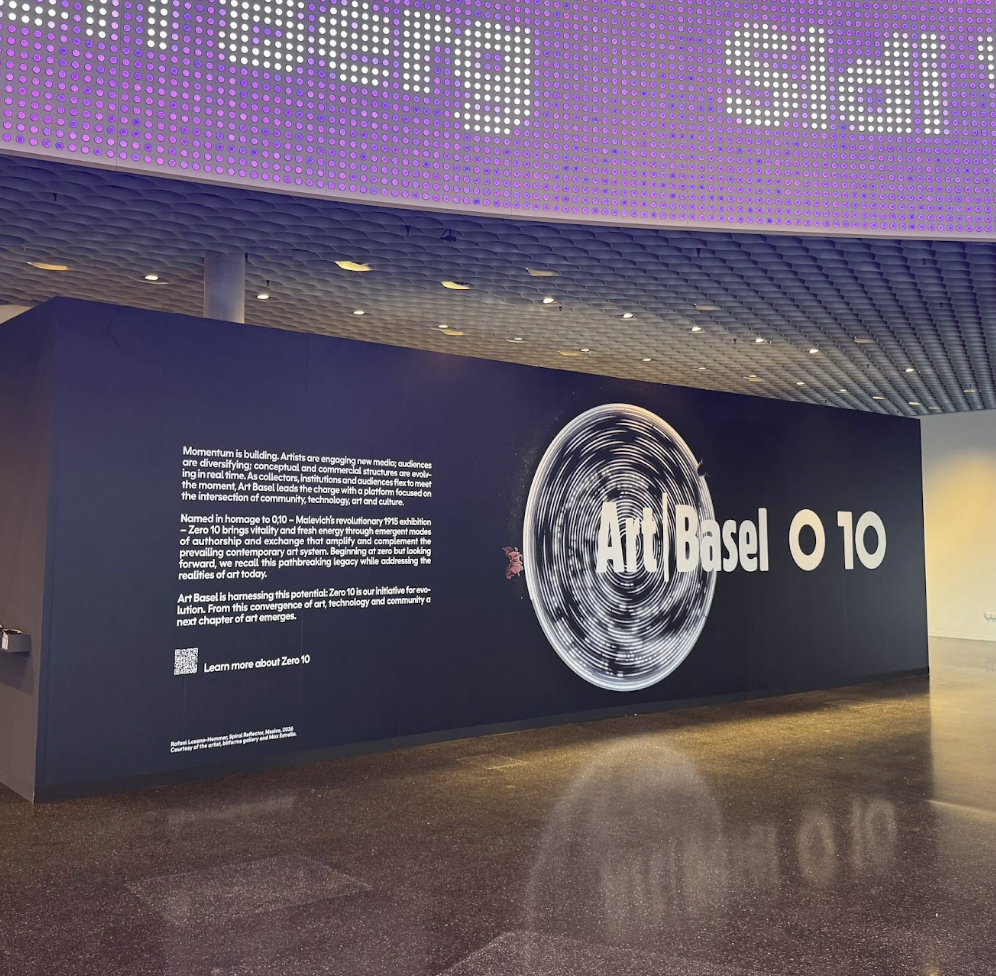
Zero 10 debuted in Europe this week. While this marks its first European edition, it is the third edition overall of Art Basel's dedicated sector for digital art, following its launches in Miami Beach and Hong Kong.
Curated by Trevor Paglen and Eli Scheinman under the theme The Condition, Zero 10 Basel 2026 brings together 16 presentations at the Event Hall on Messeplatz. The range is deliberately panoramic for a larger audience: from a 70-year survey of computer art history to live autonomous drawing programs from the 1970s, from participatory blockchain sculptures to institutional net art.
What does it mean to encounter digital art at the world's most consequential fair? And how does a sector that began as an experiment become a legitimate space for collecting? We walked all 16 booths to find out.
What It Felt Like To Be There
The line to get into Zero 10 on Wednesday, June 17, the first public day, stretched around the corner as people wanted to enter at 4pm, not 4:01pm. That detail matters. Because these were not, for the most part, people we recognise from the Web3 space. They were the general Art Basel crowd: traditional collectors, museum professionals, journalists, curators. People curious about digital art, perhaps for the first time.
The sector itself felt different from Miami and Hong Kong. More discreet. The presentations were controlled, confident rather than loud, in keeping with the whole Basel spirit. The screens were not competing for your attention; they were inviting sustained looking. The physical works and prints numerous. The concepts were there; the quality was there. It simply did not announce itself as previous editions.
Tours were numerous throughout the week, and the atmosphere around them reflected a growing seriousness. The most talked-about celebrity moment: Kanye West received a lengthy personal tour of the sector from curator Eli Scheinman. Maybe a new member for 100 collectors club?
What this edition did more convincingly than any before? It anchored digital art in the lineage of art history. The historical works (Vera Molnár's 1970s plotter drawings, Harold Cohen's AARON running live, the net art from HEK's permanent collection, ArtMeta's 70-year survey) were not presented as curiosities. They were the historical lineage. Digital art is not a new medium that appeared with NFTs. It has a 70-year history of rigour, institutional validation, and aesthetic development.
That recentering matters enormously! The NFT boom of 2021 did something paradoxical: it gave digital art enormous financial attention while simultaneously undermining its credibility in the eyes of traditional collectors. The hype, the speculation, the collapse: all of it attached itself to the medium and left a residue of scepticism that serious artists working with technology have been dealing with ever since.
Basel may be where that changes. When Hauser & Wirth, Marian Goodman, and Sprüth Magers present in the same sector as newer galleries, the implicit message to a traditional collector is clear: this is not a separate category to be evaluated on different terms.
This is contemporary art. The tools are different. The questions are the same. Zero 10 Basel 2026 may be the edition that gives digital art the seriousness — in the eyes of the traditional art world — that the NFT years temporarily took away.
16 Stops Across Zero 10 in Basel
1. John Gerrard — Fellowship | Z1
Fellowship opens the sector with a prophetic and timely triptych. Three of John Gerrard's perpetually running virtual worlds (Western Flag (Spindletop, Texas) 2017, Flare (Oceania) 2022, and STANDARD 2023) are shown together for the first time. Each is locked to a real geographic location and the solar calendar, replacing a flag's fabric with atmospheric phenomena: smoke, fire, water vapour.
Catalogue / Website: https://fellowship.xyz/exhibition/10214
From 24HOA: ‘STANDARD’ by John Gerrard with Fellowship sees a $500,000 USD sale. The 2023 created artwork (formerly Surrender Flag) is a real-time digital simulation and edition of 4 + 2AP. Each frame is generated live, with no two repeating.
Collector's takeaway: John Gerrard's work is held in MoMA, Tate, Centre Pompidou, and LACMA. Strong institutional validation and clear historical importance. 'STANDARD' sold for $500,000 USD on day one. The 2023 created artwork (formerly Surrender Flag) is a real-time digital simulation and edition of 4 + 2AP. Each frame is generated live, with no two repeating.
2. Aziza Kadyri — eastcontemporary | Z2
Three free-standing textile and metal installations draw on suzani embroidery traditions from Central Asia. Kadyri uses a custom-trained AI model to reinterpret inherited patterns, examining questions of authorship, cultural memory, and collective identity. The work asks what it means for a machine to learn craft, and what is lost or transformed in that learning.
Website / Catalogue: https://www.east-contemporary.org/5-1-artist-bio-page/aziza-kadyri
Collector's takeaway: One of the most compelling voices at Zero 10. Kadyri is an Art Basel Awards 2026 Emerging Artist nominee. This nomination is a strong early-career signal and the moment to enter.
3. 0xDEAFBEEF — Asprey Studio | Z3
Matter and Signal brings together an unlikely combination: blacksmithing, audio synthesis, and code. Its centrepiece, Glitchbox, is an interactive sculpture that records participant-generated outputs permanently on the blockchain. Tyler de Witt (0xDEAFBEEF) began his career as a blacksmith before emerging as one of the most rigorous technical artists of the blockchain art era.
From 24HOA: Artist 0xDEAFBEEF sees $164,000 USD in sales with Asprey Studio at Art Basel Zero 10. Three Synth Poem: Oscilloscope, 2021-26 forged iron sculptures, electronics, and generative code are acquired, two for $80,000 USD total, and one paired with an original Ben Laposky Oscillon, 1953 gelatin print for $54,000 USD. Four Hashmarks, 2023 sculptures, digital artworks and prints are acquired for $30,000 USD total.
Website / Catalogue: https://aspreystudio.com/pages/asprey-studio-at-art-basel-in-basel-2026
Collector's takeaway: 0xDEAFBEEF's crossover from Web3-native to institutional art world with works now in LACMA and the Toledo Museum of Art is one of the defining collector narratives of this decade. Pay attention to Tyler’s series, Chronophotograph, inspired by Eadweard Muybridge’s early photography.
4. Avery Singer — Hauser & Wirth | Z4
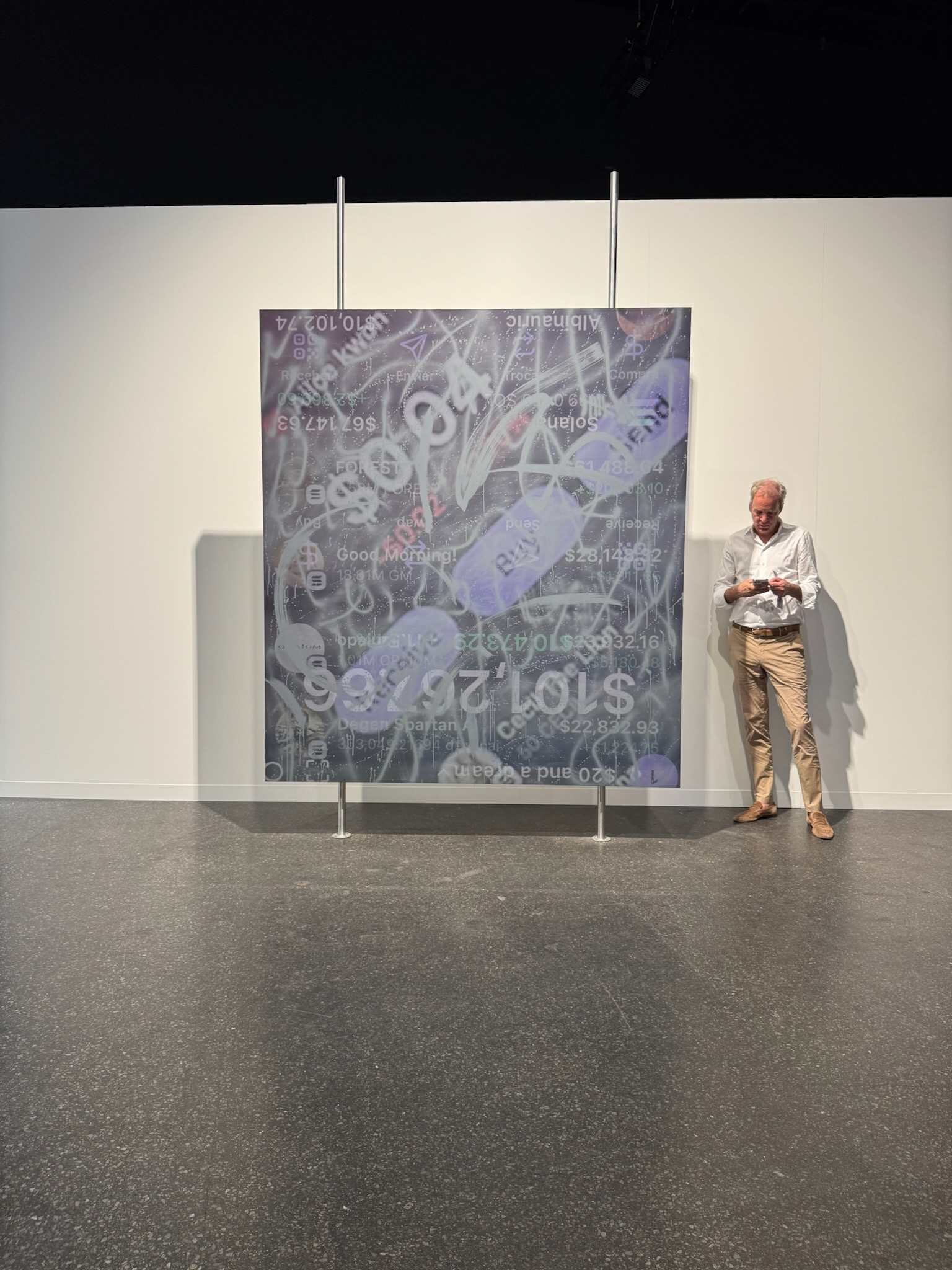
The most unexpected presence at Zero 10. Hauser & Wirth brings Avery Singer–one of the most closely watched painters of her generation–into direct dialogue with digital culture. Shit Coin Maxi (2025) is a large composite layered image depicting two digital wallets discovered on X/Twitter, made with Singer's distinctive fusion of digital painting tools and airbrush technique.
Website / Catalogue: https://www.hauserwirth.com/art-fairs/art-basel/special-projects/?lightbox=shit-coin-maxi
Collector's takeaway: Avery Singer is among the most closely watched painters of her generation. This work brings her practice into direct dialogue with digital culture: a natural fit for a Zero 10 acquisition, with the backing of one of the world's leading galleries.
5. Rafael Lozano-Hemmer — Max Estrella & bitforms gallery | Z5
Five interactive installations occupy the booth, each examining how perception is mediated by computation, AI, and surveillance. Works respond in real time to visitors' facial features, heartbeats, thermal signatures, and movements. The premiere of Black Hole (2026) anchors the presentation alongside Spectral Subjects (2024) and Broken Mirror (2025).
The co-presentation by bitforms (celebrating its 25th anniversary) and Max Estrella brings together two galleries with long and serious commitments to media and interactive art.
Website / Catalogue: https://maxestrella.com/fair/art-basel-2026/
Collector's takeaway: Lozano-Hemmer is a defining voice in interactive and media art with strong gallery and institutional backing worldwide. A staple name in the house.
6. Vera Molnár — Interface Gallery & Galerie Oniris | Z6
The historical anchor of the sector. Vera Molnár (1924–2023) began using computers in 1968 (two years before the first microprocessor) and is now widely recognised as a founding figure of generative and algorithmic art. Interface Gallery and Galerie Oniris present her computer-generated drawings from the 1970s alongside her abstract geometric works.
Website / Catalogue: https://www.oniris.art/en/events/49/
Collector's takeaway: Vera Molnár is the canonical origin point of generative art. Her works are foundational, institutionally validated, and increasingly scarce. The parallel Kunstmuseum Basel show only heightens the moment. Essential for any serious digital art collection.
7. Andreas Gysin & Leander Herzog — Nguyen Wahed | Z7
Two complementary works from Nguyen Wahed, one of the most discerning digital art galleries operating today. Leander Herzog's Infinite Garden (2025) is a blockchain-based generative ecosystem in which collectors become active participants, assembling and sharing ever-changing digital flora on-chain. Andreas Gysin's Meltdown (2023–26) transforms programming code itself into a shifting, rhythmic visual language, exposing the poetic substrate beneath computation.
Website / Catalogue: https://privateviews.artlogic.net/2/843a5d382bd06092fadf82/
From 24HOA: Meltdown by Andreas Gysin Sells Out at Art Basel Zero 10, Highlights Include XCOPY Gobble and Grifter, Beeple Bull Run, and M0dest 1-of-1 Secondary Works. ‘Meltdown’ by Andreas Gysin with Nguyen Wahed sells out for $72,000 USD in total at Art Basel Zero 10. The collection is made up of 16 fully on-chain generative artworks, first written by hand in 2023 and updated in 2026. Each is acquired for $4,500 USD by collectors including 137, Ian Rogers, and the OpenSea Flagship Collection.
Collector's takeaway: Infinite Garden reframes the collector as gardener in a living on-chain ecosystem — a novel acquisition model. The pairing of the two artists is intelligent: Herzog invites you into a system, Gysin reveals the system beneath.
8. Ryoji Ikeda — Almine Rech | Z8
data.gram (2022) translates scientific data from particle physics to cosmological measurements into precisely choreographed audiovisual compositions. Computer displays run these translations continuously, converting numbers into light, sound, and time at machine speed.
Website / Catalogue: https://www.alminerech.com/fairs/12472-datagram-n11-a-solo-presentation-by-ryoji-ikeda-at-zero-10
Collector's takeaway: Ikeda is one of the most consequential figures at the intersection of music and visual art. data.gram is among his most concentrated works. Presented by Almine Rech, with strong secondary market history.
9. Digital Masterpieces: From Code to Canon — ArtMeta | Z9
The most historically ambitious presentation in the sector. ArtMeta's Digital Masterpieces: From Code to Canon is a 70-year survey of 100 works told in seven chapters: SIGNAL (oscilloscope imagery, 1950s), SYSTEM (plotter and mainframe art, 1960s), GRAPHIC (screen-based image culture, 1970s–80s), NETWORK (connected systems and early internet art), GENERATIVE (code as artistic medium, from the Algorists to on-chain art), INTELLIGENCE (machine learning and AI art), and PROTOCOL (blockchain as artistic infrastructure).
A quarter of the works are shown physically at Art Basel. All 100 are viewable online. The artist roster is exceptional: Ben Laposky, Mary Ellen Bute, Desmond Paul Henry, Ken Knowlton & Leon Harmon, Charles Csuri, Frieder Nake, Gottfried Jäger, Rebecca Allen, Larry Cuba, William Latham, Eduardo Kac, George Legrady, John Maeda, Nancy Burson, Botto, Memo Akten & Katie Hofstadter, Primavera De Filippi, DADA, Mitchell F. Chan, and others. Curator: Georg Bak.
Website / Catalogue: https://masterpieces.artmeta.org/
Collector's takeaway: Digital Masterpieces presents works that are rarely — in some cases never — commercially available.
10. Harold Cohen — Gazelli Art House | Z10
AARON, the autonomous artmaking system created by Harold Cohen (1928–2016) in the early 1970s, runs live throughout the fair, generating autonomous drawings continuously. Three programs are presented: Reconstruction of Mazes (1970–72/2024), KCAT AARON (2002), and Gijon AARON (2007).
Cohen was a British artist and computer scientist who created AARON five decades before the current conversation about AI-generated art. What the fair is discovering now — that a machine can produce works with aesthetic coherence, without direct human input in each instance — Cohen was demonstrating in 1973. The Whitney Museum acquired AARON codes in 2024; M+ acquired historic AARON drawings the same year.
Website / Catalogue: https://gazelliarthouse.com/art-fairs/65-art-basel-2026-booth-z10/
Collector's takeaway: AARON is the historical anchor of machine-generated art. These live drawings produced by the same code Cohen wrote decades ago and are true collectors’ gems.
11. Jan Robert Leegte — OFFICE IMPART & Upstream Gallery | Z11
Three bodies of work (JPEG, Sightings, and Orbits) are united by an investigation into compression as one of the hidden infrastructures of digital image culture. Leegte has made art using the internet as his primary medium since 1997. His work is not about what digital systems display but about the systems themselves: their logic, their limits, and their invisible shaping of visual experience. The presentation is co-presented by OFFICE IMPART and Upstream Gallery.
Website / Catalogue: https://officeimpart.com/jan-robert-leegte-works
Collector's takeaway: Leegte is among the most important practitioners of net art with a practice spanning nearly thirty years. His work makes visible the invisible architectures that shape every digital image.
12. Andreas Gursky — Sprüth Magers | Z12
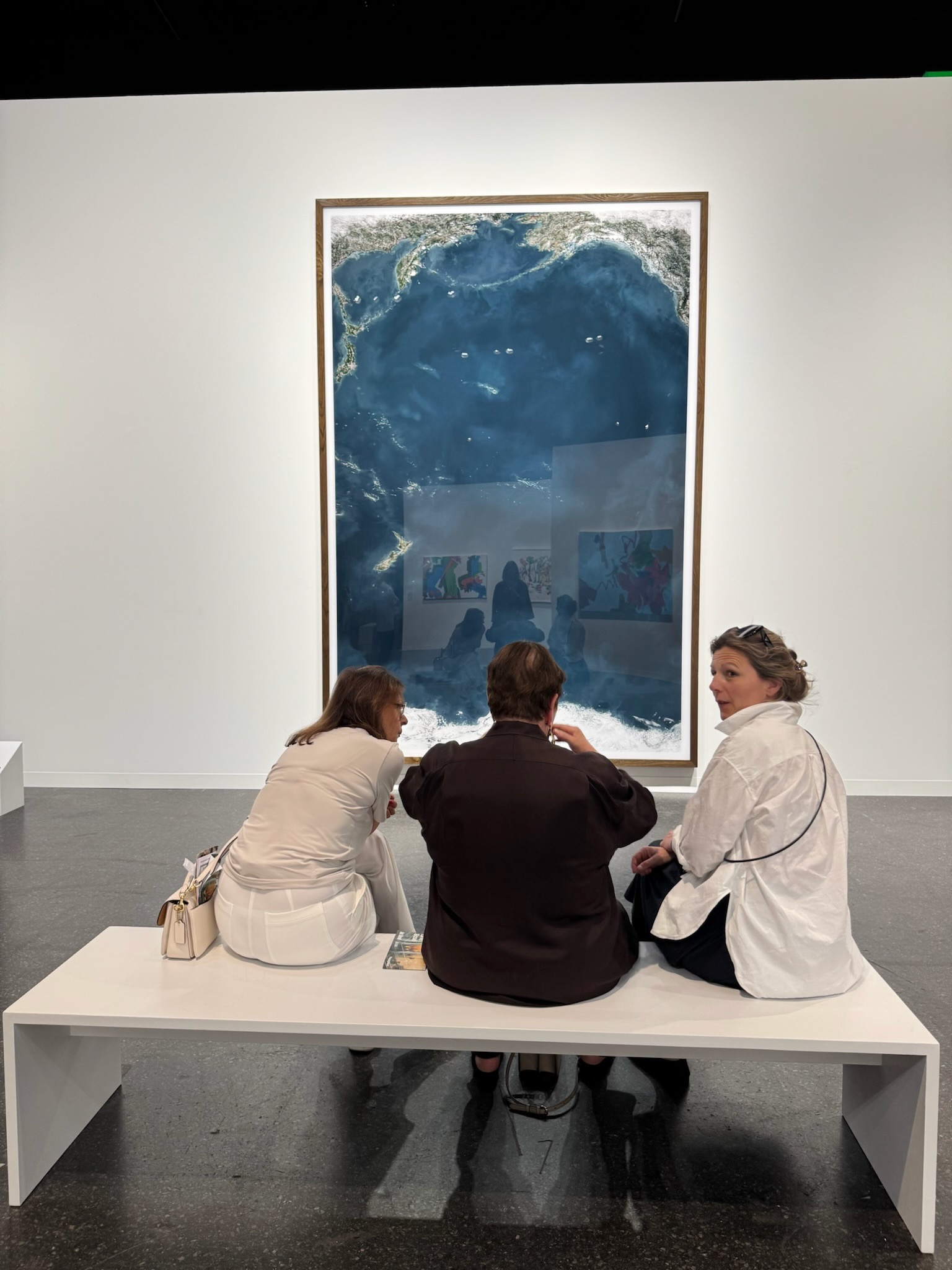
The most market-significant work in the sector. Ocean V (2010) is one of Gursky's monumental composite deep-blue oceanscapes, derived from satellite and photographic imagery. The work questions the boundary between documentation and construction, reality and representation.
Website / Catalogue: https://spruethmagers.com/
Collector's takeaway: Gursky's Ocean V is among the most iconic works in contemporary photography. Its inclusion at Zero 10 makes the definitive argument that digital art has always been embedded in the mainstream art world and signals strong secondary market value.
13. William Mapan — Art Blocks | Z13
Art Blocks returns to Art Basel Zero10 with William Mapan, one of the most celebrated generative artists. Two new generative series: Paysages Plausibles and Dances on Shadows (DOS) are presented alongside État des lieux (2026), Mapan's largest oil painting to date: a 2m × 2.5m canvas assembled from 20 wood panels that translates his generative sensibility into a sweeping physical landscape.
Website / Catalogue: https://www.artblocks.io/articles/william-mapan-paysages-plausibles
From 24HOA: 'Paysages Plausibles' by William Mapan with Art Blocks sells out for $220,000 USD total. Centerpiece 200 x 250cm oil on canvas 'État des lieux' sells for $80,000 USD, and five 60 x 80cm works sell for $28,000 USD each.
Collector's takeaway: Art Blocks dedication to presenting generative art to larger crowds is not to be proven anymore. Many participations to art fairs, collaboration with museum and recent Generative Art Foundation now shows market results. Paysages Plausibles by William Mapan sold out for $220,000 USD total (digital). Centerpiece oil on canvas 'État des lieux' sold for $80,000 USD, and five 60 x 80cm works sold for $28,000 USD each.
14. Hito Steyerl — Esther Schipper & Andrew Kreps Gallery | Z14
Green Screen (2023) is a large-scale installation featuring an LED wall made from recycled glass bottles, AI-generated imagery, and bioelectrical connections to living plants. Electrical signals from the plants shape the work's evolving sound and low-resolution animations of blooming flowers, creating an active dialogue between organic life and digital systems.
Steyerl is the sharpest critical voice on technology and representation in contemporary art. Green Screen doesn't celebrate digital systems — it interrogates them. The recycled glass, the plant signals, the AI imagery: each element forces a question about what is natural, what is computational, and what the difference actually means. Two major galleries co-presenting amplifies the institutional weight considerably.
Website / Catalogue: https://www.hitosteyerl.net/
Collector's takeaway: Hito Steyerl remains the sharpest critical voice on technology and representation in contemporary art. Green Screen implicates both nature and machine in an image system that feels urgent at this moment.
15. Agnieszka Kurant — Marian Goodman | Z15
Marian Goodman appears at Zero 10 for the first time; and the significance of this should not be understated. One of the most prestigious galleries in the world choosing to present here is a statement about the sector's legitimacy.
Agnieszka Kurant's Alien Internet II (2023/2026) and Unthoughtforms (2026) bring together sculptures made from compacted, pulverised materials and installations digitally controlled in an electromagnetic field. Kurant explores collective cognition, AI, and biological networks as intertwined phenomena.
Website / Catalogue: https://www.mariangoodman.com/news/1347-agnieszka-kurant-art-basel-zero10/
Collector's takeaway: Kurant is one of the most rigorous thinkers on collective and machine intelligence in contemporary art. The technical rigor and craftsmanship level are worth looking into. Any work by Kurant immediately becomes the centerpiece of a collection.
16. Early Net Art from the HEK Collection — Haus der Elektronischen Künste | Z16
The institutional mark of Zero 10. HEK Basel presents five significant works of early net art from its permanent collection, in a non-selling presentation. Artists: !Mediengruppe Bitnik, etoy, JODI, UBERMORGEN, and Studer/van den Berg — all foundational figures in net art from the 1990s and early 2000s. Curator: Sabine Himmelsbach.
HEK is not here to sell. It is here to remind every collector in the sector where this all came from, and to suggest that the conversation has not yet fully reckoned with its own history.
Website: https://hek.ch/en/program/events/hek-zero-10-early-net-art-from-the-collection
Collector's takeaway: HEK's presentation is a non-commercial, historically grounded perspective on where digital art came from. Essential context for any collector navigating the broader field.
6 Things to Keep in Mind as a Collector
1. The blue-chip galleries have arrived
Hauser & Wirth, Marian Goodman, Sprüth Magers, Almine Rech, Esther Schipper. This is not the gallery roster of an experimental sector: it is a cross-section of the most powerful commercial galleries in the world. Their presence at Zero 10 Basel 2026 marks a threshold
2. History is the argument
ArtMeta's 100-work, seven-chapter survey spanning 70 years, Harold Cohen's live AARON programs drawing autonomously in real time, HEK's non-selling net art collection: all make the same case: digital art has a history that predates the blockchain by five decades, and that history is now being priced.
3. What you own is often bigger than what you see
One of the clearest lessons from this sector is that digital art frequently lives beyond a single visual output. Glitchbox records your interaction permanently on-chain. Infinite Garden places you inside a living generative ecosystem. The question to ask at every booth is not only what it looks like, but what it does, and what you actually own when you collect it.
4. The physical craft is returning and accelerating
État des lieux, Mapan's monumental 2m × 2.5m oil painting assembled from 20 wood panels, translated directly from his generative code. The textile and metal suzani-inspired installations of Aziza Kadyri. The blacksmith-forged sculpture at the centre of 0xDEAFBEEF's booth. The assumption that digital art is screen-based is being actively dismantled at this edition.
5. Sales confirm the market demand is real
This was not a sector for looking only. STANDARD by John Gerrard sold for $500,000 USD on day one. Paysages Plausibles by William Mapan sold out at $220,000 USD total. État des lieux went for $80,000 USD. Five smaller Mapan works sold at $28,000 USD each. These are real market signals.
6. The most important edition and the quietest
Zero 10 Basel 2026 will be remembered as the edition where the sector stopped being an experiment, not because it announced itself loudly, but precisely because it didn't. More discreet than Miami or Hong Kong, the works were not competing for your attention; they were inviting sustained looking. The NFT boom temporarily undermined digital art's credibility in the eyes of traditional collectors, Basel 2026 may be where that changes.
Walking Together
A visit gives you access. An article gives you context. But collecting develops through conversation.
100 collectors members discovered the Zero 10 sector with private tours and advisory support throughout the fair week. For personalised guidance on the works presented here, or to discuss any acquisition, contact us at hello@100collectors.art.
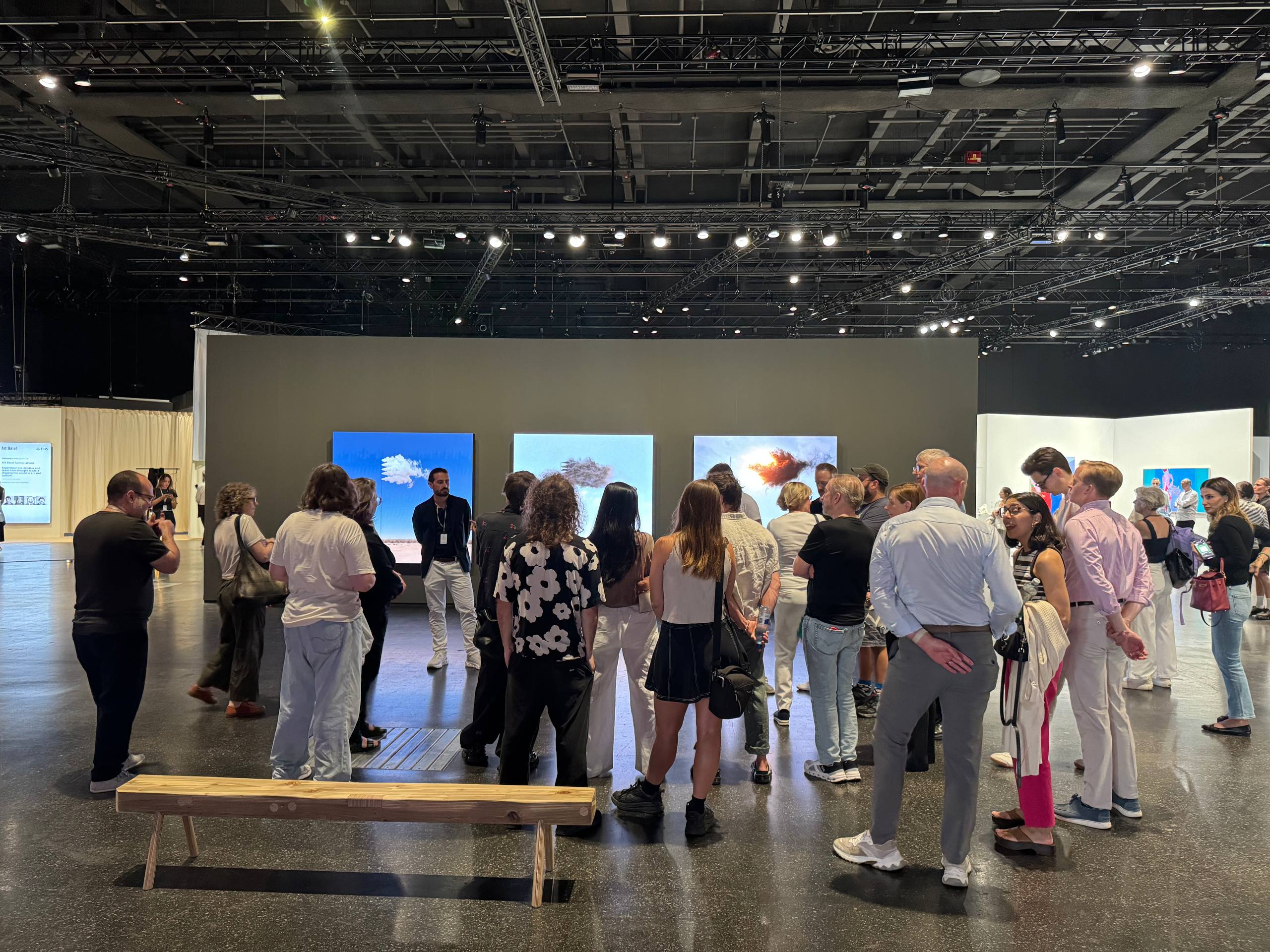
Image credits: Photography taken at Art Basel Basel 2026, June 17, 2026. All rights reserved.