.svg)
What does it mean to hold a fair when the region is still carrying the weight of conflict?
Art Dubai's decision to move forward with a Special Edition in 2026 says something. Not loudly, but clearly. Sixty galleries, a more intimate format than usual, and a digital sector of twelve galleries that felt genuinely alive.
This edition is smaller by design and stronger for it. Most of the people I met over those first days were from the region: Dubai, Riyadh, Doha. There was a kind of commitment that you rarely feel at the large international fairs. A sense that people had chosen to be there.
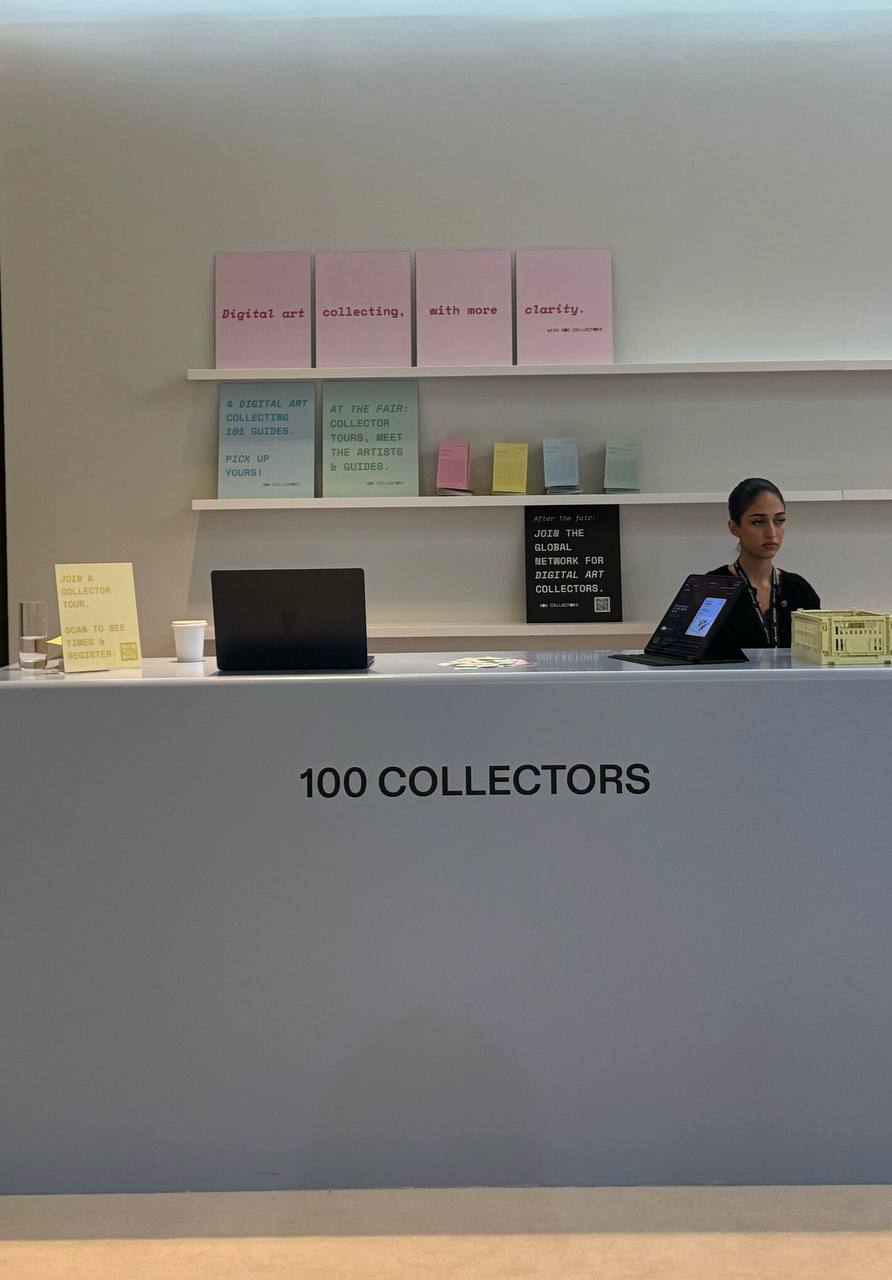
As institutional partners of Art Dubai this year, 100 collectors is present throughout the weekend with collector tours, physical guides, and conversations in the arena foyer at Booth 13. These are my notes for you from walking the digital sector.
The Digital Sector
The digital sector is curated by Ulrich Schrauth and Nadine Al-Khalil and brought together twelve galleries, a mix of regional and international. The breadth is real: video installation, generative systems, interactive works, sound, painting, blockchain-based projects, and works that are beyond categorization.
Walking through the sector, a few recurring questions emerged across very different practices:
What does the body become under technological systems? How do we transmit memory and perception in a digital age? And where does the line between nature and technology actually sit today?
Credits: Walk through from Ulrich Schrauth (Instagram)
Here is what I found at each booth. Exclusively for you, directly from the floor.
1.Art Fungible
Body, Perception, Sound
Amrita Sethi's practice begins with voice. From the sound of a spoken word, she generates shapes, and from those shapes, visual works. The piece presented at Art Dubai, Dance of Light, takes this further: a composition of music that generates visual forms through the movement of a single dot, in real time, in response to viewers.
What makes it interesting is the layering. Live generation, sound, prints, video, and painting coexist within the same installation. The dot, in Sethi's language, represents the present moment. Not a metaphor for it. The thing itself.
Collector's takeaway: Sethi's work is a strong entry point for collectors interested in sound-responsive and generative art. The installation format rewards time and attention. The more you stay, the more you see.
2.RARARES Gallery
Time, Nature, Technology
Two artists with very different approaches, both circling the question of where digital creation ends and physical matter begins.
Chunkook Lee works in 3D modeling and then moves into the physical world: wooden panels worked with clay, forms that have traveled through digital space before arriving as objects. There is something almost alien about the results, a quality that appeared in several booths this edition.
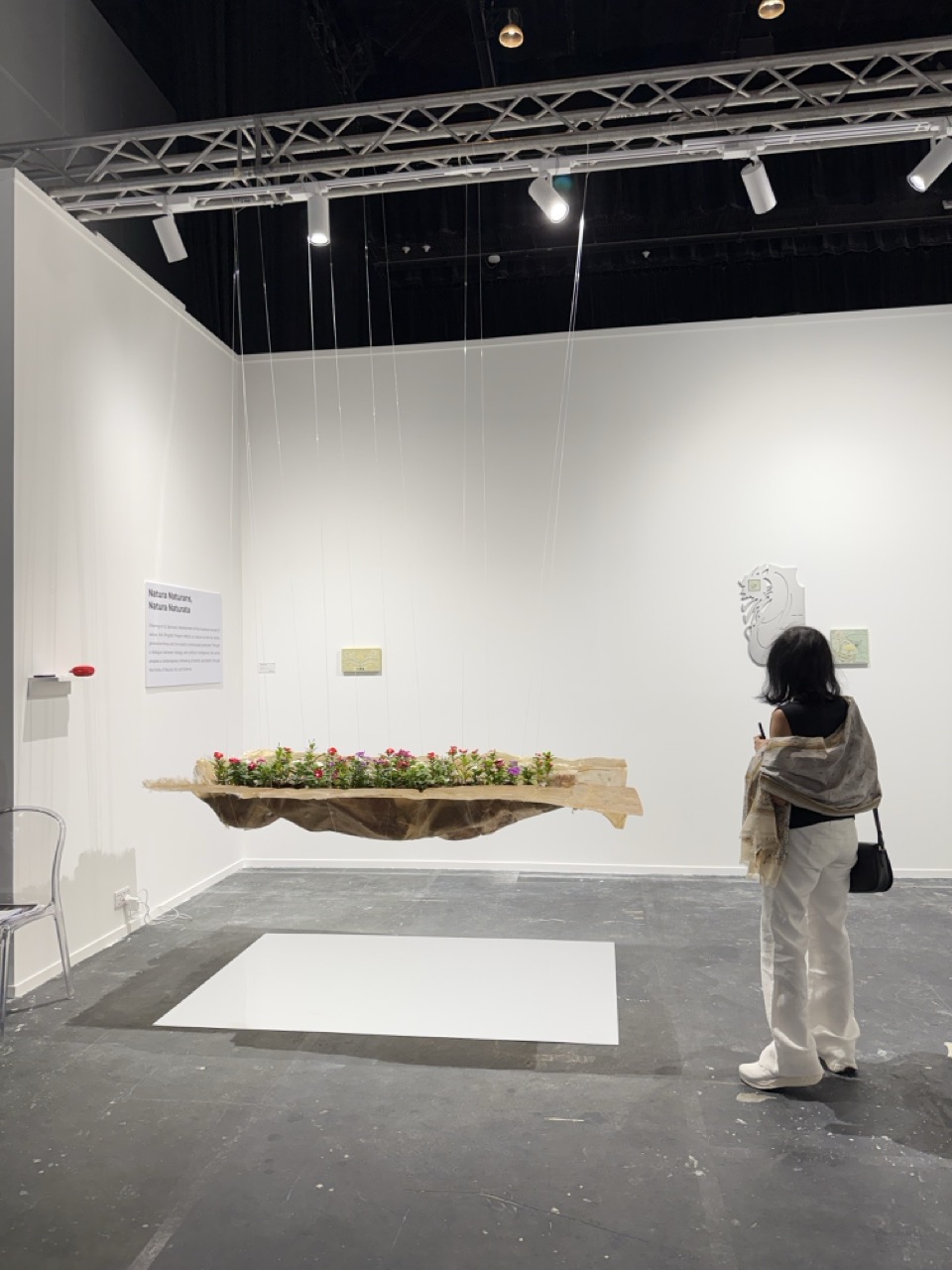
Fatma Lootah, one of the most important artists working in the UAE, presented an earth installation with an added sound layer. The forms speak of vessels, of the shape of absence, but the sound brings something else: flowering, breath, a cycle that is still moving. It is one of the quieter works at the fair, and one of the most lasting.
Collector's takeaway: If you are building a collection that takes seriously the dialogue between digital processes and physical making, both artists are worth a careful look. Lootah's practice in particular has a depth and a rootedness that is rare.
3.Foundry
Nature, Dialogue, Algorithm, Time
Four positions, and a strong curatorial thread running through all of them.
Nation 2.0 presents an empty parliament room. Machinery and golden structures. Decisions now made by computer and data. No humans present. The work is not apocalyptic. It is quiet, almost calm, which makes it more unsettling.
Fakewhale Studio brings two video works, Hide and Seek and Ritual, exploring AI-generated representations of human experience.
Scerbo, presented through Pinksummer, challenges the idea of the museum as a neutral space, proposing instead works designed to integrate into lived environments.
Collector's takeaway: Foundry is presenting artists who are asking what happens to human presence inside systems that were built by humans. The tone is reflective rather than dystopian. These are works that live well over time.
→ View the Foundry catalogue → View the Pinksummer catalogue

4.Dom Art Projects
Nature, Body, Perception, Point of View
The gallery's curatorial premise is that there is no real divide between the physical and the digital. Three artists, three ways of exploring that idea.
Sofya Skidan's new video works, filmed in the UAE, use AI filters that feel simultaneously local and cosmic. Her figures are hybrid in the most literal sense: human forms entangled with glass tentacles, technology as extension rather than intrusion.
Michiko Tsuda's performance-based work takes a single subject and films it from two completely different perspectives. The dissonance between those two views is the work. It is very spatial, very present, almost theatrical.
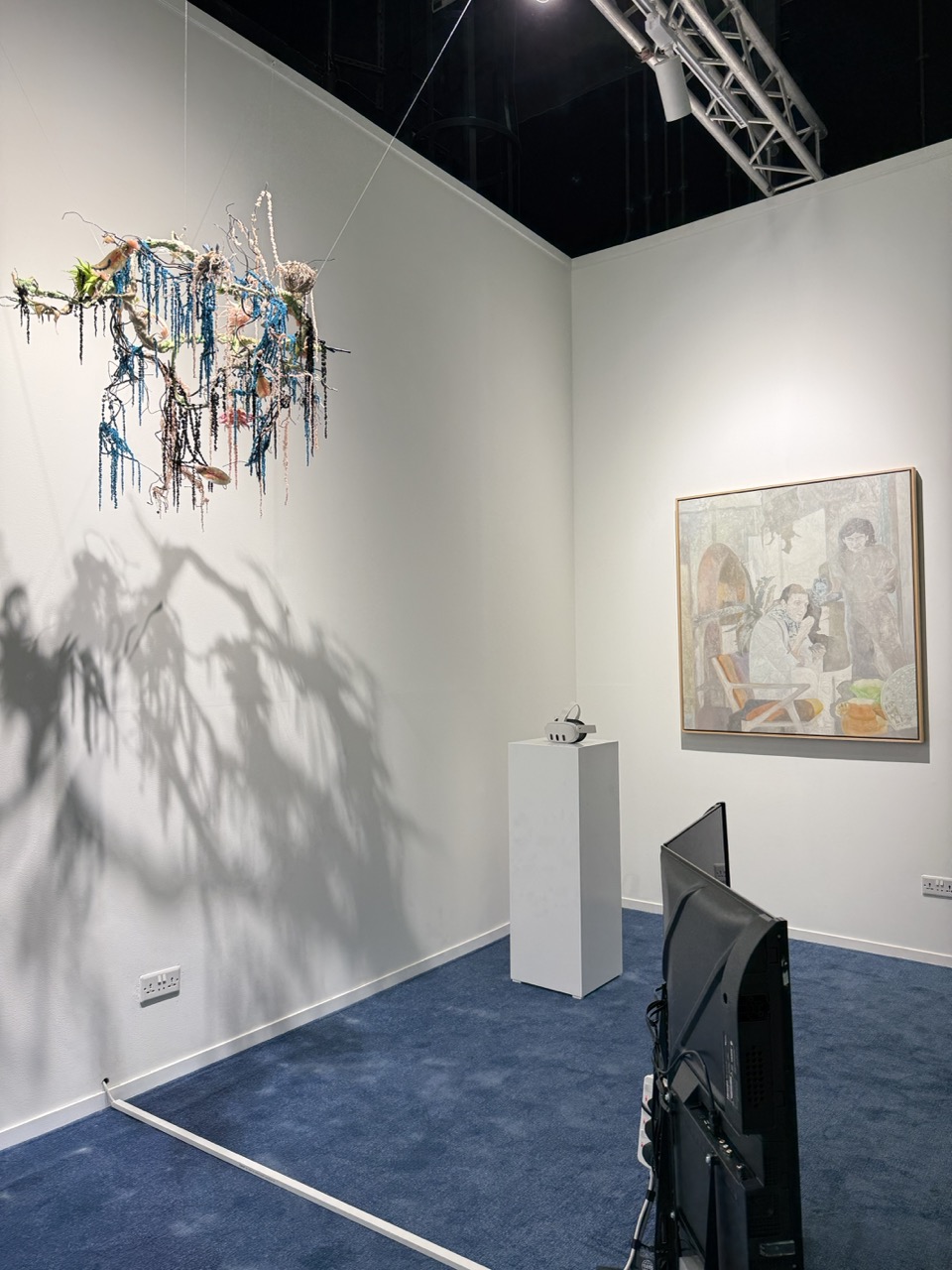
Kirill Makarov combines painting with VR, merging classical and digital visual languages into single surfaces where multiple planes coexist. Body, perception, hybrid vision: all in one frame.
Collector's takeaway: Dom Art Projects is presenting some of the most spatially and conceptually ambitious work in the sector. Skidan and Tsuda in particular are artists whose trajectories are worth following closely.
→ View the Dom Art Projects catalogue
5.lilia ben salah
Body, Fragmentation, Memory
A pairing that makes a point about continuity.
Amal Abdenour moved to Paris in 1962 and discovered the photocopier in 1970. From that discovery came a practice built around fragmented self-portraits, identity, exile, and self-representation. Using Xerox machines as her primary tool, she became a foundational figure in Copy Art and Body Art before her work turned increasingly public and political. She died in 2020, and her practice is now being rediscovered as a major contribution to feminist and experimental art history.
Zoulikha Bouabdellah, born in Moscow in 1977 and raised in Algiers, works across video, installation, sculpture, and photography. Her work reinterprets elements from both Islamic and Western visual cultures, prayer rugs, ornament, nationalist symbols, to challenge stereotypes and open up spaces of resistance and ambiguity around the female body. Her breakthrough video Dansons (2003) entered the Centre Pompidou collection and she has since shown internationally across major institutions and biennials.
Collector's takeaway: This presentation is a reminder that the questions digital art raises about the body, self-representation, and fragmentation have deep roots. Abdenour's work in particular deserves far wider attention.
→ View the lilia ben salah catalogue

6.AWL
Body as Subject, Body as Object
Agnes Questionmark's Opera Medica is a nine-minute, three-channel video installation, originally developed as a live performance with Gabriel Levy. The setting is a staged surgical environment. The actions are precise, repeated, drawn from medical procedures. The structure is choreographic but the feeling is procedural, almost protocol-like.
At its center is a question about the body: when does lived experience become data? The work places the body at the intersection of medical, technological, and computational systems that continuously interpret and reconstruct it. The posthuman is not a concept here. It is a condition that the work gives shape to.
Collector's takeaway: Opera Medica is one of the most formally rigorous works in the sector. For collectors interested in performance-to-video practice and questions of the body under technological systems, Agnes Questionmark is an important voice.
→ View the Agnes Questionmark catalogue

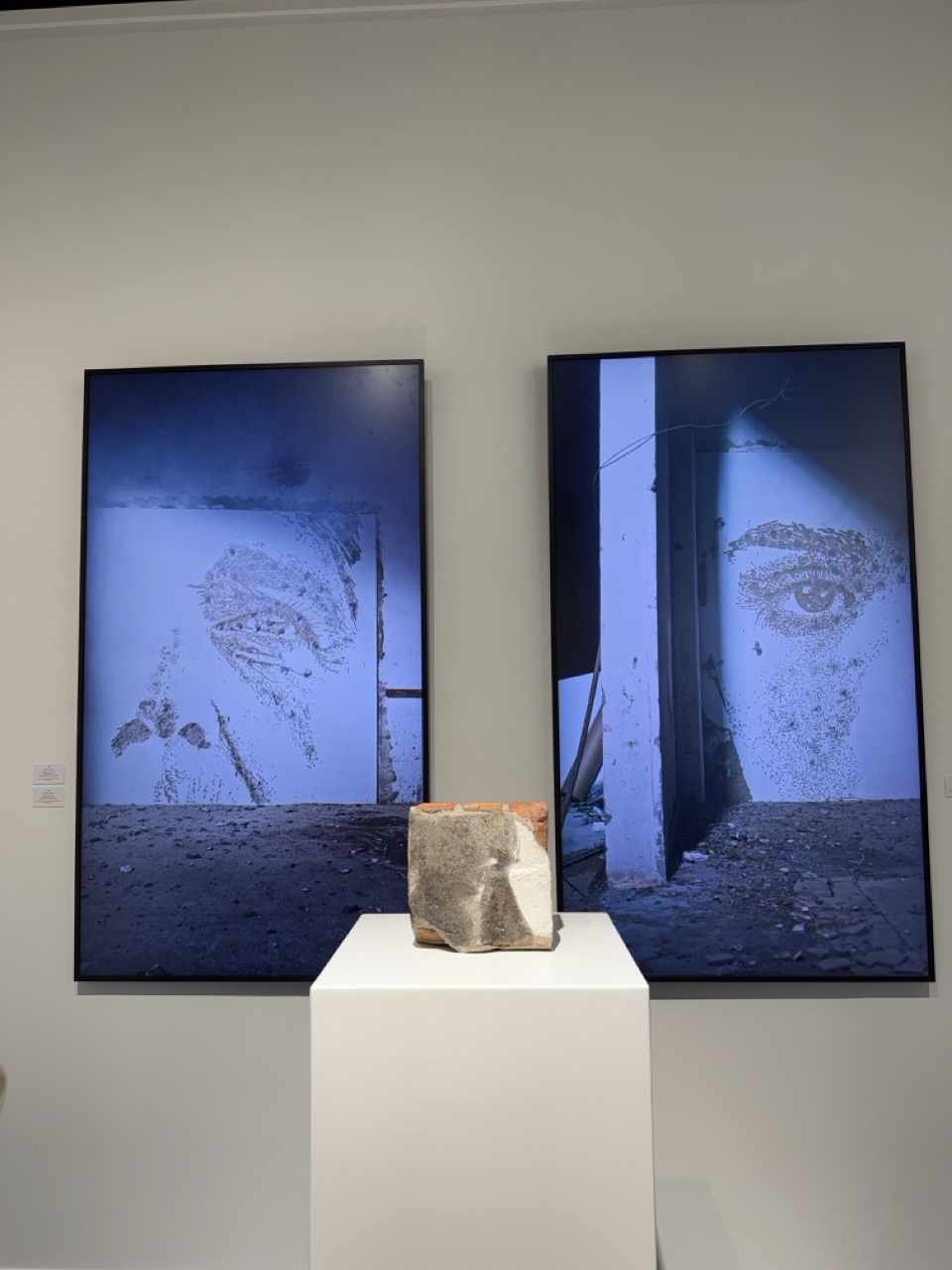
7.Shankay
Humanity, Image, Meme Culture, Technology
Four artists with distinct practices, held together by a shared interest in how images circulate, transform, and accumulate meaning.
Vhils works with destruction as image-making: controlled explosions captured in slow motion, laser-cut acrylic, demolished building fragments. Portraits that seem suspended between physical matter and digital screen.
Eduardo Enrique uses branded objects, sneakers, bats, golf balls, to critique consumerism. One installation suspends shoes that repeatedly hit the ground through a motorized system, an endless loop of consumption and spectacle. Surreal and darkly funny.
Isaac Sullivan enlarges images to the point where they nearly dissolve into pixels, and transforms the outputs of AI language models he trained himself into plaster reliefs. Artificial intelligence treated as archaeological relic, almost.
Yutaro Inagaki's paintings depict anonymous hybrid figures drawn from memes, gaming aesthetics, and AI imagery. His sculptures, made from discarded keyboard keys, feel like creatures born from technological debris. The emotional register is surprisingly tender: loneliness, identity, overstimulation.
Collector's takeaway: Shankay brings together artists who are working in and around the psychology of hyper-digital culture. Inagaki especially has a visual language that is immediately recognizable and worth tracking.
8.JD Malat Gallery
Digital Collage, Flow, Painting, Online Culture
A group of painters who arrive at questions about digital culture from very different directions.
Casper Brindle's gradients, reflective surfaces, and shifting light effects almost behave like screens. His earlier use of LEDs creates a bridge between Light and Space traditions and contemporary digital aesthetics, without making the connection heavy-handed.
Santiago Parra works with singular brushstrokes that feel almost performative. His process embraces spontaneity and the trace of human action, which feels like a quiet counter-argument to the endlessly optimized image world we navigate every day.
Masayoshi Nojo combines photography, digital image selection, silk-screen transfer, and layered materials. The results feel suspended between memory, reproduction, and material presence, like layered image files where historical visual languages have been filtered through contemporary techniques.
Ur Kasin begins from online sketches and internet image flows before translating them back into paint. His works carry the psychology of hyper-digital life: fragmented attention, absurdity, overstimulation, identity shaped through screens and feeds and endless accumulation.
Collector's takeaway: This is the booth that most directly shows how painting and digital culture are in active conversation. Ur Kasin and Nojo are both artists to watch for collectors interested in how image culture moves between digital and physical.

9.Iregular
Live Generation, Interaction, New Technologies
Iregular works at the intersection of art and technology, experimenting with geometry, light, sound, typography, mathematics, algorithms, communication protocols, AI, and machine learning. The studio also develops its own proprietary technologies.
What defines the work is the role of the audience. The installations use infinite, randomized combinations produced by interactive systems. The public does not just observe: it influences, and therefore finalizes, the work. Interaction is the medium, not an add-on. Iregular has a portfolio of more than fifty works that have traveled across nearly thirty countries.
Collector's takeaway: For collectors interested in interactive and participatory work at the highest technical level, Iregular is essential. These are works that are genuinely different each time they are experienced.

10.Rizq Art Initiative
Appropriation, Economy, Extraterrestrial Territory
Soliman Lopez has spent years developing one of the most conceptually ambitious projects in the fair. Its subject is the asteroid Psyche, a body in the asteroid belt discovered in the nineteenth century, composed almost entirely of metal, platinum, gold, silver, and iridium, representing a monetary value that is genuinely difficult to comprehend. In 2023, NASA and SpaceX launched a research mission that will arrive at Psyche in 2029.
Lopez's project unfolds in three acts. The first includes legal documents stored in the blockchain, proving that an individual can claim ownership of the asteroid, not to exploit it, but to protect it. The contract is embedded in DNA seated on iridium. The second act, Software Obscura, is a full setup in Blender that reproduces all available data to photograph Psyche as it will appear when NASA arrives. The third act, The Radio Flag, replaces the planting of a physical flag with metal objects that create a radio frequency capable of touching the surface of the asteroid.
Collectors who acquire the work contribute to financing the protection of Psyche from exploitation.
Collector's takeaway: Eridium is one of the most layered and serious projects engaging with blockchain as a legal and ethical instrument. This is not a work about ownership as spectacle. It is a work about what ownership could be used for.
→ View the Soliman Lopez catalogue

11.SSK
Perception, Smell, Molecular Worlds
In 2024, SSK (Studio Siddhartha Kunti) realized he had accumulated enough data to begin visualizing the natural world through its aromas. Working with a researcher, he began translating molecules into visual form, building a practice that now spans two collections: an oud from Cambodia (seventy molecules rendered as a single digital work) and a whisky study (830 spirit aromas).
When collectors acquire the oud work, they also receive the synthetic smell of the oud itself. The digital and the sensory are not separate. They arrive together.
Collector's takeaway: SSK is doing something genuinely new with the question of what can be digitized. Smell has been one of the last sensory registers to find its way into digital art practice. This is early-stage work on a question that will only become more interesting.

12.Plan X
Memory, Transmission, Ritual
The Ethiopian collective Yatreda closes the tour with something that felt necessary. Their work documents two forms of cultural practice: Sedea, a traditional Ethiopian dance, and Zewed, a ritual battle. Every sculpture in the booth has a digital companion edition. The physical is a symbolic representation of the video.
What matters here is that none of it is AI-generated. The images are real, the documentation is real, and the production quality is extraordinary. These are works about memory, transmission, and ritual, the challenge of preserving what is embodied in practice against the flattening effect of contemporary image culture.
Collector's takeaway: Yatreda is one of the most impressive presentations at the fair. Their work raises urgent questions about what digital tools are actually for when it comes to cultural memory. This is a collective to follow closely.
6 Things to Keep in Mind as a Collector
1. Smaller can mean sharper
The Special Edition format concentrated the energy in ways that larger fairs rarely manage. With sixty galleries total, conversations lasted longer and encounters felt less rushed. The digital sector benefited from that intimacy. For collectors, this edition offered more depth per square meter than many larger shows.
2. The region is not peripheral
A significant portion of the collectors, gallerists, and artists present this year were from the Gulf and wider region. The energy that it brings is different from the international circuit energy. It is more committed, more invested in what the fair means locally. For collectors working in or interested in the region, this edition was a signal worth taking seriously.
3. The body is the recurring subject
Across the twelve galleries, what kept returning was the body: hybrid bodies, bodies under technological systems, bodies as data, bodies as spectacle, bodies remembered and transmitted. This is not a coincidence. Artists working with digital tools today are consistently drawn to the question of what we become when we are processed, observed, and reconstructed by systems we built.
4. Digitization is expanding beyond the image
SSK's smells, Soliman Lopez's DNA-embedded legal contracts, Yatreda's audio-visual documentation of living rituals: the most interesting digital practices right now are not primarily about screens. They are about what can be recorded, transmitted, and preserved across formats we are still figuring out. Collectors who expand their frame beyond the visual will find more.
5. Context is part of the work
Several of the strongest presentations here were difficult to fully understand without background: the legal structure of Soliman Lopez's asteroid project, the cultural specificity of Yatreda's rituals, the molecular research behind SSK's aroma collections. The collectors who left with the deepest engagement were those who took the time to ask. This is a field where curiosity is a collecting strategy.
6. The conversation is the beginning
At a fair like this one, the conversations that matter most are not always in the booths. They happen between booths, after tours, in the spaces where collectors and artists are in the same room without a formal structure around them. Art Dubai created those conditions this year, and the digital sector held them well. That is worth noting for what comes next.
Join us at the fair
Throughout the weekend, we run three tour formats for collectors: a curatorial walk through the digital sector, intimate artist conversations, and a dedicated tour for younger audiences. The exchanges those tours generated, the questions collectors asked, the connections they made between works, are exactly what 100 collectors exists.
If you want to continue that conversation, we are here.
Pauline Foessel is CEO and Founder of 100 collectors, and served as institutional partner representative at Art Dubai Special Edition 2026.