.svg)
How do you experience a digital art sector beyond individual booths?
At art fairs, most encounters with digital art happen in fragments. A screen here, an installation there. But what’s often missing is the bigger picture: how works relate to each other, how a curatorial vision unfolds, and how collectors move through the space.
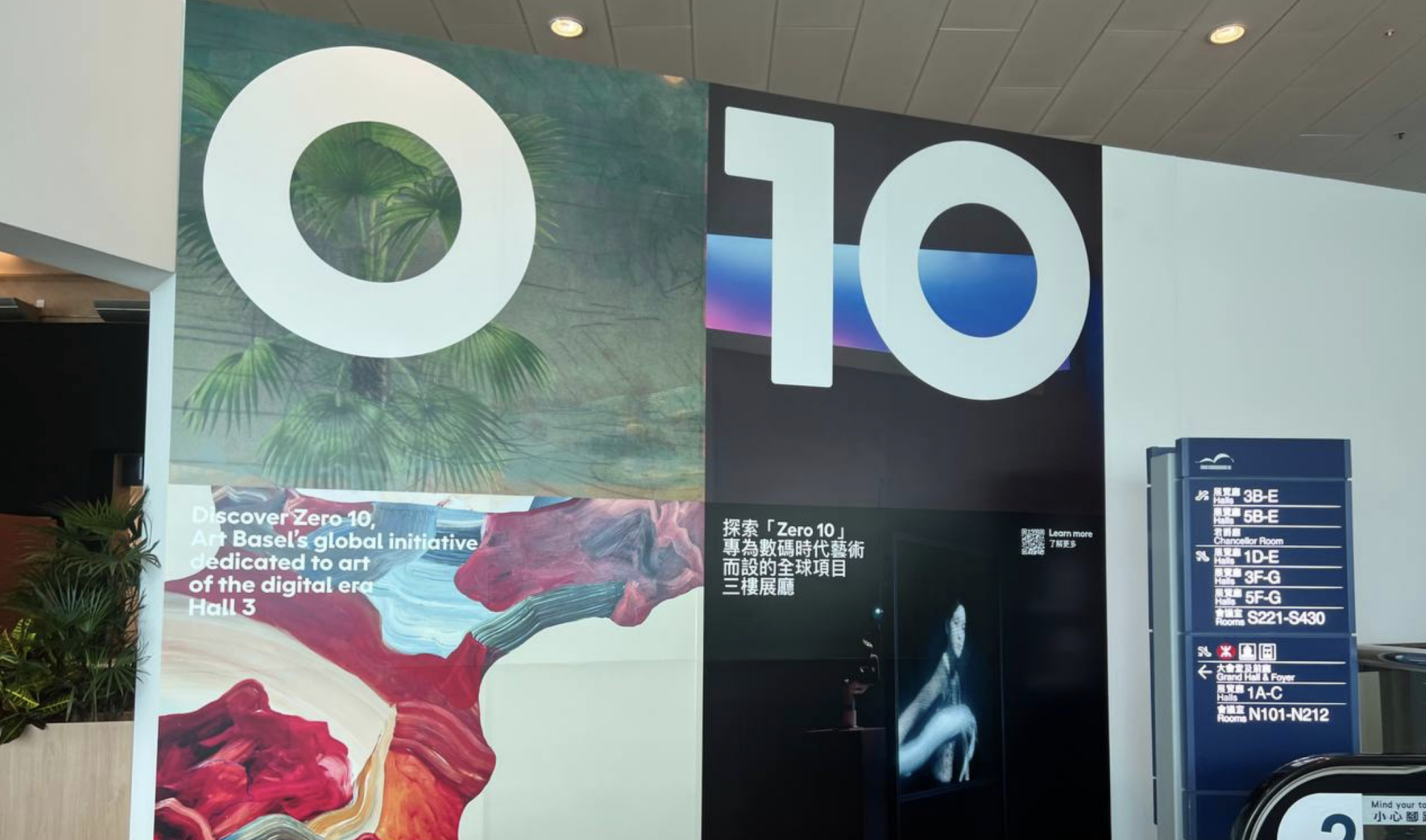
With Zero 10, Art Basel Hong Kong’s digital sector, this question becomes essential.
This second edition marks a clear evolution. Stronger curation, more ambitious presentations, and a growing presence of collectors engaging seriously with digital art.
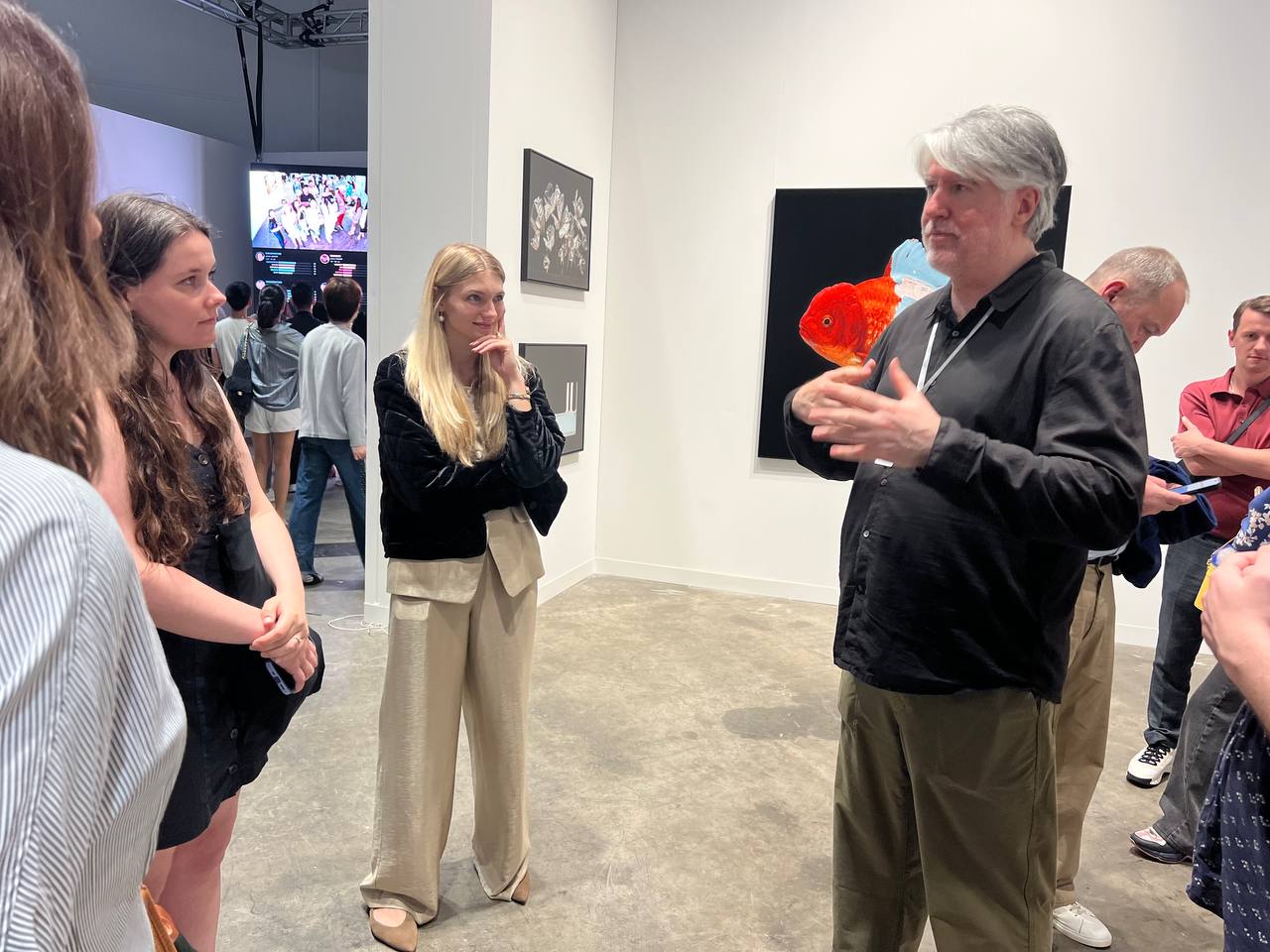
To make sense of it, we walked the space.
A Spatial Walkthrough of Zero 10
Single booth views never tell the full story.
This walkthrough reveals the structure of the sector. The rhythm between booths. The shifts in scale, medium, and attention. The way certain works open conversations that continue across the aisle.
It also highlights something important:
Zero 10 is no longer an experimental corner. It is becoming a space where different approaches to digital art coexist and are tested in front of collectors.
→ Watch the full walkthrough: https://youtube.com/shorts/PjGWdKl2vvs?feature=share
→ Discover the catalogues here
12 Stops Across Zero 10
1. Jonas Lund - Office Impart
Jonas Lund presents a practice built around systems rather than images. The work exists through rules, participation, and circulation.
“It’s about care, responsibility, network, and maintenance.”
Collector’s takeaway:
Jonas Lund is an artist to keep firmly on your radar. His work reframes collecting as active engagement within a system.
→ Watch: https://youtube.com/shorts/TzwXz8EL03s?feature=share
2. Emi Kusano - RK Contemporary
Emi Kusano explores identity through AI and retro-futurist aesthetics, drawing from visual cultures shaped by the internet.
Her Ornament Survival series translates emotion, memory, and self-image into data.
Collector’s takeaway:
Emi Kusano is an artist to watch for how she blends AI imagery with nostalgic visual language, capturing how identity is shaped today.
→ Watch: https://youtube.com/shorts/IqeNHQTyeIw?feature=share
3. Claire Silver + ThankYouX - Plan X
“Before Words” explores perception before it stabilizes into meaning.
An AI that senses and reacts without awareness. Images that distort as you try to read them.
Collector’s takeaway:
If you’re interested in the space between digital and physical, ThankYouX is an artist to watch. Alongside Claire Silver, who continues to push AI into new forms of material presence.
→ Watch: https://youtube.com/shorts/Ip8iMgCvan4?feature=share
4. Laurie Simmons + Petra Cortright - Solos Gallery
Two generations meet around artificial and constructed realities.
Cortright moves between digital painting and NFTs.
Simmons extends decades of work on representation into AI.
Collector’s takeaway:
If your collecting is driven by curiosity about how technology can be used in unexpected ways, both artists offer strong entry points across time.
→ Watch: https://youtube.com/shorts/nmjH0T9r_Yk?feature=share
5. DeeKay - AOTM Gallery
DeeKay translates inner emotional tension into a clear visual language rooted in animation.
His 1/1 work R U OK? captures the pull between light and dark states.
Collector’s takeaway:
DeeKay is quickly becoming one of the defining voices of digital-native visual culture, with a language that is both immediate and widely recognizable.
→ Watch: https://youtube.com/shorts/7-v0r1ggfnw?feature=share
6. Robert Alice - Onkaos / Colección SOLO
SEAL connects blockchain to a 2,000-year history of Chinese collector seals.
Ownership is not new. The way it is recorded is evolving.
Collector’s takeaway:
Robert Alice explores how digital ownership connects to deeper histories of authorship and identity, offering a broader cultural context for blockchain-based art.
→ Watch: https://youtube.com/shorts/eP94lHMrMQ8?feature=share
7. Jack Butcher - Silk Art House
Work, Luck, Play is presented as three works on pedestals, not walls, looking at how value gets made, how chance gets staged, and what happens when the two meet in a room full of strangers.
Jack Butcher has a sharp way of making those systems visible.
Collector’s takeaway:
Jack Butcher is a key voice emerging from digital and crypto-native culture.His work turns ideas about value, labor, and luck into sharp conceptual artworks collectors are increasingly paying attention to.
→ Watch: https://youtube.com/shorts/Nep5IbUnEt0?feature=share
8. Kevin Abosch - TAEX
In Testing Ground, Kevin Abosch approaches landscape as a site of experimentation rather than representation.
Each work evolves through iterative exchanges with generative systems, mirroring how environments are continuously formed and reformed.
Collector’s takeaway:
Kevin Abosch is widely recognized as one of the key figures exploring identity and technology in digital art, making his practice particularly relevant for collectors interested in conceptual blockchain-based work, AI and systems.
→ Watch: https://youtube.com/shorts/L-x8sO-pTxc?feature=share
9. BOTTO - BOTTO DAO
What happens when an artwork watches you back?
Each session begins from a single seed image and evolves over two hours, across three screens, with BOTTO’s internal AI agents debating what to do next. Moments of attention, posture, reaction become signals that influence the image as a unique record of that encounter.
Collector’s takeaway:
What does it mean to collect art created by decentralized autonomous artists? If you’re interested in the newest perspectives on AI, autonomy, and participatory decision-making - especially in relation to blockchain and governance - you shouldn’t miss Botto.
→ Watch: https://youtube.com/shorts/az1I0ppT7QQ?feature=share
10. Harvey Rayner - Art Blocks
Algorithmic Synesthesia explores how emotion can be expressed through code.
Using custom algorithms, Harvey Rayner generates abstract compositions where color, form, and texture act as carriers of emotional states. The work sits between painting traditions and computational systems.
Collector’s takeaway: Harvey Rayner shows how code-based art can carry the depth and sensitivity of painting. Presented by Art Blocks, this work is a strong reference for collectors interested in more painterly approaches to generative art.
→ Watch: https://youtube.com/shorts/qsqPWuvlhTQ?feature=share
11. Group Show - Asprey Studio
A presentation bringing together Tim Yip, Qu Leilei, and All Seeing Seneca across sculpture, ink, AI, and digital media.
From monumental figures shaped by memory to ink drawings extended through AI, the booth explores how cultural narratives evolve across generations.
Collector’s takeaway:
If you’re interested in how digital art engages with history, craftsmanship, and identity, this presentation offers a strong cross-generational perspective.
→ Watch: https://youtube.com/shorts/1nBjIysVaYE?feature=share
12. Sougwen Chung - Fellowship / ARTXCODE
Where does a gesture begin when it’s no longer made by a single hand?
In RECURSIONS, robotic systems trained on the artist’s gestures extend and respond in real time, turning drawing into a shared process.
A monumental scroll records this exchange live.
Collector’s takeaway:
Sougwen Chung is one of the most advanced voices exploring authorship today, where creation becomes a dialogue between human and machine.
→ Watch: https://youtube.com/shorts/aceCZkyfB3A?feature=share
13. Kim Asendorf - Nguyen Wahed
Can pixels behave like sculpture?
PXL POD transforms particles into evolving structures that drift, remember, and interact. Movement feels less animated and more alive.
In the Duo Pod, two systems intersect, creating tension and the illusion of volume.
Collector’s takeaway:
Kim Asendorf shows how generative art can move into spatial and sculptural territory, expanding what digital work can be.
→ Watch: https://youtube.com/shorts/9XtVq_nKiyI?feature=share
14. Daniel Canogar + Quayola - bitforms
Data becomes something you can experience.
Daniel Canogar translates real-time inputs into dynamic sculptural environments.
Quayola’s Storms captures wave behavior through computational processes, creating images that feel both painterly and precise.
Across the booth, systems become material.
Collector’s takeaway:
A strong example of how digital art connects data, environment, and perception into works that evolve over time.
→ Watch: https://youtube.com/shorts/RQQfI9fvRD0?feature=share
6 things to Keep in Mind as a Collector
1. Digital art is no longer a niche medium
What feels increasingly clear is that digital art is becoming one of the defining artistic languages of this era. It is accessible, highly legible to contemporary audiences, and naturally open to participation. Collectors should stop reading it as a side category and start reading it as a central cultural form of the present.
2. The strongest works are not just using technology. They are confronting it.
The most important works at Zero 10 were not simply showcasing AI, generative systems, or digital tools. They were asking harder questions: what happens to human agency in a world shaped by models, agents, and algorithms, and what new forms of collaboration emerge from that condition? That is where the real depth of the field now sits.
3. The artwork is often bigger than the image
One of the clearest collector lessons is that digital art often lives beyond the single visual output. In many cases, the real work includes the system, the behaviour, the activation, the installation logic, and the way the piece unfolds over time. Collectors need to understand not only what they are looking at, but what they are actually acquiring.
4. Discover strong artistic statements
What stood out in Hong Kong was not the technology alone, but the artists who used it to say something clearly and on their own terms. The strongest presentations came from works with a distinct position, a recognizable language, and a sense of intention that held beyond the medium itself.
5. This field is being built by serious people
The ecosystem around digital art remains one of its greatest strengths. Artists and gallerists are still building this space with unusual intensity, generosity, and belief, often in close dialogue with one another throughout the fair. That matters for collectors, because in a field still taking shape, the quality of the people around the work is often part of the quality of the work itself.
6. Asia may become one of the most important growth markets in digital art
Hong Kong felt less like an outpost and more like a signal. The energy around Zero 10 suggests that Asia could become one of the most important regions for the expansion of digital art practices over the next 12 to 24 months. For collectors, that makes this moment worth paying close attention to. These still feel like the early days of a digital art renaissance.
Walking Together
A video gives you access. An article gives you context. But collecting develops through conversation.