.svg)
Menu

Spanning more than sixty years, Univers Programmés [Programmed Universes] ambitious exhibition at MAC Lyon charts the trajectory of digital art from its nascent phase in the 1960s to the sophisticated, interactive works of the present day. Beginning with early forays into computer-generated imagery, the show traces a lineage of artistic innovation shaped by the evolving tools of technology—culminating in today’s algorithm-driven environments, immersive installations, and blockchain-based practices. It offers not only a chronological overview, but also a conceptual map of how digital media has progressively reshaped visual culture.
A critical reference point within this historical arc is the 1995 Lyon Biennale, whose theme—Installation, Cinema, Video, and Digital Media—was prescient in its recognition of the growing entanglement between art and emerging technologies. At the time, its curatorial premise was seen as provocative, pushing against conventional hierarchies of medium and embracing a future-facing perspective that would soon become central to curatorial discourse.

The exhibition’s historical anchoring begins with the pioneering work of Nam June Paik, widely credited as the father of video art. His Magnet TV (1965/1995), on view here, exemplifies his radical approach: by placing a magnet on a television screen, Paik manipulates the cathode ray tube’s electron flow, disfiguring the broadcast signal into abstract forms. In doing so, he transforms a mass media device into a dynamic, participatory object—what he envisioned as an “electronic painting.” The work remains a foundational gesture in the redefinition of moving image practices.
Contemporary positions within the exhibition demonstrate the continued diversification of the digital art landscape. Ian Cheng’s Thousand Islands Thousand Laws (2013) deploys real-time simulation and video game mechanics to construct self-generating narrative systems, reflecting on cognition and chaos. Oliver Laric’s Hermanubis (2019), a sculpture derived from open-source digital scans, interrogates questions of authenticity and duplication in an era of ubiquitous reproduction.
%2C%202022.jpg)
Meanwhile, Baron Lanteigne’s Nature Morte 7 (2022) ventures into the decentralized architectures of Web3, questioning the infrastructure and economies that support digital creation today.
What emerges is a portrait of digital art as a field of expanding horizons—plural in form, interdisciplinary in nature, and continually evolving in dialogue with the technologies that shape our world. Far from being confined to the screen, it spills into space, sound, and structure, blurring the boundaries between the virtual and the physical, the conceptual and the experiential.

Embodied Interfaces and the Poetics of Code
Beyond its historical narrative, this exhibition also explores how technological innovation has redefined the relationship between artwork and viewer—shifting from passive observation to active, embodied experience. Immersion, once the realm of cinema or installation, has taken on new forms in digital practice, where sound, movement, and data interact to produce sensorial environments that respond to the presence of the audience.
A compelling example is Core (2020), an installation by Adrien M & Claire B, originally commissioned by La Gaîté Lyrique in collaboration with composer Olivier Mellano. Designed as a spatialized, meditative environment, the work synchronizes generative visuals with a haunting soundscape, blurring the boundaries between digital choreography and musical composition. It unfolds as a living entity—responsive, atmospheric, and contemplative—drawing viewers into a space where code becomes rhythm and silence becomes structure.

Equally striking is Jan Kopp’s News from an Unbuilt City (1998), a large-scale interactive sound installation comprising fifty floor panels, each activated by the audience’s steps. As visitors move across the surface, urban fragments—conversations, ambient noise, ephemeral signals—emerge, layering into a dynamic and ephemeral sonic map. The piece proposes an architecture of participation, inviting the audience to co-construct an imagined metropolis through their physical presence. It reflects a shift in artistic authorship, where the city exists not as a fixed site, but as an evolving auditory fiction shaped by collective engagement.
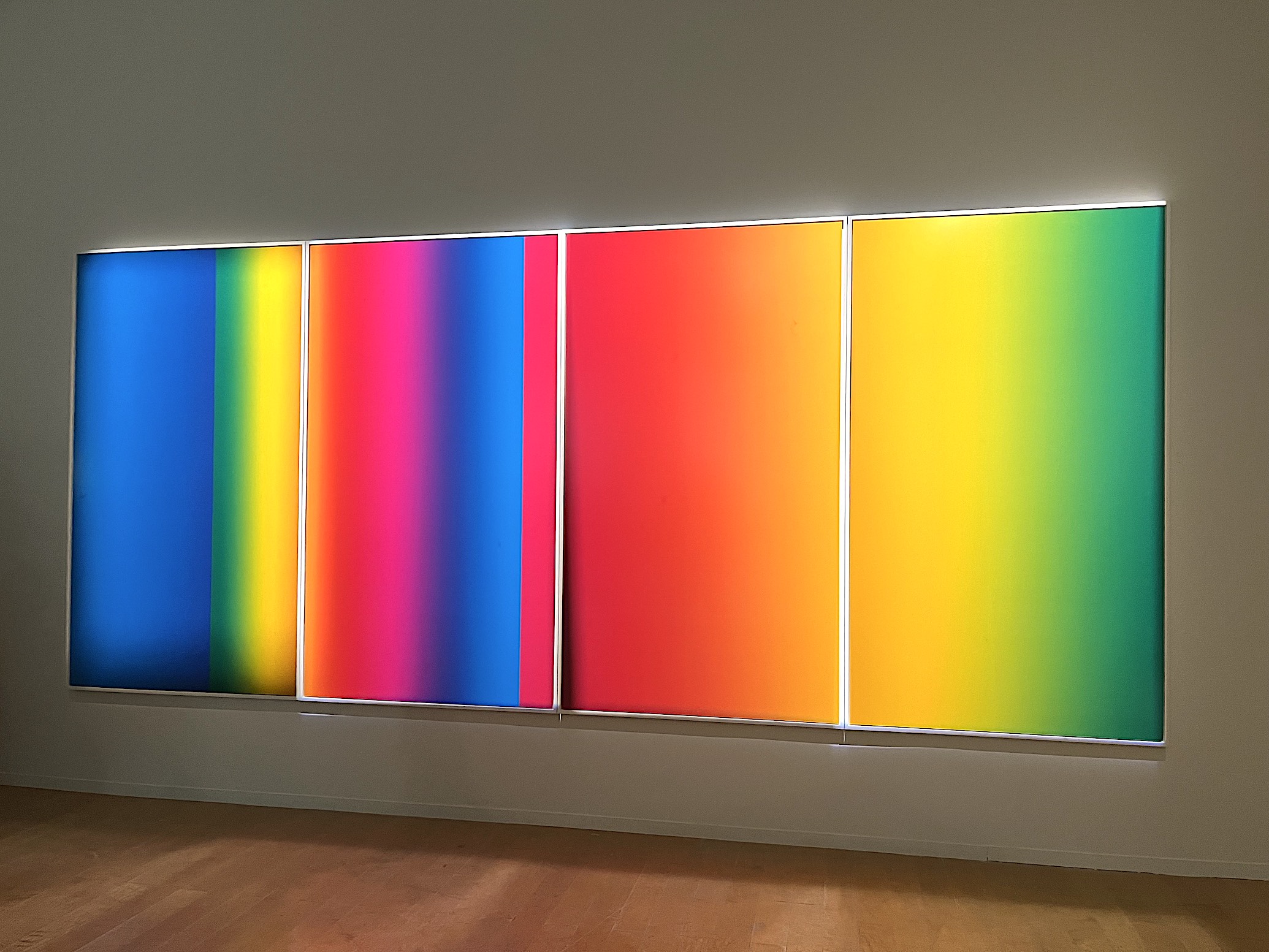
Elsewhere in the exhibition, the digital aesthetic is distilled into a single monumental image in Cory Arcangel’s Photoshop CS: 84 (2020), a large-format C-print that channels the visual language of software into a meditation on abstraction and authorship. Created using default Photoshop gradients, the work transforms a utilitarian graphic interface into a plane of luminous colour fields, recalling the emotional charge of Abstract Expressionism while firmly rooted in digital process. In its fusion of technical constraint and visual poetry, Arcangel’s piece reimagines the screen as a site of aesthetic potential—where algorithm replaces gesture, and the machine becomes a vehicle for quiet introspection.
A New Canon in the Making
In bringing together works that span generations, geographies, and media, the exhibition offers more than a retrospective—it proposes a reframing of digital art as a central current within contemporary practice. Rather than treating technology as a separate or secondary concern, the show reveals it as both material and methodology, embedded in the conceptual foundations of artistic production since the mid-20th century. What emerges is not a singular narrative, but a constellation of practices that reflect the complexities of an increasingly digitized world. As institutions and audiences continue to reassess the place of digital work within art history, this exhibition stands as a timely and necessary contribution—one that asserts digital art not as an outlier, but as a vital force shaping the aesthetic, social, and philosophical questions of our time.
Univers Programmés [Programmed Universes]
Curated by Matthieu Lelievre At MAC Lyon - Musée d'art contemporain
From March 7th 2025 to July 13th 2025
Reviewed by Marlene Corbun
