.svg)
Menu
Our condition is to be born humans. But to be human as an adjective is an effort.
It requires an active commitment to understanding, to listening, to accepting differences — to practicing humility in the face of the plurality of beings and stories that shape this world. Humanity, in this sense, is not a static identity but a continuous exercise.
The 36th Bienal de São Paulo — "Not all Travelers Walk Roads - of Humanity as Practice" - embraces exactly this idea. Inspired by a poem by the Brazilian poet Conceição Evaristo, this edition proposes that some worlds can only be reached through silence, through poetry, and above all through the act of listening. Bringing together 125 artists, mostly from Latin America, Africa, and Asia, many of whom live far from their countries of origin, the Bienal foregrounds relational ways of knowing: ancestral memory, embodied wisdom, oral storytelling, and the intelligence of the senses. Rather than staging identity as topic, it reflects on coexistence, empathy, and the delicate work of dismantling asymmetries so that humanity may be practiced, not presumed.
At the helm of this edition is Bonaventure Soh Bejeng Ndikung, the Cameroonian-born curator, writer, and director of Berlin’s Haus der Kulturen der Welt (HKW). Invited to lead the challenging task of shaping the second-oldest biennial in the world — and one of the most important exhibitions of contemporary art globally — he assembled a team of five co-curators: Alya Sebti, Anna Roberta Goetz, Thiago de Paula Souza, Keyna Eleison and Henriette Gallus. Instead of asking them to represent their regions or areas of academic expertise, Ndikung assigned each a migratory bird route, encouraging them to think beyond national frameworks and toward movements, crossings, and relational geographies. This is why, throughout the exhibition, artists’ countries of origin do not appear as labels of identity; what unites the curatorial team is a shared commitment to artists who generate new narratives, new ways of sensing, and new imaginations for the world.
Within this vast constellation of voices, I was particularly drawn to a group of young artists born from the 1990s onward . For this article, I selected five artists I believe our 100 Collectors community should know: artists who embody the spirit of this Bienal, weaving together ancestry and futurity, vulnerability and strength, the intimate and the planetary.

1 - Ana Raylander Mártis dos Anjos
(São Paulo, Brazil, 1995)
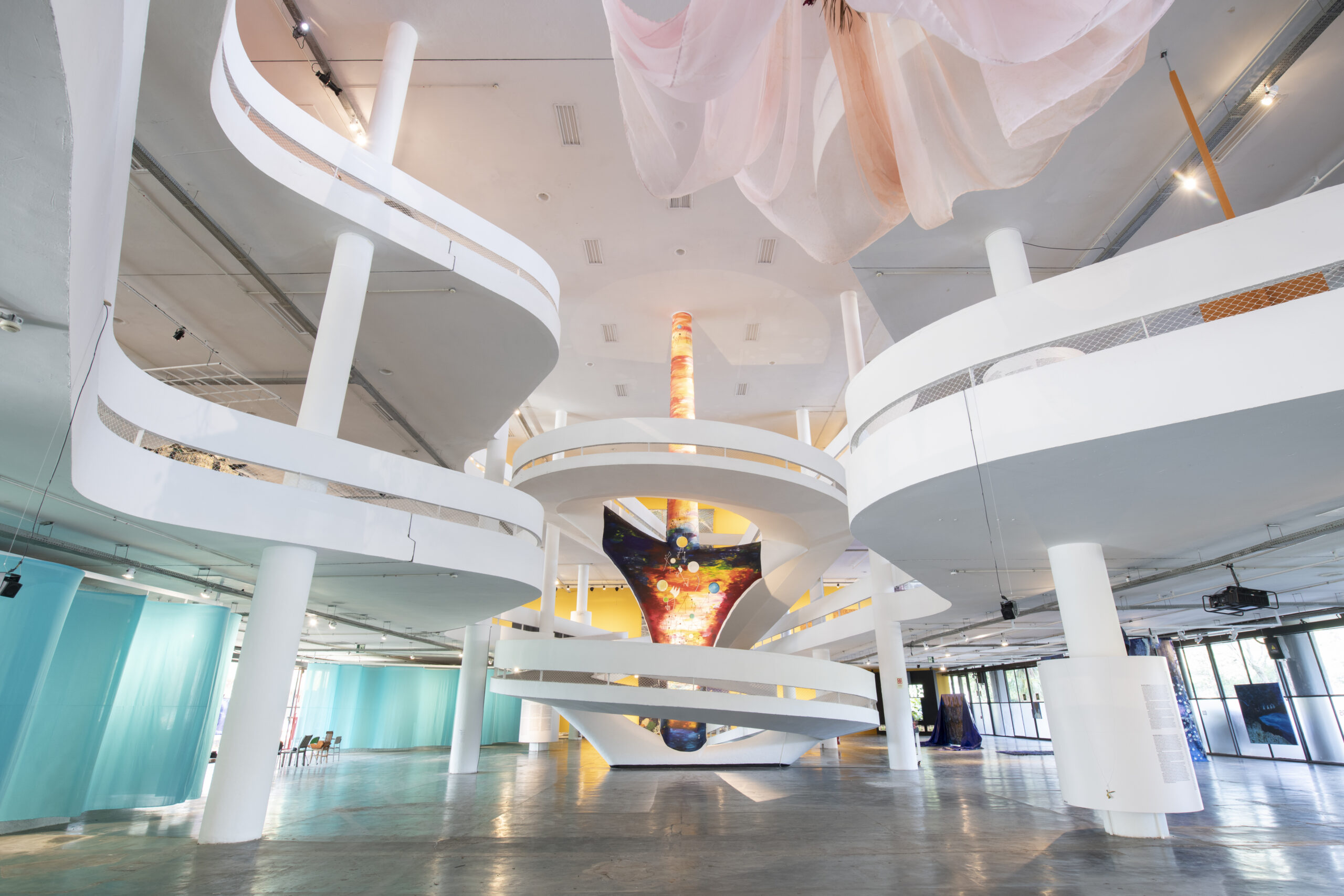
The iconic Bienal Pavilion in São Paulo - designed by Oscar Niemeyer - is celebrated in this edition, with its flows, columns, and ramps becoming integral to the curatorial vision. Ana Raylander Mártis dos Anjos’ installation "A casa de Benê" (2025) amplifies this relationship, drawing even more attention to the building’s architecture.
Stretching across all three floors of the pavilion, the work is anchored by nine monumental columns, each representing one of the artist’s grandfather’s nine children. Rising from the ground floor to the second level, they create a striking visual axis while grounding the project in ideas of lineage and the structures that sustain a family across generations.
Each column is wrapped in over 4,000 pieces of second-hand clothing and textiles, turning everyday garments into carriers of memory. Scattered throughout are objects preserved from her grandfather’s home - he was a craftsman and field worker who built his house with his own hands.
For Ana Raylander - a Black trans woman - intimate and personal histories are as vital as official ones. Her work challenges the narratives that are often silenced or pushed aside, reclaiming them as central. By occupying the pavilion’s central nave with such scale and presence, she asserts these stories as fundamental to how we understand family, heritage, and the world around us.

2 - Ruth Ige
(Ilé-Ifẹ̀, Nigeria, 1992. Lives in Auckland, New Zealand)
The blue paintings of Ruth Ige are, for me, the most arresting works in this Bienal.
Ige moves fluidly between past and present, treating time as a single, shifting ocean. Memory and futurity merge; her figures seem suspended in a continuum where history is not behind us.
One of the most compelling aspects of her presentation is how she expands the very idea of the canvas. Her works are not confined to the stretcher - they unfold across the floor, hang from the ceiling, and appear as architectural elements, as shelters for the body. The paintings become environments, thresholds, and objects - portals into a world built almost entirely in shades of blue.
Blue, for Ige, is ancestry, language, and protection. Her primary reference lies in Nigerian indigo traditions such as the ancient Kano Dye Pits and the Yoruba adire cloth, in which hand-dyed patterns carry stories across generations. Her blues evoke ocean and sky, immensity and introspection, spirituality and transcendence - even subtle echoes of Yves Klein’s monochromes.
Her practice is also grounded in a life shaped by movement - born in Nigeria, raised in Botswana, and coming of age in New Zealand. This geography informs her understanding of Blackness: “it is not local, it is planetary.” Her work confronts the incompleteness of how Black artists have been positioned in art history, reclaiming the Black figure as central, visible, and undeniable.

3 - Pol Taburet
(Paris, France, 1997. Lives and works in Paris)
At only 28 years old, Pol Taburet has developed one of the most singular visual languages in this Bienal. His practice blends silence, ritual, death, religion, and Caribbean cosmologies, drawing from Vodou, horror cinema, trap and hip-hop lyrics, and the syncretic poetics of thinkers like Édouard Glissant.
Taburet’s contribution to the Bienal, "Someone’s Child" (2025), unfolds as a limbo. The floor is covered in earth, the light is cold and white, and the atmosphere feels suspended, as if time were momentarily paused. At the center stands a large earthen form made of mud and polystyrene, anchoring the installation like a body caught between worlds. Around it, bronze sculptures inhabit the room: a series of bird-like figures, perched high on steel masts, watching from above. They hover between guardians and predators - as if deciding whether the central figure will ascend or be condemned.
Taburet is widely known for his paintings, which he formulates using resin, fish skin, and alcohol, applying them with an airbrush to create ghostly, faceless figures. Dressed in formal or ceremonial clothing, they feel both familiar and unsettling. They recall the masked beings from Kubrick’s Eyes Wide Shut: elegantly dressed, perhaps bankers or politicians, yet trapped in a liminal state - you cannot tell whether they are preparing for a banquet or awaiting judgment.
In this installation, everything feels stripped down, enigmatic, and tense: an environment where silence gathers in the corners, and where something sacred - or dangerous - always seems on the verge of emerging.
4 - Helena Uambembe
(Pomfret, South Africa, 1994)
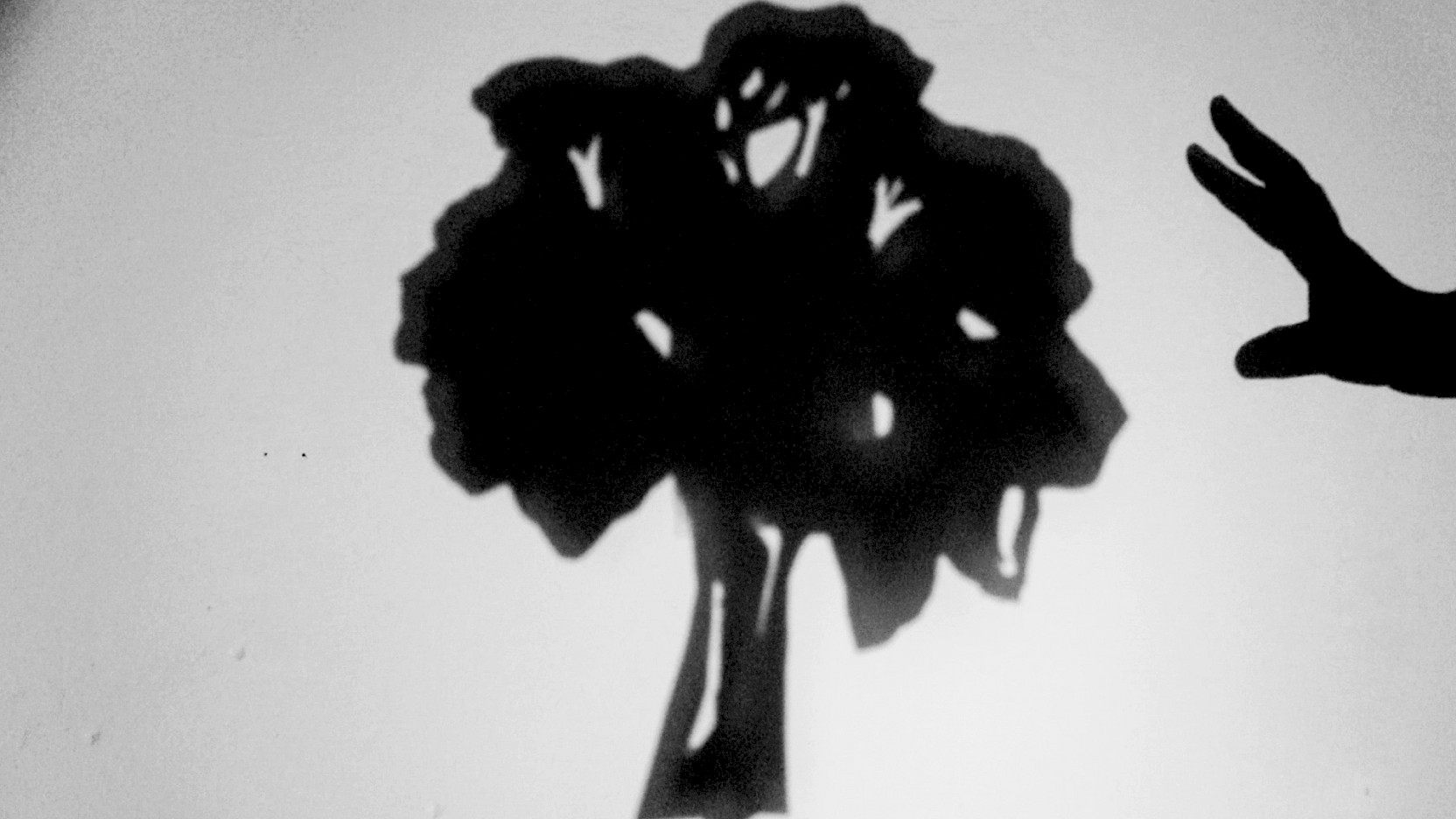
The way Helena Uambembe tells this story is striking: a shadow-theatre projected onto the ceiling of a darkened gallery, where viewers are invited to lie down and look upward. At the center of the narrative are two colossal twin brothers locked in an endless struggle. Their rivalry splits the earth beneath them, casting shadows over the small, fragile creatures who inhabit the space between. These beings - overlooked, unheard, almost invisible - bear the consequences of a conflict that is not theirs.
The work draws from Uambembe’s memories of the Angolan community of Pomfret, a South African outpost marked by the painful legacy of the 32 Battalion: a military unit composed of Black Angolan soldiers but commanded by the white apartheid army. These men did not join by choice, but by the urgencies of survival, displacement, and war. Their story remains largely unrecognized - Angolans who fought for a regime that denied them citizenship, later rejected both in South Africa and in Angola. Her father was one of them.
Uambembe transforms this history into a space of metaphor and myth-making. The installation also gestures toward mirroring landscapes - a poetic retelling of the separation between Rio de Janeiro’s Sugarloaf Mountain and Angola’s Morro do Moco, the homeland her parents were forced to leave. Two continents once imagined as connected, now split apart.
Drawing from African traditions of oral storytelling, shadow play, and masquerade, Uambembe re-enacts pain without sensationalizing it. The mythic becomes a vessel for lived history, opening space to reflect on inheritance, exile, and the fragile reconstruction of identity across fractured landscapes.
5 - Antonio Társis
(Salvador, 1995. Lives between Salvador and London)
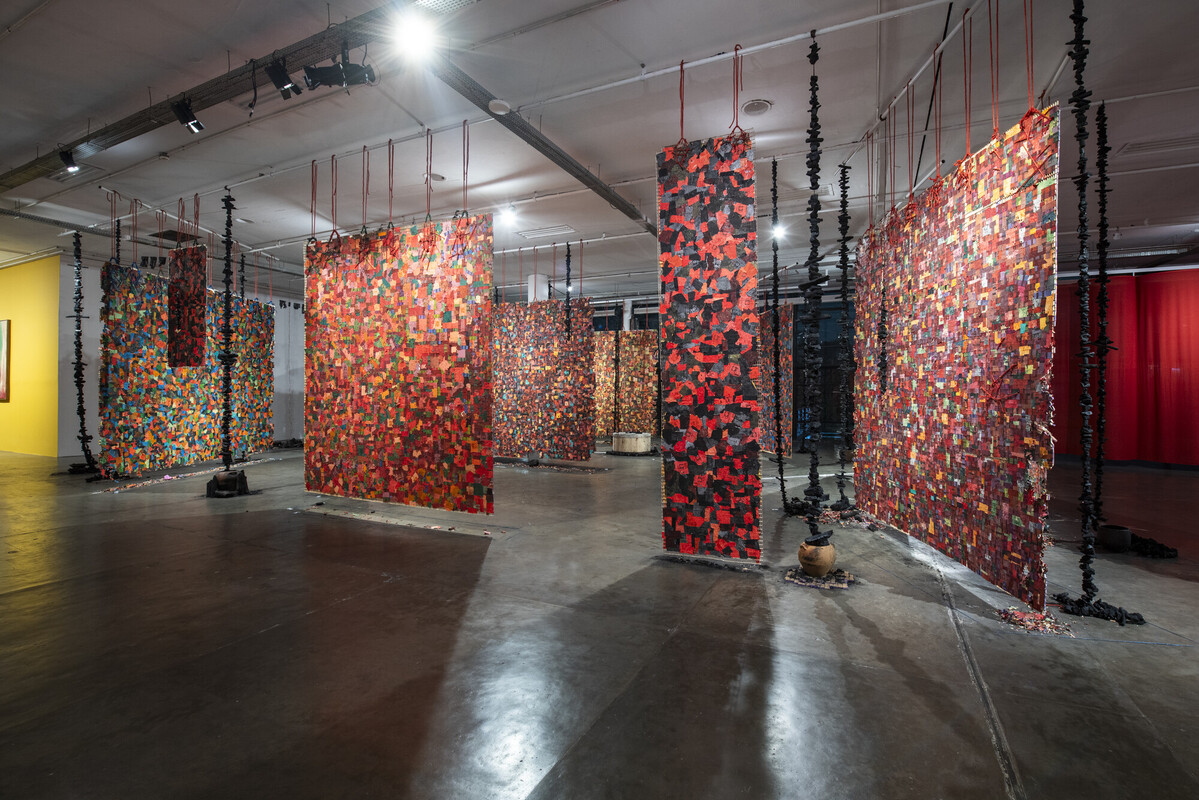
The work of Antonio Társis is deeply shaped by his circumstances. Growing up in a community in Salvador with little access to art materials, he began collecting what the city offered: discarded matchboxes found along his daily routes. Their shifting tones - altered by sun, rain, and time - revealed a palette he could claim as his own. From these modest fragments, he developed a meticulous, conceptual practice anchored in transformation.
In the installation "Vista de Catástrofe Orquestra #1", the matchbox becomes a potent metaphor, evoking the informal economies of Brazilian streets; the small gestures that sustain life — lighting, cooking, burning; and the invisible manual labor that echoes Black and peripheral histories. A match holds the potential for combustion: energy about to ignite, a metaphor for social and racial tension. Fire is double-edged — it illuminates, but it also destroys. In a broader historical sense, it reflects the ambivalence of modernity: the “civilizing” flame that simultaneously burns bodies and territories.
Coal, too, plays a symbolic role. It is what remains after fire - residue, scar, memory of heat. It speaks to what survives destruction, to what refuses to disappear. Coal also evokes skin, the Black body, mining, and forced labor - a material bearing historical and racial weight.
The installation is completed by sound activations: the granular noise of falling coal and the pulse of African drums marking the rhythms of life and labor. Together, they form a kind of symphony: one that evokes the Amazon, its rumbling warnings, and the cries the forest sends back to us.
36th Bienal de São Paulo
"Not all Travellers Walk Roads - Of Humanity as Practice"
Parque Ibirapuera, São Paulo, Brazil
September 6, 2025 - January 11, 2026
Click to see the 36th Bienal de São Paulo website: https://36.bienal.org.br/en/
Read the 36th Bienal de São Paulo catalog, with full list of artists, artworks and curatorial texts:
https://36.bienal.org.br/en/publicacao/catalog/
Find here another rich publication with texts related to the curatorial narrative:
https://36.bienal.org.br/en/publicacao/reader/
