.svg)
Menu
In the dark, shoes left at the entrance, with a single light bulb, high up, swaying gently, and nothing but sound and vibrations, a feeling of constant terror, relentless excessive noise, not a moment to breathe, to exist.
A few weeks ago, I found myself in the immersive installation of Julian Charrière, “Black Smoker,” at the Museum Tinguely in Basel. The last room of his “Midnight Zone” exhibition contained field recordings that he had recorded near deep-sea volcanoes while the space vibrated. But to me, it was something else. I guess it is because I just finished a training on Blue Ecologies by the Institute for Postnatural Studies (that I recommend with all my heart!), so my entire self was sensitive to the impact of the Anthropocene on deep seas. To me, it felt like I experienced what living creatures on the ocean floor experience every day since we decided that exploiting the ocean was easier than changing the way we produce energy and technologies.
In the distance, the sound of water, of aquatic movements, of a few aquatic species. But even more, the mechanical sounds took on an exaggerated importance, shrill or heavy, echoing, repetitive, or random. Every sound was linked to a physical vibration, creating a strong effect on my body, my ears, and my skin. It felt like a scream. A scream from the deep sea, from machines, from whales, and from submarine creatures. It felt like a post-natural scream, everything intertwined.

Seeing the world as binary doesn’t work anymore. There is no more natural vs. artificial, human vs. machine, or organic vs. digital. We are surrounded by aliens, queerness, and zeros.
The term “post-natural” can be slippery. It doesn’t mean the end of nature. It doesn’t mean it is not “natural.” It means that we recognize that what we call nature has always been cultural, technical, and transformed. Forests are shaped by ancestral agriculture. Rivers are redirected by dams. Species are altered by data and desire.
Brazilian Indigenous thinker Ailton Krenak says we must dream with the planet—to hear the stories of the rivers, the trees, and the stones. We should explore different understandings of the worlds that coexist without eliminating others, without competing or disputing, as we see in the modern world. “Life is a cosmic dance,” as Ailton Krenak said. But what if today some of these stories now come through sensors? Through AI? Through images generated from datasets?
To develop a post-natural sensibility is to accept that the “natural” has already been mediated and to stay with this entanglement rather than deny it.
A post-natural sensibility is, perhaps, nothing more than a willingness to notice new relationships. Between species. Between systems. Between dreams and data.

In World Upstream, Cezar Mocan invites us to enter a gamified simulation of a world where sentient machines coexist within a disused dam site, enjoying an eternal picnic and a life of leisure. In this world, a living vacuum cleaner and a wise poplar tree live a daily life that is both absurd and moving. In this reality, Cezar Mocan presents a technology that does not dominate, that is not in opposition to “nature,” but lives with it. It is humorous. Poetic. Post-human.
At the end, it is all about relation. Today, artists are mapping this new terrain through code, sound, motion, and simulation.

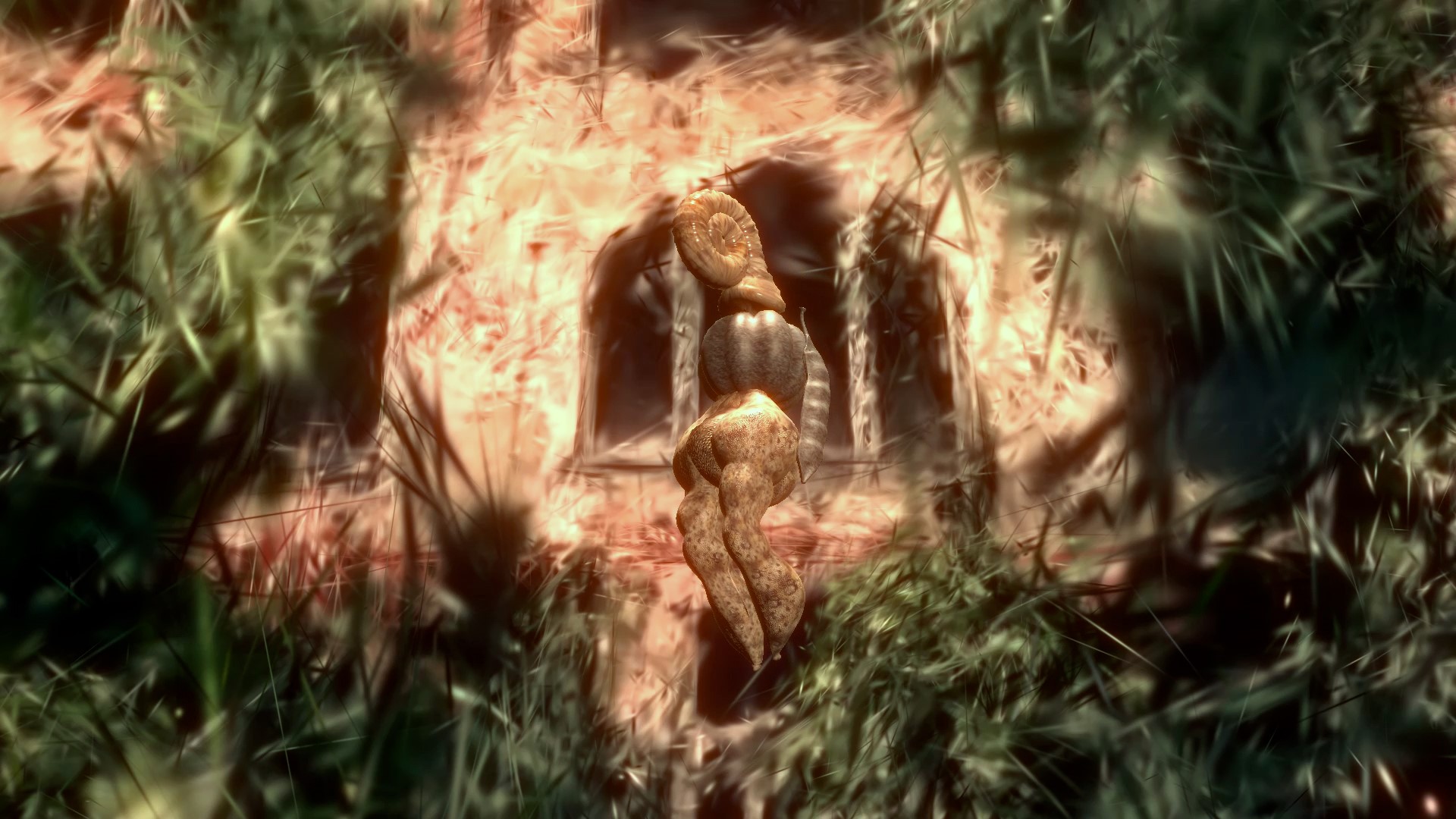
In Artificial Natural History, Sofia Crespo transforms biological archive data into non-terrestrial marine creatures. These speculative organisms are born through neural networks as machine interpretations of marine species. The question here is whether we are looking at pure inventions or at future post-natural species’s archives.
With Seed Wisdom, Anke Schiemann gives voice to seeds and the memory of plants through dance, rituals, and recipes. She listens to the stories that plants have to tell us, across centuries and seasons. She listens to plants that are subjected to the pressures of industrialized agriculture, yield requirements, and species conformity. Those that have been modified, stressed, or exposed to toxic substances. Does the very concept of natural seeds exist today?
With Wonderland II (Beijing Sunrise), Peter Wu+ presents a meditative and contemplative video of a sunset on a screen that reacts to real-time environmental data from Beijing: pollution, traffic, and air quality. What we consider commonplace, everyday, a setting sun, is in fact questioned. Is it an artificial, synthetic video of the sun? Or has the sun, too, become post-natural in our eyes?
These artists don’t critique or call for nostalgia; they invite us to see things differently, to embrace new imaginaries. They imagine a positive future, a future where the post-natural sensitivity is experienced on a daily basis.

Click here to read the previous article of the "World Becoming" series written by Diane Drubay for 100 Collectors.