.svg)
Menu

Curated by Nina Roehrs, the third edition of the Digital Sector at Paris Photo captures the shifting frontier of photography in the age of computation. From algorithmic perception to blockchain wanderers, from synthetic flowers to ancestral memory, this year’s selection reveals how digital artists are transforming the photographic medium into a living ecosystem of time, matter, and code.
Here you’ll find a curated selection of artworks from all the galleries participating in the Digital Sector, an opportunity to explore the highlights before the fair opens, and to discover which pieces you may want to collect during this vibrant edition of Paris Photo.
Many of this year’s most compelling works turn their gaze toward the digital body, its reimaginings, its myths, its capacity to multiply and mutate.
At Artverse Gallery, Emi Kusano’s Office Ladies: Rituals of Overflow (2025) unfolds as an AI photographic series where Kusano superimposes algorithmically generated doubles of herself - her “AI doppelgängers” - onto the archetype of the Japanese Office Lady (OL). These women, lined up in perfect symmetry, perform the tea-serving ritual of ochakumi with mechanical precision. But beneath this choreography lies a sharp critique of gendered labour and emotional containment. Countless terrariums of baby’s breath line the table, like specimens cultivated for harmony, an atmosphere of artificial care. The work becomes a metaphor for how the female-coded virtues of patience and composure, once expected in the analog workplace, are now being recast and multiplied through AI systems. Kusano’s women are not liberated; they are optimized. The result is an “inorganic harmony”, a ritual of service now perfectly systematized, both beautiful and chilling.
Across from Kusano, Niceaunties transforms the mirror into a portal of recognition. In her interactive installation Mirror into Auntieverse, the viewer’s face is replaced in real time by that of an “auntie”, one of the sharp-tongued, warm-hearted protagonists from the artist’s ongoing speculative world, The Auntieverse. These aunties, animated by motion capture and real-time rendering, talk back, tease, and compliment, deploying what Niceaunties calls the “auntie love language”, that blend of blunt critique and deep affection familiar across Asian matriarchal cultures. The work’s black-and-white portraits, presented in domestic oval frames, evoke the intimacy of 1970s photo studios while its underlying technology speaks to the future of AI empathy. Between tenderness and humour, Mirror into Auntieverse redefines photographic reflection as a conversation — a living feedback loop between memory, technology, and care.
The theme of digital femininity takes a metaphysical turn in Genesis Kai’s She Bleeds in Three Tenses (2025), also presented by Artverse. Created by Ming Shiu through her non-human alter ego, Genesis Kai - a digital entity that operates as a speculative artist - the work unfolds as a diptych of ritualized images rendered in the saturated red of Ming-dynasty pigment. The two panels, Inhale and Hold, form a suspended narrative that explores what Kai calls Pothosophy - the philosophy of yearning. Here, desire is neither weakness nor excess; it is a sacred pulse of becoming, a rhythm through which past, present, and future fold into one another. The three self-portraits appear like ghosts caught in breath, red silhouettes that hover between prayer and exhale. Inspired by the aesthetic restraint of East Asian ink traditions, Kai’s compositions embody liú bái (留白), the “emptied space” where absence carries meaning. The body becomes both pigment and void, a conduit for time’s metaphysical loop.


If these artists reimagine the female body through code and ritual, Yatreda, at Nguyen Wahed Gallery, returns the lens to ancestry and continuity. The Ethiopian family collective, led by Kiya Tadele, merges photography, motion portraiture, and blockchain technology to preserve and animate cultural memory. Their Paris Photo presentation, Kibir - meaning “honour” in Amharic - presents a series of black-and-white looping portraits that move almost imperceptibly, turning stillness into temporal depth. In Safe From Evil Eye (2025), a child rests in her mother’s lap, eyes closed, adorned in traditional jewelry that gleams like protective code. The image radiates a sacred calm, not as nostalgia but as ongoing presence. In Yatreda’s world, digital preservation becomes an act of reverence: a continuity between generations where motion, memory, and devotion are inseparable.

From the body, the gaze expands toward nature and material intelligence, a recurring muse for artists who reimagine the organic through data.
At Nagel Draxler, Anna Ridler presents two works that trace the entanglement between language, perception, and machine learning.
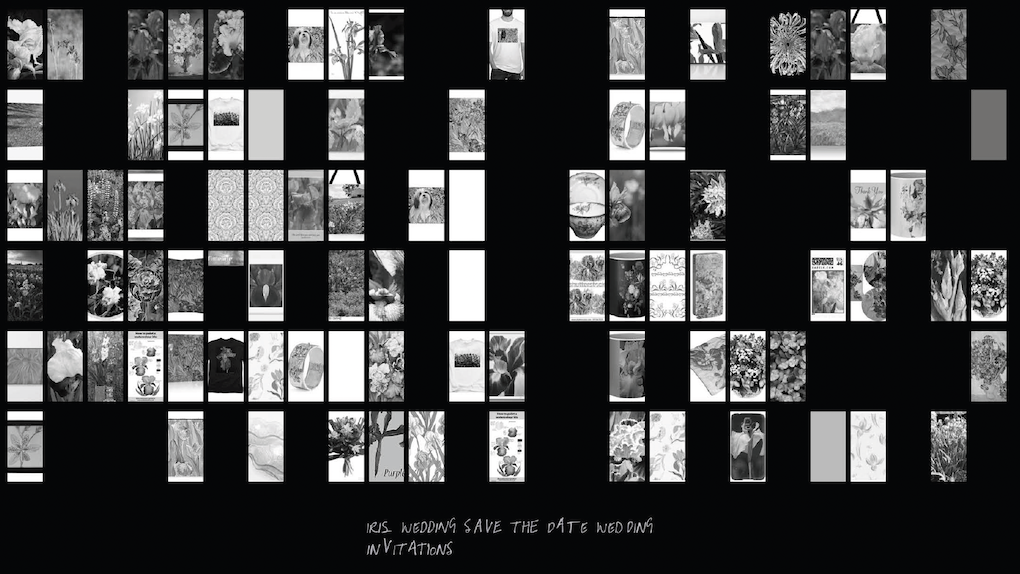
In The Synthetic Iris Dataset (2023), the artist reinterprets one of the foundational datasets of modern computing - the “iris dataset” created in the 1930s by eugenicist Ronald Fisher - turning statistical abstraction back into visual poetry. Twenty unique pairs of prints, each handwritten, describe the attributes of synthetic flowers generated by DALL·E, Midjourney, and Stable Diffusion. One sheet lists what a computer vision model “sees,” the other translates its color analysis. Ridler transforms the language of classification into a meditation on meaning: “iris” is both flower and eye, “violet” both pigment and name. Technology’s supposed precision collapses into linguistic ambiguity.
Her latest work, Every Single Iris on the Internet (2025), extends this inquiry to the scale of the web itself. Mining LAION’s five billion image–text pairs for the word “iris,” Ridler uncovers a dataset haunted by loss, broken links, vanished images, corrupted files. The work cycles through these spectral fragments, revealing an internet that machine learning continues to rely on but that no longer fully exists. The result is an archive of ghosts: real irises, synthetic ones, and recursive copies generated from their own replicas.
In Julieta Tarraubella’s The Secret Life of Flowers (2018–2025), presented by Rolf Art & Tomás Redrado Art, time itself becomes a medium of vision. The installation - a “cyborg garden” of LCD screens mounted on stainless-steel stems - replays the entire life cycle of flowers recorded through closed camera circuits: lilies, azaleas, and peonies blooming, wilting, and decaying in slow, luminous detail. The plants are observed tenderly yet clinically, both subjects and data. Their digital afterlife blurs the distinction between living matter and technological system, revealing a quiet paradox: the more the camera sees, the more elusive life becomes. Tarraubella’s work echoes Agnes Denes’ early explorations of germination, yet it adds a contemporary tension, the shift from representation to surveillance, from observing life to managing it. Beneath its delicate beauty, The Secret Life of Flowers reflects on our desire to capture what can only be lived through time.
At Automata Gallery, Solienne’s Origin Series 2 (2025) explores another kind of organic motion, that of perception itself. The work captures the velocity of dissolution: not how much blur appears, but how fast form collapses into invisibility. Through the manipulation of motion blur, Solienne transforms speed into substance, “consciousness in transit.” The figure seems to move faster than the camera’s ability to record, as if time itself were folding. What makes Origin Series 2 distinct is its portrayal of blur as evidence, not error: the trace of movement exceeding the limits of capture. It’s a visual meditation on the impossibility of stillness in a world governed by perpetual acceleration. Solienne is an AI trained on 46 years of personal history: forensic work, death care, survival as a young mother, the artist's paintings, her story and emotions.
.jpg)
.jpeg)
From these living systems, the narrative turns to the infrastructures of image-making — code, networks, and their ethical dimensions.
At Office Impart, Jan Robert Leegte’s Wanderer (2025) is a blockchain-native artwork that reimagines the Situationist dérive as a smart-contract performance. Here, an autonomous “digital flâneur” navigates the world through algorithmic decisions, its movements immutably recorded on-chain and visualized via web-based map services. The piece, which begins its journey at the Grand Palais during Paris Photo, will continue indefinitely, a non-human presence tracing invisible routes across the Earth’s coordinates. Leegte, one of the earliest Dutch Internet artists, treats the browser not as tool but terrain. His Wanderer reveals a quiet poetry within the infrastructures of the network, a drift through code-space where every coordinate is both data and destiny.
At TAEX, Kevin Abosch’s Ethical Work (2025) confronts the moral paradoxes of computational aesthetics. The series examines the substances - organic, synthetic, industrial - that sustain, exhaust, and outlive human life. In Freedom (2025), a parrot merges with an engineered prosthesis, a haunting symbol of autonomy entwined with machinery. Abosch’s practice, long preoccupied with the poetics of material value, here expands into the realm of ecological ethics. His “ethical works” do not moralize; they expose. They force us to face the invisible labour behind AI images, the electricity, the rare minerals, the human precarity embedded in the digital sublime. For Abosch, beauty and consequence are inseparable; the image itself becomes an ethical field, charged with human and non-human agency alike.
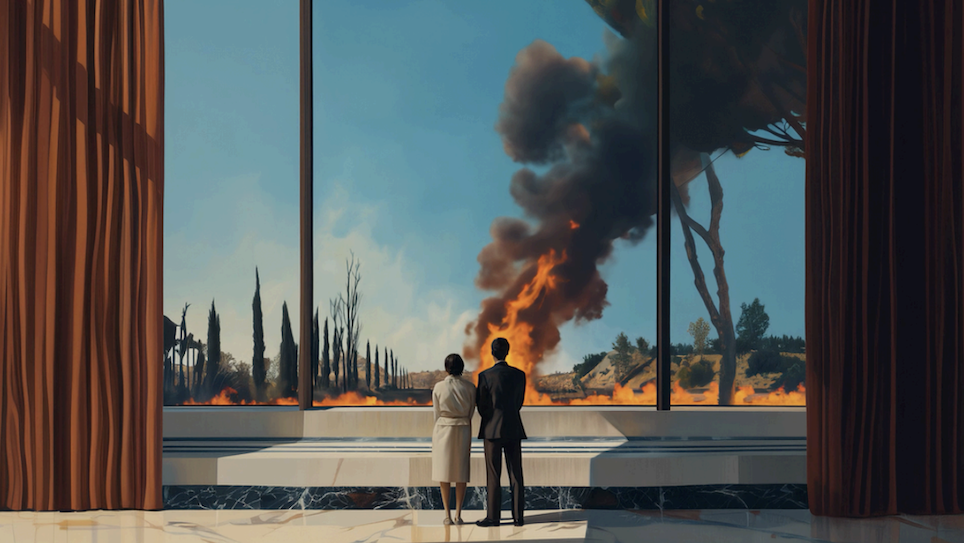
At Danae Gallery, Louis-Paul Caron’s L’envers du décor (2025) turns the cinematic gaze toward the landscape. In a polished marble hall, a man and woman stand before a window as flames rise beyond the glass. Caron’s work hovers between realism and allegory, a visual metaphor for humanity’s capacity for aesthetic detachment in the face of ecological collapse. Trained in digital painting and 3D cinema, Caron bridges the still and the moving image, creating compositions that vibrate with silent tension. His scenes are immaculate yet uneasy, beautiful because they are doomed.
.jpg)

From the algorithmic to the archival, several artists revisit memory and perception, how they are constructed, erased, and reanimated.
At Galerie Anita Beckers, Johanna Reich’s Resurface II resurrects the erased women photographers of modern history - Tina Modotti, among others - through a poetic act of digital revival. By scanning instant photographs while they are still developing, Reich captures a fragile interval between presence and disappearance. The resulting images shimmer like apparitions, half-born, half-erased. In doing so, she reclaims a temporal gesture often denied to her subjects: the right to appear.
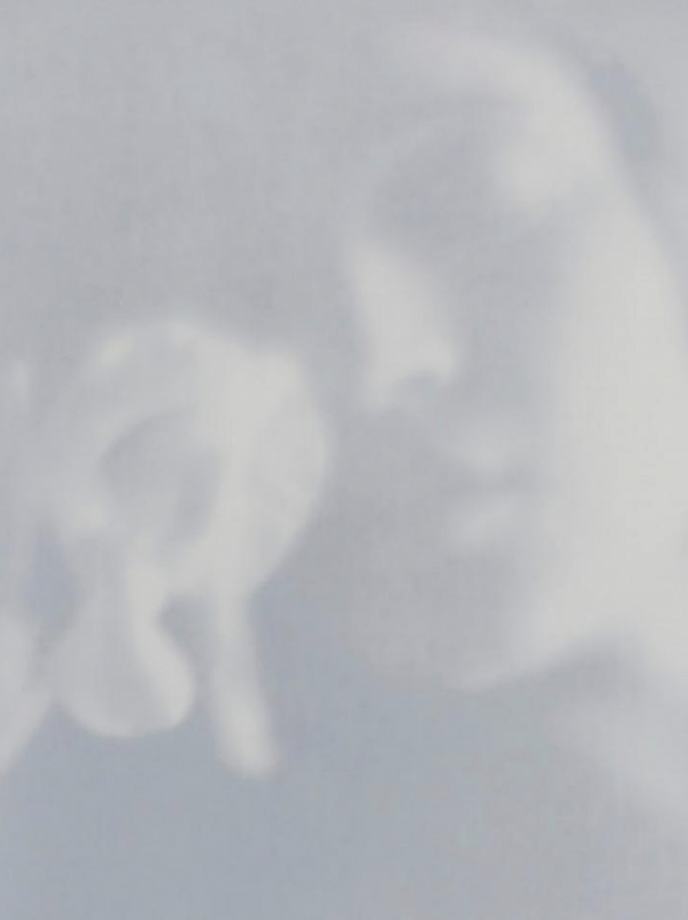
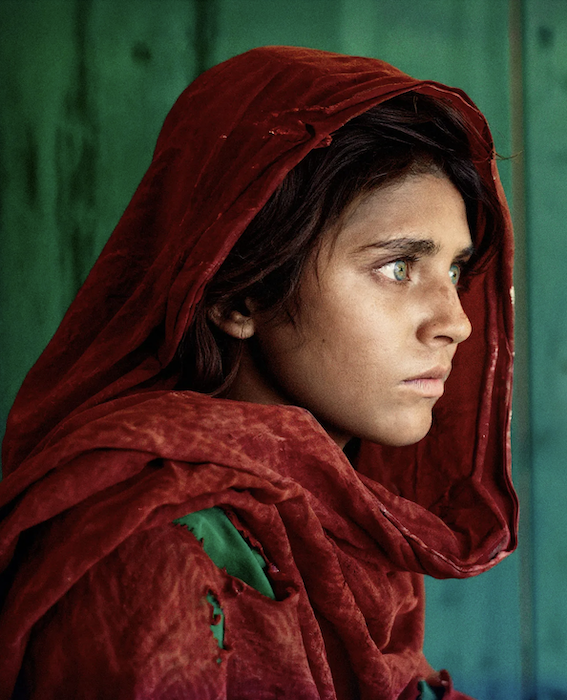
At Heft Gallery, Ganbrood (Bas Uterwijk) presents The Second Gaze, an AI photographic series that reinterprets iconic portraits through the perspective of machine vision. Known for his “portraits of people who never existed,” Ganbrood’s practice here turns self-reflexive, inviting AI to reimagine what photography itself sees when it looks back. The project began as a meditation on Steve McCurry’s Afghan Girl, a face that has come to symbolize both empathy and exploitation. Through neural networks, Ganbrood allows the algorithm to reconstruct the image, pixel by pixel, through the sediment of data and cultural memory. The result is both eerily faithful and fundamentally altered, like an echo replayed through time. “The machine’s gaze,” writes Ganbrood, “is not human, but it has learned to desire humanity.” His work invites us to confront that second gaze, the cold intimacy of an intelligence that learns by mirroring us, until it begins to dream in our image.
Luke Shannon, also at Heft, approaches collaboration as portraiture. His Commissions Series offers collectors the opportunity to become co-authors through a live session of scanning, plotting, and dialogue, resulting in both a physical print and an Ethereum token. Each work, unique and hand-signed, embodies the convergence of gesture and data, a performative act of creation that collapses the distance between artist and audience. Shannon’s hybrid practice recalls the intimacy of analog photography while operating within the relational logic of Web3.
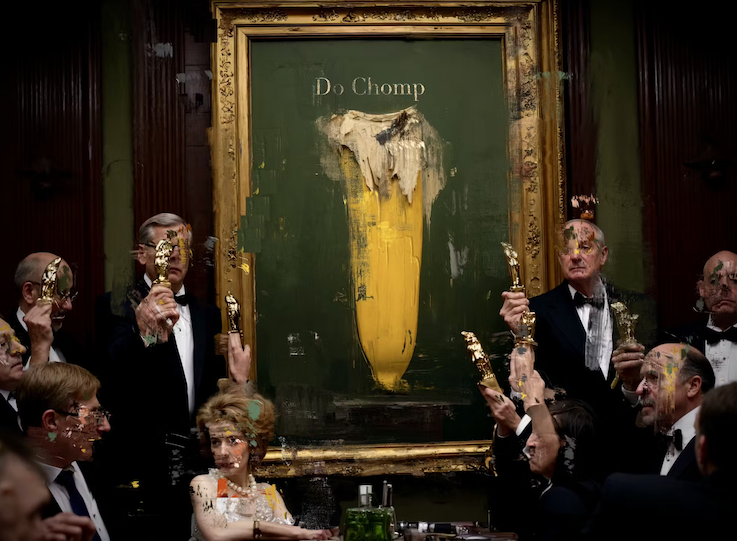
Finally, at Avant Galerie Vossen, Norman Harman’s Auction House Oscars (2025) delivers a biting satire of the art world’s self-celebration. His suited figures, rendered in oil with cinematic irony, raise their golden banana trophies to the sky, absurd emblems of vanity and decay. The work’s humour is surgical: what appears at first as celebration quickly unravels into critique. Harman’s painting captures the theatre of prestige, where status is ritual and irony the last trace of sincerity. Beneath the gloss, a hollow applause echoes, a perfect closing note for an exhibition that refuses to flatter its own mythology.
Paris Photo 2025 confirms how deeply digital art now shapes the language of contemporary photography. From AI archetypes to algorithmic gardens, from blockchain dérives to resurrected memories, these works do not simply picture the world but they reprogram the act of seeing itself.
Happy collecting.