.svg)
Menu
The last two weeks were another highlight of the year. Frieze London and Art Basel Paris took place within a two-week period. Each of these two fairs is surrounded by smaller side fairs. In Paris, we visited Asia Now, The Salon by NADA and The Community, as well as the Paris International.
In London, we discovered the paintings of Emily Kraus. The artist had a very small studio during her studies, but since she wanted to create large-scale paintings, she had to find a technique that would allow her to do so. She built a construct that allowed her to work in sections, similar to a printer. That's why the rhythms are evident in her paintings. It is, so to speak, a manual technique inspired by a digital model.

Emily Kraus
A Murmuration of Twenty-Eight Blackbirds (V), 2024
Oil on canvas
290 x 512 cm
Represented by The Sunday Painter, London
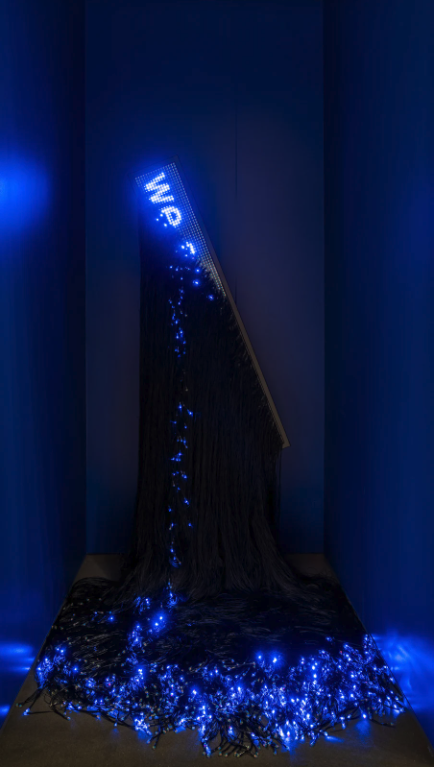
One of the few female digital artists we have discovered is Doki Kim from South Korea. Doki Kim takes a profound interest in the various layers of the world, including space and nature, society and culture, matter and energy, and time and space. Using immaterial media such as light, heat, gravity, and language, she creates works that explore the 'phenomena' that occur in the interaction of matter. Continually questioning 'what' we are and 'how' we exist, Kim's work is scientific, philosophical, sometimes poetic, and shamanic. Through her multi-media installations that operate in various ways, the artist invites viewers to open their senses and engage as a passionate interpreter of her work.
Doki Kim
Blue Hour, 2023
Led display, electric wire, speaker, video 5 min., looped
dimension variable
Represented by Gallery Baton, Seoul
Another digital artist is Jenna Sutela. In her work electromagnetic waves permeate our surroundings and our very being, unrestrained by flesh, bone, or spatial boundaries. Sutela describes her works 4 Hz and 40 Hz as neuroactive sculptures. Consisting of blown glass and programmable LEDs, the works embody the electrophysiological foundations of delta and gamma waves. Governed by unique light programs, the glass heads pulse within frequency ranges corresponding to the electrical oscillations normally present in the human brain while sleeping (4 Hz) or perceiving and remembering (40 Hz). Channeling the esoteric roots of electric and light therapies, the sculptures work to induce open, boundless forms of existence part and parcel of the wider environment.
The sculptures are part of a cycle of works originating in Sutela’s commission for Biennale de l'Image en Mouvement 2024 at CAC Genève. Another work in the series is currently presented at Kunsthalle Bremen as part of the Pauli-Preis 2024 exhibition.

Jenna Sutela
4 Hz, 2024
blown glass, LEDs, microprocessors, wiring
160×32×45cm
Represented by Temnikova & Kasela, Tallinn
In Paris, we discovered Peter Kogler at the Galerie Mitterand. Peter Kogler has unwearyingly over the past 20 years offered different versions of the recurrent themes of ants, brains, globes, light bulbs and other interlaces that map out a mental landscape. He was one of the pioneers of computer-assisted work and continues to use it in a bi and tridimensional way so to underline as many social metaphors. Peter Kogler comes under the influence of American minimalist artists. He was honored in the category Computergraphique for work "Untitled I" by the jury of the Prix Ars Electronica.

Peter Kogler
Untitled (Brain), 2023
Flightcase avec projecteur holographique, lumières RGB-LED, impressions, câble, plateau roulant
H 90 x 71,4 x 110 cm
H 35 3/8 x 28 1/8 x 43 1/4 in
Unique
Represented by Galerie Mitterand, Paris
The David Kordanksy Gallery in Los Angeles represents the Chinese artist Guan Xiao. Guan Xiao (b. 1983, Chongqing, China) takes a playful approach to her sculpture, video, and installation artworks. She creates a visual language that breaks through historical and cultural boundaries by establishing diverse relationships between a variety of rich materials, and using collage to blend classical art with industrial manufacturing to build a unique form of contemporary art. She often juxtaposes physical objects—such as industrial products and cultural artifacts — alongside images amassed from scrolling through the infinite universe of desktop and laptop screens. Her works generate cohesive textures between binaries sourced from contrasting and even conflicting worlds, and fuse old and modern, digital and analogue, and natural and artificial modes. Attuned to both possibilities and looming hazards, Guan Xiao’s prescient and fascinating arrangements critique the technological thrust of the present moment while providing indelible visions of our dislocated, rapidly approaching future.

Guan Xiao
Slumbering knights standing, 2024
brass, aluminum, and acrylic
74 3/8 x 28 3/8 x 36 1/4 inches
(189 x 72 x 92 cm)
unique in a series of 3
Represented by David Kordansky Gallery
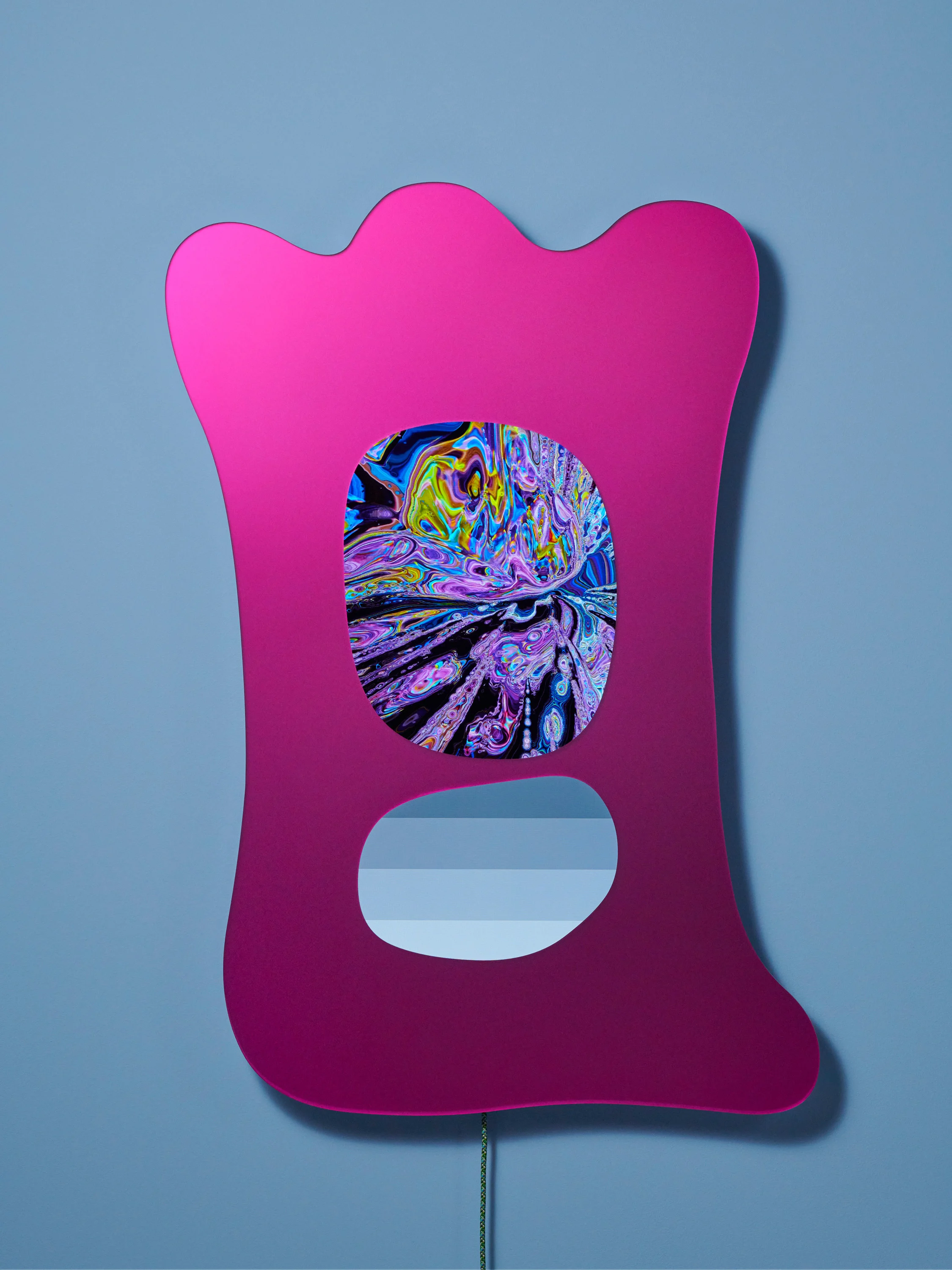
It was also a great pleasure to see the pioneer of digital art from Switzerland, Pippilotti Rist, with new works. In her work, she combines sculpture with digital media.
Pipilotti Rist
Slimy Slouchy Century, 2024
Video installation, vertical flatscreens, in sanded purple acrylic glass on mirror frame, integrated video player, silent
Duration: 9 minutes, 39 seconds
Unique 46 x 32 inches
(116.8 x 81.3 cm) (C37706)
$ 180,000.00
Represented by Luhring Augustine, New York
As the name suggests, the Asia Now fair focuses on art from the Asian region. Unfortunately, we did not discover any exciting digital artworks at the fair, which is why we have decided to introduce the artist Etsu Egami. She paints in single strokes. Each line is drawn only once.

Etsu Egami
You Are Beautiful, 2023
Öl auf Leinwand
107 x 199 cm
USD 31’000
Plus applicable taxes
Represented by Galerie Kornfeld, Berlin und Chambers Fine Arts, New York
Qualeasha Wood’s latest investigations into digital Black womanhood lead her to the relationship between artificial intelligence and perceptions of the black femme self. AI-engineered face and body filters encoded into Instagram, Snapchat, TikTok, et al are far more intensely transformative than their predecessors. Lead by a myth of neutrality - a myth the tech bros cum overlords tell themselves over and over about the character of the systems they develop - the digital tools that alter bodies on social media surreptitiously and instantaneously impose Eurocentric beauty ideals upon us in overbearing ways.

Qualeasha Wood
Swag Surfin, 2023
Woven Jacquard, Glass Beads 84 x 56 inches
Represented by Kendra Jayne Patrick, Berne
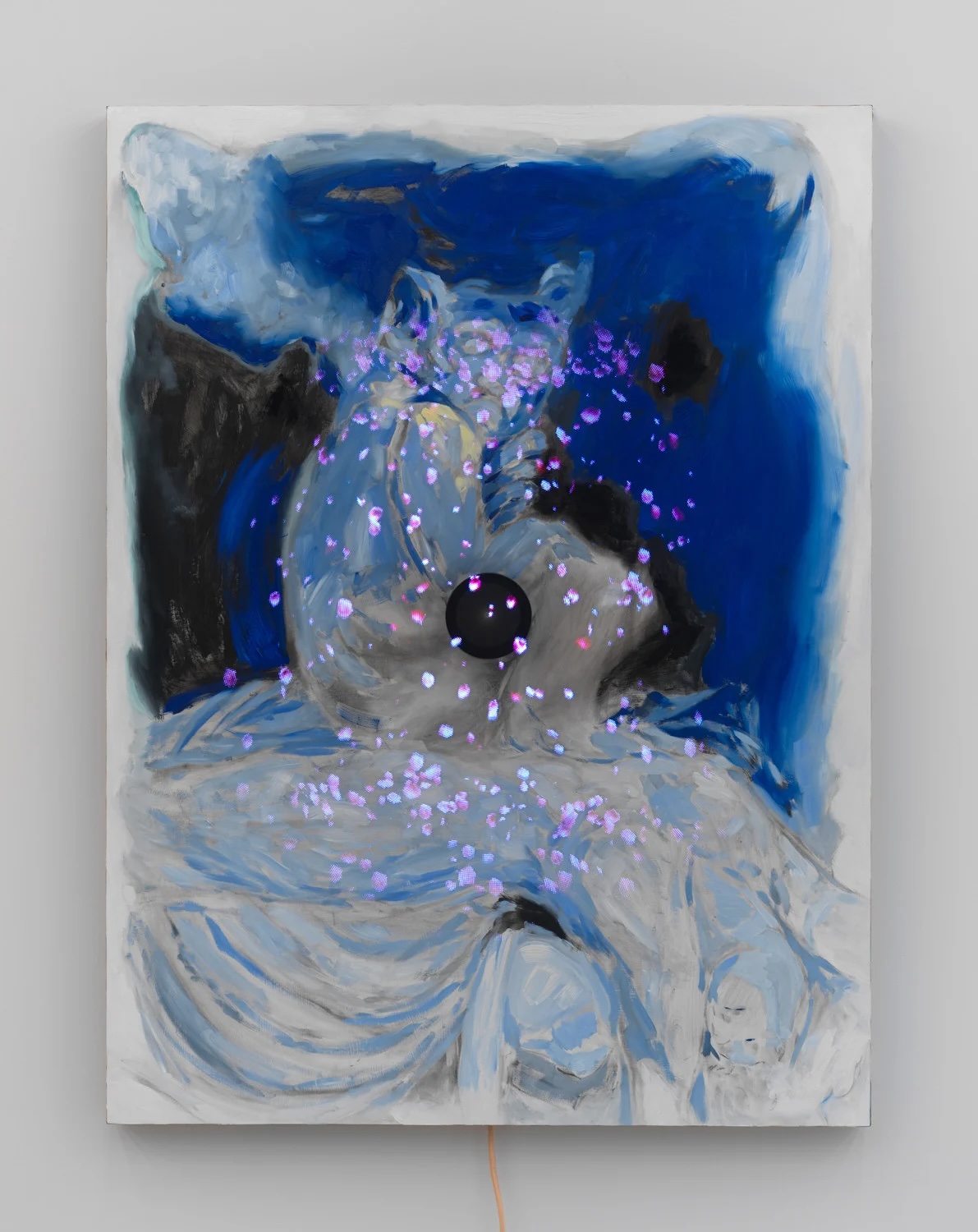
We discovered a pioneer who combines classical painting with digital media at Magenta Plains. Her name is Rachelo Rossin. This new series of hologram paintings explores the intricate relationship between technology and human cognition. Drawing inspiration from Henry Fuseli’s iconic painting, "The Nightmare,"–which Rachel references in her use of the mare and the imp, the artist delves into themes of sleep paralysis, where consciousness awakens while the body remains ensnared in the stillness of REM atonia. This juxtaposition reflects on our own encounters with technology. Through vibrant visual symbols like the Monrovian Star and the hurricane, Rachel invites viewers to reflect on the profound impact of rapid technological advancement.
Rachel Rossin
Mare with Zoetrope (After Henry Fuseli), 2024
Embedded holographic display, animated zoetrope video, cloth-covered cord, charcoal, acrylic airbrush and oil on birch wood panel
48 x 36 x 5 in.
121.9 x 91.4 x 12.7 cm.
13 min 17 sec (RR_080)
(Image 1/3)
Represented by Magenta Plains, New York
The Paris International Art Fair focuses on emerging art. We also found little digital among the emerging artists, which is why we decided to recommend a classic painter. Lisa Jo composes her works in detail in Photoshop before transferring them to the canvas.

Lisa Jo
The Politics of Guilt,, 2024
Oil on linen
164 x 250 cm
26,000.00 EUR + VAT
Represented by Gallery Molitor, Berlin