.svg)
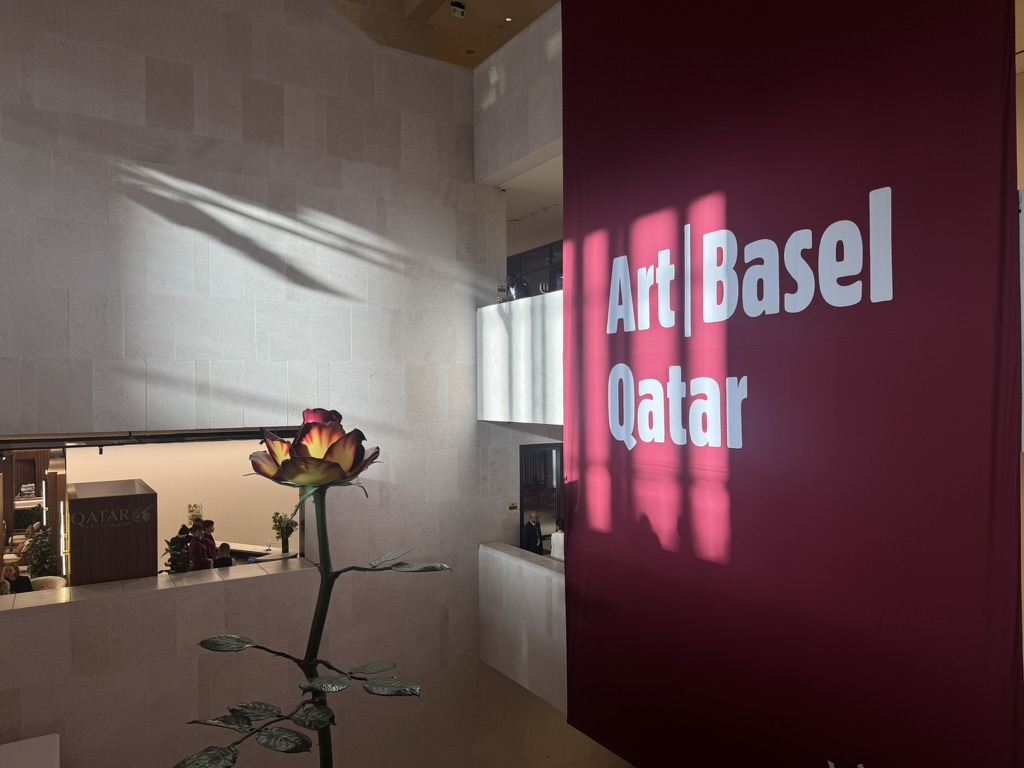
Art Basel Qatar did not feel like an art fair designed to be consumed. From its first edition, the fair proposed a different rhythm — slower, more fragmented, and intentionally restrained in scale. Spread across several sites in Doha rather than concentrated in a single monumental hall, the experience unfolded as a sequence of pauses rather than a continuous flow.
This rhythm was not incidental. It shaped how works were encountered, how conversations unfolded, and ultimately how value was perceived.
From Consumer to Collector
One of the most defining aspects of this edition was the choice to privilege solo presentations. Each gallery focused on a single artist, allowing visitors to engage with a practice in depth rather than through rapid comparison.
This approach fundamentally altered the role assigned to the visitor. Rather than navigating abundance or reacting to visual overload, visitors were encouraged to stay longer, to understand context, and to follow an artistic trajectory. The fair did not ask for quick decisions or accumulation; it asked for attention.
This shift — from consumer to collector — can be read through the lens of the fair’s curatorial sensibility. With Wael Shawky at the helm, the logic of presentation echoed an artist’s relationship to work: one that values duration, coherence, and narrative over immediacy.
The solo booth, in this context, was not simply a display format. It became a condition for looking, one that allowed works to exist without competition and visitors to engage without pressure.

A Fair Anchored in Its Region
Art Basel Qatar was also deeply rooted in its regional context. Artists from the Middle East, North Africa, and South Asia were not framed as an appendix to a global narrative; they were central to it. Their works addressed questions emerging directly from the region — identity, memory, power, displacement — reinforcing the idea that a fair should reflect the place in which it exists.
Rather than importing a pre-existing model, the fair articulated its own position, shaped by local histories and contemporary realities.
Education as a Cultural Backbone
Beyond the fair, encounters with educational institutions revealed another essential layer of the ecosystem being built. VCUArts Qatar demonstrated the depth of investment being made in training future artists and designers, while maintaining close proximity to exhibition spaces and professional practice.
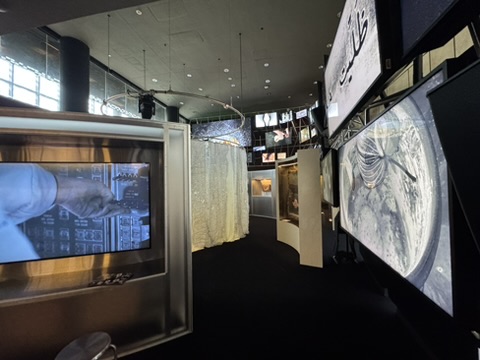
Similarly, The Media Majlis Museum at Northwestern University in Qatar, dedicated to journalism, communication, and media, emphasized the role of critical thinking, storytelling, and representation in shaping cultural discourse. The exhibition What’s between, between is a proposal of defining what really means Gulf Futurism.
Together, these institutions highlighted the importance of bridging education and exhibition — ensuring that artistic production is not only shown, but contextualised, questioned, and transmitted.
Off the Beaten Track: Community in Formation
Outside the official fair circuit, initiatives such as GubGub Studios offered a glimpse into emerging local dynamics. Bringing together thirteen artists based in Qatar, the studio functions both as a workspace and as a place for community, exchange, and events.
Its ambition goes beyond production. It signals a desire to build proximity — between artists, audiences, and conversations — reminding us that sustainable ecosystems are built through shared spaces and long-term commitment.

Generosity, Access, and a Different Kind of Glamour
While the presence of wealth is unmistakable, it was not the dominant impression. What remained was a sense of generosity — access to institutions, artists, curators, and dialogue. The social program, including dinners, receptions, and performances such as Jenny Holzer’s, balanced refinement with openness.
Here, glamour did not replace content; it framed it.
An Open Question, Not a Conclusion
As with any first edition, questions remain. Is this model commercially sustainable? Will galleries return? Will the collector base expand over time? These uncertainties are real.
But first editions are not conclusions — they are positions. What Art Basel Qatar proposed was not a finished answer, but a direction.
Toward a Different Model for Art Fairs
Art Basel Qatar suggested that art fairs do not need to be massive to be meaningful, nor accelerated to be relevant. They can be smaller, regional, and attentive to time. They can privilege discovery over saturation, and engagement over accumulation.
If art fairs are to evolve, this first edition in Qatar may point toward a future in which fairs become cultural jewels — rooted in place, shaped by artistic sensibility, and committed to depth.