.svg)
ArtMeta’s “Digital Masterpieces” at Art Basel
This year, I had the privilege to have my work exhibited at the ArtMeta’s booth “Digital Masterpieces: From Code to Canon” at Art Basel's zero10. In less than 50 square metres, the booth, curated by Georg Bak and Roger Haas, exposes around 25 canonical works representing the last 70 years of computer-based art. Ranging from Laposky’s 1955 photograph of an oscilloscope curve to my own cybernetic blockchain sculpture (Plantoid 18) created in 2023, the booth is there to remind us that, despite only reaching mainstream recognition in the past few years, computer-based art has a steadily yet largely overlooked history.
New artistic substrates
The exhibition is organized into 7 chapters: Signal, System, Graphic, Network, Generative, Intelligence, and Protocol. The goal is not to present a succession of styles or technologies, but rather to illustrate how new technologies eventually came to be understood as new artistic substrates. The 1955 oscilloscope photograph and the 2023 Plantoid are presented in the same room because each marks a moment when a particular computational layer first became available to art.
In the 1950s, artists began experimenting with electronic signals as such. In the 1960s, they built more advanced systems, with software executed by computers and devices. In the 1970s and 1980s, synthetic images and computer graphics became a new tool for creativity. In the 1990s, the network expanded the realm of possibilities to a whole new dimension. In the 2000s and 2010s, coding became an integral part of the artist’s toolkit with the growing popularity of generative art and artificial intelligence. Finally, in the 2020s, the protocol itself became art, with the advent of blockchain and smart contracts as instruments for artistic mediation.
Each substrate does not displace the ones before it, but rather expand the realm of artistic expression available to the artists. The Digital Masterpieces exhibition illustrates how this process has evolved over the past 70 years, reminding us that the most popular contemporary works currently drawing the most institutional and market attention are ultimately the result of a linear progression from previous canons.
A walk through the substrates
SIGNAL — Ben F. Laposky's Oscillon n. 59 (1955) represents one of the earliest works in the booth. The artist used an oscilloscope to translate electrical input into mathematical curves and photographed the resulting figures in order to capture them on film. As Georg Bak noted, the work is literally the first generation of a screenshot, i.e. an analog screen signal made permanent through a photo shot. Next to it, Mary Ellen Bute's Oscilloscope Tests, also from the 1950s, are other experiments with this new artistic medium which produced forms that no other medium could produce at the time.
SYSTEM — In the 1960s, artists began experimenting with computers and hardware devices. Frieder Nake is known to have made one of the first plotter drawings (1965) produced through a procedural algorithm, written in an early programming language. Charles Csuri's Numeric Milling Machine Sculpture (1968) is recognized as the first computer-generated sculpture, produced by feeding a function into a milling machine which carved the form from wood. The substrate here is no longer the signal itself, but the overarching system, i.e. the software algorithm that, once executed through a computerized system, produces a form the artist could not draw directly.
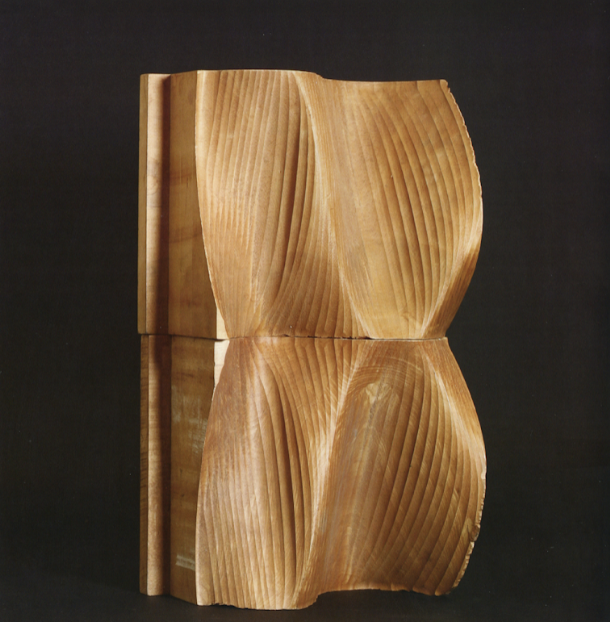
Signed 1968 (sculpture)
3-axis milling machine, wood; accompanied by ink on plotter paper (IBM 7094 computer, CalComp drum plotter)
33 × 56 × 22 cm (sculpture); 64 × 38 cm (plotter drawing)
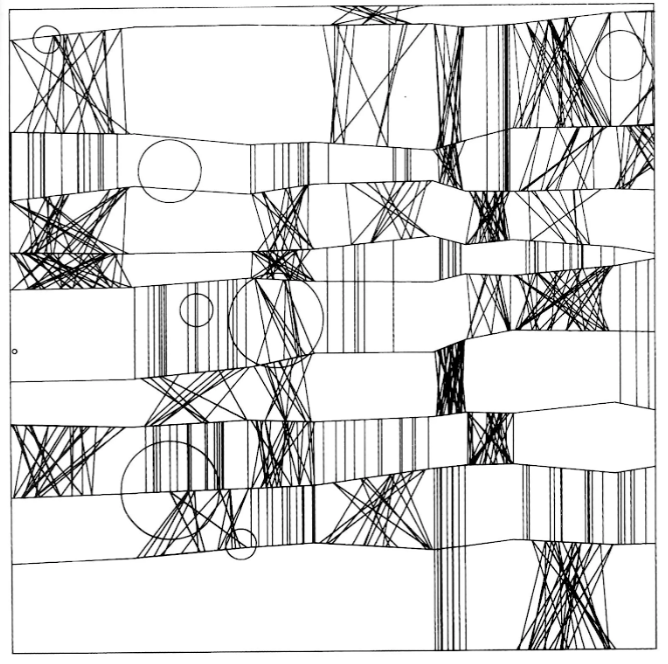
ZUSE Graphomat Z64 plotter drawing on paper
61 × 61 cm
GRAPHIC — In the 1970s and 1980s, computers began capable of producing digital imagery on screens. David Em's Transjovian Pipeline (1979) depicts a virtual space that is rendered from purely synthetic data. Rebecca Allen's Swimmer (1981) and Steps (1982) represents a similar attempt at exploring what is currently referred to as “virtual reality”. The substrate has, once again, evolved to encompass also the synthetic visual space that the algorithm produces.
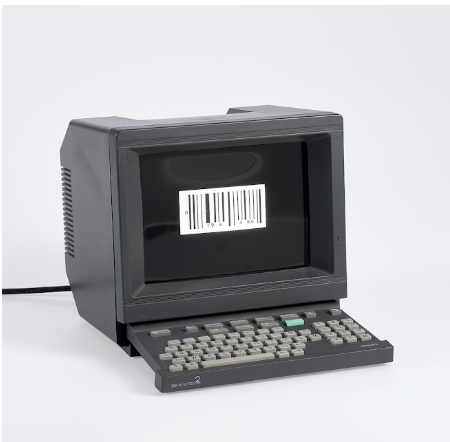
Minitel artwork, Minitel computer24.5 × 25 × 24.5 cm
Edition of 3 (2/3)
NETWORK — The booth subsequently takes us to the 1990s, with a series of canonical net.art works, like Edouardo Kac’s Minitel artwork (1986) or Vuk Cosic's Deep Throat (1998): an artwork produced for the early web and distributed through it. The substrate here is not the screen nor the algorithm, but the network itself, as Internet connectivity becomes the new artistic medium.
GENERATIVE — The algorithm comes back as a living and executable artistic language. William Latham's Mutation Y1 on Yellow Paint of Infinity (1992) is an evolutionary system in which forms breed and develop across generations. In this case, the artist did not decide on the form that the art would take, but only stipulated the rules of its becoming. The substrate is the generative procedure that generates the art.
INTELLIGENCE — With the advent of generative AI in the 2000s, artists started to experiment with intelligent systems. Gene Kogan's Abraham series (2021) is produced by an autonomous AI artist, trained and instructed to generate works under its own name. Memo Akten and Katie Hofstadter's Boundaries (2024) use AI to illustrate how these systems interpret our world. In both cases the substrate is no longer the algorithm that the artists have written, but rather the model that the artists have trained.
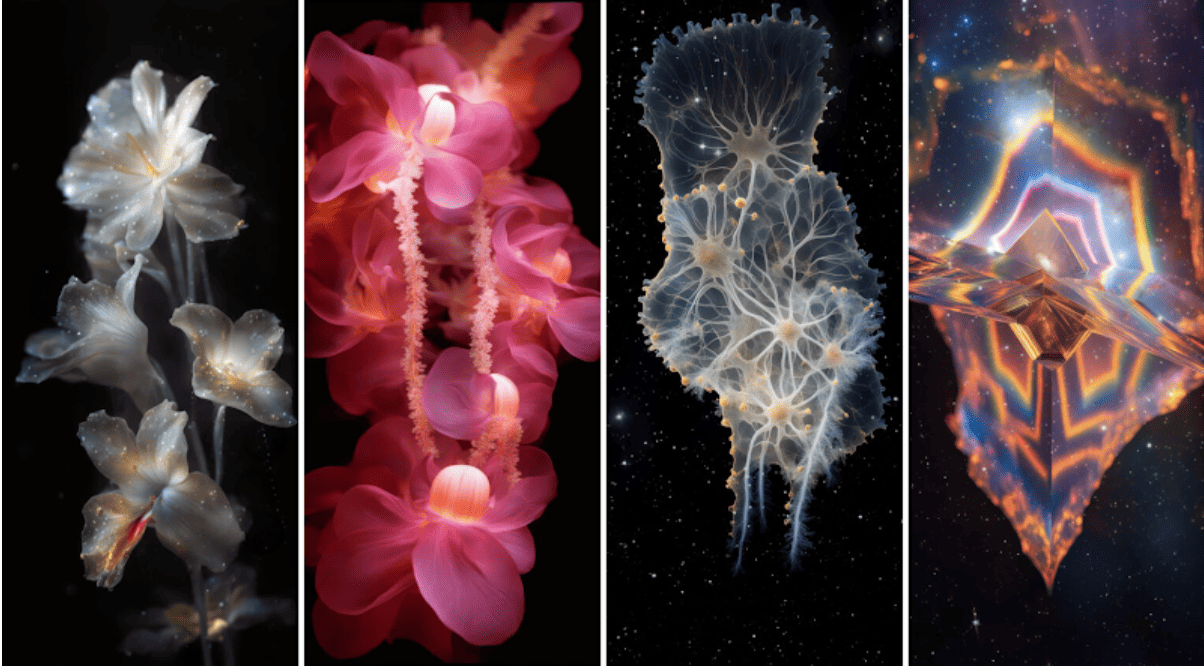
Video and sound installation, 8:15 min.
Edition 2/5 + 1 AP
PROTOCOL — The seventh and final chapter of the booth is about protocols. This is precisely where my own artwork sits. Plantoid 18 is a metal sculpture that comes along with its own crypto wallet on the Ethereum blockchain. People can feed it in order to collect one of its digital seeds: a song and video animation produced through generative AI and recorded on the blockchain as a NFT. When the Plantoid accumulates enough cryptocurrency from human pollinators, it automatically transfers the funds through its smart contract to commission an artist to produce a new Plantoid. The substrate of this work is not the metal sculpture, nor the software algorithm, nor the blockchain network, nor the generative AI model—although all of those are present in the work. The artistic substrate is the protocol itself, i.e. the rules and procedures that operate the work and enable the work's own reproduction.
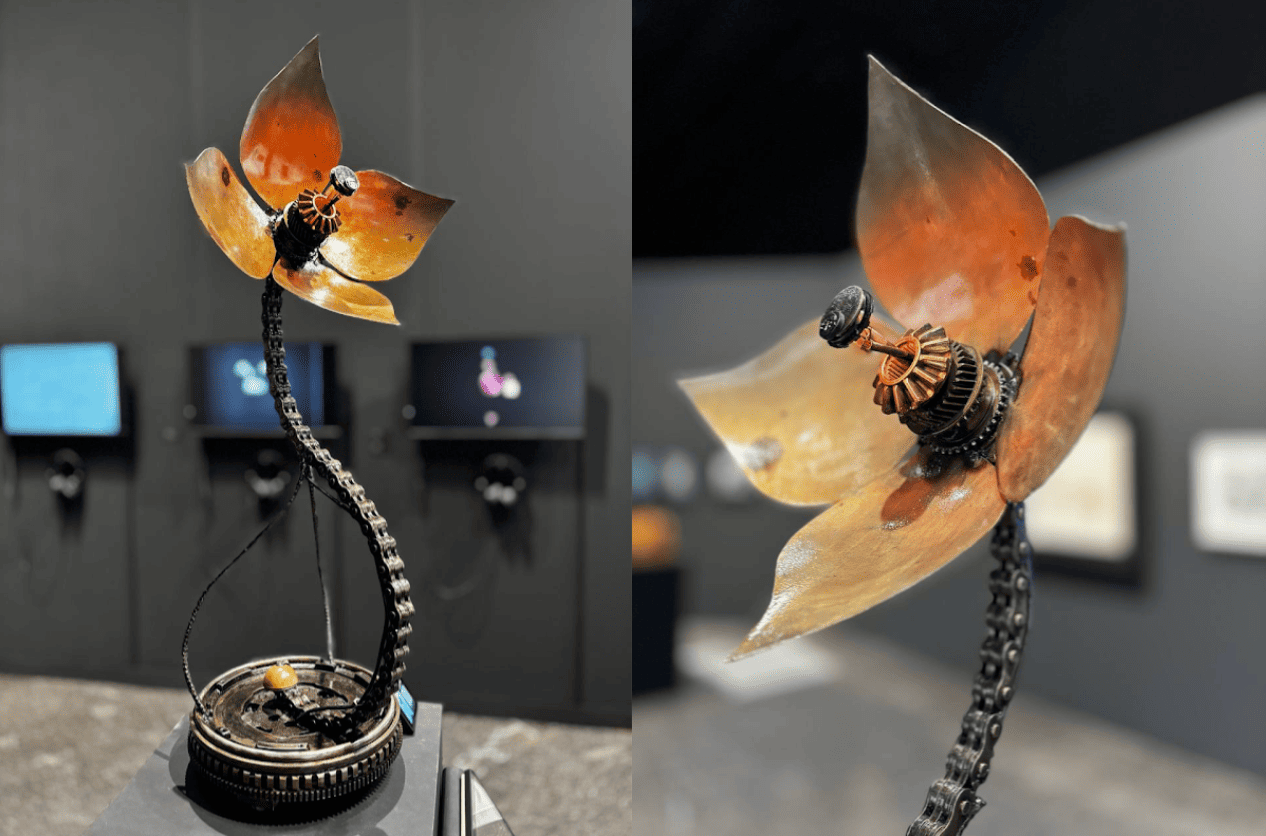
Mixed media sculpture and smart contracts on the Ethereum blockchain, 100 × 50 × 50 cm (base: 40 cm)
It should be noted, in this context, that Digital Masterpieces is proposing its own curatorial argument as a continuation of previous curatorial works. A few weeks earlier, in Venice, I had the chance to participate in the Strange Rules exhibition at Palazzo Diedo, where Mat Dryhurst, Holly Herndon, and Hans Ulrich Obrist inaugurated Protocol Art as a novel curatorial category. Digital Masterpieces contributes to that argument by showing that the gesture identified and named by Strange Rules is in fact inherited from seventy years of antecedents. Looking at my own artwork standing at the very end of the booth, as the youngest member of a long family, made me recognize, with a mix of admiration and humility, how much I owe to these previous artists.
The time has come
Looking through the catalogue of the many other works that could not be physically exhibited at the booth, it becomes clear that the canon of computer-based art has been forming for 70 years, largely outside the institutional art history conversations. According to the curators of Digital Masterpieces, the moment has finally arrived to bring it inside.
Since I left Basel, I have been pondering on why this argument is being made now, and what are the conditions that triggered such an institutional recognition?
I can think of multiple reasons for that. As the first generation of computer artists are no longer amongst us, the question of what will be preserved and how it will be sold becomes more urgent than ever. Institutions that have begun acquiring computer-based works and are dealing with the challenge of maintenance and preservation of digital works. Collectors who began collecting digital art through the NFT wave of the early 2020s are now wondering what the lineage of their holdings actually is. And many of the artists working at the edge of contemporary (myself included) are increasingly asked to situate our practice within a domain of art history that we are often not sufficiently acquainted with.
By bringing these works together and describing their lineage, Digital Masterpieces make that history available to the people who will, hopefully, write the next chapter of it.
Digital Masterpieces: From Code to Canon, presented by ArtMeta and curated by Georg Bak and Roger Haas, was on view at Art Basel zero10 from 17–21 June 2026. The full catalogue of 100 works remains accessible online at masterpieces.artmeta.org.