.svg)
Menu

It was an out-of-this-world experience, the one that will first come to mind whenever I think about the Biennale 2024. You see it from the outside: like an earthquake, an act of subversion, a mound of dirt covers the main entrance of the emblematic German Pavilion. As you enter through the side door, a room with what seems to be a spaceship hovers above your head while you are mesmerised by the extraterrestrial sound and light. Created by respectively Ersan Mondtag, a German theatre director of only 37 years, and the celebrated and critical Israeli filmmaker Yael Bartana, these works are just the starting point for the exhilarating exhibition Thresholds.
Mondtag built a giant immersive installation with degraded rooms and dirt, where a performance occurs twice daily. In Monument to an unknown person, five actors cook, clean, and sleep on and with dirt. He tells the story of his Turkish Grandfather and thousands of other people who died because of health issues after working in German asbestos factories. In her video Farewell, Bartana suggests the narrative of Israeli people onboarding a space shift and going to find a new planet to start humanity again. They both regard stories of in-betweenness, where foreigners peer at new — and unsuccessful — beginnings.
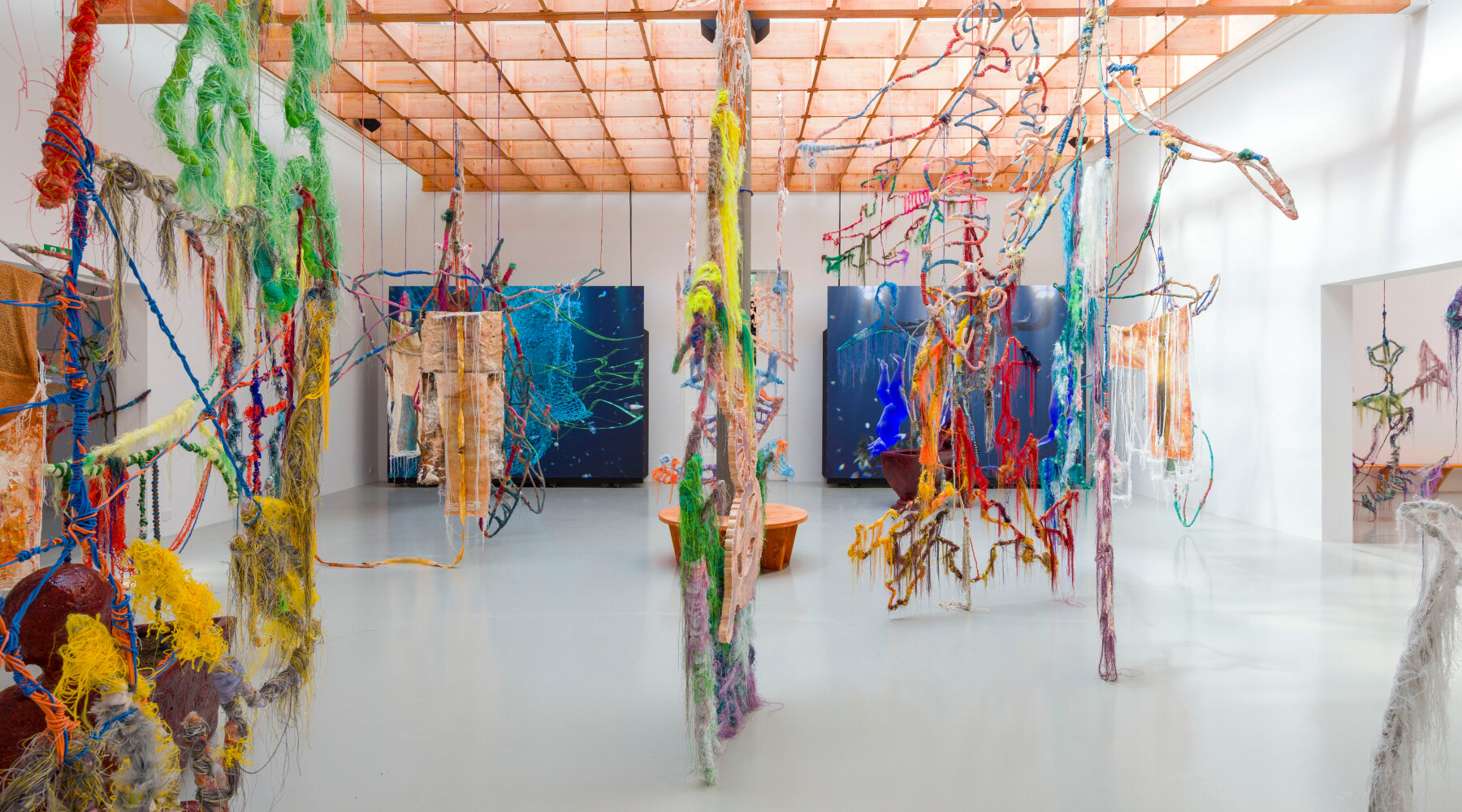
The feel-good exhibition by French-Caribbean Julien Creuzet invites visitors to a sensitive visit. Here, the wisdom of the body comes before rational, cognitive knowledge. The exhibition space is populated by colourful sculptures suspended in the air made with a handful of materials, such as threads, shells, fish nets, plastics, and neon liquids. Together with smells and ethereal sounds, they build an environment of an underwater-like fluidity, where a sense of cosiness and reverie coexist.
Growing up in Martinica, an ex-French colony, Julien Creuzet points out how he has always been regarded in France as a citizen 'from overseas.' Therefore, he touches deep memories related to the idea of the ultramarine journey and the imaginary of strange characters — nonhumans and with superpowers — who would live on the other side of the seas. We are all building our journeys on earth, and water is an excellent metaphor for what binds us together through these crossings: it is an elementary substance for every human being.

Repeat after me: Tu-tu-tu-tu-tu-tu-tu-tu-tu-tu-tu. It sounds like gunshots, doesn't it? The Polish Pavilion was overtaken not by a Polish artist but by the Ukrainian Open Group Collective, who brings the sounds of War to a karaoke—the exhibition space of Repeat After Me is occupied by bar-like tables, bar stools, and microphones. Two screens project videos of survivors of the War in Ukraine, who pronounce the sounds they heard during the attacks. Visitors are asked to repeat them. The starting point of the artwork is a survivor-guide brochure distributed by the Ukrainian government in 202: the ability to know sounds may save lives.
This is a phenomenal and original way to talk about the language of War, which is not local but global. The collective brilliantly handles resonance and empathy by bringing the horrible experience of the Ukrainian War to people worldwide. Here, the sounds of War reverberate in our bodies.

Speaking of water and sound, the exhibition Listening All Night To The Rain by celebrated film artist John Akromkah also presents both as common languages that go beyond borders and connect human beings and nonhuman entities. He blends documentary images from hundreds of archives with fictional scenes produced by the artist and his team, resulting in beautiful and contemplative films that seem suspended in time. Water is the element that connects the different videos and symbolises the crossings of the black diaspora.
Born in Ghana's capital, Accra, in 1957, a little less than two months after the country declared independence from the UK, Afromkah tackles decolonization issues and re-tells history from different points of view than the official narrative told by the Global North. By mixing images from the past and present and various events worldwide, he simultaneously shows different narratives on different screens. That is why visitors also walk into the pavilion through the back door: he tells stories that are hidden, covered, and out of sight.

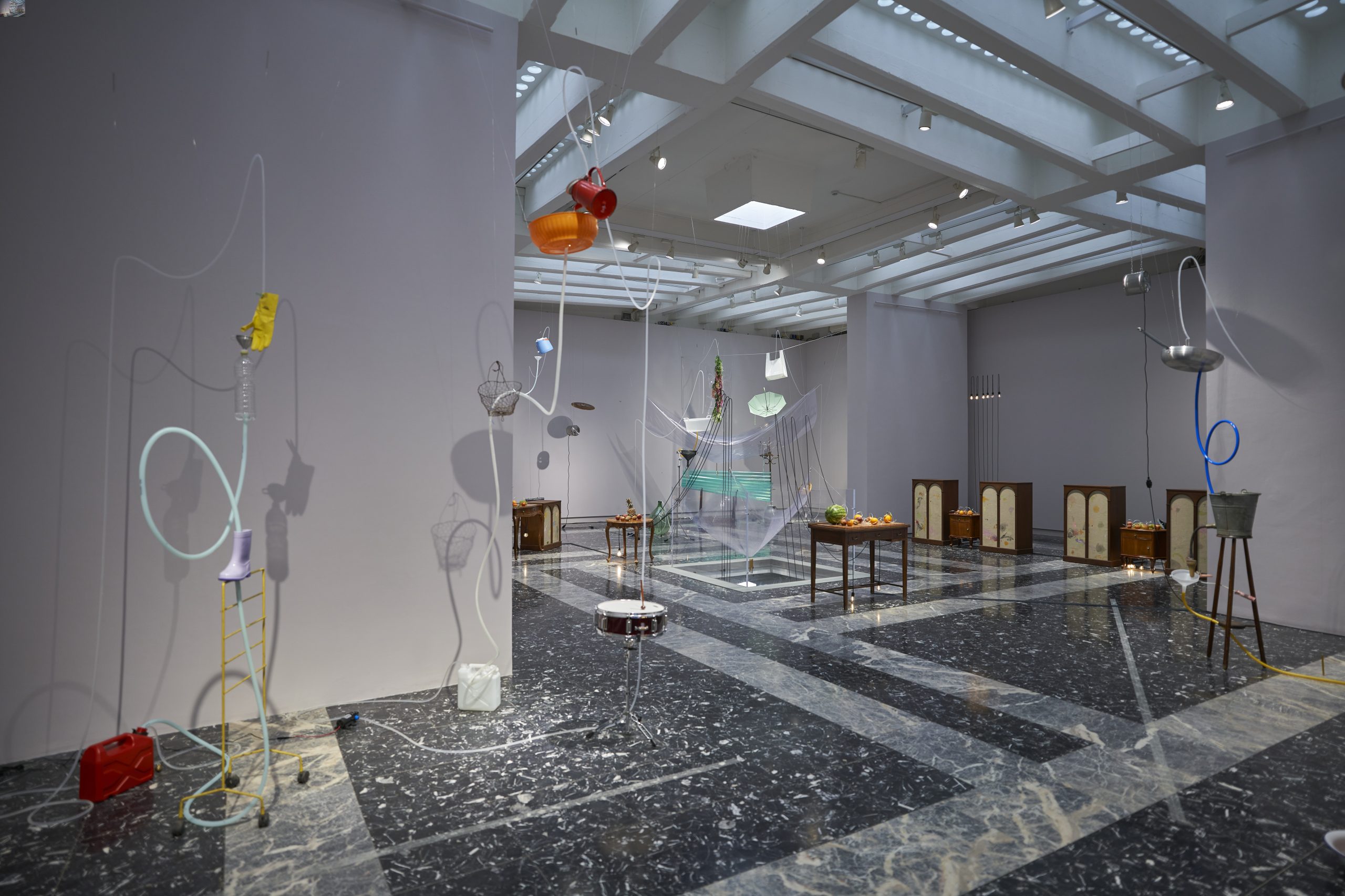
Artist Yuko Mohri is interested in how a crisis sparks people's highest levels of creativity. Indeed, her pavilion shows many inventive solutions, making use of fruits and vegetables bought in the nearest grocery store and second-hand furniture acquired in some of Venice's antique shops. In Compose, the fruits' internal state shifts constantly; by inserting electrodes, she converts their moisture into electric signals, which then control the intensity of light and sound in the space.
Mohri took as a starting point the inventions of railway workers in Tokyo, who ingeniously employ everyday items to stop water leaks at stations. Seemingly, in Venice, improvised bridges built with pipes pop up as soon as water levels go up. Mohri's work points out the environmental crisis and emphasises changes humans cannot control, like water and the passing of time.