.svg)
Menu
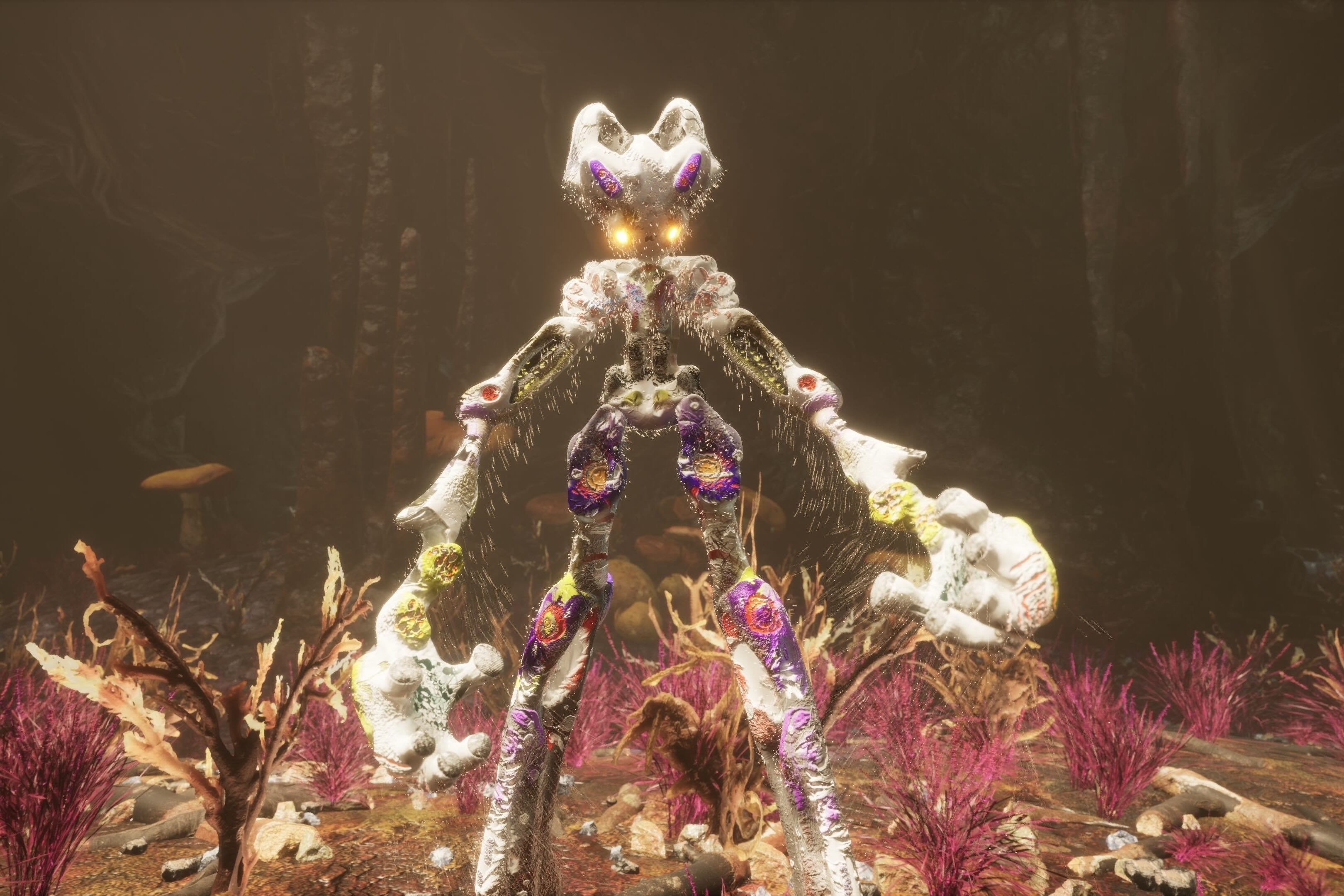
In the past two years, you see his name everywhere. Brazilian artist Gabriel Massan, born in Rio de Janeiro in 1996, caught the attention of Serpentine Galleries, which commissioned his work Third World – The Bottom Dimension. Since 2023, this game-based project and expanded installation has been showcased in prestigious contemporary art spaces, bringing audiences closer to the participatory and narrative elements of gaming.
Through collaborative storytelling, the work challenges the colonial concept of "exploration." The term "Third World" originally refers to the classification imposed on emerging nations, but here, it suggests a Plan C: a new planet, inhabited by monstrous characters who question colonial and hegemonic narratives—the stories always told by the victors.
Gabriel references the book Unpayable Debt (2022) by Brazilian philosopher Denise Ferreira da Silva to construct a nonlinear narrative that interrogates the precarious and systemic existential conditions of Black and Indigenous peoples—an inevitable history, repeated over and over from different angles and perspectives.
I visited his exhibition at Pinacoteca de São Paulo, in Brazil, this February and was thrilled to finally have the opportunity to interview him:

Gabriel Massan (Photo: Oliver Marshall)
Julia Flamingo: I’d like to start by understanding a little about your references today. What have you been researching? What has been inspiring you? It could be in art, but also gaming.
Gabriel Massan: I think my references, what inspires me, change depending on the environments and experiences I navigate within. Some things persist, while others are more fleeting or tend to fluctuate. I think that when I started, it wasn’t really about traditional arts, or painting, or sculpture, or even new media. My main interest was in cinema. And all of my visual approaches, let’s say, were related to cinematic images—mainly Japanese and Hong Kong cinema.
I think that since I’m really passionate about fantasy as a genre, maybe it was influenced by growing up immersed in cartoons. And when I fell in love with cinema, I followed the path of psychological thrillers, fantasy, and drama. I also really liked period films and war films—not in a way connected to adventure or action, but more because of the stories, the different cultures, the tales, the mysteries. And I think that, little by little, since I was also a gamer, these universes started to complement each other.
Then, in my fascination with Japanese cinema, I ended up discovering Nam June Paik’s work on YouTube and found out about video art. So, it was a slightly less conventional path for an artist coming from an academic background, but for me, who grew up on the internet, it was the only possible path. It was the only way I could explore my way of seeing the world, which was quite fantastical, even when I was a teenager, without necessarily building a connection with the reality I grew up in—a reality that was quite violent and culturally limited.
Also, for a large part of my childhood and teenage years, I took theater classes. So, I think dramaturgy was already part of my universe.
But I think that with this initial interest in rethinking my reality, the way I found to do it was by building and sculpting every part of this scenery. That led me to create this archive of sculptures and digital objects, which I use for different works, different installations, and films—what I call “sculpture-actors.”
I've been thinking a lot about Ai Weiwei’s work. I really like Arthur Jafa. I also really like Joan Jonas. And I would say I’m usually more inspired by video artists than digital artists. I research other digital artists, I stay in touch, I follow the work of Lawrence Lek, Danielle Brathwaite-Shirley, and Yen Chang. But what grabs my attention the most are video artists.
I’ve really been into Polish cinema. That’s what has been inspiring me lately. Maybe because of living in this European wartime state, where the mind becomes a bit more cautious.
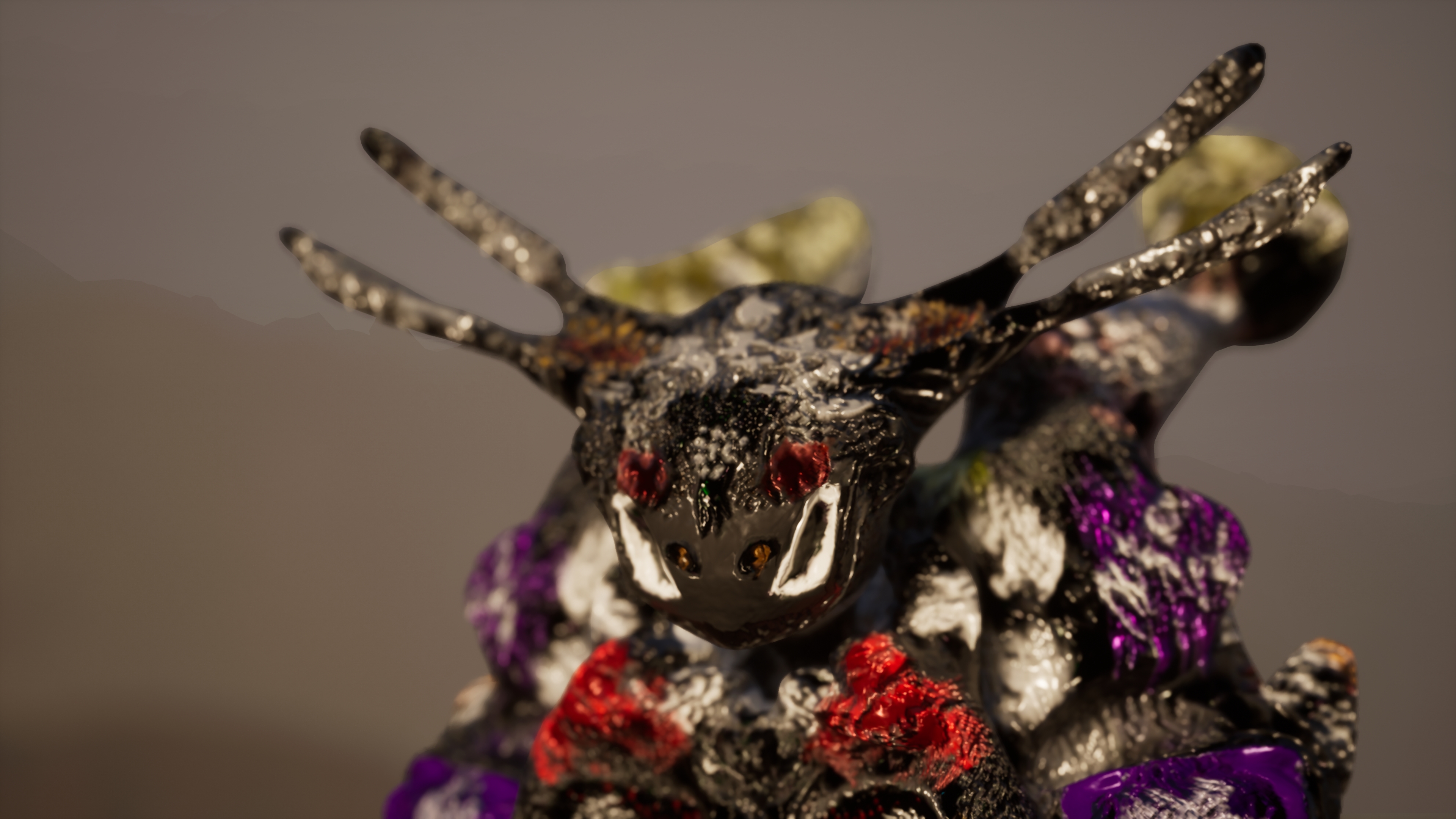
Scene of "Third World"
Julia: You grew up on the outskirts of Rio de Janeiro, dealing with the hostility and violence of the city. I imagine that gaming and the internet took you out of your reality and into this space of speculation, fiction, and dreams. Art does that to us—it takes us out of our world and transports us elsewhere. And then, later, you physically left Rio de Janeiro and moved to Berlin, stepping into another place. I’d love for you to talk about that transition.
Gabriel: My personal experience influenced me in some ways, but I didn’t create the game based on my ego. The game is very much about crossing different territories and the experience of arriving in each one of them.
I come from a small city in the Baixada Fluminense region called Nilópolis. My city has 100,000 inhabitants, so it’s really small. Since I was a child, I would always go to Rio de Janeiro—for theater classes, as I mentioned, or to visit museums. I had friends all over the city because of forums, Orkut, and all those online spaces. So, I always forced myself to move around. I never really fit within my reality.
Crossing these distances, moving between different neighborhoods, and navigating different social and economic contexts—the contrast was striking. Later, when I entered university at Parque Lage in Rio, these disparities became even more intense. Moving around the city became increasingly dangerous because I had friends who were murdered. Not just police violence, but this general state of war in Rio de Janeiro, where there are territories you simply cannot enter or even pass near.
The fears I had pushed me toward São Paulo, where I worked a lot in the creative industry. Over time, I realized that I had this tendency to migrate. But the biggest shock came when I moved to Germany. And in all these places, I was always very concerned with how I was perceived, how I was understood. All these reflections influence me—all these positions of inequality, not just because I come from a peripheral area, but also because I’m queer.
Each of these places sees me and understands me differently. And I believe the game is about that, too. It’s also about responsibility. Other creators who work with me also move between different environments frequently, and face similar issues.
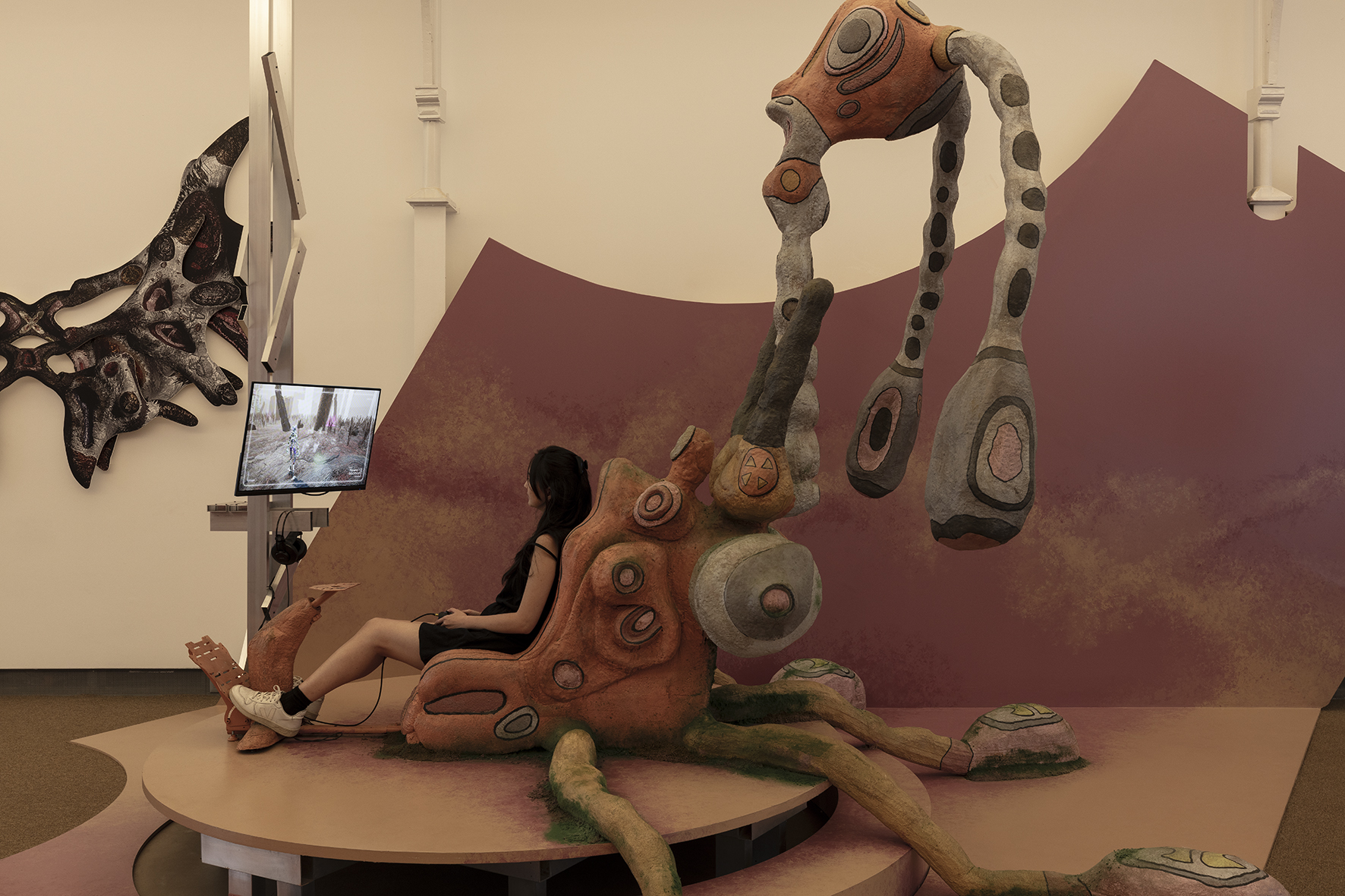
"Third World – The Bottom Dimension" at Pinacoteca de São Paulo
Julia: At first glance, it seems to me that all games could be works of art. They have creation, identity, storytelling, narrative, and participation. But I’d like to understand from your perspective—what makes your work, your game, be accepted in the contemporary art world? How does that happen while other games are not? Is there prejudice from the gaming industry itself, or from the contemporary art world? Or is it your trajectory?
Gabriel: I think contemporary art is largely about who decides what is considered art. Someone has to look at something and declare it to be art for us to recognize and accept it as such. I think it was the same with me. The biggest difference, perhaps, is that I always took ownership of these tools: I started with digital sculpture and video art. Then I moved into augmented reality, virtual reality, and eventually into gaming and motion capture. Now, I work with artificial reality and artificial intelligence.
I didn’t come from an entertainment background or from the industries that these tools were originally designed for. For example, when I started working with Blender, I never watched a single tutorial. I just experimented, testing and learning what made sense for me within that software.
Everything was a big experiment. For example, with Unreal Engine—the software used for game development—I use it to create films and immersive installations. Everything is a test. It can work brilliantly or be a complete disaster.
The difference is that art games are not necessarily developed for the user. They are experiences. Traditional games, on the other hand, are designed for profit. The game has to function on all computers. Its interface must be user-friendly for all audiences. There are guidelines about what a game must contain.
Games typically include tutorials, violence, and collection systems that are embedded in a colonial or capitalist logic. Art, however, challenges these predefined narratives. Just as television, video, and virtual reality were questioned by artists, I believe gaming is now being used to critique these structures.
Ultimately, gaming became the most effective way for me to bring together multiple professionals and artists in a collaborative platform where each person plays a role within this giant creative monster.
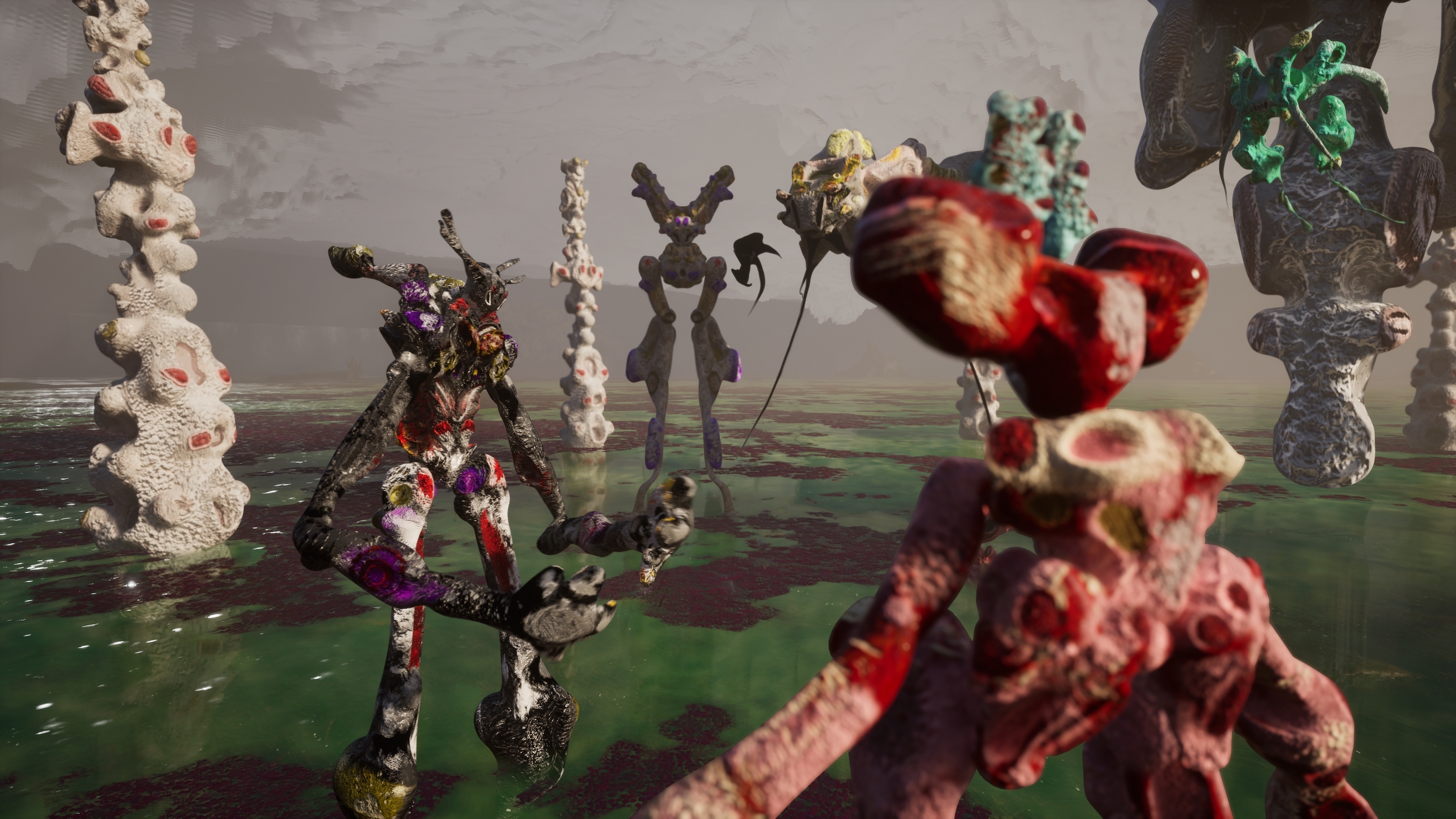
Scene of "Third World"
Julia: Actually, I think it would have been very difficult for me to discover your work if you weren’t circulating in the contemporary art world. Whether we like it or not that someone has to say it’s art, on the other hand, contemporary art allows me to discover worlds that aren’t mine—because I don’t play games, and I’m not part of the gaming world. Contemporary art builds a bridge, and through that, I can get to know your world and your work.
You ended the last question talking about this colonial logic. So I want to ask you: is it possible to decolonize technology? When we think about Web3, there was this idea of decentralization, horizontality, and collectivity. And today, we see that it’s not horizontal at all—it’s vertical, colonial, and managed by large organizations and corporations. What do you think about this?
Gabriel: I think…when I started working with digital art, there was practically no big discussion about it in Brazil. And that was one of the reasons I had to emigrate if I wanted to continue my practice. The only suggestions I received were to change my medium—to do painting, sculpture, or just video. I always had to deal with a lack of opportunities, and, as I said, I was constantly rethinking the role of these tools.
In a way, yes, it’s discouraging—especially since I followed all the conversations around Web3, the rise of NFTs, the transparency of digital contracts, and DAOs. It all felt like a major shift in what was possible. But unfortunately, it’s a pre-established world, and no matter how much effort is made—and there are still many collectives, artists, and organizations fighting for decentralization—it’s difficult to sustain those conversations when the market crashes.
Regarding artificial intelligence, it was already part of my work. When we develop games, AI is already integrated into the universe—because for a world to exist, some kind of life has to circulate within it and act according to certain parameters. What I’ve seen now is a rapid, almost irreparable expansion of AI. On one hand, it scares me because of wealth accumulation and the fact that the world has become even more unequal in recent years. But on the other hand, it surprises me and opens up new possibilities.
I think my work doesn’t offer answers—it just raises more questions. And what affects me the most is my unconscious state—how these limitations and how these circles are closing in, how that haunts me, affects my behavior, censors me. These are the universes I try to build—creating spaces or sharing a collective feeling without necessarily naming it.
That’s how I’ve been dealing with technology. In a way, by giving fewer names and definitions and making more space for sensations—because I think the answers to all these issues are collective. Even if I take action, someone else has to engage with it. So I think sharing my restlessness ends up being more important than sharing my dissatisfaction.
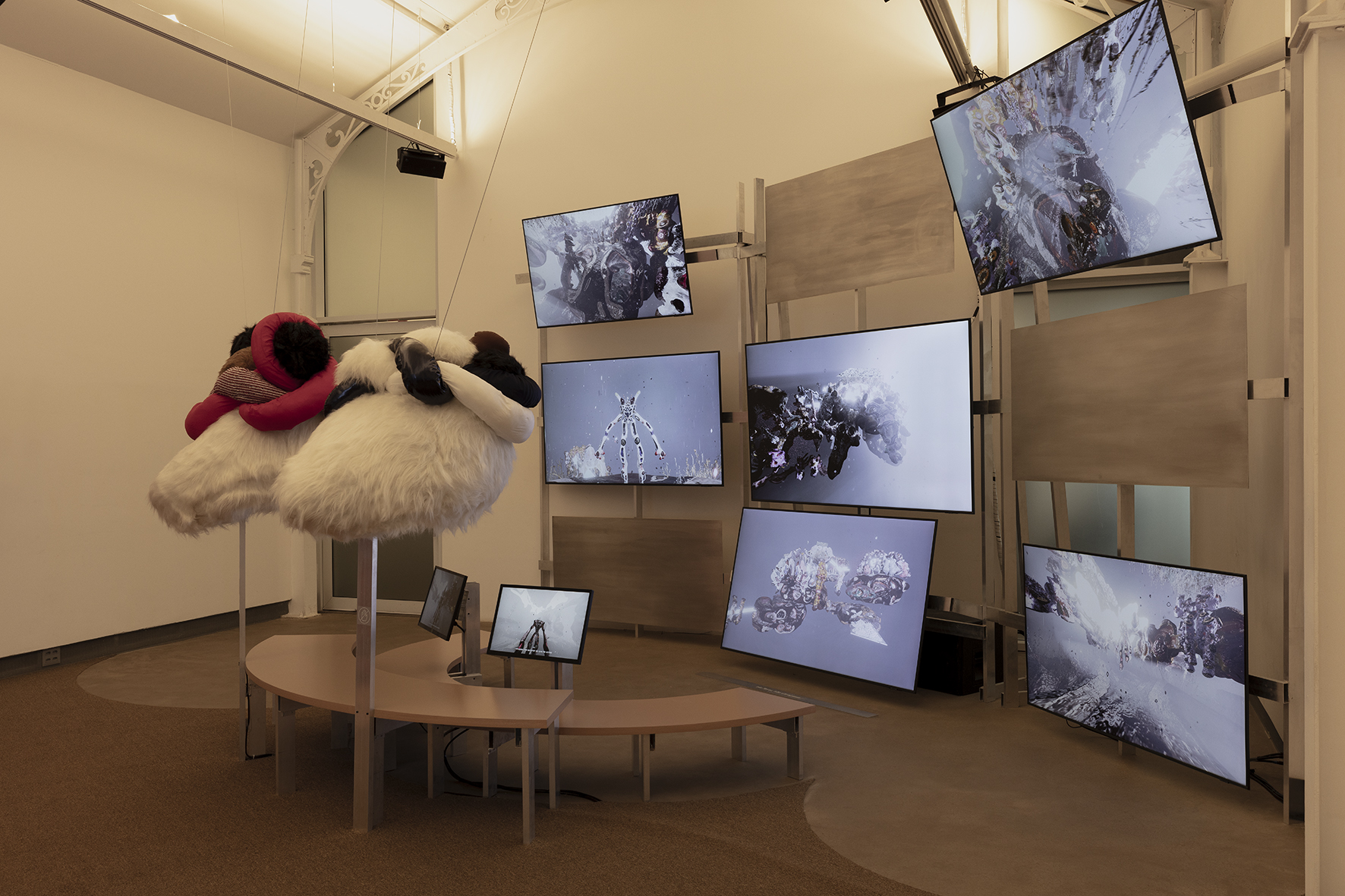
"Third World – The Bottom Dimension" at Pinacoteca de São Paulo
Julia: Do you think moving to Berlin made sense? Do you feel that games have more space? Do you feel like there is a more intense or critical debate?
Gabriel: I moved in January 2020. When I arrived, before the pandemic, Berlin was completely different. There was more room for discussions about new media, and there was a large community of digital and performance artists. I think COVID drastically reduced that. The city also changed a lot in terms of accessibility—it used to be a cheap place with many cultural events for different audiences.
Later, with censorship issues in Germany, budget cuts in culture, art, and education, the artistic scene was impacted. It’s still very active, but not comparable to what it was before.
For me, Berlin is more of a safe base in Europe. I think because my concerns don’t intersect with Germany’s internal conflicts. My identity as a Latin American and as someone of African descent doesn’t play a direct role in the conflicts here.
So, in a way, I feel that tension less, but it still affects my conscious and unconscious state. I also noticed how censorship affects me without me even realizing it. But little by little, you start acting and thinking differently. You become more cautious about what to say, when to say it, and where to go.
I have a studio in Wedding, inside an old factory that, in the 2000s, was taken over by German artists and later regularized as a collective space with many artist studios. I might be one of the very few immigrant artists there. Most of the artists are much older. I think this kind of opportunity still exists in Berlin—to have a space where I can consolidate my research and bring my elements into it. But I see Berlin more as a port than as my heart’s city, you know?
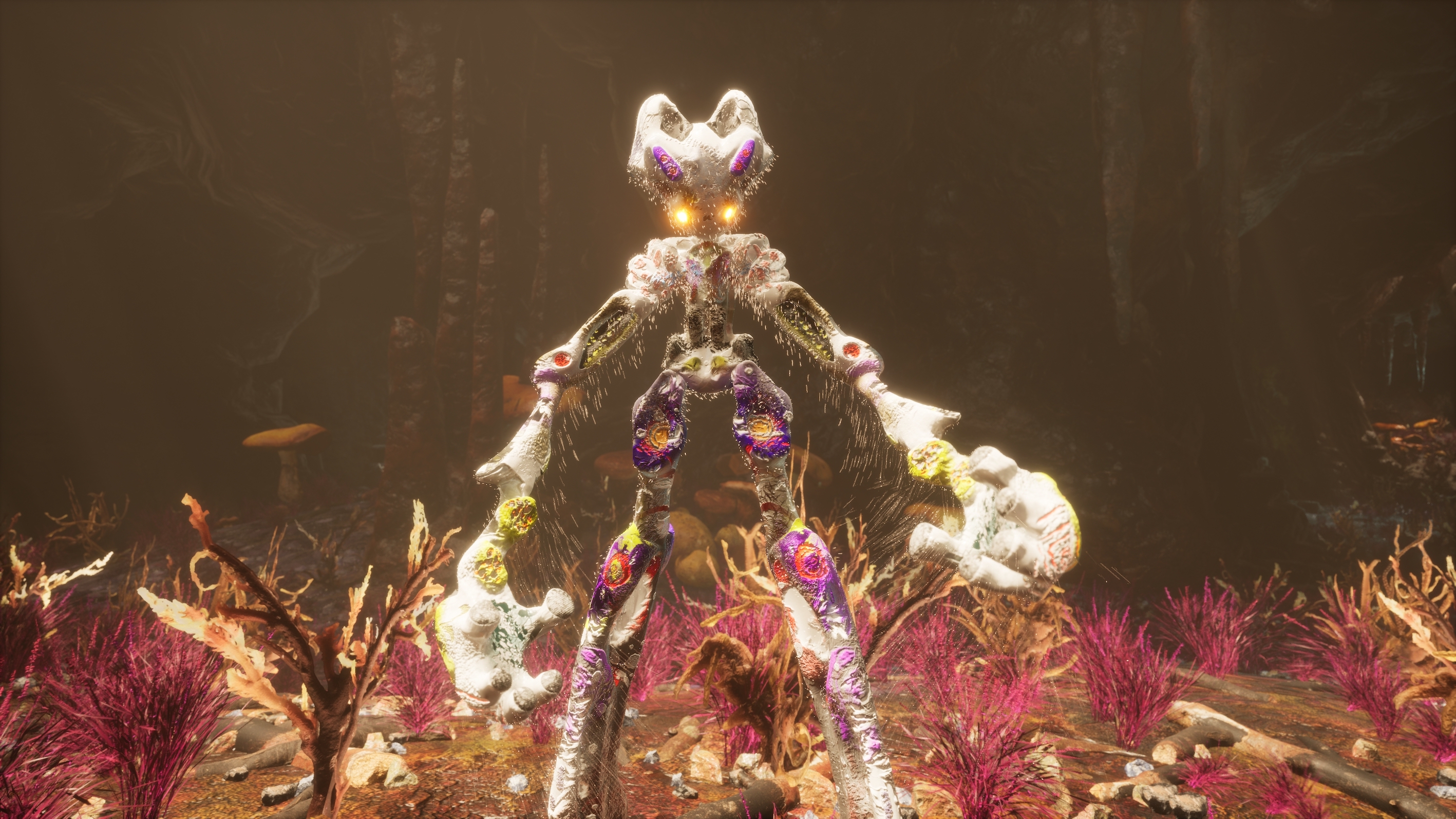
"Third World – The Bottom Dimension" at Pinacoteca de São Paulo
Julia: What are you working on right now? Or maybe, what are your next exhibitions that you’re excited about?
Gabriel: Last year, I worked a lot—it was eight exhibitions, one after the other. If I’m not mistaken, three or four of them were connected to my Third World project.
This year, my next solo exhibition is in March at BOZAR, Palais des Beaux-Arts in Brussels, Belgium, so I’m preparing for that.
In general, I’m also working on redubbing my previous works into Portuguese. And I’m starting to produce a new game, which might be released at the end of the year. But overall, I’m mainly preparing exhibitions with the works I developed last year.
At the beginning of last year, I had an issue with my vision due to stress. It felt like I had a thick, viscous liquid in my eyes that eventually dried up. And I realized how much I had worked in 2023.
I also noticed that I had been working non-stop without taking vacations. It made me rethink the artist’s condition. Since I work with new media, my career path is dictated by institutions. Unlike painters or sculptors who have a closer relationship with the market, new media artists often depend on institutions. And because of that, you have to follow institutional schedules, which leave little time for production.
So, it’s been good for me to be more selective about what I want to do.
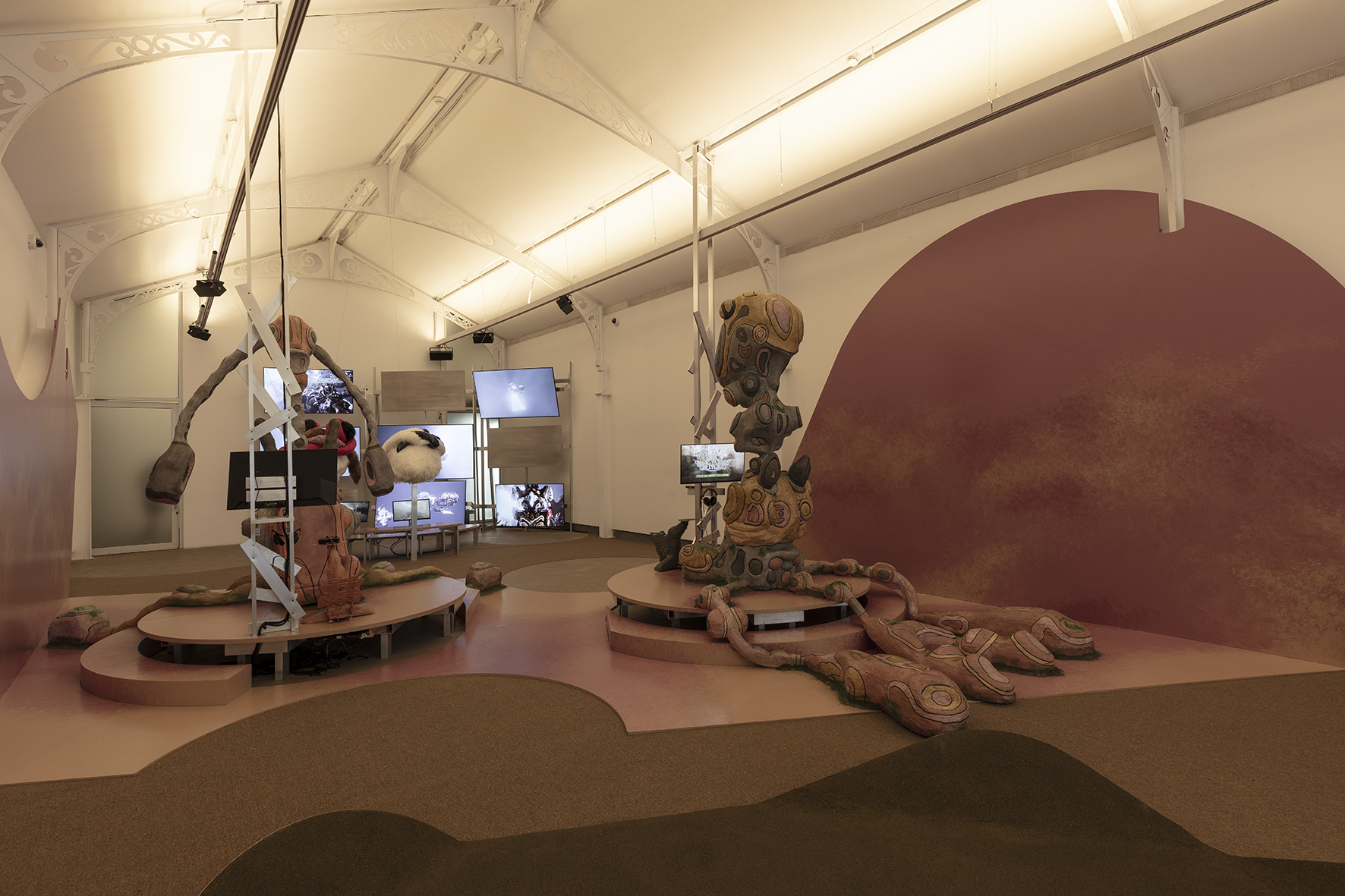
"Third World – The Bottom Dimension" at Pinacoteca de São Paulo
Julia: I think if you ask many artists working within the market system, they’ll tell you they work at full speed. But it’s interesting to understand that your work follows the institutional logic. I actually think that’s a good thing—because, sure, institutions have their demands, which can be challenging, but, on the other hand, research is valued more in the institutional world, like museums, than in the commercial market.
Gabriel: Yeah, I think it’s mostly about this romanticized idea that working in art is a dream. This perception comes from the origins of Western art, where artists were supported by nobility, while craftsmanship wasn’t considered art. And even today, it’s the same thing.
The artists that come to mind for me are all from working-class backgrounds. If they don’t work, their studios don’t exist. But without some form of unionization, the rights of not just artists but also curators, researchers, and writers get pushed aside. And we end up working seven days a week, for countless hours.
That’s something I’ve been trying to negotiate more. In the past, it felt like a double-edged sword for me—if I didn’t work or if I worked less, it felt like the quality of my work would decrease, like opportunities would dry up.
I think when I started, I had a lot of anxiety because art wasn’t paying my bills. I kept thinking, When will the moment come when I can actually pay my bills through art?
And it’s interesting to see that, globally, everything is about youth—like, you have to achieve a certain level of success by 40, or 30, or be The Next Big Thing by 26 or 27. But that’s a total myth. Artistic research takes years to mature.
Understanding that helped me make peace with myself.
"Third World" was created by Gabriel Massan in collaboration with artists and thinkers LYZZA, Castiel Vitorino Brasileiro, Novíssimo Edgar, and Ventura Profana. It was commissioned and produced by Serpentine Arts Technologies, in association with the Julia Stoschek Collection and powered by Tezos.
Click here to download the game