.svg)
Menu

Artist and researcher Giselle Beiguelman develops her practice at the intersection of art, technology, and memory, questioning the regimes of visibility and erasure that shape both our digital and physical worlds. Her work exposes the layers of disappearance embedded in history and culture, addressing everything from censored archives to bodies made invisible by dominant narratives.
In the exhibition Poisonous, Noxius and Suspicious, currently on view at Centro Cultural Fiesp, in São Paulo, Brazil, Beiguelman delves into the history of plants and women who have been silenced, banned, or demonized over the centuries. Her research bridges botany, art, and science to reveal how certain forms of knowledge have been marginalized—whether due to prejudice, economic interests, or the imposition of a Eurocentric perspective on knowledge.
Through fictional portraits and videos created with AI, the artist rescues and reimagines these existences, creating a space of visibility for what has been historically suppressed. In doing so, Poisonous, Noxius and Suspicious sparks an urgent reflection on the mechanisms of control and exclusion that continue to operate in the digital age.

Giselle Beiguelman [Photo: Jorge Lepesteur]
Julia Flamingo: Your work actively challenges the notion that there is only one truth or a single dominant narrative. In doing so, you are decolonizing knowledge and history by revealing untold stories. How do you approach this same decolonization within the realm of technology?
Giselle Beiguelman: It’s a daily ritual, a negotiation. I keep insisting that when you work with artificial intelligence, you are training the system—in other words, you are working for free. By using it, you are working.
You can be trained by the system, by the machine, to do exactly what it dictates—its most common aesthetic, which aligns with hegemonic thought, hegemonic imagery, and the cliché. Or you can truly learn from the machine, understanding how it develops certain reasoning patterns to negotiate alternatives.
In this exhibition, some images took six weeks to be completed. Many negotiations with the platform were necessary because datasets use what already exists—what humanity has produced—with all its biases and social Darwinism, privileging certain phenotypes over racialized bodies. All of this affects the ability to create the work.
Sometimes, I feel a bit like a teacher, a bit like a therapist, a bit like a friend. And at times, I get super nervous, super irritated—like, why did it return this image? I thought my prompt was finally at a point where everything made sense. The secret of artificial intelligence is the pattern—that’s what it seeks. Confronting this pattern is an act of resilience, but it is also about producing new imaginaries within the platform.
I have received repeated threats of expulsion, censorship, and suspension as if I were supposedly violating community guidelines.
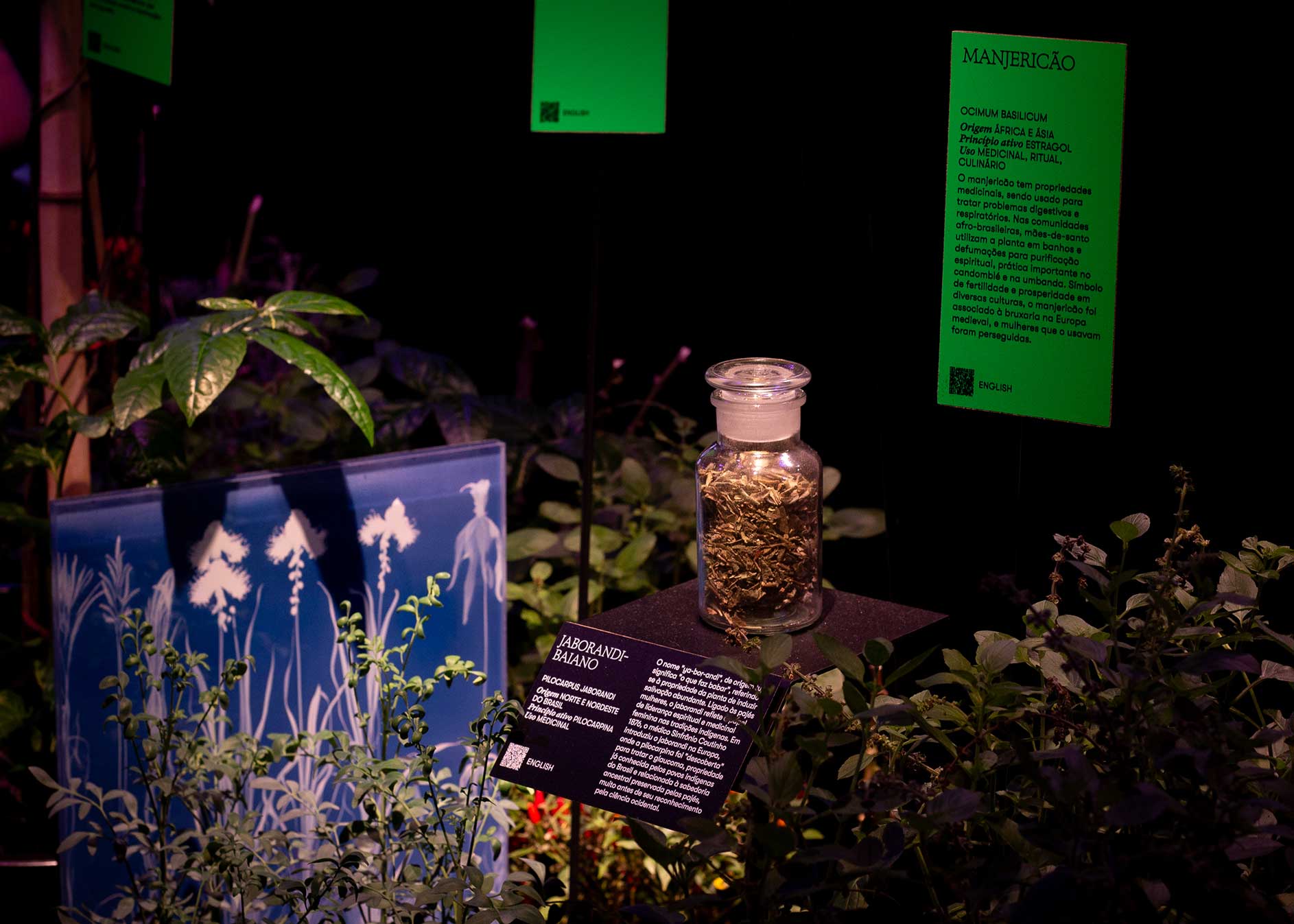
Exhibition View at Centro Cultural Fiesp in São Paulo, Brazil
Julia: Censored in what way?
Giselle: Platforms and companies are constantly defending themselves against lawsuits. Platforms are designed to make money, and for that reason, they are concerned about avoiding legal action. How do they do this? They create filters to prevent certain discourses from gaining traction because hegemonic thought can easily turn into fascist ideologies. We are witnessing this in real-time.
I work with sensitive themes, sensitive words, and now with plants—not only addressing delicate issues such as antisemitism, racism, and misogyny, which I explored in my latest exhibition Botânica Tirânica, but also expanding into psychotropics, hallucinogens, aphrodisiacs, and stories of women who have suffered extreme gender-based violence.
The platform reacts primarily to terms. That’s when it threatens and warns me. I used to be afraid of the blue screen of Windows. Now I fear the black screen of artificial intelligence—the one with a black background and white text.
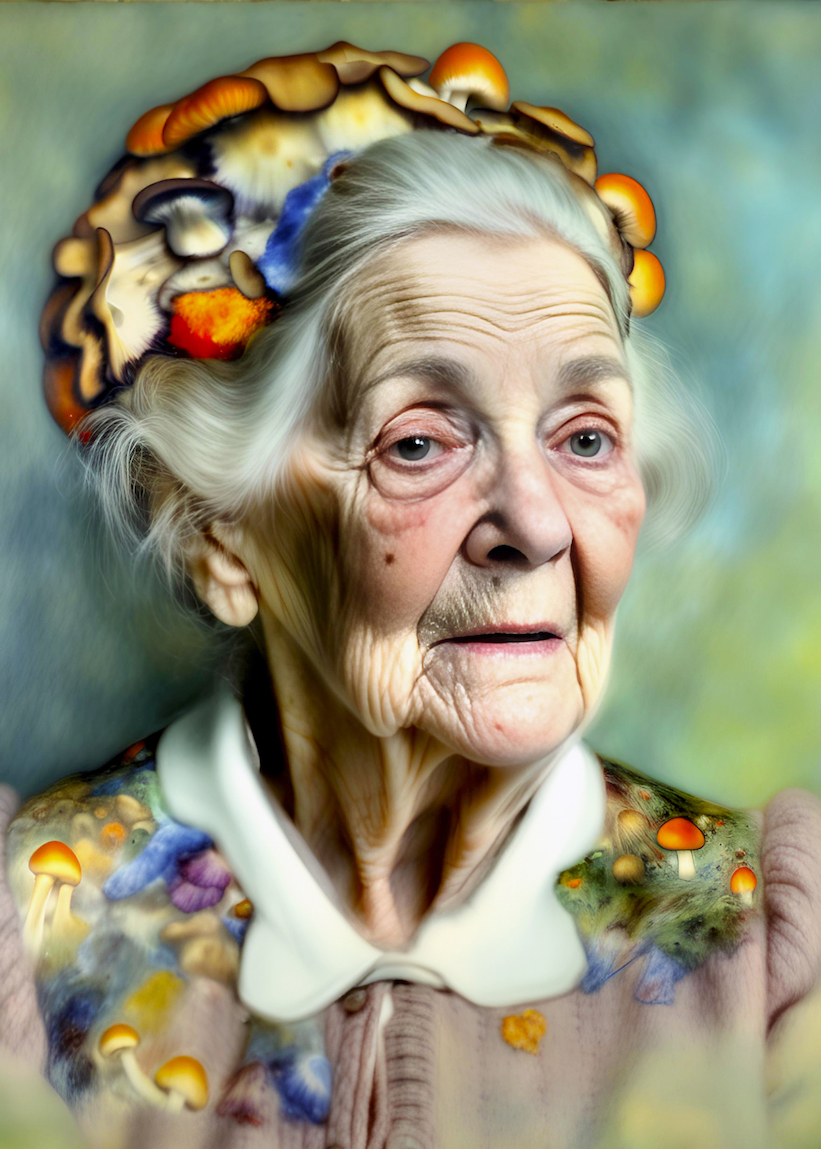
Invented portrait of Mary Elizabeth Banning (1822-1903), author of "The Fungi of Maryland" published in 1888 and today considered the first scientific work dedicated to mushrooms in the United States
Julia: How does artificial intelligence reinforce ageism, particularly in its depiction of older women?
Gieselle: I have deeply felt this anxiety around erasure, the weight of age, and how it limits access and mobility. There is an entire system of violence and erasure against women over 60. The risk of being forgotten, of having one's history neutralized, is immense.
Is artificial intelligence inherently terrible? No. What’s terrible are the humans who produce horrible datasets, shaping how youth-centric imagery always dominates. I see how this resonates with many people, especially women.
When generating images of women, they usually start out very badly. The first phase is always about imagining—AI begins by guessing, and the fastest thing it produces is anime-like dolls: beautiful, clichéd women. Then I start negotiating age, providing references, and suddenly, the women appear as frail and decrepit.
This shows how old age is imagined as a state of sadness and defeat. But I didn’t want these women to appear as if life had beaten them down. I wanted to give them a dignity that the masculine world perhaps never did.
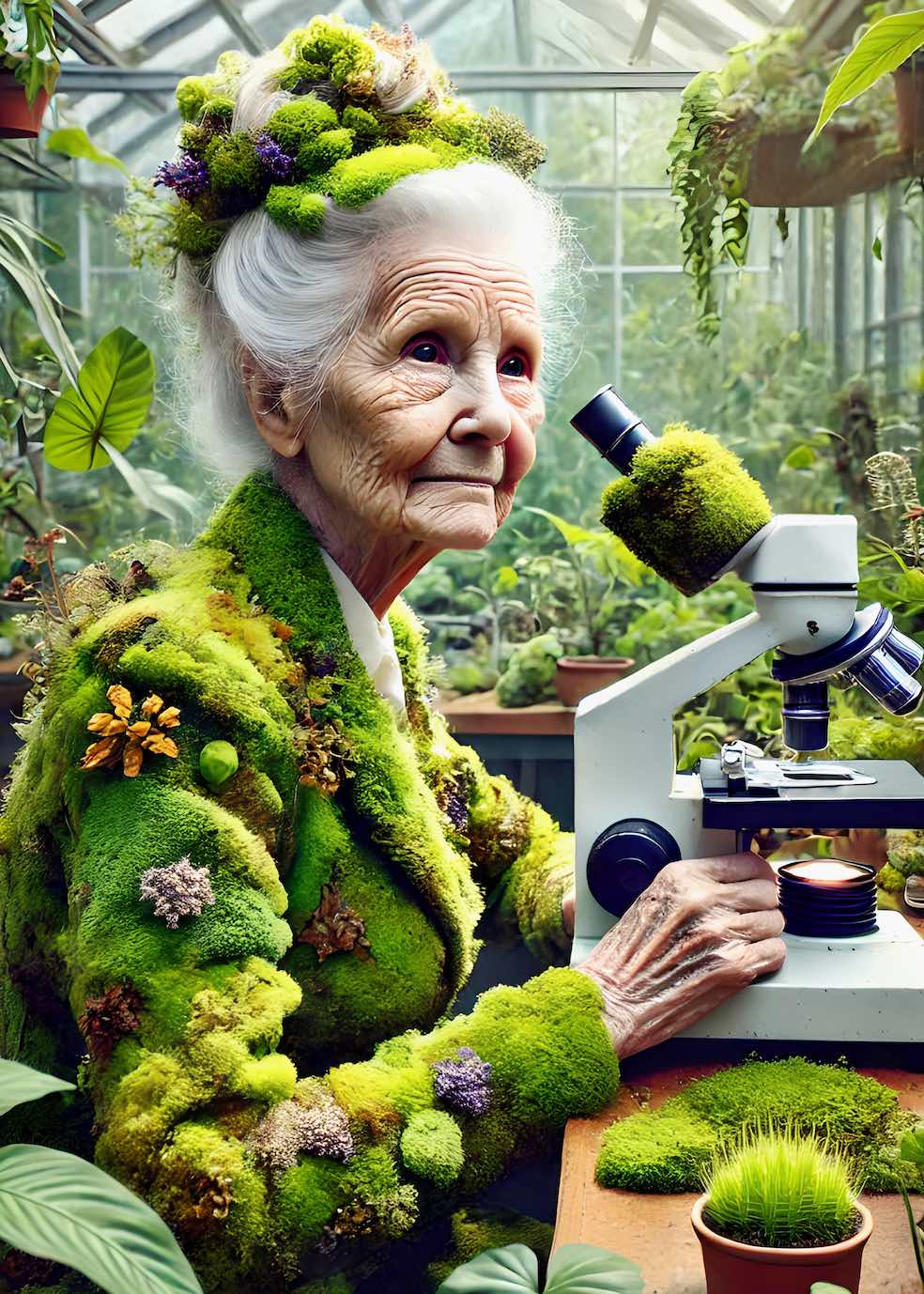
Invented portrait of Maria do Carmo Vaughan Bandeira (1902-1992). In the 1920’s she identified and classified more than 500 specimens of plants, Funghi and lichens
Julia: And the portraits you present in the exhibition are truly striking, as they blend these beautiful, ageing women—their wrinkles, their marks—with flowers and plants. When and how did you start exploring this connection between women and plants?
Giselle: I started researching plants and artificial intelligence at the same time, and I don’t think that’s a coincidence. I fully immersed myself in these intelligences—beyond the human ones—whether mechanical or from other species. I’ve been around plants since I was a child, and I love them.
The first things I researched were mushrooms. Today, we know they aren’t plants—they belong to their own kingdom, fungi. Mushrooms have long been associated with witchcraft, with women condemned as witches for possessing them, and even with Nazism. The Nazis created a character called the "poisonous mushroom," which became the foundation for an entire Nazi pedagogy. To this day, the educational book The Poisonous Mushroom is the best-selling propaganda book in history. The idea behind it is that something may appear harmless, but it isn’t.
As I continued researching, I realized there were many other plants with similar stories. I began linking the erasure of these plants to the erasure of history itself. Some plants have cruel histories, like henbane, mandrake, and foxglove. Others were long associated with ritual use—indigenous ceremonies, African ceremonies—which colonizers viewed with both fear and repulsion.
Take chilli peppers, for example. Today, they are widely consumed, but they were once associated with "vulgar" cuisine and, above all, with women who had strong sexual appetites. European elites scorned them. Or erva-mate, which was believed to make indigenous people more alert. In its raw form, it’s pure caffeine. Missionaries feared this, so they categorized it as a "demonic plant."
The exhibition opens with the story of Eve—a Black woman and the first woman to be stigmatized because of a poisonous, suspicious fruit: the apple. The association of evil with the apple is a Western, Catholic invention. The exhibition connects these narratives, and it’s fascinating to see how people recognize familiar things yet also realize how much they don’t actually know about them.
How many women were burned at the stake simply for using basil?
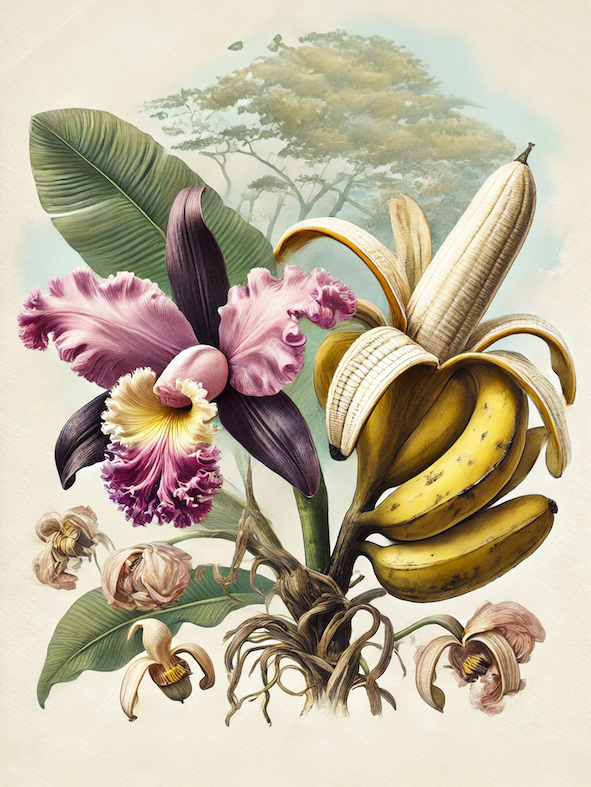
The gallery of invested plants is presented at the exhibition as videos and photos amidst the garden of real plants
Julia: This is such an extensive, in-depth research project—I imagine it must have been difficult to translate all of this into an exhibition space. And it turned out incredible!
Giselle: Yes, it was very challenging. The exhibition consists of the videos and photos I created of these women, but also the physical plants in the space. It is housed in an environment completely inhospitable to plants—a dark corridor, underground, in the middle of Avenida Paulista, the main avenue in São Paulo.
We also mixed invented plants into the living plant garden, weaving fictional stories about the invented plants with speculative narratives and the biographies of real ones.
The text became part of the artwork itself. And I’m surprised by how much people engage with the reading. You, I, we’re used to exhibitions—we know that most people don’t stop to read. But here, visitors pause at every label, every video, every bit of information. It’s a process of discovery.
Many people have cried here, especially women.
-
Poisonous, Noxius and Suspicious is on view at Centro Cultural Fiesp, in São Paulo, Brazil through April, 4th.
Click here to learn more about the exhibition.
Giselle Beiguelman is an artist and professor at FAU-USP, the School of Architecture and Urbanism at the University of São Paulo. She researches archives and preservation methods for born-digital archives, art and activism in the networked city, and the aesthetics of memory in the 21st century. She is the coordinator of the FAPESP Thematic Project Digital Archives and Research: Art, Architecture, and Design and the author of Políticas da imagem: vigilância e resistência na dadosfera (UBU Editora, 2021; 2nd ed. 2023) and Memória da amnésia: políticas do esquecimento (Edições Sesc, 2019), among others. Her artistic works are part of museum collections in Brazil and abroad, such as ZKM (Germany), Jewish Museum Berlin, MAC-USP, and Pinacoteca de São Paulo.

The gallery of invested plants is presented at the exhibition as videos and photos amidst the garden of real plants