.svg)
Menu

Crosslucid is an interdisciplinary artist duo whose work blurs the boundaries between reality and fiction, organic and synthetic, and self and collective identity. Through a fusion of photography, digital art, and gaming, they explore themes of post-humanism, technology, and the ever-evolving nature of identity in our hyper-connected world. Their surreal, visually arresting works challenge traditional notions of the body, reality, and the impact of technology on human perception.
In this Q&A, Sylwana Zybura and Tomas C. Toth, the creative minds behind the Berlin-based collective, delve into their creative process, inspirations, and how their art navigates the intersection of technology and humanity.
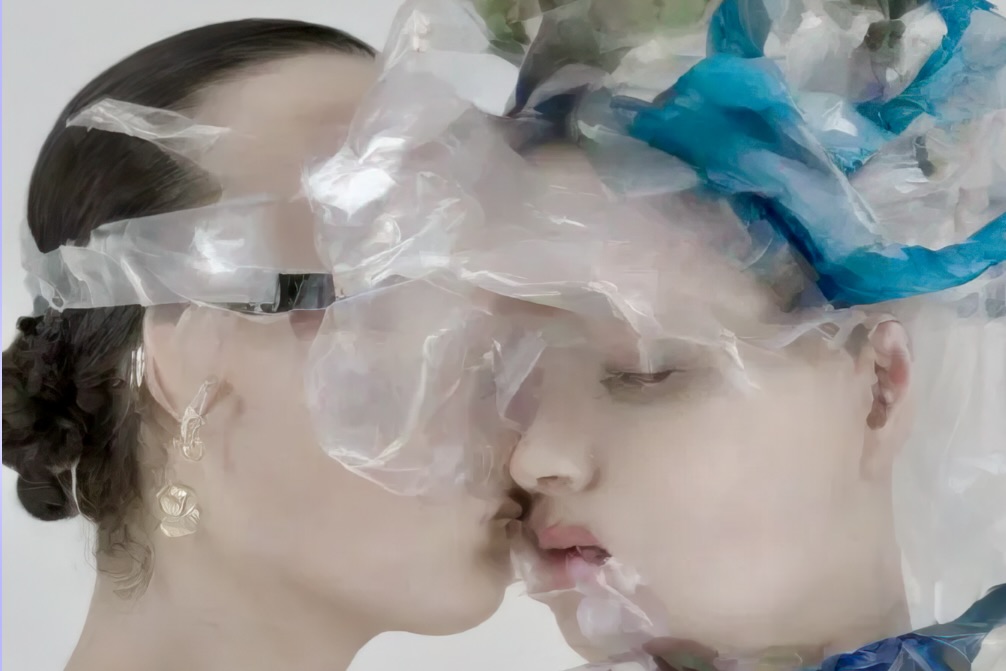
Julia: At Office Impart [the great digital art gallery showcasing your work in Berlin], I got to see your first publication, “Landscapes Between Eternities’(2018), as well as the digital and participatory outcome of this work, “we have never been human\alias” (2024), in which audiences can play with your models. I was mesmerized. Can you explain how these projects took form?
Tomas: We were looking a lot at the possibilities of filters and the change of identity across different platforms. And this shifting of nature, of appearance, of level of identity. It actually started with the portrait of our close friend at the time, who shared with us his skin condition, a type of sickness that always makes your skin itch and always creates this discomfort of being in your skin. He shared this dream with us, his desire to be covered maybe fully in Vaseline. Something of dancing and sweating, of getting out of that skin. And then we were just like, ‘yeah, let's do that’. The project really works towards reimagination of ourselves more as a network, something that is constantly in change and is not a container; the skin doesn't contain it.
Sylwana: And it's really beautifully connected to all the further explorations and even to the latest one with creation of the model where identity is almost dissolving and it's always becoming. We trained the model by altering the parameters a little bit. This is the model; this is the container of the world that you are invited to play, and you can use the prompts, and you can create things that maybe we wouldn't even think of to create.
Julia: Before that, when did you start working together?
Tomas: We met back in London in 2014 and started collaborating on commercial projects at the time. And then it came like pretty organically that somehow the ideas and research that we were interested in, in relation mostly to technology and how technology shapes the self and the different concepts that we hold, and then how it can sort of map out beyond the boundaries of conceptual frameworks. We didn't find a space for that within advertisement. And that's how we got to Berlin, to find our way in the art world.

Julia: How are the latest technologies essential for developing the most important concepts of your practice?
Sylwana: I think what is really exciting about our practice is because it's co-evolving with technology. There are different outputs and modes of operation, almost like prototyping futures and seeing how we can utilise these technologies. But also, you can see them as co-creators and maybe like different species rather than something that's extractionist to give us a new perspective on ourselves and the environment around us. So probably like AI is currently the main of the tools, but it might be that something else will emerge in the next months, and we will definitely be interacting with it. So it's always kind of exploring the unexplored.
Each project is, although all very connected conceptually, very different in the output. It can be an installation, a printed body of work, an interaction, or a certain kind of game-type experience. We are now developing one for LAS in Berlin that we'll launch directly after the art week.
Julia: LAS! I have been accompanying the exhibitions they develop, and it is all really exciting. Tell me more about this project.
Sylwana: It's an online activation with four different projects. It's a collaboration with an artist and or artist collective with a science fiction writer. And there might be an activation in physical space. This is a kind of initiation of the project we have been working on since April. It's communal storytelling with live AI generation. So, it's technically very complex because these pipelines don't exist. So we had to develop them with collaborators from London and the sci-fi writer Orion Facey.
I think that LAS understood very well that it requires investment in order for those projects to actually scale. Like in a film almost, it’s important to involve other voices. It was actually quite beautiful that they trusted us with the process without us knowing the final outcome because it didn't exist yet. And this is kind of what we miss very often with institutions.
Julia: What is your relationship with collectors and with NFTs?
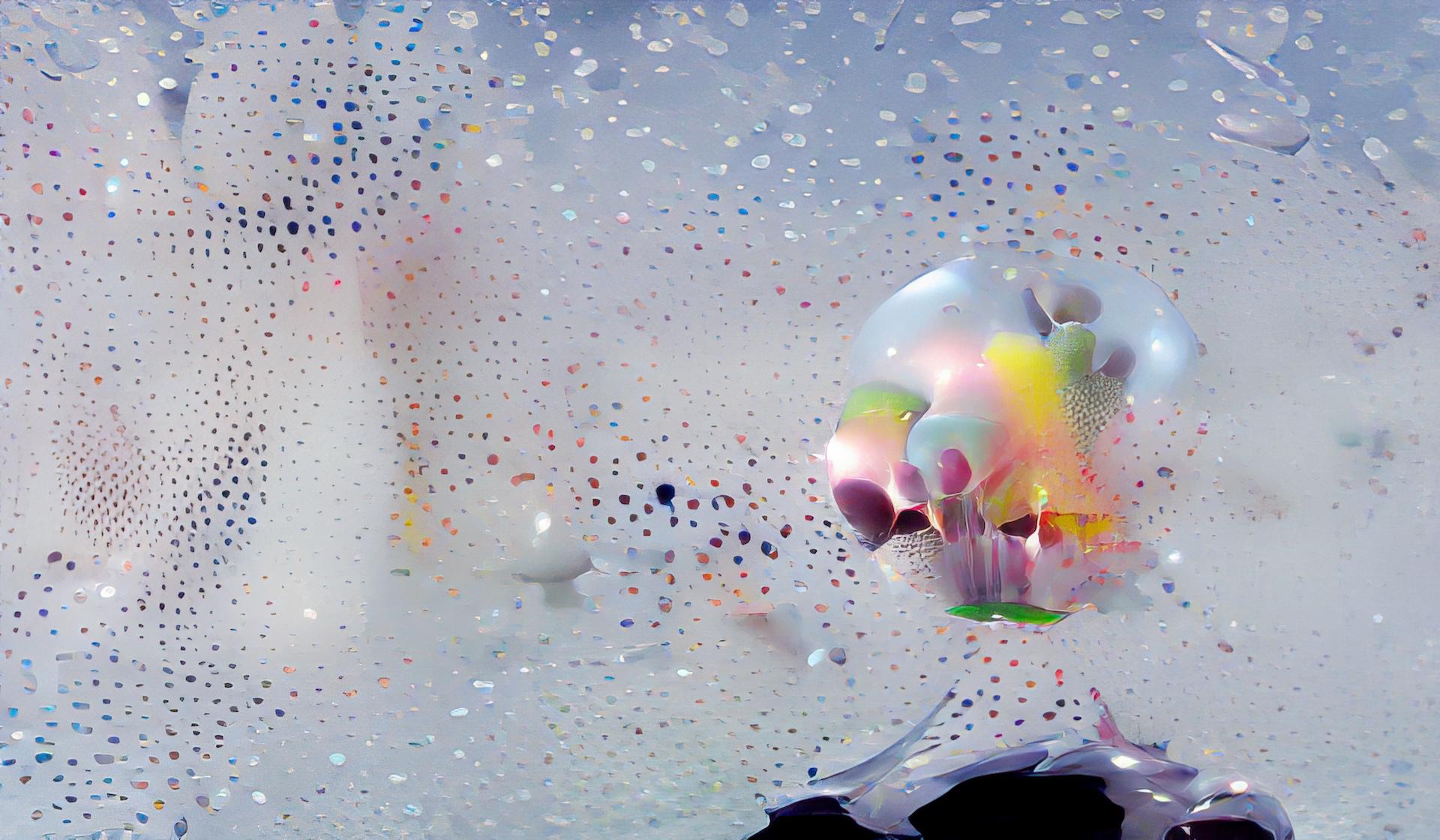
Sylwana: So we kind of decouple NFT from the physical piece. We see NFT only in the sense of a contract and provenance, really. So we give the collectors the possibility of acquiring a digital piece, which is the NFT, which attributes the provenance to the person, but they can purchase additionally a print. And we made this experience with many collectors that if they collect digital art they don't want a physical piece connected to it.
And then the physical piece can work in accordance to the needs or the wishes, can be adapted and also the, you know, because the physical piece is also the size, the paper, how it's going to be presented. These are all decisions that can be made together with the collector if they feel like it. So I think that the agency there is also quite important.
In the meanwhile, the digital project “Red The Ocean Around U” was launched. Accessible on LAS website until December 2025, this distinctive online experience invites participants into an immersive and continuously evolving narrative ecosystem, highlighting the notion of games as a poetic manipulation of agency. Click here to play.
Current and recent selected exhibitions include: MetaCity at Shanghai Architecture Biennale (CN), Vellum LA (US) , EPOCH.Gallery, The Osaka Museum of Fine Arts (JP), Francisco Carolinum Linz (AU) iMAL (BEL), Expanded.Art (DE), Art Encounters Biennial (RO). Click here to learn more.

