.svg)
Menu
It took six years for Eduardo Kac to create Adsum: a glass cube laser-engraved with the words “Here I am” in Latin. Measuring just 1 × 1 × 1 cm, the sculpture can be held between two fingertips and, under ordinary circumstances, would take no more than a few minutes to fabricate. On its own, such an object would hardly place a Brazilian artist among the most innovative figures on Earth.
That is precisely where everything changes: Adsum was not created for Earth, but for space.
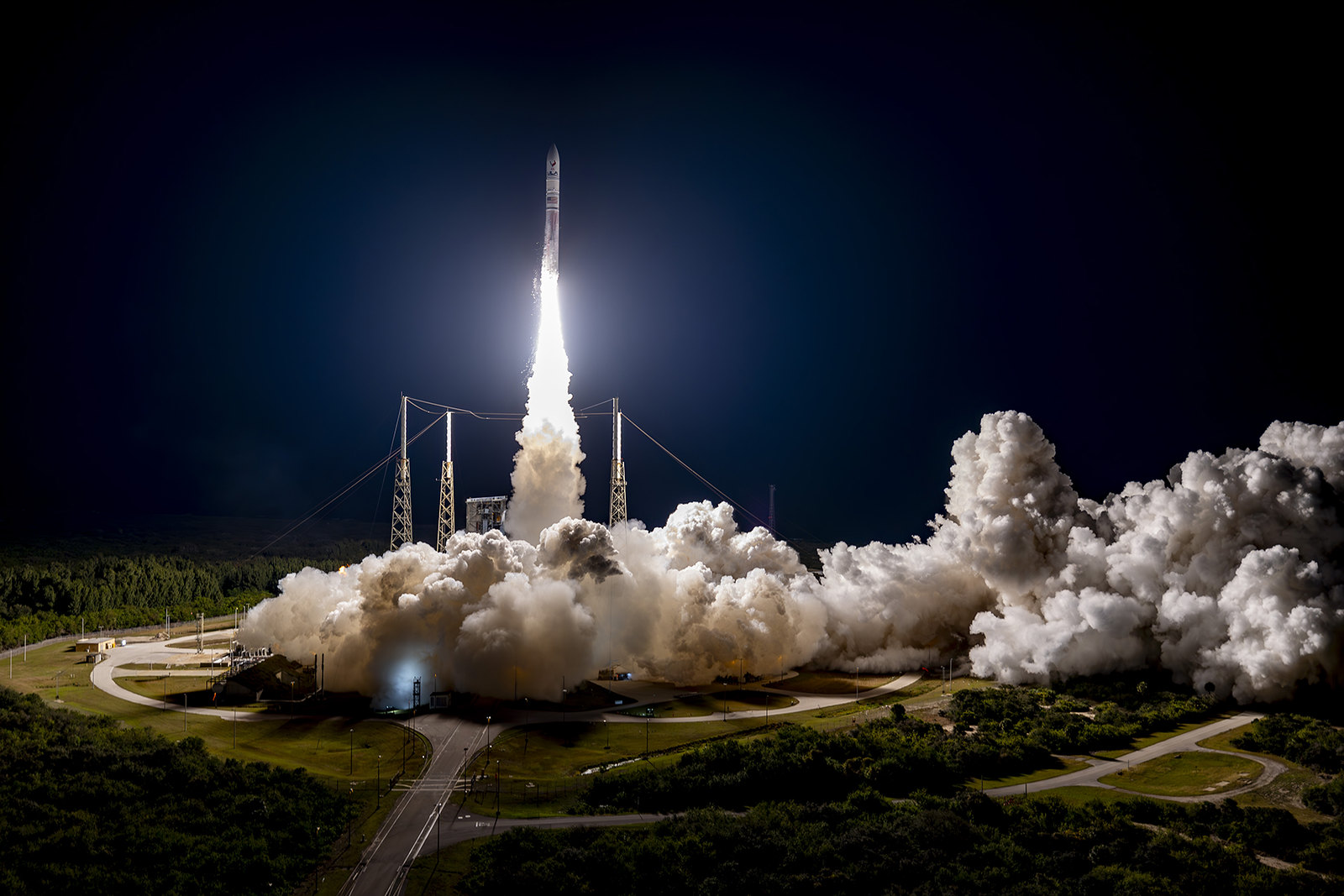
The work landed on the Moon on March 2, 2025, after traveling onboard a SpaceX Falcon 9 rocket launched from the Kennedy Space Center in Florida on January 15, 2025. The artist-scientist is widely recognized as the first artist to conceive and realize an artwork specifically for extraterrestrial conditions. In 2017, in collaboration with French astronaut Thomas Pesquet, Kac launched Inner Telescope: a sculpture made of cut paper in the shape of the letter M. In a zero-gravity environment, the poem has neither beginning nor end, floating freely in orbit. Depending on its orientation, the word moi (“I,” in French) emerges.
If we are talking about art and technology today, Eduardo Kac has been at the forefront for more than forty years. Producing some of the most cutting-edge work since the 1980s, he is the creator of what we now call bioart - a practice that works directly with living organisms, manipulating and creating DNA, proteins, and cells. One of the most emblematic examples is GFP Bunny, in which molecular biology from a jellyfish was combined with a rabbit named Alba, whose skin glowed fluorescent green. In 1997, Kac also became the first human to implant a digital microchip into a robot.
Despite all this, Eduardo Kac has no social media presence and shows little interest in the contemporary hype surrounding blockchain, NFTs, or cryptocurrencies. Something of a deep-space extraterrestrial, he remains committed to connections and conversations, to works that unfold over decades, and to a practice that may continue long after we are no longer here.
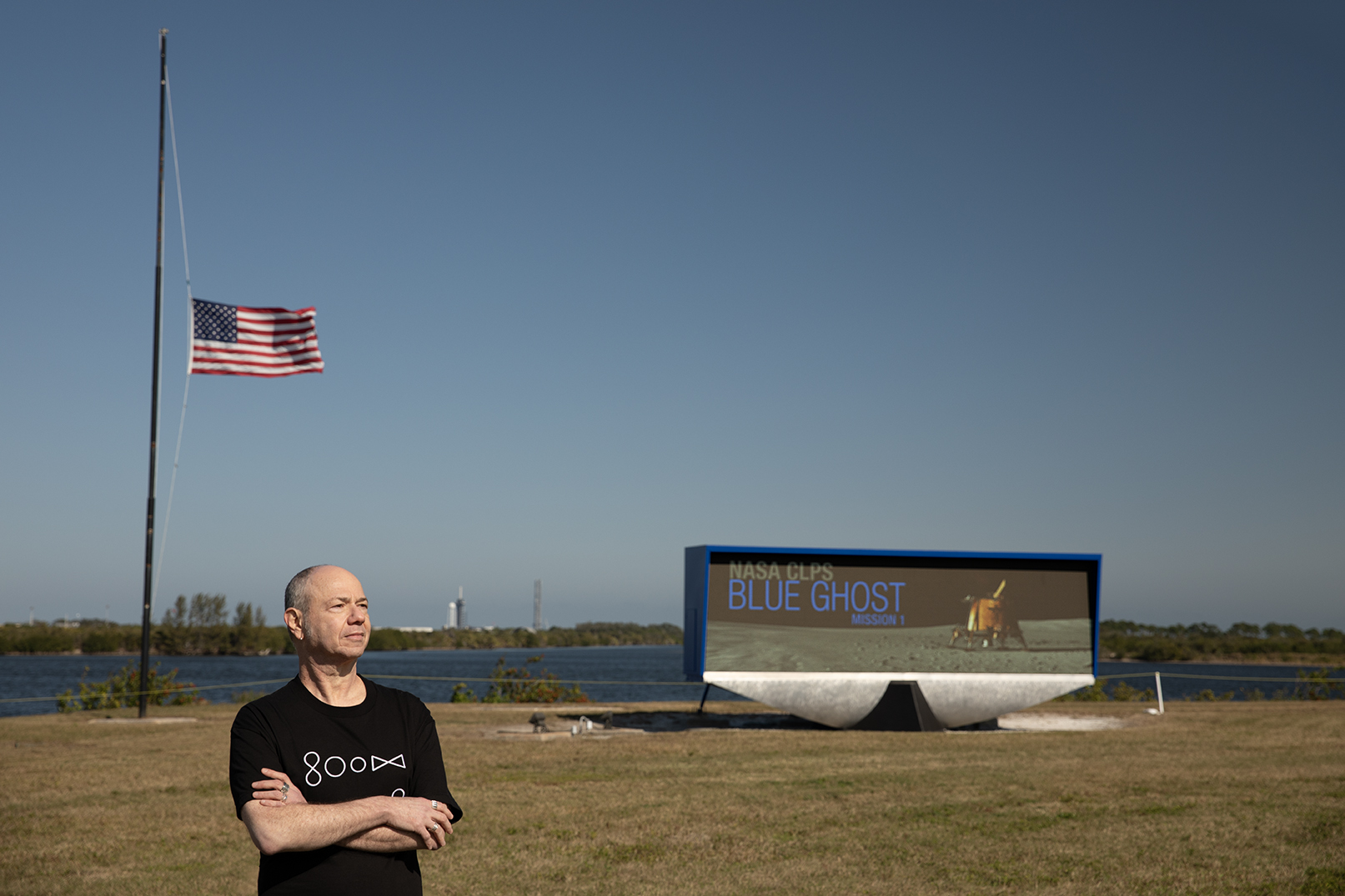
Eduardo Kac in front of Launch Complex 39A (LC-39A), Kennedy Space Center, Cape Canaveral, Florida, on January 14, 2025, thirteen hours before liftoff. Photo: Warren Cockerham.
Julia Flamingo: What changed in the last decade that led institutions to revisit your early digital work?
Eduardo Kac: In the last ten years, international institutions turned their attention to rescue the early days of digital art, of online art. Several international museums made exhibitions. And then, in this context, what I did in the beginning of the 80s, beginning of 1982, was rediscovered. Above all, the fact that I created some of the first online works, in 1985.
It wasn’t on the Web, it was the French Minitel network. It took me a long time to recover this work, because restoring a digital work isn’t easy. In the 80s, the more you go back in time, the more complicated it gets. It took me 15 years to complete the restoration. It was a gigantic work, exactly as it was at the time, without taking away the perfect color. And that’s what I wanted. It’s no use doing the work to get an approximation. It has to be restored as it was.
And the first time we displayed the work properly restored was in 2015 at the Whitechapel, in London, at the Electronic Superhighway exhibition. The exhibition was very beautiful.
Well, that’s when it all started. Then, there was that exhibition at the New Museum, The Art Happens Here.
Tate was the only museum that bought the four pieces on Minitel. Reina Sofia has one, MoMA has one.
So let’s say my digital life was rediscovered, especially in the 80s and 90s, from this whole story. People started to look a little more: what’s before, what’s after. The Minitel was a bit of a reference, but people started to look more. Private collectors have been looking. There are works before and after in other collections.
And now I think there’s an understanding that Eduardo is not “just” a bio-artist.
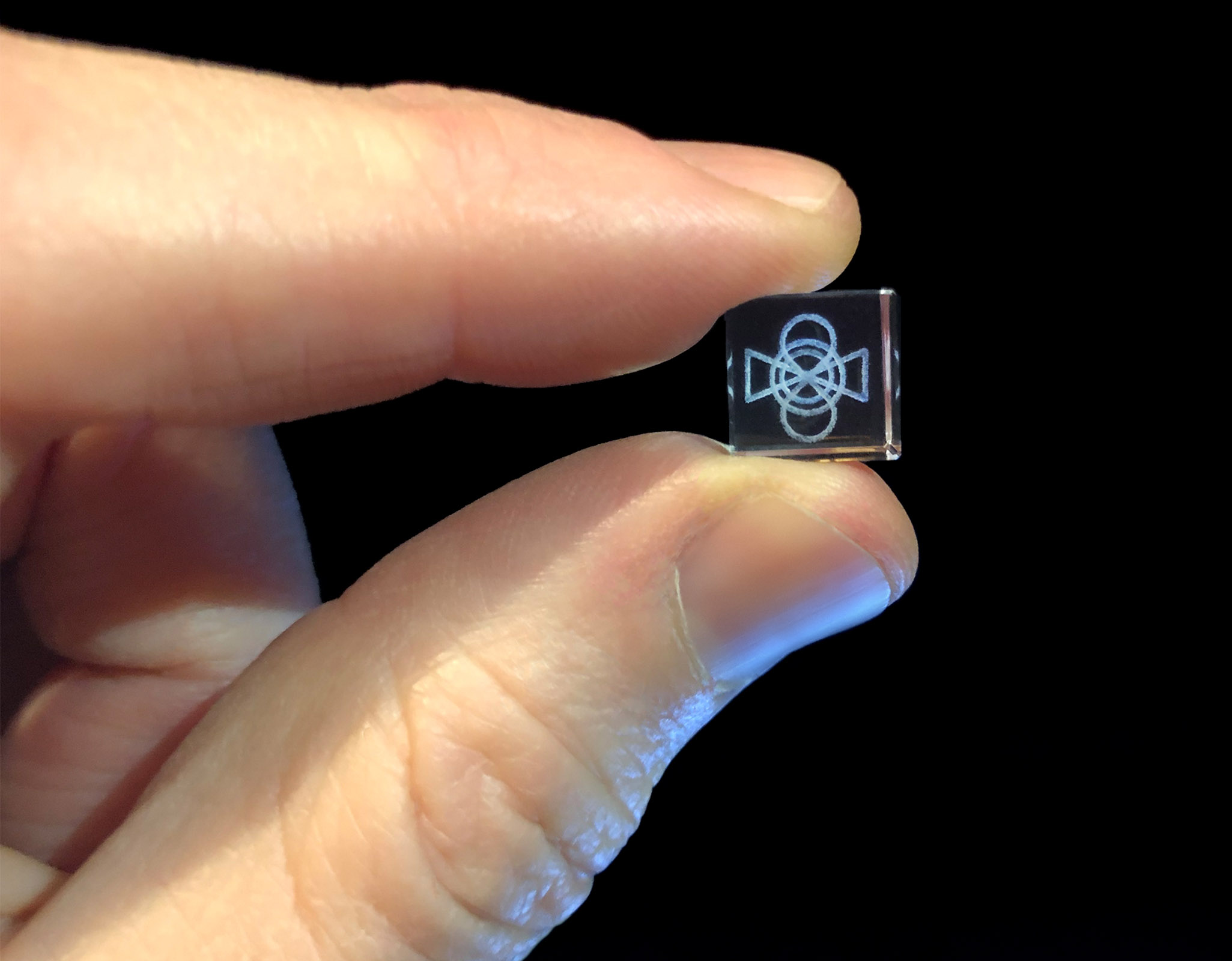
Eduardo Kac, Adsum (2019), space artwork (laser-etched optical glass), 1x1x1cm (0.39x0.39x0.39"). Adsum landed on the Moon on March 2, 2025, at 2:34 am CST. Edition of 5. Credit: Kac Studio.
When you say “spatial art,” what do you mean?
When I talk about spatial art, I’m not referring to the production of images that represent anything related to space, like those backgrounds many people use.
For me, spatial art is really about working with the materialities of space exploration. Of course, it can involve zero gravity, but not necessarily. On the Moon, for example, there is gravity - one sixth of Earth’s gravity. These extraterrestrial environments have very particular characteristics, very different from working on Earth.
It’s a logic so different from everything else that it truly requires focus. It’s different from digital, it’s different from everything.
I wanted to make this preamble to say that this work I’ve been developing with a lot of patience since 1986, and that now, since around 2009, I’ve been placing greater focus on it. My central focus is really the development of spatial art - taking it further and deepening it. I’ve also learned a lot over these decades, and today I’m able to move forward more. For example, this work [Adsum] that I landed on the Moon on March 2, 2025 took six years of work.
So you see, I’m already managing to shorten this time.
But it makes a difference to shorten the time needed to realize a work in this context, because working in space is very difficult. And it’s not me who says this - NASA says it.
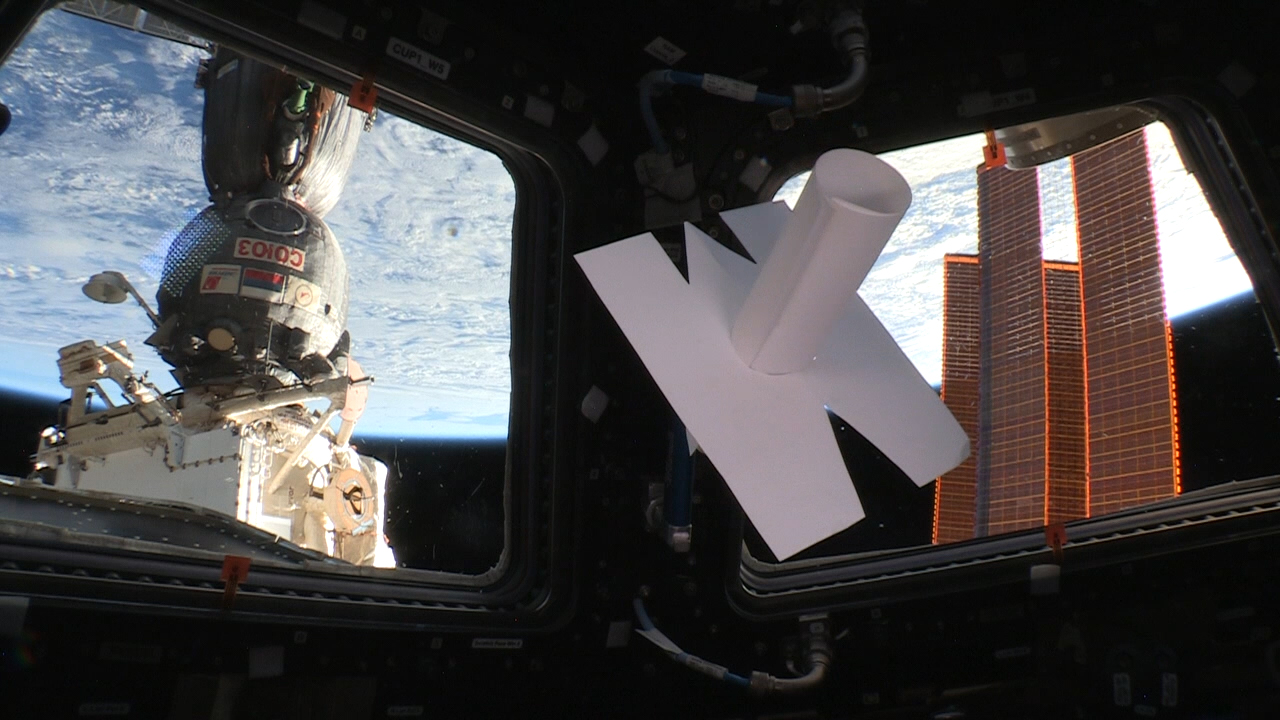
Inner Telescope floating in the International Space Station (ISS), in orbit around the Earth
Have you ever thought about going to space? Have you had that desire?
If the opportunity presented itself, I would certainly accept it. You have to do training, but to go into what’s called Low Earth Orbit, it’s not that complicated.
Of course, it must be a gigantic emotion. The vibration of the rocket at launch must be incomparable to anything. The anticipation, the restlessness, isn’t comparable to being on an airplane. I can only imagine being up there on top of a capsule, with that fire pulling, lifting you vertically. That experience must be incomparable. It must be incredible. And seeing the Earth from outside must also be incomparable.
So if the opportunity presented itself, I would accept it. But the current costs are prohibitive. Naturally, over decades and centuries, flights will become commonplace and priced like airplane travel. But that will take a long time. I believe it’s a matter of centuries, not decades.
But it will happen.
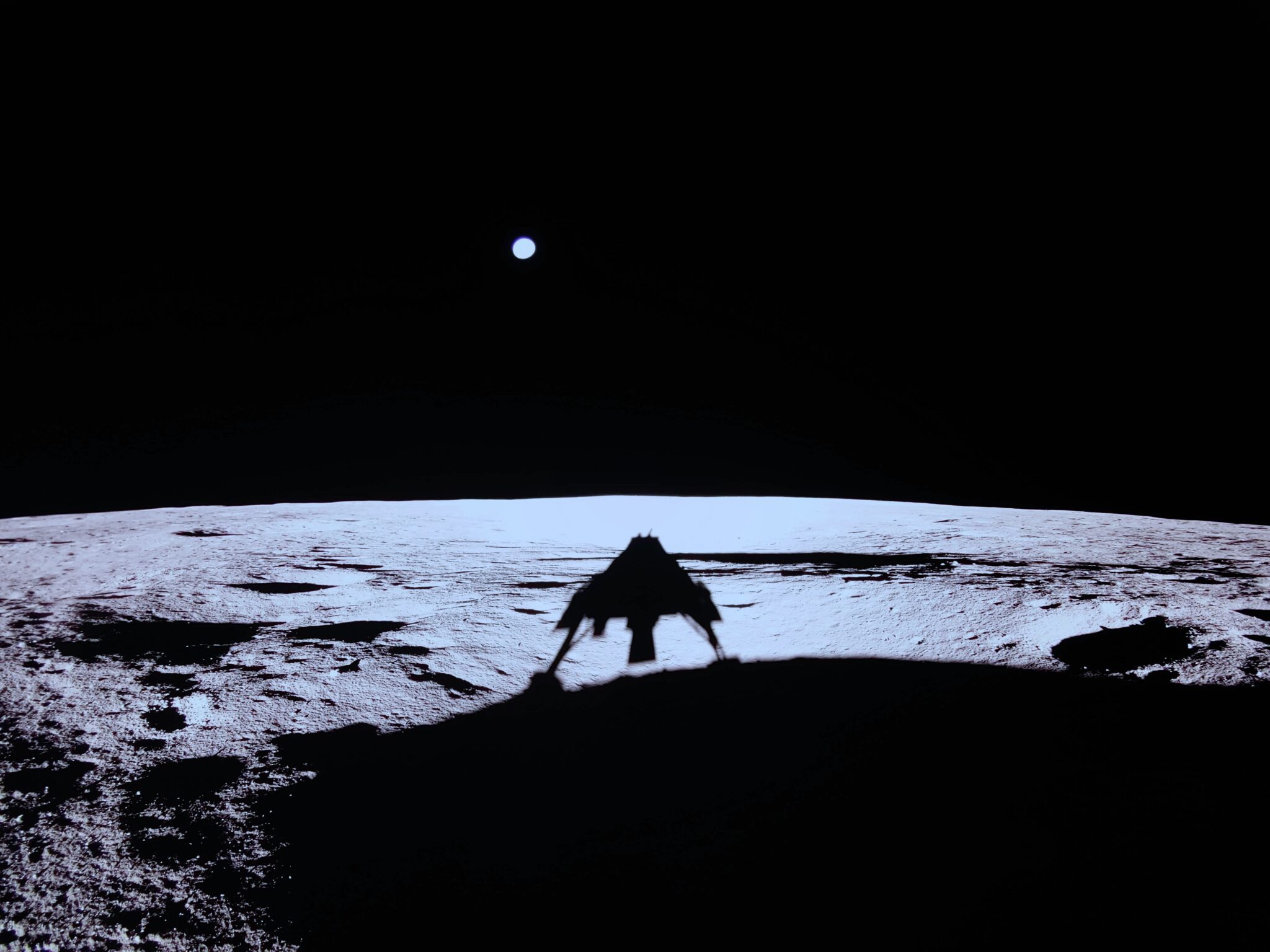
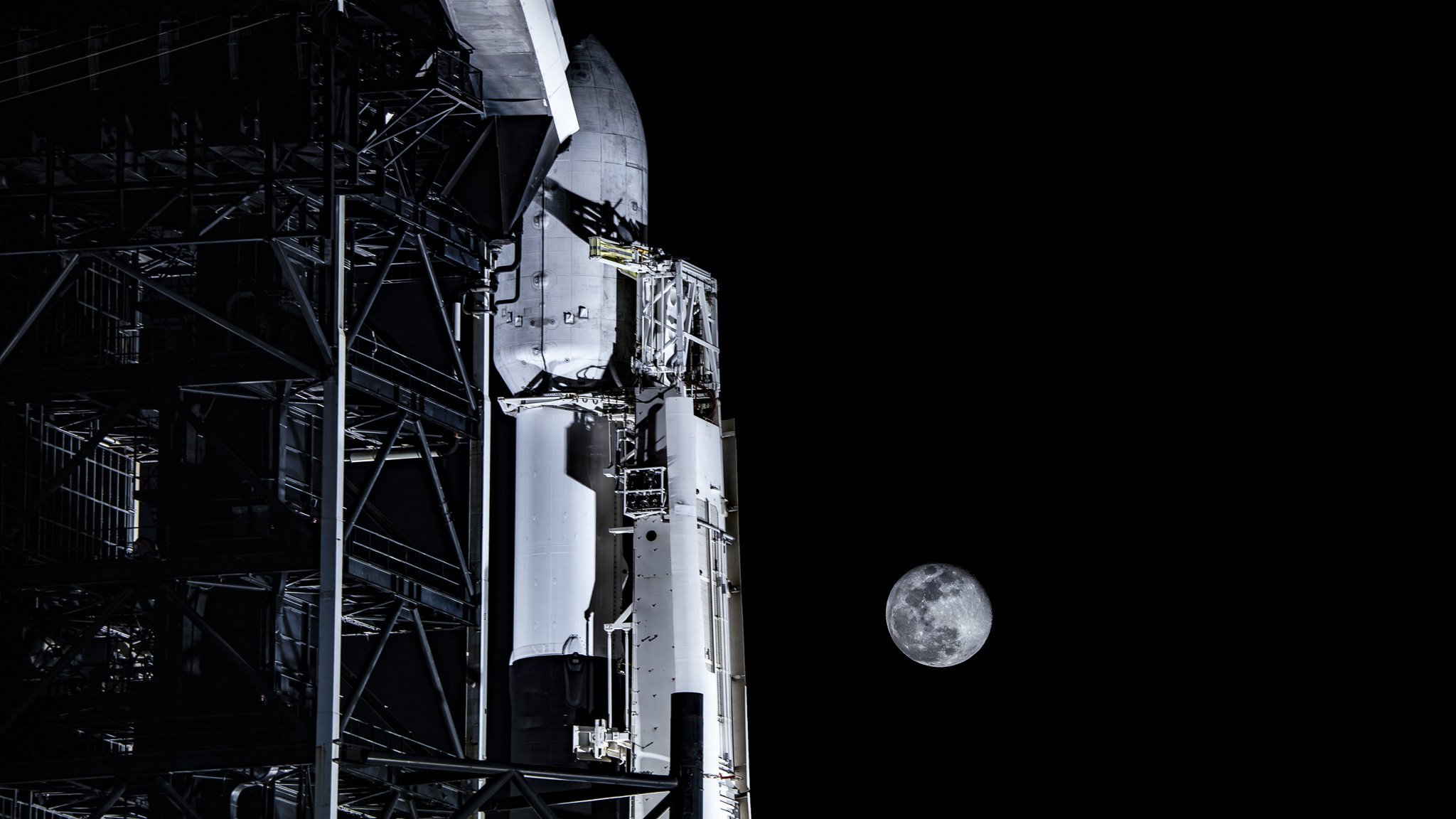
Adsum landed on the Moon on March 2, 2025, at 2:34 am CST. At 5:15 am CST, after softly touching down on the surface, Blue Ghost captured an image of its shadow with Earth on the horizon. Credit: Firefly Aerospace.
How do you finance your work?
I don't have anyone financing. If I put the question that way, I don’t work. If I think that way, I don’t do anything.
Since I can’t work intensively because of the non-existence of funding, the only way I can work is extensively. Funding would allow me to work intensively. If I had millions of dollars, I could land parachutes wherever I wanted, red carpets would roll out. But when you don’t have millions of dollars, you have to be creative in your approach.
The way I compensate is time. That’s why the project that began in 1986 took me 38 years.
What finances the production of new works is the sale of works that already exist. In the end, all artists are like that. What’s interesting is that funding agencies work with deadlines and want to see a return. And I can’t guarantee success. I can’t guarantee success.
In these flights, there are many competent, intelligent people working to make it work. Everyone wants it to work. The flight to the Moon that landed on March 2 cost 105 million dollars. Everyone wants it to work. But something can always happen that you don’t anticipate, and that can result in the failure of the mission.
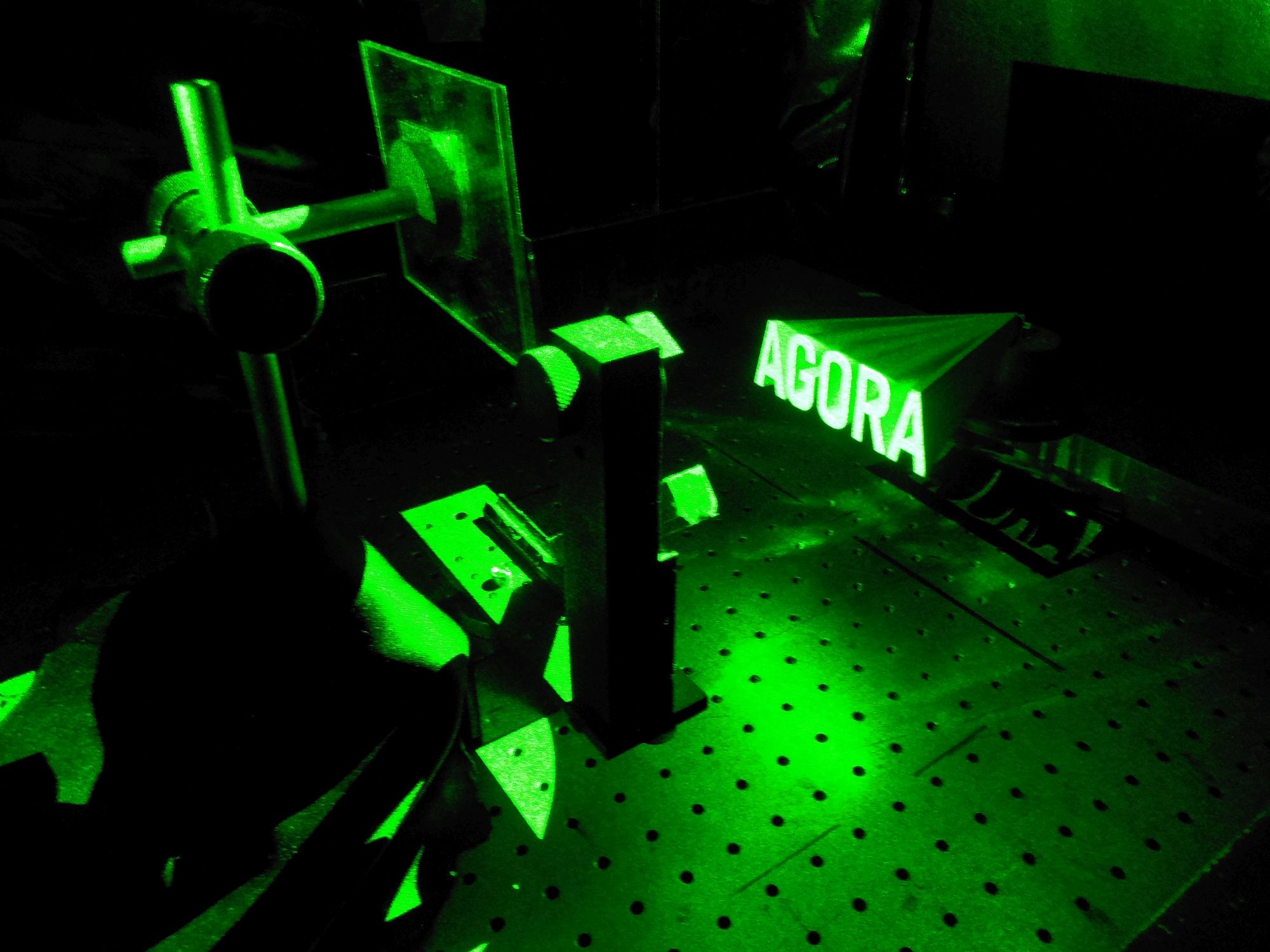
The making of Eduardo Kac’s, Ágora, shot with a pulsed YAG laser at 532 nm on laboratory-made silver halide holographic emulsion.
I wanted to tag you several times on Instagram, but I noticed you don't use social media accounts. Why is that, Eduardo?
For several reasons. Basically two. When social networks started, it became very clear that no one read the fine print. Everything you put there is automatically owned by the company. They have the right to resell it, do whatever they want with it.
So I thought that this was not correct, and that this compromised the intellectual property of my work. Another thing I understood is that this is a communication channel that you need to constantly feed to do right. It’s like television. You can’t broadcast from two to two fifteen and stop for lunch. You have to constantly feed it.
I don’t like to work like that. When I do something, I want it to be punctual, well done, and presented. When I have nothing to say, I stay quiet, working. When I have something to say, I go out and communicate it. When I don’t, I go back to the studio and work in silence.
The making of Eduardo Kac’s, Ágora, shot with a pulsed YAG laser at 532 nm on laboratory-made silver halide holographic emulsion.
And how do you do it, then, to reach people - the public and collectors? How do you create and maintain this network?
I think what’s interesting is what we’re doing now: a deep conversation, a true connection. I’m not attracted to superficial, fast exchanges. Lightning bolts without depth. It’s the economy of attention, where no one really pays attention. You’re always moving from one thing to another.
Paul Valéry already answered this when he said: I’d rather be read many times by few than once by many. I’d rather have repeated connections with a small number of people than superficial connections with many.
It’s not about artificial exclusivity. If I could reach the whole planet being who I am and doing what I do, that would be wonderful. But maybe that’s not compatible with deep dialogue.
My work takes a long time. Ágora [a holographic word-and-image poetry created in 1986 and launched for perpetual interplanetary orbit in 2024] took 38 years. What would I say on Twitter for 38 years?
_
To explore more of Eduardo Kac’s practice beyond Earth and across time, visit www.ekac.org
