.svg)
Menu
Collaborating as an artist duo is an intense and deeply close relationship. Four hands and two minds - artist’s minds! - working on the same projects for years can be incredibly enriching and, at the same time, extremely challenging. Virginie Ittah and Kai Yoda have, from the very beginning, since they met at the Royal College of Art in 2013, understood their practice as a constant process of symbiosis, a term that refers to a close, long-term interaction between different organisms, where each contributes to and benefits from the relationship.
For them, collaboration is not a strategy. It’s the very foundation of how they’re able to combine their greatest interests: artificial intelligence and manual practices. Acknowledging that it’s impossible to know everything or master every technique, they reach out to specialists and craftspeople who bring in what they do best. It’s within this collaborative ecosystem that Ittah Yoda creates work that is both powerful and sensitive, where emotion and sensorial depth are never lost in the presence of digital technologies.
I first encountered their work at Galerie Poggi during ARCO Madrid in March 2025, and I can say with certainty: it was the most striking body of work I saw at the entire fair. Listening to how they arrived at that result was nothing short of fascinating.
*Throughout this interview, the artists’ responses have been presented as one, reflecting their shared voice and collaborative identity.

Portrait Ittah Yoda. Photo by Lucie Dumoulin, InstanT Productions
Julia Flamingo: I understand how you merged your work in terms of medium and form. Virgil coming from sculpture and Kai with a background in environmental studies, moving image studies and photography. The fusion of those practices transforms into something very interesting about your work, visually. but I’d love to know how your ideas and conceptual concerns became unified. You probably started with different interests — so today, what are the shared concerns that guide your practice?
Ittah Yoda: Our concerns circulate in phases, but one of the very first connections we had — even before we started working as a duo — was a mutual interest in the movement of the body or the face, rather than just the image of it. We were both looking at artists like Rodin or Thomas Ruff, exploring whether a portrait could go beyond the surface to express motion, memory, or something more internal. That became an early conceptual link between us.
We also share hybrid backgrounds — Kai is Swedish and Japanese, and Virginie has a complex mix of cultural heritages. This sense of hybridity, of living between cultures, religions, and geographies, was something we both intuitively related to, and it became central to our identity as artists.
Later, after we moved to France, we began to rethink the materials we were using — especially from an ecological standpoint. Before that, we had been working with resin and chemical pigments. But once we arrived in Paris, we entered a new network of curators and institutions. Many of them began asking critical questions: "How do you feel working with toxic materials at a time of ecological urgency?" And that made us reflect.
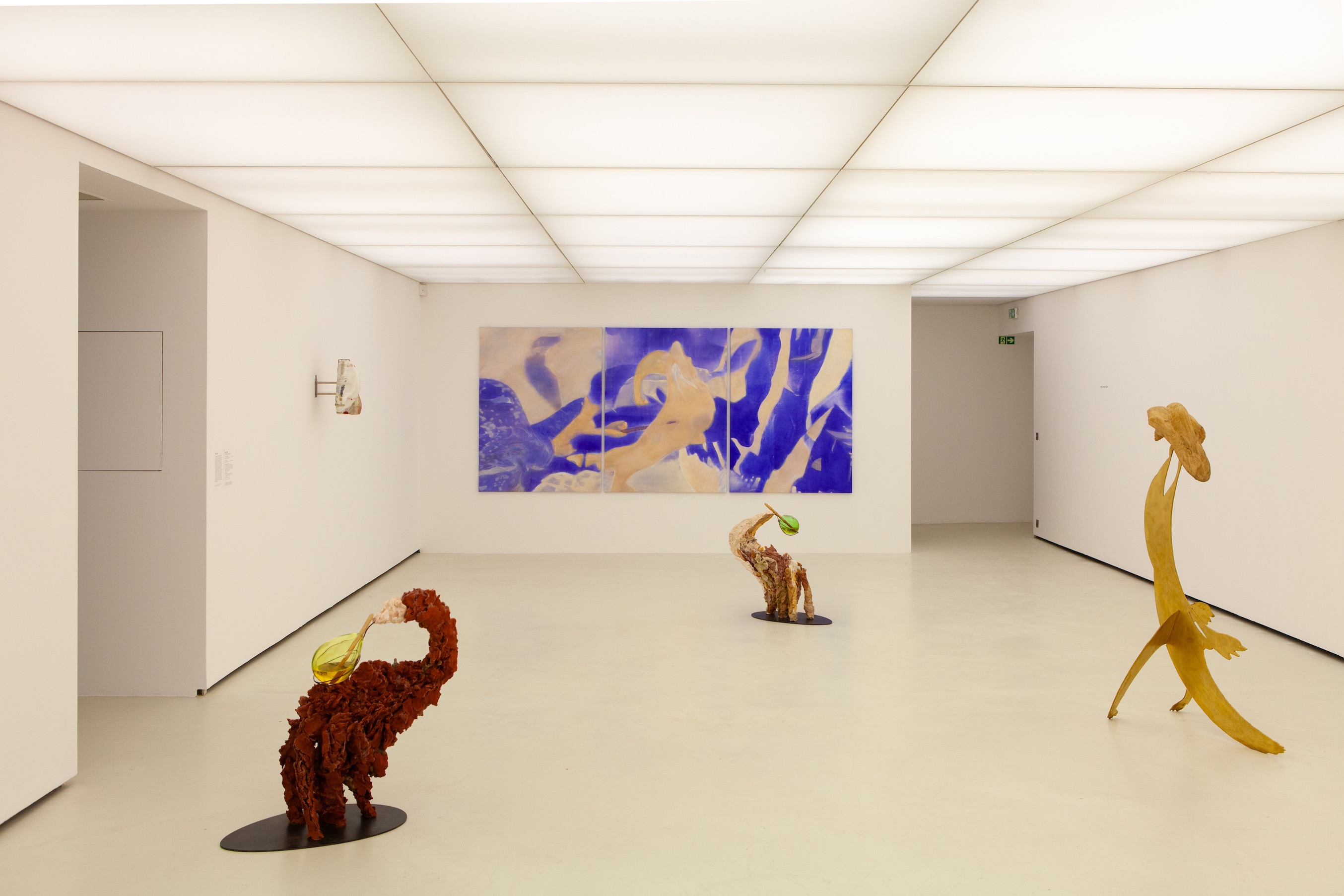
Revenir du présent, 2024, Collection Lambert. Photo by Ittah Yoda
That led to a complete shift. We stopped using resin entirely. We still start with digital creation — everything begins in 3D — but we now collaborate with artisans to translate those digital forms into organic materials like blown glass or wood. This transition also allowed us to tap into traditional French savoir-faire — working with local glassmakers, woodworkers, and craftspeople, combining technological processes with historic, even ancestral, techniques.
We also began doing residencies — like the one at the Institut de la Mer in Villefranche-sur-Mer — where we researched plankton and symbiosis systems. That was a key moment. These organisms, invisible to the human eye, live in constant cooperation. They survive by helping one another. This idea of mutual support and interdependence resonated deeply with us — both in terms of our identity as a duo, and in terms of imagining a post-Anthropocene world. A few philosophers call this the Symbiocene — a new era where humans and non-humans can support one another symbiotically.

Incarnation, 2021, Rencontres d'Arles, Couvent Saint-Césaire, 2021. Photo by Ittah Yoda
Julia Flamingo: I find it fascinating how you brought in the idea of plankton and this post-Anthropocene imaginary. But I’d love to understand more clearly how your use of artificial intelligence fits into this process. How exactly do you work with AI? And how does it combine with the traditional, manual aspects of your work?
Ittah Yoda: From the very beginning, we always developed our shapes in 3D software. Even when we were still casting in resin, everything started digitally. When we made the ecological shift, we kept the same digital base — but instead of resin, we began casting in blown glass, or working with natural fibers and organic pigments.
For example, one of the glass sculptures you saw at ARCO Madrid, which contained perfume, was actually partially generated by AI. We had received funding from the Centre National du Cinéma in France to develop a custom 3D software. We worked with an engineer to create a tool where we could feed in a “family” of around 200 3D shapes. The AI used this dataset to generate entirely new forms. These were then 3D printed, used to make plaster molds, and finally blown in glass by local artisans.

Series Win, sculpture Elina et parfum Lascaux, 2023. Photo by Ittah Yoda
So even though we work with traditional craftsmanship, the origin of the forms remains deeply connected to technology. That’s the dichotomy we love — the friction and harmony between ancient techniques and futuristic processes. In the show we’re currently presenting in Lyon, for instance, we used raw wild silk printed with digital patterns and overlaid with natural pigments, collected and ground by hand.
The project of collecting natural pigments started earlier — during a residency in Saudi Arabia. We asked ourselves: why keep buying industrial pigments if we could collect and process the materials ourselves? Since then, we’ve been gathering ochre and mineral stones near exhibition sites. For the Lyon show, we went to the surrounding mountains and collected golden and red stones, which we transformed into pigments and used in the wax sculptures and fabric pieces.
AI, for us, also became a way to go beyond our individual authorship. We wanted to create forms that felt like they came from somewhere between us, or even beyond us — something that didn’t feel entirely ours. That began when we worked with two creative coders who helped us build VR environments. The system they developed could manipulate forms algorithmically, and we started noticing that it produced unexpected results. But there were limits — the shapes could feel repetitive or looped.
That’s when we pushed further — we started collaborating with AI specialists to generate constantly evolving forms, where the result would never be the same twice. In that way, AI became part of the symbiotic logic we were already exploring through nature — a force that shapes the work, but is not fully controlled by us.

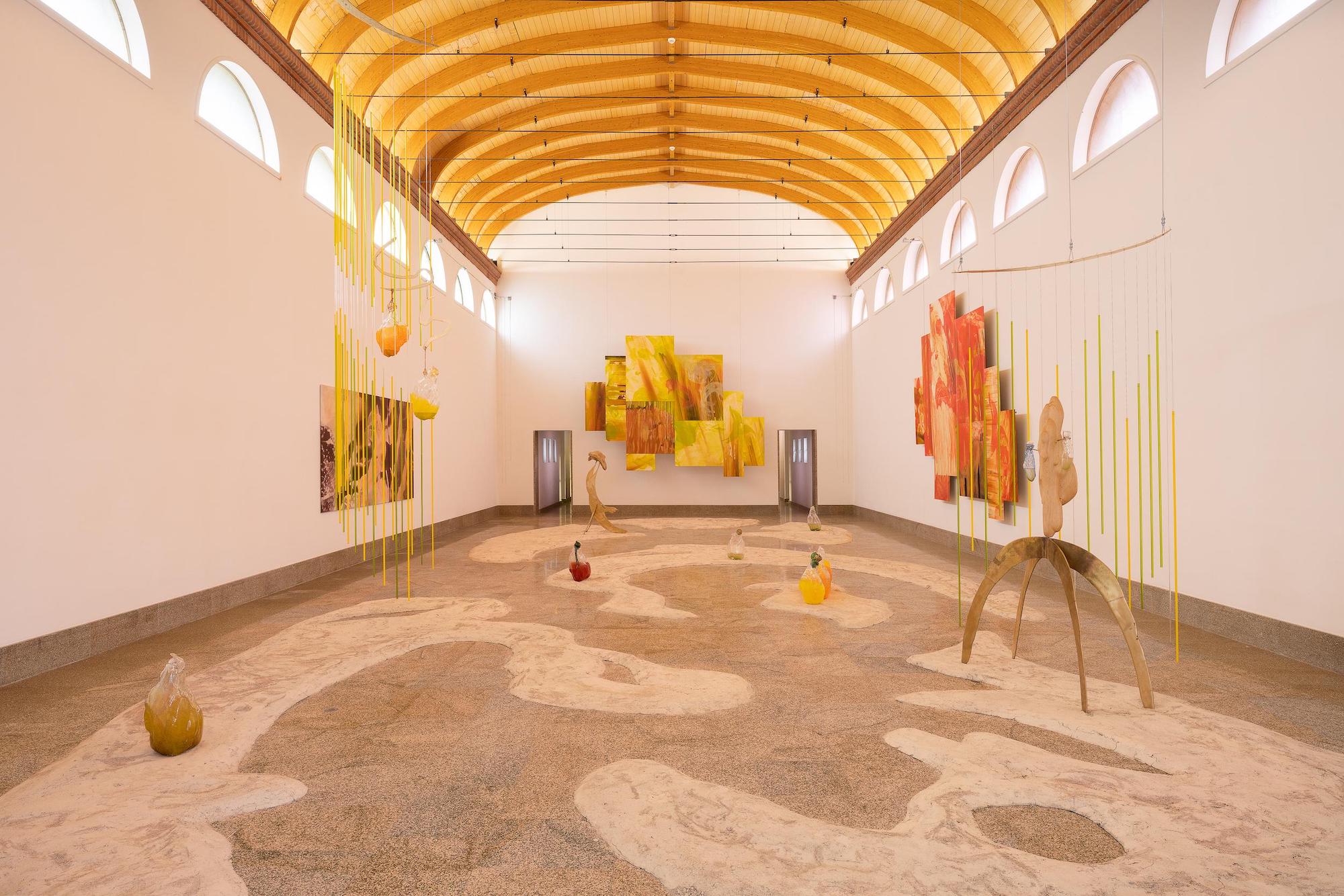
Arcadia, 2024, Bally Foundation. Photo by Andrea Rossetti
Julia Flamingo: You’ve mentioned your research residencies a few times — and I know you’re currently doing two. Virginie is in Greece, at the Therapeia Art Residency in the island of Paxos - how cool is that?! - and Kai at Poush in Aubervilliers, near Paris. How do residencies help you develop your practice? Why are they such a central part of your process?
Ittah Yoda: Residencies have become essential for us because they allow a kind of embedded practice — not just making work in a studio, but living, researching, and creating in direct relation to a specific place. There’s something transformative about being fully present in the environment where the work will eventually be shown.
In each residency, we actively connect with researchers, scientists, or craftspeople in the area. Each residency becomes a micro-ecosystem of exchange. And the effects accumulate. Over time, as we move between geographies — Indonesia, Japan, France, Saudi Arabia, the U.S. — we collect materials, knowledge, and impressions. And these things don’t just stay separate: they begin to blend, just like our shapes do. Everything we collect — pigments, memories, textures, even digital files — enters our “bank” of evolving materials.
This mirrors the evolution of our forms: some of the shapes you see in our current works actually originated from early designs we created together almost ten years ago. In a way, the residencies are part of that same evolutionary cycle. They don’t just influence what the work looks like — they shape who we are while we’re making it.
It’s also philosophical. We feel close to the ideas behind relational aesthetics — the notion that art is not just the object, but the relation it generates. We don’t want to just drop an artwork into a space, detached from its context. We want each work to emerge from a network of conversations, landscapes, materials, and human encounters. And residencies allow us to do that — to create something that could only have been made in that specific moment, with those specific people, in that specific place.

Arcadia, 2024, Bally Foundation. Photo by Andrea Rossetti
Where to see exhibitions by Ittah Yoda
Shows on view:
Echo of a Past, Promise of a Future – currently on view at the Museum of Contemporary Art in Lyon [until July 15th]
Aftershock, currently on view at Podium gallery, Hong Kong [until May 24th]
Upcoming shows:
Galerie Poggi in Paris [opening in May]
ROH Projects Gallery in Jakarta, Indonesia [opening June 6]
Kunstverein Gottingen in Gõttingen, Germany [opening in July]
