.svg)
Menu
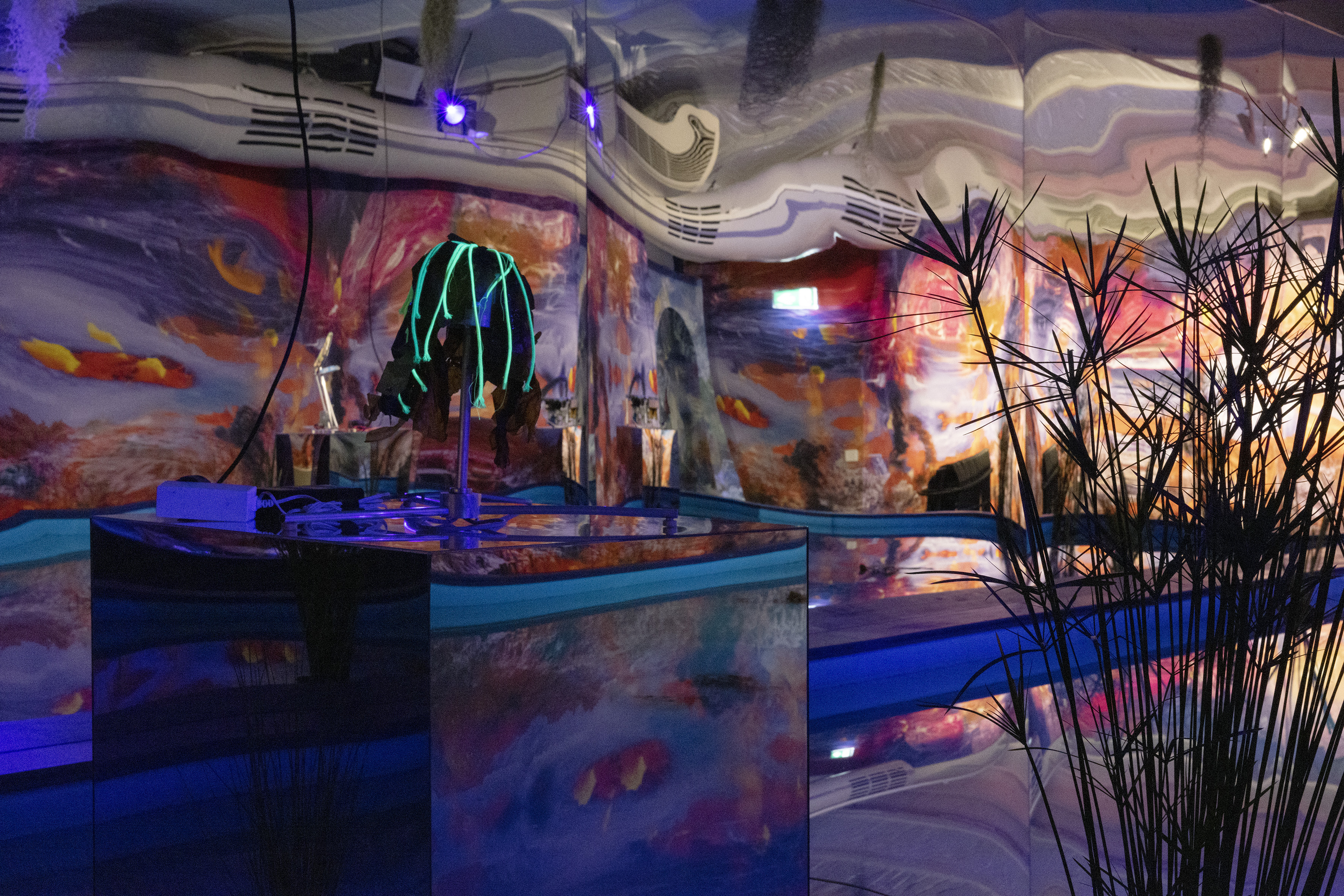
An exhibition that functions as a living organism, while being built upon an artificial landscape. Entering Anne Duk Hee Jordan’s The End Is Where We Start From is not about understanding everything immediately, but about becoming part of an evolving environment that challenges our perceptions of the natural and the synthetic.
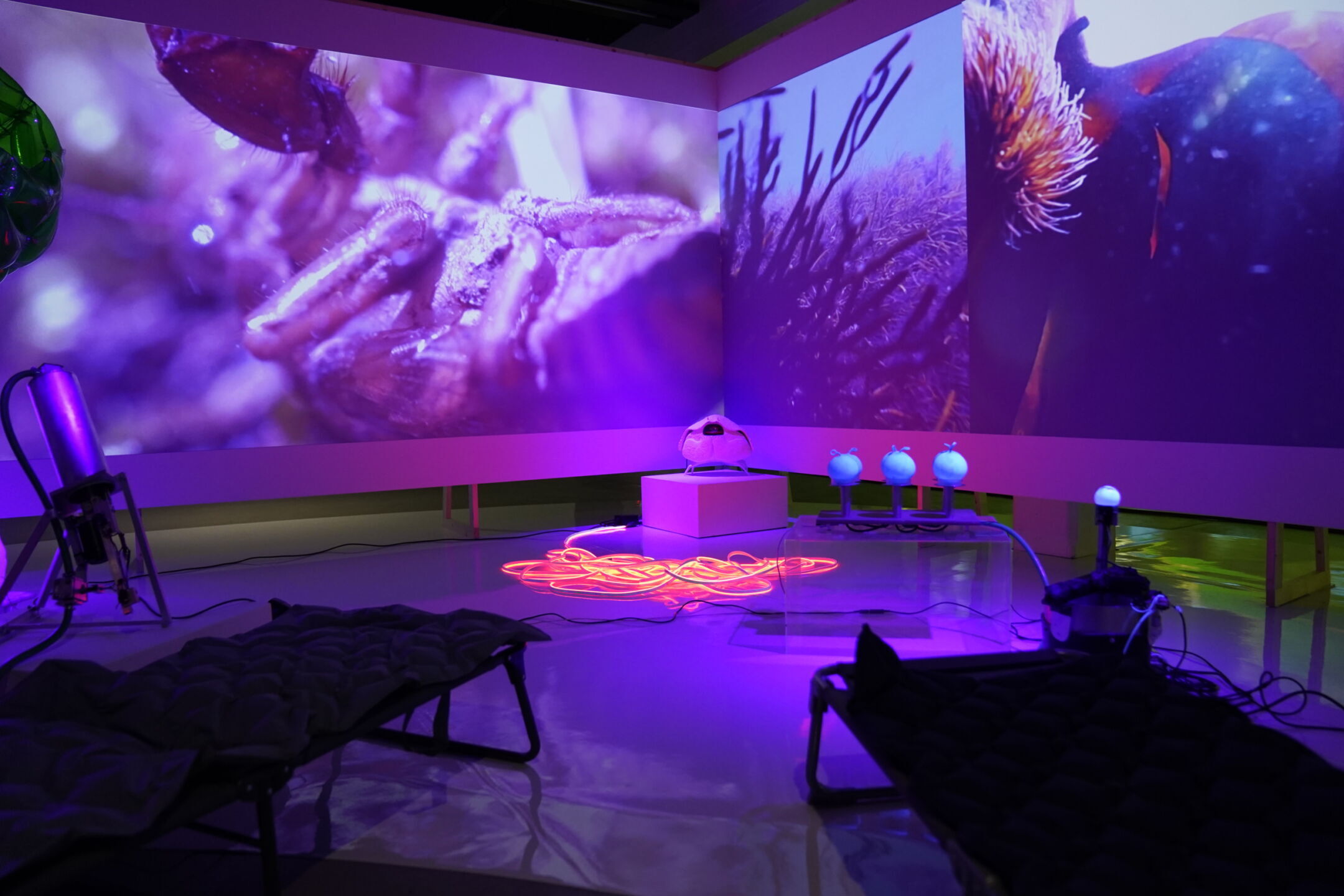
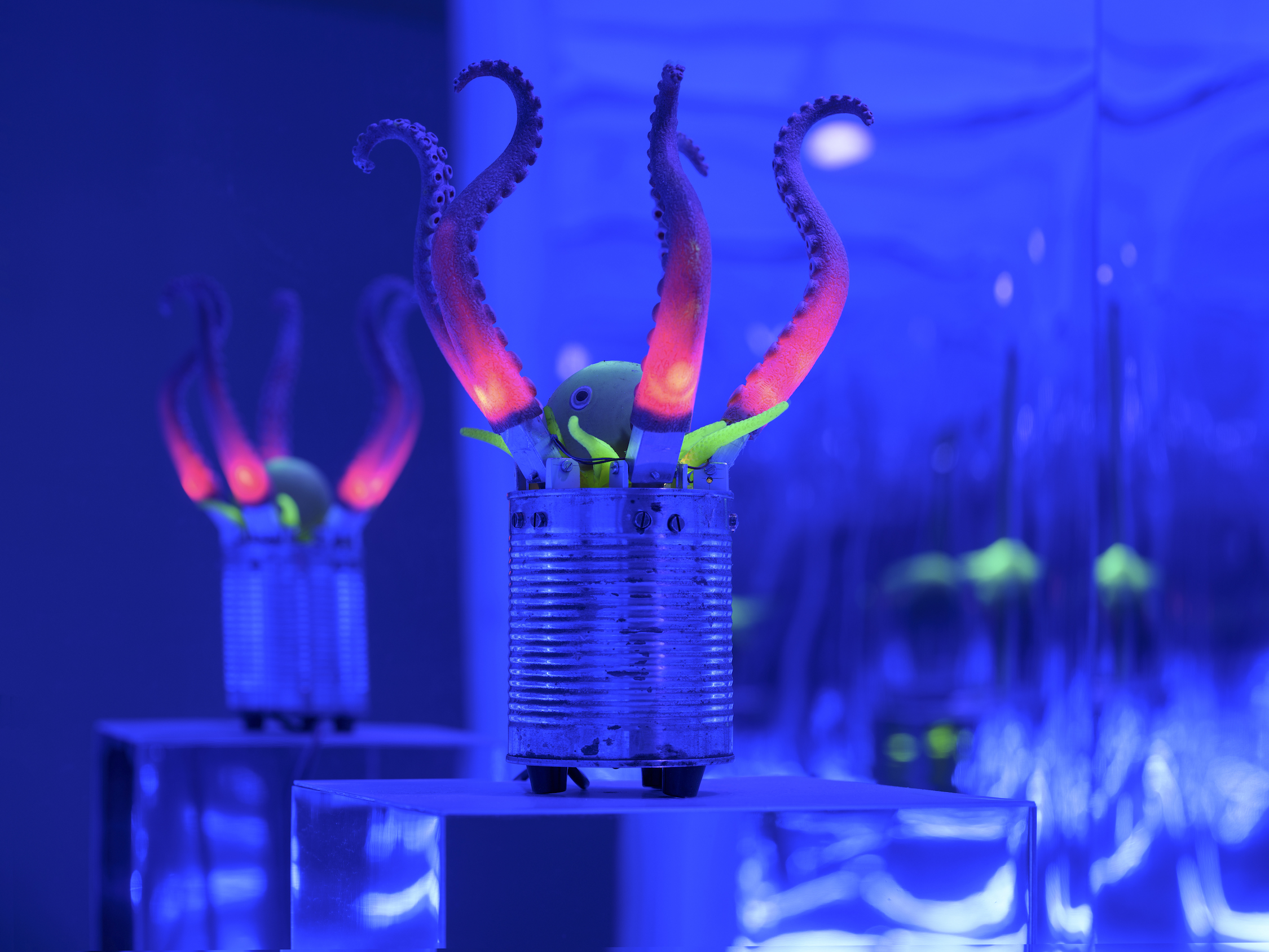
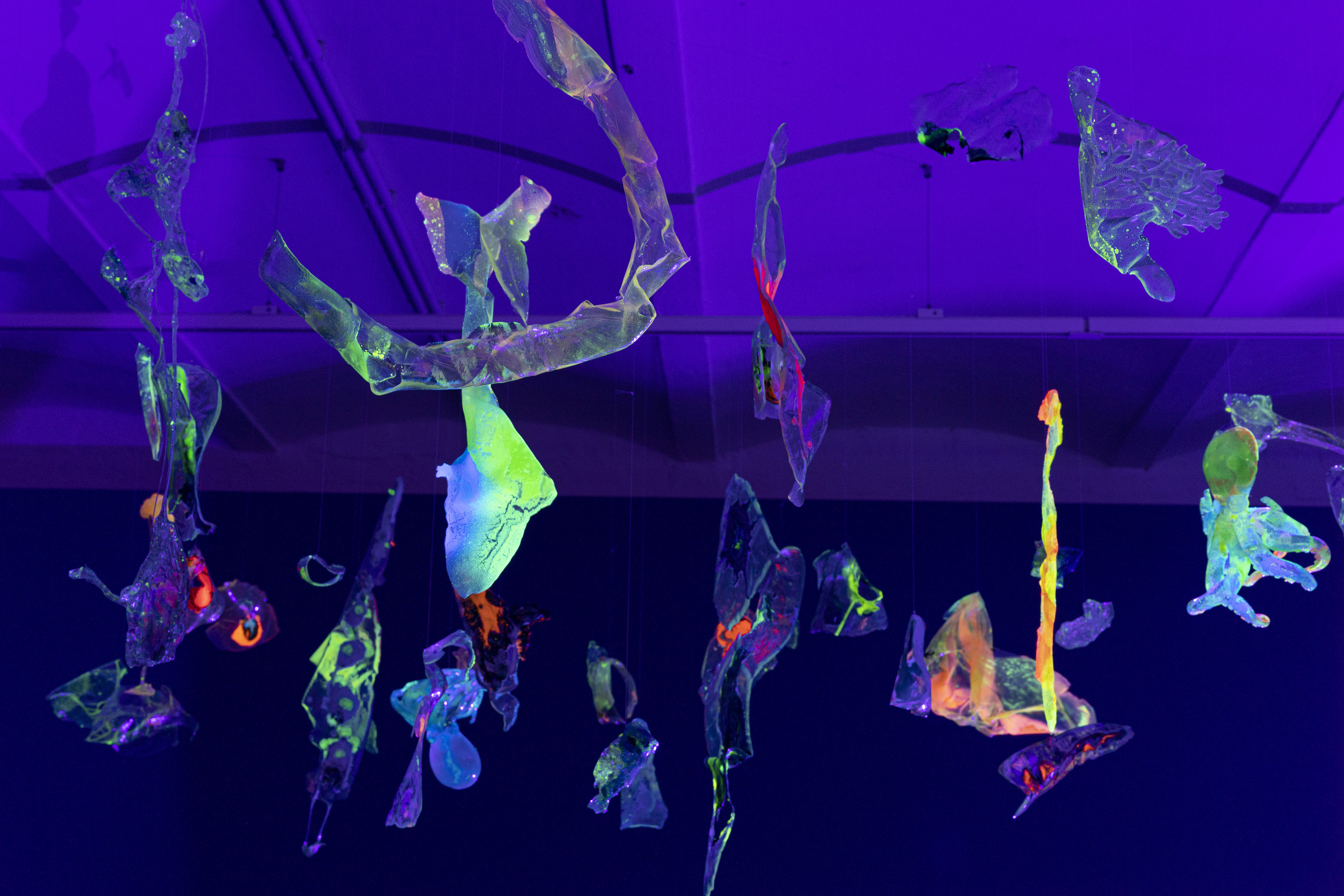
Developed specifically for KunstHausWien in Vienna—a museum designed by the visionary Austrian artist Friedensreich Hundertwasser, whose unique architectural style merges nature and human creation—Jordan’s temporary exhibition spans two floors. The first features water tanks with snails, alongside an expansive immersive installation that includes a pool filled with rainwater, mirrors, large painted textiles, and robotic sculptures. Above, light, sound, and video work together to create an atmosphere reminiscent of an underwater world, inhabited by both visible and microscopic living beings.
In the work of the Korean-German artist, knowledge is not vertical but horizontal. For Duke Hee, whether through technology, human intelligence, or the wisdom of other living creatures, everything is part of a circle—and humans are no better than any other form of life.
With such a thought-provoking practice, I could expect no less than a deep conversation with the artist and her generous curator, Barbara Horvath:

© Clara Runge
Julia Flamingo: As soon as I entered the exhibition, I was immediately intrigued. I wasn’t familiar with your work, but I was already deeply interested in the ecological approach of Hundertwasser presented in the other rooms of the museum. Then I saw how everything in your show was interconnected: the ecological themes, the social consciousness, technology. For me, that was incredibly interesting. And somehow, I guess, you put there both past and future. Also in the title itself 'The End Is Where We Start From.'
I’d love to start by asking how Hundertwasser's work and his museum have inspired you to create your exhibition. I mean, he has been talking about ecology for decades, he died in 2000, and today our agenda is all about about ecology and nature. But he was addressing these issues back then. So I would like you to tell me how does his work inspires your work for this exhibition.
Anne Duk Hee Jordan: I came to Vienna when Barbara invited me to the show and I hadn't seen his house before. But of course, I knew his work. And when I was young, I was fascinated by how he built and constructed houses and their surroundings. Also because of my father's background, he's a construction engineer. And when I was young, the way I earned my money was that I was always hanging out on the construction sites. So I learned how to build, basically.
He [Hundertwasser] never had straight angles. It’s a bit like Alice in Wonderland. So you have to be really careful how to walk through the floor and how to use the walls. I was a bit overwhelmed when I got there. I was like "Oh, Barbara, can we not just do one floor?!” But for me, it was very important to integrate his being, the house, the energy, everything he built upon. It's his legacy, you know. It was very important to somehow engage with the house and Hundertwasser and his vision and his energy. Otherwise, it would not have made any sense to me. And I made so many sketches and had sleepless nights by thinking of how to envision that.
It is in his name, Hundertwasser, how he was related to water. It needed to have a waterscape.
And from there on, I started to develop this idea that the end is where we start from. So everything starts and everything ends. And if there's an end, there's also mostly a new beginning. And if you think about composting, this is the only amazing thing about death. This is the only way how death comes back to life. And it's like this kind of circle and thinking in like ecological, non-disruptional way. So everything needs to be in a circle. And then, of course, we all come from this planet is basically based on water. So also our body is made out of water. Everything like the whole molecules in our system is made out of water. So of course, it made complete sense to me to integrate all this.
And also to think in a futuristic way how the ocean will be approached. And how it’s exploited by humans in order to find out more research. About longevity and how to prolong life. So in order to do that, scientists go into the deep sea. And then they start to exploit corals and sponges and the sea cucumbers. And all of this is just for our own well-being. And so this is also the kind of criticism I do in my work. But always trying to put the humour in it. It's about technology. But at the same time, I'm trying to decolonize technology and the digital gaze. Because everything that is based on technology is based on exploitation and on what we do about colonialism.
© KunstHausWien / Foto: Michael Strasser
Barbara Horvath: I will add one interesting additional info. The waterscape that Duke Hee just mentioned is basically filled with 4,000 litres of water. And the Kunsthaus Wien, because we had a remodernation process, we built in a cyst in the garage which holds about 8,000 litres of rainwater. So the whole waterscape is filled with rainwater.
It's not fresh water. And interestingly, Hundertwasser most of his time lived on a boat. And the boat was called Regenwasser, rainwater. So, you know, again here I feel there is a lot of circular movement. This is a living organism which is in the exhibition, it lives. We discovered little mosquito larves in it. This then lead us to the problem that we needed to insert fish that eat the little mosquito larva.
So the whole exhibition is more like an organism. And this was very challenging, I think, for the whole team, but also the museum, of course, was not used to it. But it was worth it.
© Courtesy the artist & Alexander levy, Berlin © Anne Duk Hee Jordan, Foto: Sophie Gruber
Julia: I was thinking about your work as a whole: the kinetic sculptures, you putting us humans on the same horizontal level as other living organisms and systems in the world. And the Anthropocene. So, in my research, I was thinking about all of this is present in your practice. But I also wanted to understand what makes this exhibition different.
And, to me, oxygen is the most important thing in the show. it's not addressed, It's not obvious. But it's there. It's everywhere. As the oxygen is, right? So oxygen, for us human beings, we do not speak about it. We do not address it. Although it's the most important thing we need to live. So if you could perhaps comment on that.
Duke Hee: Yeah. I mean, we all have to breathe. If we stop breathing, we're dead. Oxygen is a waste product of photosynthesis, what the glands do. And so that glands can grow, for instance, in water, they need CO2. And then they produce the oxygen in order to grow. So normally these aquascapes, like big aquascapes, do have CO2 tanks. So they give CO2 so that the glands thrive.
The work 'World's Away’ talks about the phytoplankton. And the phytoplankton is responsible for 50 to 80% of oxygen. So it's much more than our forests, what we have on land. And then we also have to think about everything that grows on land and all the plants, they all come from the marine. During time of evolution, those plants emerge from the sea to the land. So basically, when you're in the mountains, you see and you walk basically on the ground of the sea. But like many, many years, a million years, ahead or in the past.
And this is, of course, everywhere in the exhibition, like in 'Atmospheres of Breathing.' But it’s also more a philosophical and political approach. I think this installation talks about many, many things. But it was also developed during Corona. And there were a lot of such questions: who has the right to live? Who has the right to breathe? And then, of course, we talk about bacteria and viruses and then parasites and symbionts. But because everything is related. So it's the same with our nervous system and our gut.
Our gut is full of bacteria. And if they're bad, they're bad for our brain. But if they're good, they're very good for our entire well-being. And we also know nowadays that the gut regulates our entire immune system. So everything is connected, you know, and this is also like the 'Atmospheres of Breathing.' So, my perspective of what I try to do is always to invest things from a non-human perspective, even if I'm a human. But I'm trying my best to zoom into the macro or microscopic level of other beings.
Barbara: It's an interesting thought you were raising up. And also when you think about the water, you know, when you think about the way it was that huge audio installation where you basically dive into, you change your perspective from the vertical to the horizontal.
And, you know, in the coolness of the ocean, your heartbeat slows and the blood is redirected to the vital organs to minimize oxygen consumption. So I think oxygen, you're right, It’s somehow also a basic line. But I mean, that's the way we can live here on this planet, I would say.
© Anne Duk Hee Jordan, So Long, and thank you for the fish, Photos: glimworkers
Julia: Yes! And I really loved 'Atmospheres of Breathing’! I was mesmerised by the colors and the dance in the video, the choreography somehow of those animals. These insects, these living beings moving so beautifully. I loved it.
Moving on, Duke Hee, I would like to understand a little bit about your background. I was thinking that there are so many things you put in your work, so many different aspects that are inside the same exhibition and layers. So, I would like for you to share with me some background, some experiences, professional, personal or academic that you think are important for developing the concept of your work as a whole to understand your universe better.
I mean, it's a very general question. You could spend your hours talking, but perhaps you could give me some indications of your past that were so important for you to create all of this concept.
Duke Hee: Hmm. I think the more you experience in life, the more you can talk. I don't read like these trial papers, but I'm surrounded by a lot of scientists and friends. And my background — I always wanted to become a neurologist or a marine biologist. So I always had this kind of approach to science in a way.
I have a background as a therapist, too. So I'm a therapist and I used to work in neurology and in oncology. But oncology is really hard, my God! I'm an expert on children with neurodiversity like autism and heavy heart behavioural disorders. And I worked in this field quite a long time until I said ciao. And I'm a chef, too, because I did that before I did everything else. I started to study electroengineering. But then this was so alienated, so I stopped that.
The study of therapy was like a medical study, so I had to study anatomy, orthopaedic, neurology, because you need to know everything when you work in this field. And then only much later I started studying art.
© KunstHausWien / Foto: Michael Strasser
Julia: Thank you for sharing all of this with me. This next question is perhaps for both of you. How do you think — if at all — that art and your work can change people? The way they think, the way their mind works? I mean, you come from fields beyond the art world, yet you address so many crucial themes in your work—especially the relationship between humans and nature, and how we can better pay attention to it. Your work encourages us to see ourselves as part of something much bigger, rather than the centre of the world. You tackle very important social and political issues.
So, how do you think art, and specifically this exhibition, can change people’s perspectives, minds, and attitudes?
Duke Hee: I don't know if I change anything. I cannot answer this because I'm not the others. And when I do the work, I just do it, you know. I just do it without any intention to change anyone.
But it's always nice to hear feedback. I did an installation at ZKM [Zentrum für Kunst und Media, in Karlsruhe] and this is also where I teach. And sometimes I had the chance to go over there. It's an interactive installation. And then there were two grown-up men and a woman around 50 or something, and they had so much fun inside this installation. They were dancing and following this interactive floor. And then I thought "Okay, this is doing something". It was really nice to see that.
Barbara: Just remember that a lot of the visitors that we have in the museum are tourists. So they come in the first two floors visiting a quite, let's say, "conservative" exhibition, you know, there are paintings, there are drawings, sculptures. And then they come up to the Duke Hee universe and they're completely lost. Really!
So that's just the opposite of what they expected to find in a museum. And I somehow like it because this way, especially the young people, they immediately find an attachment to it. They dive in, they see it as a bodily experience and an immersiveness.
And what I also like is that you see nature not as a feel-good nature, like an oasis. No, I mean, nature is much more than that. My hope would be that their sensibility towards nature and the planet and other organisms is more, I don't know, more vivid or more conscious now after that.
And again, what bustles me most is that we are so used to rush through an exhibition to see one, two, three pictures, and then we are out again. And with this show, people need to slow down. And it's very, very hard to slow down. You need to lie down, you need to sit down, you have to listen. All senses are also activated. And I think this is what is the great, great plus in this exhibition, that it is so different and so broadening.
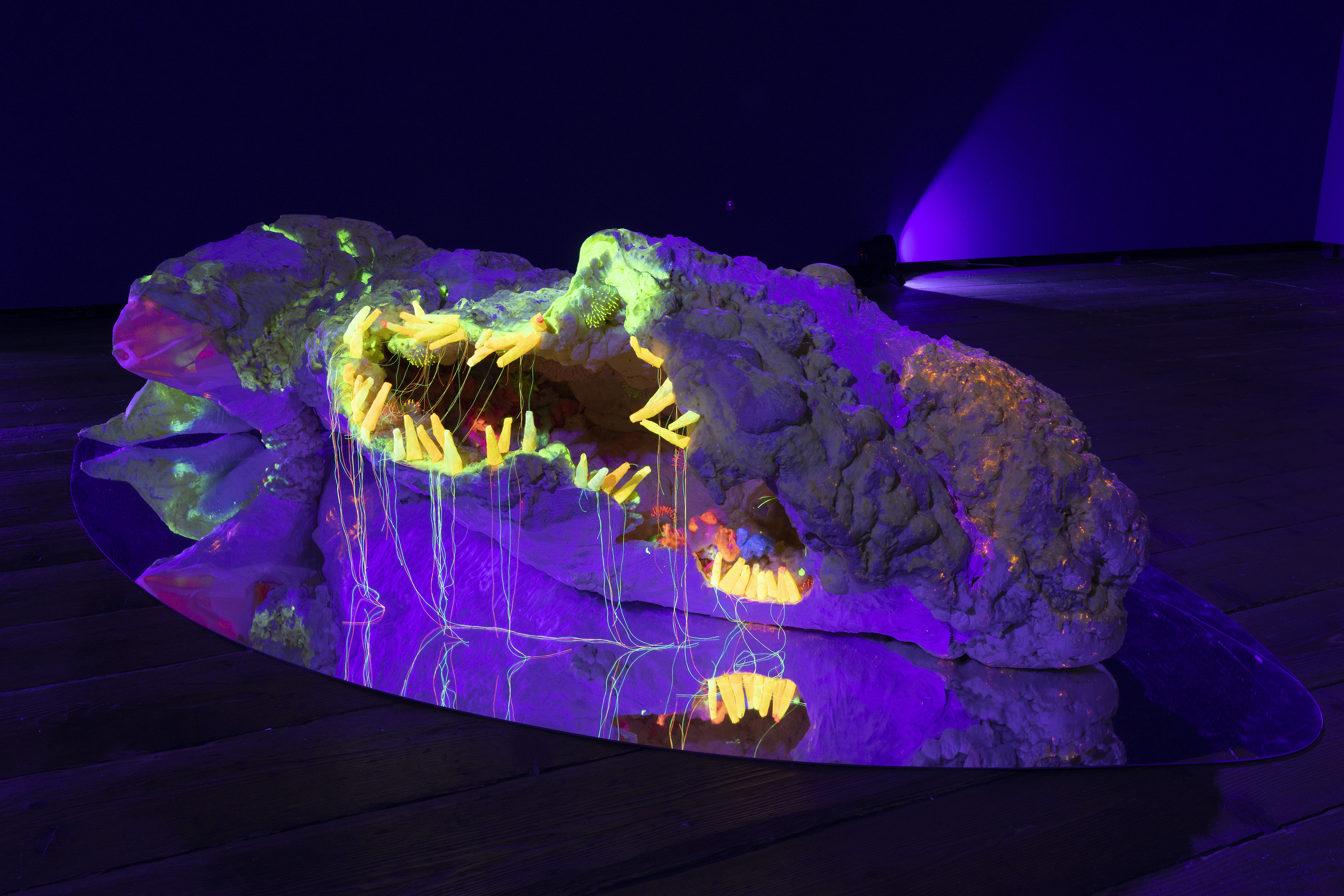
© KunstHausWien / Foto: Michael Strasser
Julia: I totally agree. I like how you're talking about the fact that intelligence is not only the human intelligence, the rational one. So when you offer a bodily experience, you are talking about the senses, how our senses need to be stimulated, and how we can feel, we can hear. Because in the Western way of thinking, we only trust the eyes, we have to see to understand and to perceive and to confirm. And then you're using other senses. Some academics discuss this —how the body already knows.
And so I think this exhibition also talks about this: the creatures we do not see, other intelligences in this world. We think it's only ours, but it's not!
Duke Hee: Yeah, I mean, it's like planetary intelligence. What we think and what we are doesn't matter. It's like how trees talk and how they communicate or stones or mold. A slime mold, for example, has 700 sexes and no brain, yet it can replicate the entire Tokyo subway system in just three hours. How can something do that without a brain?
There are so many other forms we do not understand at all. And then we say we are intelligent, but we cannot even compare. This is where I believe we should never think of ourselves as being higher in a hierarchy than any other being on this planet.
'The End Is Where We Start From’ by Anne Duk Hee Jordan, curated by Barbara Horvath, is on view at the KunstHausWien in Vienna from 11 September, 2024, to January 26, 2025.
