.svg)
Menu
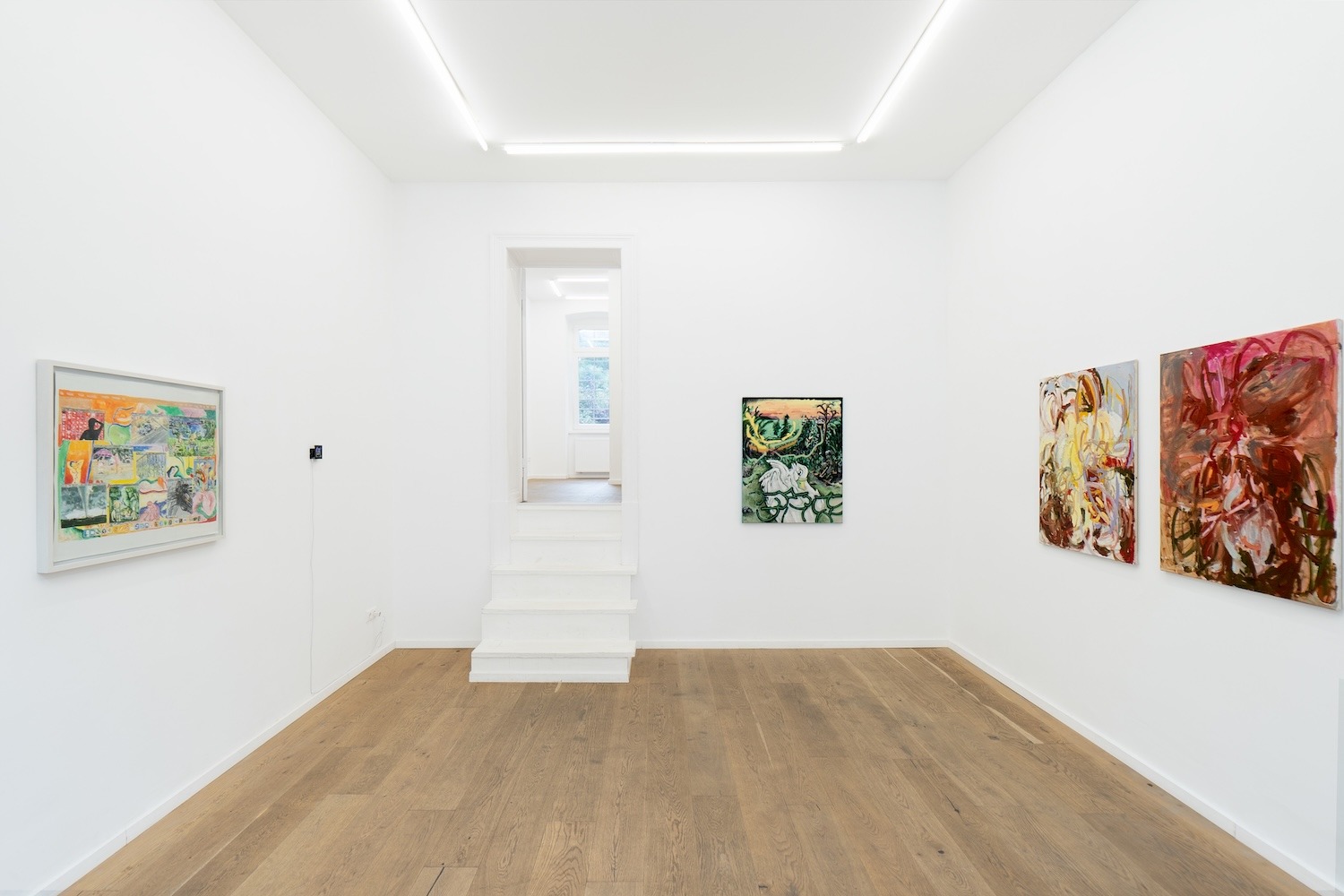
STILL WET
Zisis Bliatkas, Ilya Bliznets, Martín Bruce, DuGucciPourMonChat, Esra Eslen, Lisanne Haack, khwampa, José Narciso, Mical Noelson, Nuv1914, Daria Rastunina, RJ, Helio Santos, Santiago, Patrick Tresset, Yuran Yakon, Yuri, Sümeyra Yüce
Opening: August 14, 2026, 18:00 – 21:00
Exhibition: August 15 – September 05, 2026
Mariannenstrasse 33, 10999 Berlin
Curated by Kika Nicolela and Ruizhe Liang
In collaboration with objktcom
There is a brief interval in the life of every painting during which the image has appeared, yet has not entirely become itself. The paint is still wet. It reflects light unevenly. It receives dust, fingerprints, accidental gestures; it resists certainty. During this suspended moment the work remains vulnerable. Not because it is incomplete, but because it is still capable of being altered by the world.
Painting has long measured time through drying. Pigment hardens. Varnish seals. To become a painting has traditionally meant to pass from fluidity into permanence. From gesture into object.
Today, images seem to obey another temporality. They circulate before they settle; they are revised after publication, re-rendered after exhibition, translated from canvas to screen, from screen back into print, from print into photographs that circulate once again as images. Each stage renders the image differently, and each rendering becomes the raw material for the next. Completion no longer marks the end of an image’s life but one state within an ongoing chain of transformations. Maybe the contemporary condition is this: images don’t ever really settle.
Perhaps this is what it means for an image to remain still wet.
The title of this exhibition first evokes painting’s oldest material condition: fresh pigment not yet dry. Yet among the works gathered here, wetness describes something more elusive — a condition shared by images that refuse to settle into a single medium or a final form. Their surfaces may be made of linen, LEDs, inkjet pigment, code or machine-learning models, but none of these materials exhausts the work.
The exhibition brings together eighteen artists who share not an aesthetic but a condition: the image is never fixed where it first appears.
It would be easy — and reductive — to describe an exhibition like this one as a show about digital painting. Most of the artists gathered here would not recognize themselves fully in that description, and it is not what the exhibition intends. What is at stake is not a technique but an ontology: not how images are made, but what kind of thing an image now is, when it is considered finished, whether it can finish at all, and where, exactly, it goes on existing once it appears to have stopped. Painting, in this exhibition, is not the subject under examination. It is one of the instruments used to examine something larger – the changing life of images themselves.
It has become almost routine to describe such practices as “hybrid”, “expanded” or “post-digital.” These terms are useful, but they preserve the assumption that images move between previously distinct territories — the physical and the virtual, the analogue and the digital. The works gathered here propose something else. What looks like a crossing between separate worlds may be better understood as continuous movement within a single ecology of images.
Asked to name what they do, several of the artists in this exhibition resisted the premise of the question outright. “Post-painting reads mostly as a curatorial hedge,” says the Brazilian Berlin-based artist Lisanne Haack, “a way of gesturing at painting without committing to the word. Expanded painting is closer to something real, but it treats the expansion as a special case, as if the default is a painting sitting still.” Mathis Aguado, who works under the name DuGucciPourMonChat and moves a single image between painting, digital model, and 3D-printed sculpture, gives an answer shorter still: “Just. Painting.”
Ilya Bliznets, who paints as fluently in oil as in Photoshop, states it with particular precision: “…painting is not defined by a particular material or a specific set of tools. It is a way of thinking through images. As long as that way of thinking remains, I’m not too concerned with what the medium is called[…]” Mexican artist Helio Santos — whose landscapes begin as Python scripts, sampling and recombining pixels from photographic datasets before being reinterpreted by hand in oil — arrives at almost the identical sentence from the opposite direction: “I’m simply interested in painting as a way of thinking, regardless of the technologies involved.” And where a purely technical account of image-making might stop at the object, Santos goes further, relocating the value of the work away from the artifact entirely: “I don’t believe art is primarily about producing objects. Art is about producing knowledge, experiences, and conversations, regardless of the medium through which those ideas take form.” Two artists working on opposite continents, describing painting not as a material category but as an operation — a way of thinking that happens to have started with a brush and has no particular reason to stop there.
Santos also names where the word “expanded” comes from and why it may already have exhausted itself: “The idea of expanded painting has often been associated with expanding beyond the traditional limits of the canvas, much like Rosalind Krauss described sculpture in the ‘expanded field.’ Since then, many artistic practices have been framed through ‘expanded’ or ‘post-‘ categories. But I think we’re now living in a moment of such diversity that it’s increasingly difficult — and perhaps unnecessary — to define artistic practices through rigid concepts.” Krauss’s 1979 essay described sculpture stretching outward from a fixed center until the center itself became difficult to locate. What the conversations with these artists suggest is a further step: not a field expanding around a stable core called painting, but a set of practices in which no version of the work — canvas, file, hash, print — is obviously the center that the others expand from. The metaphor of expansion, useful for describing sculpture leaving its plinth once, may simply run out of usefulness when applied to an image that was never sitting still to begin with.
true


