.svg)
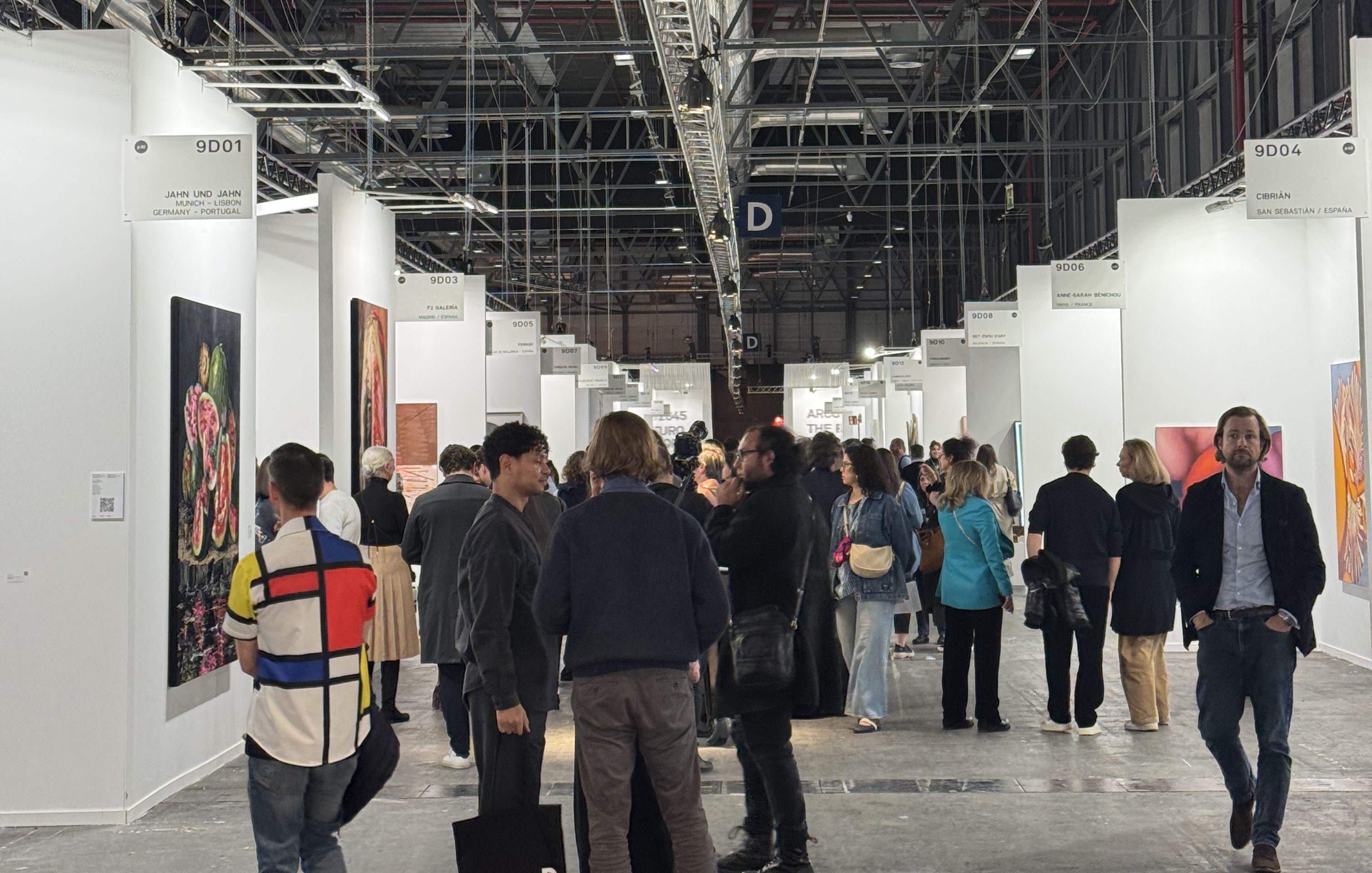
Day one at ARCOmadrid’s 45th edition confirms what many of us already sensed. This is not a secondary European fair. It is a large, mature platform with institutional weight and serious market depth.
The footprint is significant. Both in square meters and in the number of galleries, this is a fair that requires pacing and intention. You cannot see it all in one sweep. Let’s look at the data:
- Total Galleries: 206
- Countries: 36
- Artists: +1,300
- Gross square footage: halls 7 and 9 (37,800 square meters)
- Square meters of the guest lounge: 1,200 m2
The General Programme remains the backbone of the fair, dense, confident, and largely painting-forward. Opening. New Galleries introduces younger spaces (under eight years of existence) with fresh and often risk-taking proposals, while Profiles | Latin American Art continues to anchor ARCO’s longstanding and strategic dialogue with the region.
ARCO remains, arguably, the most significant platform in Europe for Latin American galleries and artists. This sustained commitment has played a tangible role in facilitating the entry of Latin American practices into the European art market and institutional collections. The fair’s consistent effort to balance emerging and established galleries from the region brings a vitality that differentiates it from other European art fairs.
This dialogue between generations and markets gives ARCO a distinctive vitality, one that feels more fluid and organically constructed than the often more predictable format of other European fairs.
On top of this, ARCO2045: The Future, for Now, curated by José Luis Blondet and Magalí Arriola, provides a reflection on the future as something unstable, layered, and already embedded in memory. It moves between déjà vu, repetition, and quiet forms of resistance.
First Impressions from the Floor
- Very large footprint.
The number of galleries is substantial and the layout expansive. For collectors, this means pre-selection is essential. Without a plan, you risk fatigue before you reach the second aisle. - First day is preview day.
The aisles were dominated by collectors, advisors, art professionals and interior designers. The first day of any fair is for acquisitions and at the end of the day most galleries know if the participation was a success or not. The rest of the days and especially the weekends are mostly social. - Big contemporary artist names: present
The fair opens with a booth showing Juan Uslé, setting the tone immediately. He is one of those artists you encounter at nearly every major European fair. Strong market presence, recognizable visual language, institutional backing. - Digital presence: structurally marginal.
We identified one NFT within the presentation of Ana María Caballero at Max Estrella. Daniel Canogar was present at two booths (Max Estrella and Anita Beckers) with strong work, along with Rafael Lorenzo-Hemmer. Beyond that, screen-based works appeared sporadically: video pieces, lightboxes, old TVs.
Important distinction: digital tools are clearly used in production across many practices. However, digital as a medium is not leading the curatorial narrative nor driving booth strategy or sales positioning.
ARCO 2026 is confident and painting-forward. Sculpture is strong. Digital appears as a secondary layer rather than a structuring force. For those collecting across contemporary and digital practices, this fair offers a clear snapshot of how the broader contemporary art market is currently faring.

Next: our 7 highlights from the fair, focused on forward-thinking galleries and artists to keep an eye on!
Nohemi Perez at Mor Charpentier
- Gallery Name: Mor Charpentier
- Location: Paris, France
- Booth number: 9C04
- Link to the catalogue: https://drive.google.com/file/d/1WXVPctaDtJMk6YC1byyegkcdMCsDtvFv/view?usp=drive_link
mor charpentier presents one of the most intellectually layered booths of the fair, articulating its proposal as an ecosystem of relations, between human and non-human, body and territory, memory and political structure. The gallery has long positioned itself at the intersection of critical practices and geopolitical awareness, and this presentation reaffirms that commitment. From Bianca Bondi’s alchemically altered domestic sculptures, where furniture mutates into fragile, living organisms, to Sylvie Selig’s densely narrative works confronting patriarchal violence, the booth unfolds as a meditation on vulnerability, interdependence and resistance. Kader Attia’s ongoing reflection on repair adds a conceptual backbone: rupture is not concealed but made visible, insisting that healing requires lucidity rather than erasure.
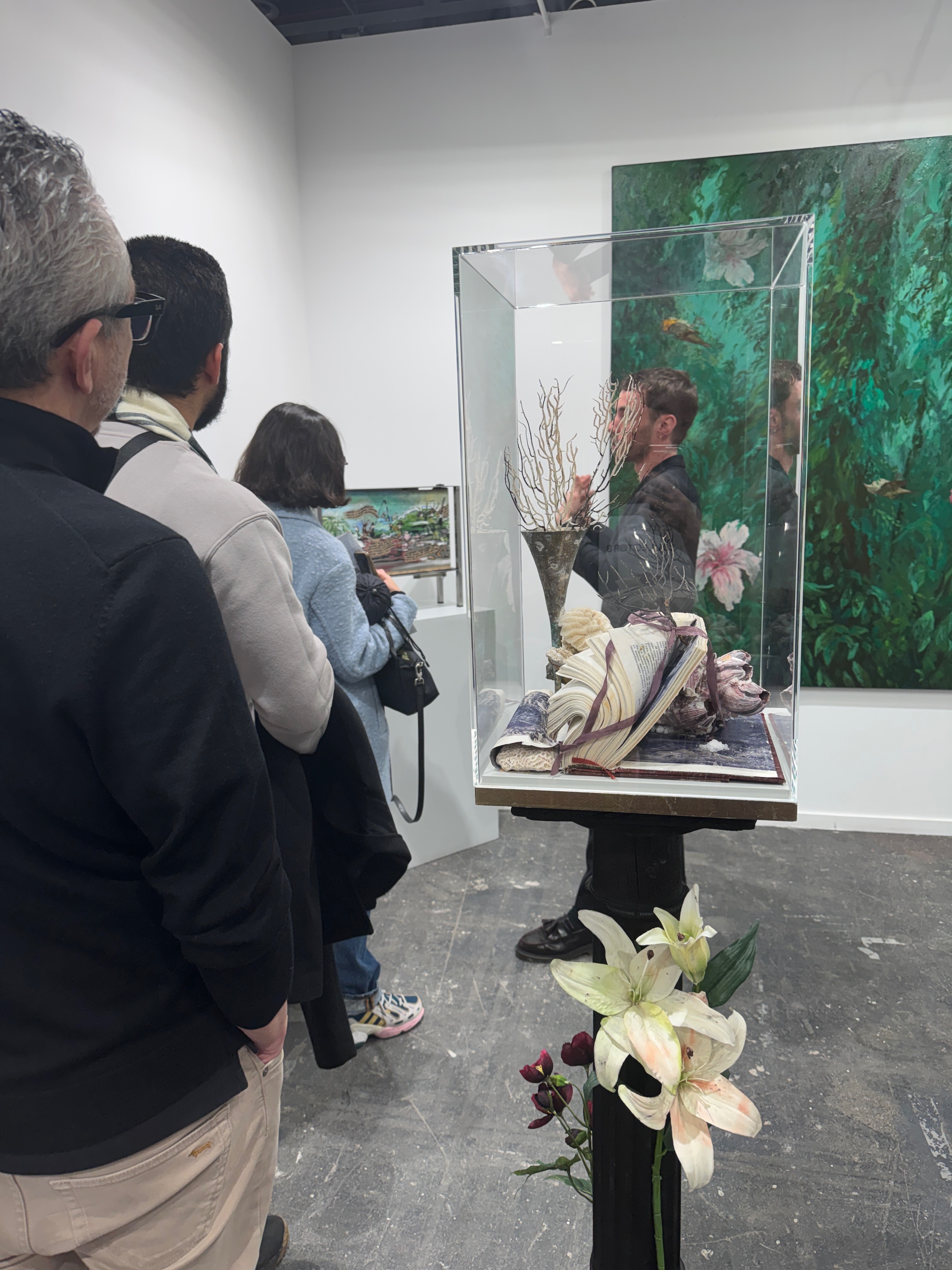
At the core of the presentation, however, stands Nohemí Pérez. Her Guardianes series bridges the forests of Colombia and Slovenia, revealing ecological systems as both sacred and politically contested territories. Working with meticulous detail and atmospheric density, Pérez constructs landscapes that feel simultaneously protective and precarious. The forest becomes a sentient entity, a witness to extractivism, migration and environmental fragility, but also a space of quiet resilience. In the context of ARCO, her work operates as a powerful reminder that landscape is never neutral: it is charged with memory, conflict and the possibility of collective care.
.jpg)
Where Hope Flows: Ana Cláudia Almeida at Quadra
- Gallery Name: Quadra
- Location: Sao Paulo, Brazil
- Booth number: 9P06
- Link to the catalogue: https://drive.google.com/drive/u/0/folders/1A1QzGkQSYkwRgsQhcEocszo4d4o_XPuX
Quadra, one of the younger Latin American galleries participating in the fair, presents a compelling solo booth in the Profiles | Latin American Art section at ARCOmadrid. The gallery continues to assert itself as part of a new generation of Brazilian spaces committed to rigorous, research-driven practices while strategically expanding their artists’ international visibility. Their presence in this section reinforces ARCO’s role as a gateway for emerging and mid-career Latin American galleries entering the European circuit.
The solo presentation of Ana Cláudia Almeida unfolds as a meditation on freedom and hope, understood less as themes than as forces circulating between body, architecture and collectivity. Working across oil painting, drawing and fabric transfers, Almeida constructs compositions where recurring droplets and cascading forms suggest states of pressure, purge and flow. Her process, including the reuse of plastic matrices and the displacement of pigments from one surface to another, embodies the very circularity she explores. Rather than depicting landscape, she proposes composition itself as a mutable structure, opening subtle fissures in rigid systems of thought and affirming art’s capacity to imagine alternative ways of inhabiting the present.

Walking on Yesterday’s News with Dave McKenzie
The ARCO2045 section plays with the idea of déjà vu. Across two spaces in the fair, works explore repetition, prediction, and nostalgia. The future here is not presented as something radically new, but as something constantly shaped by what came before.
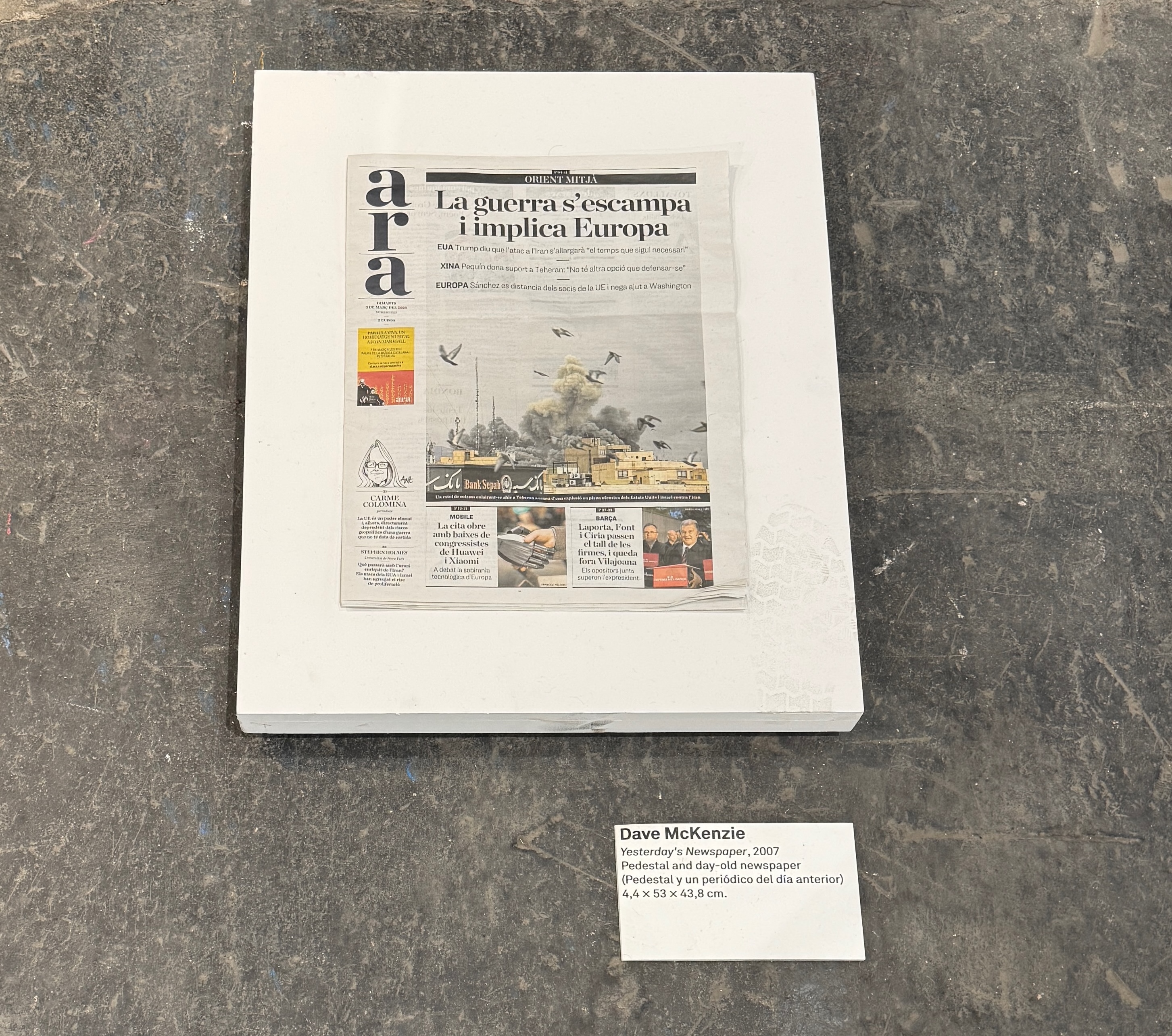
Within this context, Dave McKenzie shows Yesterday’s Newspaper (2007). The work is very simple: a pedestal displaying the previous day’s newspaper, replaced daily. What you see is always already out of date. The piece belongs to a lineage of minimal conceptual gestures, recalling artists like Felix Gonzalez-Torres who used everyday objects to mark time or absence. Here, the daily replacement of the newspaper quietly turns the sculpture into a time-based work, even though it appears static. First presented in 2007, the work reflects on how quickly information moves. Yesterday’s headlines, which felt urgent only hours earlier, already belong to the past.
Finally, two visible shoe prints on the paper and pedestal, whether intentional or accidental, adds another layer: a reminder that moving forward often means stepping on what came before.
Press article about ARCO2045 >
Spotting the AI based painting by Federico Miro at F2 Gallery
- Gallery Name: F2 Galeria
- Location: Madrid, Spain
- Booth number: 9D03
- Link to the catalogue: https://drive.google.com/file/d/1fsUNB3EMQgBHMlsaVouwfzgZLQgRKbr5/view?usp=drive_link
F2 Galería positions itself within a growing field of galleries exploring how digital technologies and software-based processes translate into physical, materially grounded works. Their booth at ARCOmadrid focuses on artists who move fluidly between algorithmic systems, archival research and manual execution, emphasizing the tension between immaterial infrastructures and tangible form. The presentation feels particularly relevant within a fair still largely painting-forward, introducing a layer of conceptual and technological inquiry into the broader dialogue.
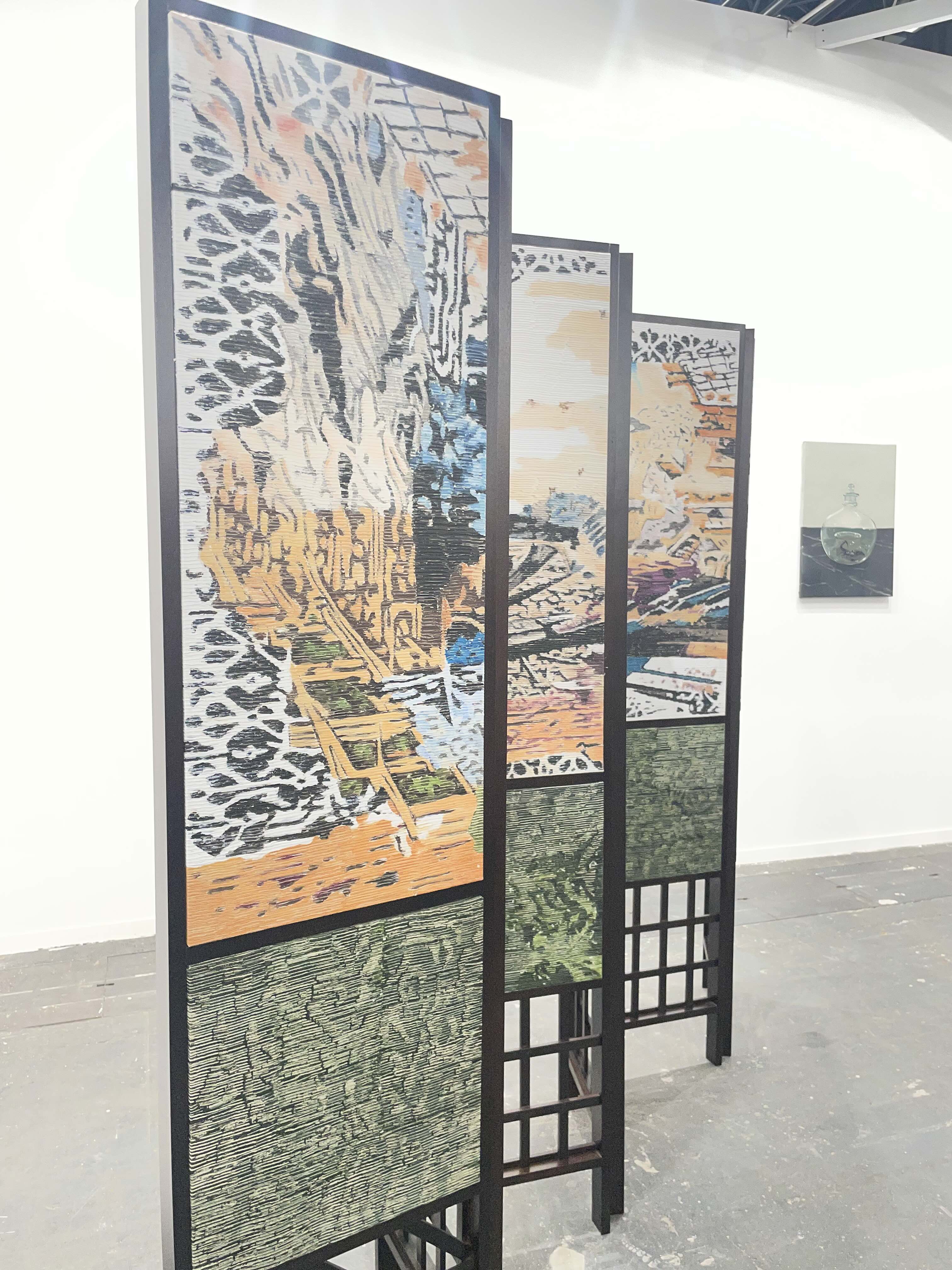
In the work of Federico Miró, this negotiation unfolds through a distinctive pictorial strategy that allows for double readings. Natural landscapes, sometimes generated through AI, are overlaid with meticulous acrylic weaves of straight lines that evoke tapestry and loom structures, encrypting organic imagery within a technological grid. The result is a confrontation between nature and cultural production, where the artificial does not erase the natural but re-codes it. Federico Miro won the PREMIO ARCO COMUNIDAD DE MADRID PARA JOVENES ARTISTAS (ARCO prize for young artists of the city of Madrid).
Raúl Silva, by contrast, turns to telecommunications infrastructure as both subject and metaphor. Through the manual reproduction of archival material from Spain’s national telephone company and a sensory ethnographic video documenting fiber-optic cable workers, Silva reframes hyperconnectivity not as seamless flow but as labor, materiality and embodied experience. Together, their works construct a subtle critique of the systems that structure contemporary perception, making visible the hidden architectures behind our digital present.

An Immersive Poetic Installation by Ana Maria Caballero
- Gallery Name: Max Estrella
- Location: Madrid, Spain
- Booth number: 9B22
- Link to the catalogue: https://drive.google.com/file/d/1TuVm_s3-7UHbwj8HwpKH_patpGUb46Wc/view?usp=drive_link
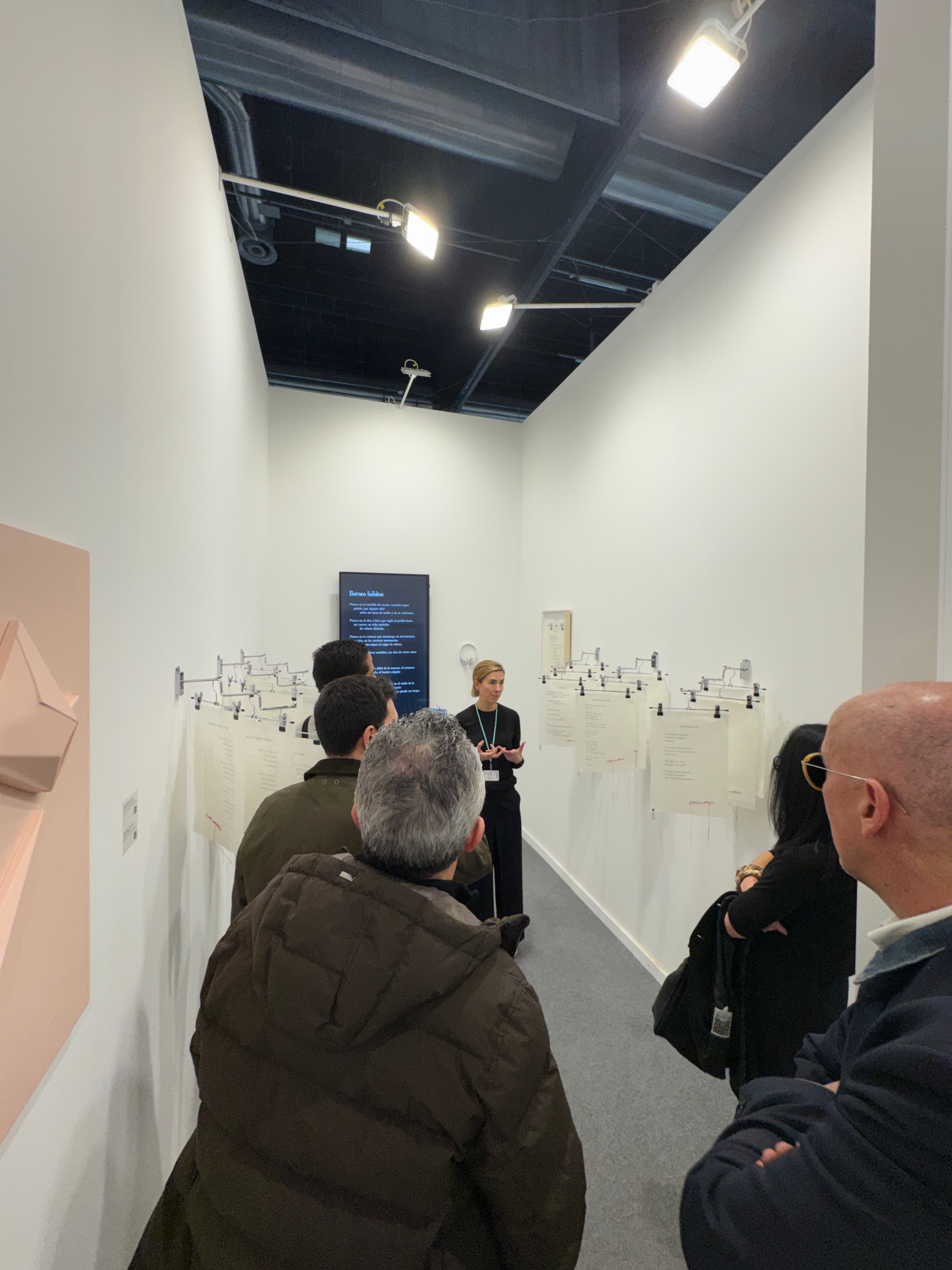
Many booths at ARCO are quite large, and the most interesting works are often tucked away in the back rooms. This is the case at Max Estrella with the installation by Ana María Caballero. Even more so when the artist is present to explain her work, which is rare at art fairs!
Head to the center of the booth and look for the brass sculpture. From there, a smaller space opens into Caballero’s multi-media installation. It feels immersive, but not because of screens. Instead, the work combines sound, text and objects. The materials range from custom paper and embroidery to hangers, artist books and bas-relief paintings.
One highlight is Literary Hooks, a new series from 2026. Caballero moves the poem from the private space of the page into a retail-like display. Poems are printed on frayed fabric and hung from trouser hangers with security tags. Her signature is hand-embroidered in red thread, with the needles still attached. It adds a physical, almost vulnerable gesture to the otherwise clean printed text.
Another work on view is Radical Repair (2025), the first piece from her new series Speech Patterns. In this series, Caballero turns texts written for her performances into physical works. She combines generative AI tools with traditional craftsmanship to explore how language can take on a sculptural form. The piece includes a painted aluminum backing and handcrafted polystyrene made by Colombian artisans. It also exists as a digital twin, extending the work beyond the physical installation.
This is the only blockchain-based work we spotted at ARCOmadrid 2026. Let us know if you see another one :)

Max Estrella’s Two Digital Art Pioneers
- Gallery Name: Max Estrella
- Location: Madrid, Spain
- Booth number: 9B22
- Link to the catalogue: https://drive.google.com/file/d/1S30jgDW-rJ6IqUyU2NLXuDDOJ65K2Vyh/view?usp=drive_link
Max Estrella also presents three recent works (all from 2025) by Daniel Canogar, a pioneer of data-driven sculpture. His practice often looks at how screens, data flows and real-time information are reshaping our relationship with the world.
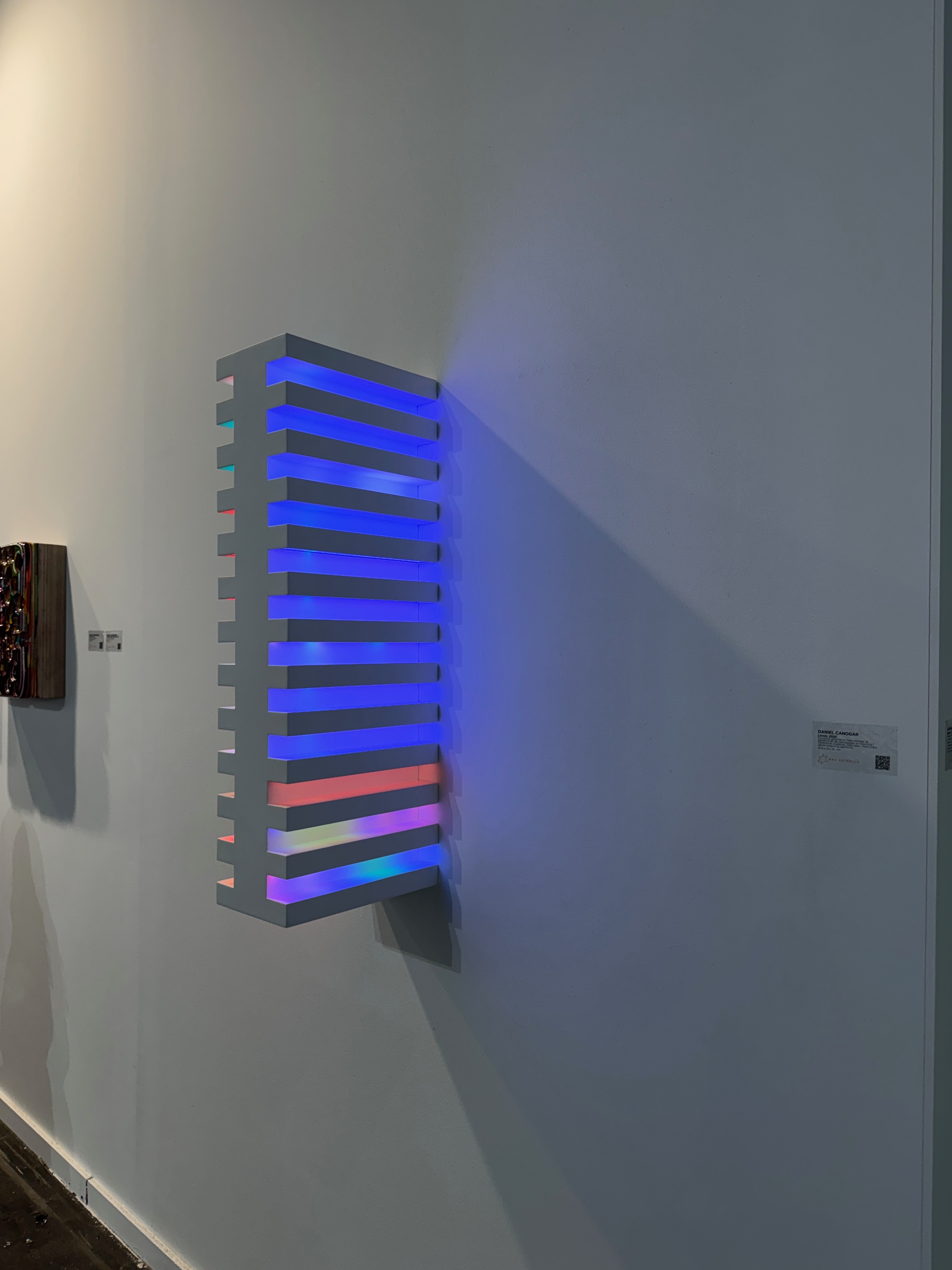
Levels (2025) is a generative sculpture that draws data from live game-streaming platforms. The piece reflects on how video games helped shape internet culture. Visually, it plays with the idea of life as a sequence of side-scrolling levels, progressing step by step like a game.
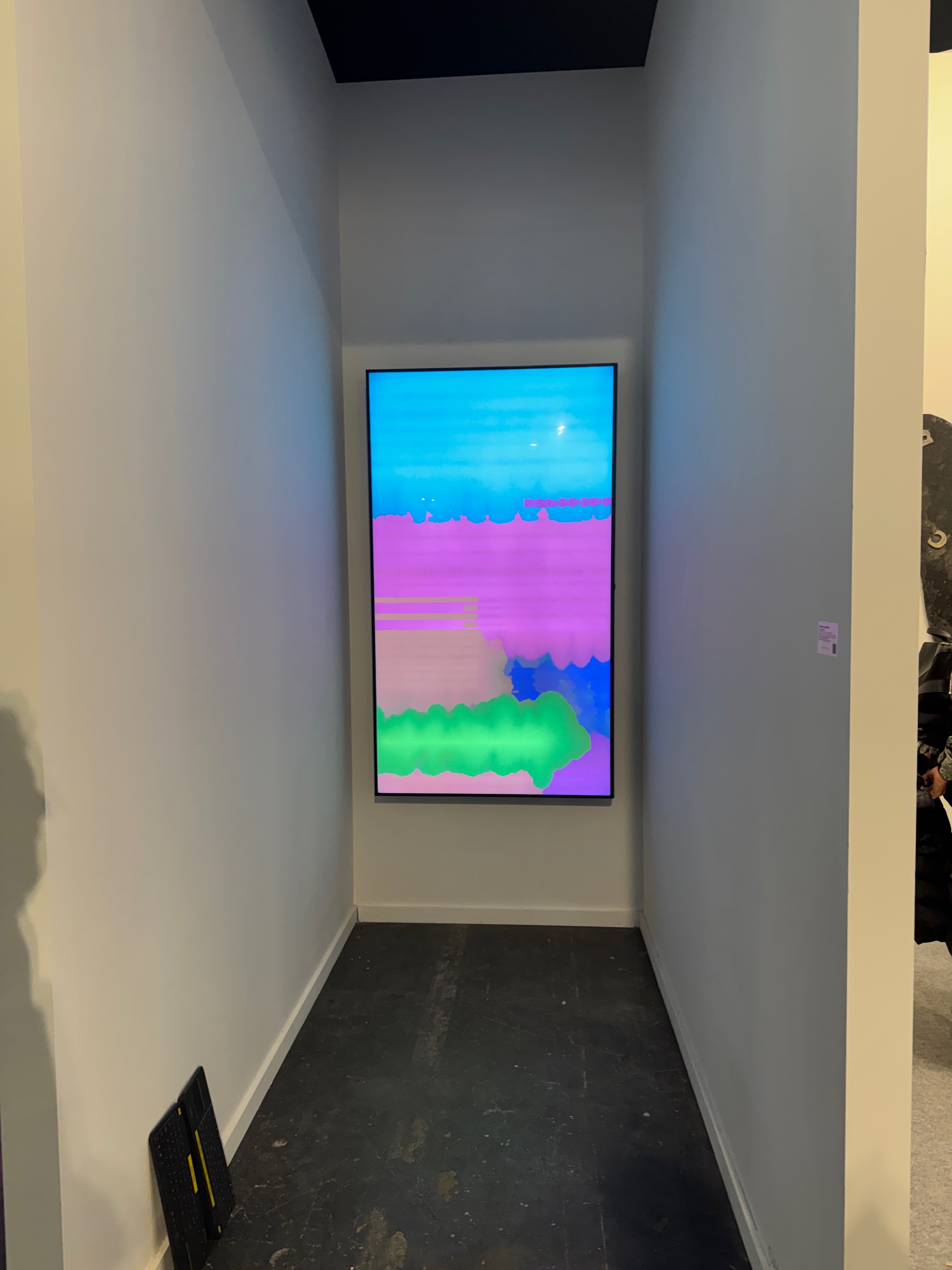
A larger screen-based work, Zero-Day (2025), pulls data from cyber-threat intelligence websites. The title refers to an undisclosed security flaw. Streams of text move across the screen as the data updates, suggesting both the scale of online threats and our constant exposure to them. The work loosely echoes the structure of an inkblot test, inviting viewers to interpret the shifting patterns in their own way.
Another welcome surprise in the booth is a work by Rafael Lozano-Hemmer, widely known for his interactive installations linking technology, architecture and the human body.
Thermal Drift (2022) visualizes the heat released by a visitor’s body. Using a thermal camera and a particle system, the work shows body heat dispersing slowly into the surrounding space. Technologies usually associated with surveillance and security are repurposed here in a more poetic way, revealing how our physical presence extends beyond the limits of the body itself.
Meeting Daniel Canogar in the flesh at Anita Beckers
- Gallery Name: Anita Beckers
- Location: Frankfurt am Main, Germany
- Booth number: 9D14
- Link to the catalogue: https://drive.google.com/file/d/1O9xEYybIswnAZUPgoQdY7WuS_EMhl7E3/view?usp=drive_link
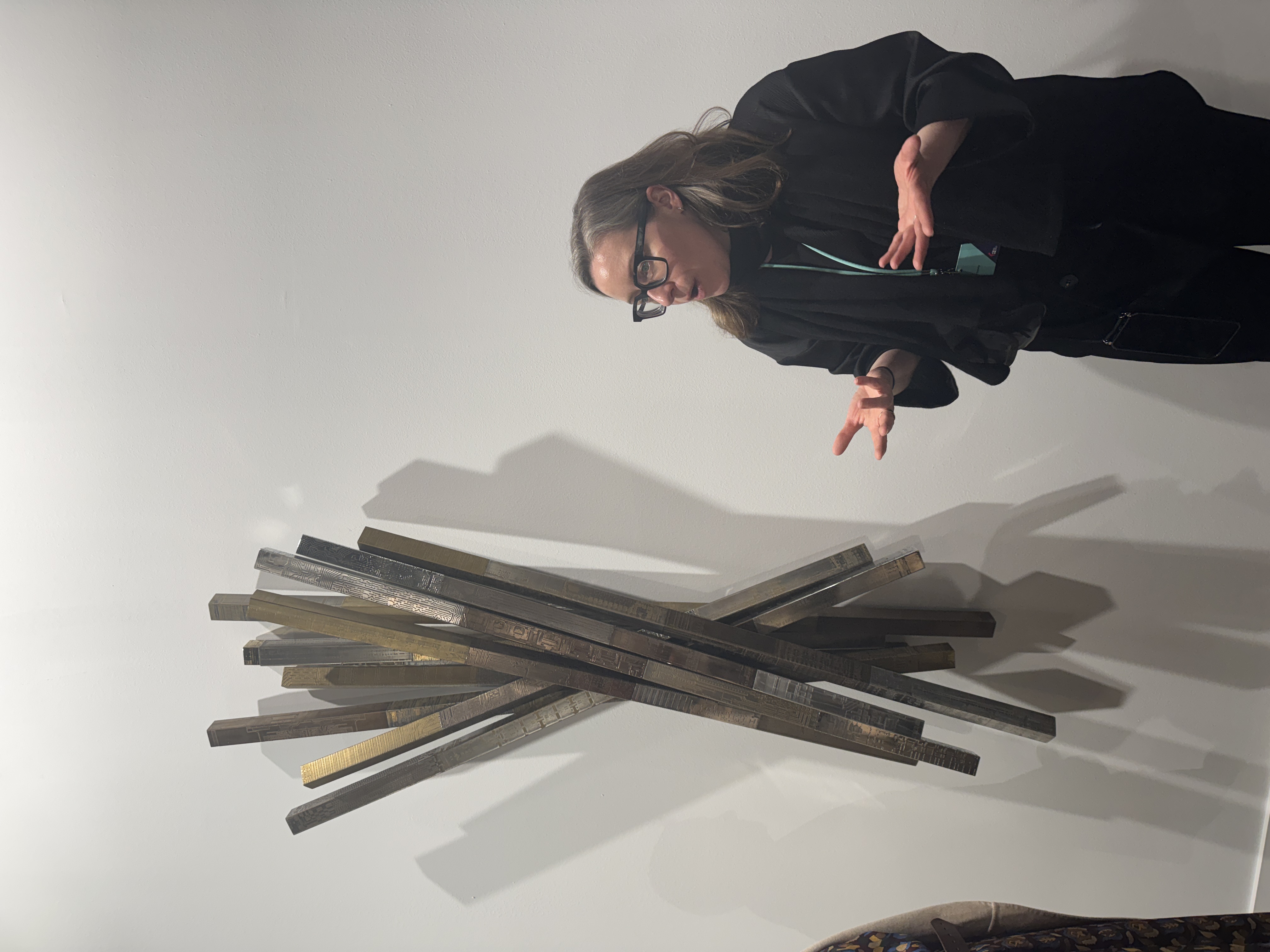
A nice surprise awaited our group at Anita Beckers. The visit started with a presentation by Anita herself of a sculpture by Daniel Canogar. Gatherings (2026) is made of stainless steel blocks acid-etched with metal patterns that depict codes and circuits. They feel familiar, like fragments of technological systems we interact with every day, yet their meaning remains unreadable. The different metals also point to the physical infrastructure behind our digital lives, materials we rarely think about even though they power the devices we use constantly.
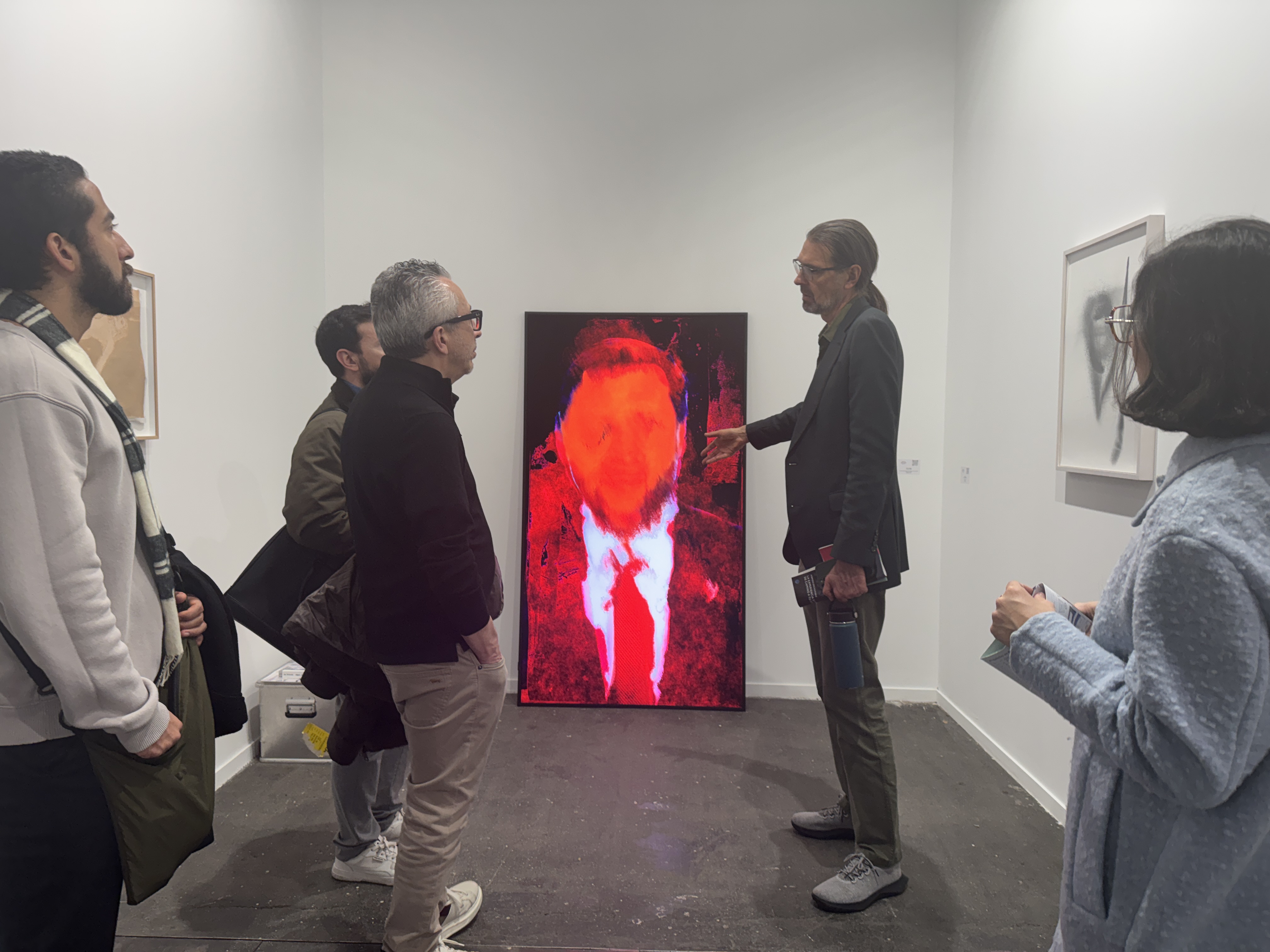
The visit became even more memorable when we were joined by Daniel Canogar himself. He spent time with our group explaining his newest video work, Iconoclast, which had been finished only a few days earlier.
The piece uses a selection of contemporary loud figures associated with power, including Donald Trump and Mark Zuckerberg. An algorithm continuously distorts their images, stretching and transforming them in slow, unsettling ways. The work never repeats. The set of figures will also change over time, with Canogar’s studio updating the selection each year based on current events.
Through this system, the work explores the long relationship between portraiture, artists, and power. In a way, it places algorithmic portraiture in the lineage of artists such as Diego Velázquez and Francisco de Goya, who also used portraits to question authority and the people who hold it.
Two Video Works Worth Noting at Francisco Fino and Poggi Gallery
- Gallery Name: Francisco Fino
- Location: Lisbon, Portugal
- Booth number: 9A10
- Link to the catalogue: https://drive.google.com/file/d/12Uh4uaJS6ydKHq3Z9hHPMb1dK7DAwjco/view?usp=drive_link
While not recent, video work remains surprisingly niche and often misunderstood by the broader contemporary art market. That makes it even more rewarding when strong pieces appear at a fair. One worth stopping for is Clerk (2011) by Ali Kazma, the Turkish artist who received the Nam June Paik Award in 2010 and later represented Turkey at the 55th Venice Biennale in 2013.
Kazma’s practice often looks closely at systems of work and organization, focusing on the gestures and routines that structure daily life: labor, time, repetitive movements, and institutional processes. In the single-channel HD video Clerk (2011), Kazma turns his attention to a notary’s clerk. The camera isolates the clerk’s hand as it stamps official documents over and over with striking speed and precision. The scene is simple, almost hypnotic.
As the gesture repeats, the individual behind the hand fades into the background. What remains is the action itself: a mechanical rhythm that reflects how institutions operate. Each stamp becomes part of a larger system of approval, quietly illustrating how bureaucracy runs through repetition.

See the video preview: https://www.youtube.com/shorts/hOiAJ3NQAEs
- Gallery Name: Poggi
- Location: Paris, France
- Booth number: 9C14
- Link to the catalogue: https://drive.google.com/file/d/13hDSmVWewbXAqOSLvtIDO5qD_2-nzUJN/view
Ukrainian artists, Yarema Malashchuk and Roman Khimei have been collaborating as an artist and filmmaking duo since 2016.
They work at the intersection of documentary and fiction. Their work explores Ukraine's recent history and present, specifically examining post-imperial power structures and their effects on a generation shaped by historical trauma and uncertainty. They use multi-channel video installations and cinematic storytelling to investigate the interplay between collective memory and personal experience. They pay particular attention to overlooked or invisible figures within historical narratives.
You might have seen their work at OFFSCREEN Paris in 2025 (that won the curatorial prize) and they currently have a major solo exhibition, Pedagogies of War, at the Museo Nacional Thyssen-Bornemisza in Madrid that we encourage you to visit: https://www.museothyssen.org/en/exhibitions/khimei-malashchuk-pedagogies-war.
Collector Resources
Catalogues from 27 galleries exhibiting at ARCOmadrid that might be of interest: https://docs.google.com/spreadsheets/d/1_fJ790j_B6lsxSMHLyrS8VAYHP5qE5pegzOGY-FfZBk/edit?gid=0#gid=0
ARCOmadrid website: https://www.ifema.es/arco/madrid