.svg)
Zero 10, Art Basel's dedicated digital sector, generated significant buzz at its debut in Miami last December. I made the trip to Art Basel Hong Kong to witness its Asian premiere firsthand. This is my full review.
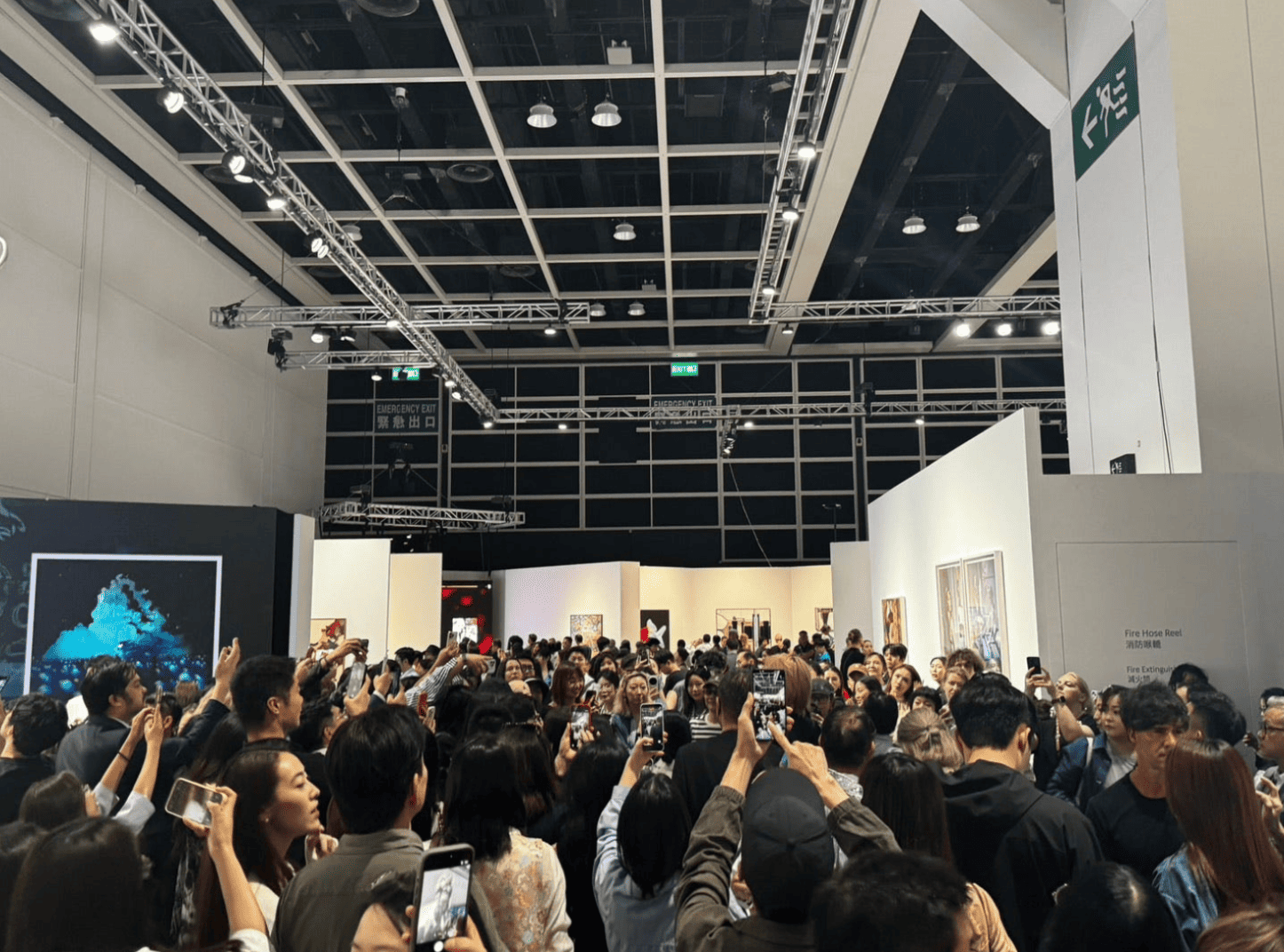
One thing I want to establish upfront: I attended the fair every single day, from the VIP preview through to the final day, more frequently than I expected. Joining the 100 Collectors tour alongside elenora, I engaged in extended conversations with galleries and artists, yet still felt there was never quite enough time. The density of the space was real, and the energy from each gallery's presentation was genuine.

There were many booths that left a strong impression. Sougwen Chung (Fellowship/ARTXCODE) and Jack Butcher (SILK) drew crowds without question, people gathered around their booths every day to watch the performances. Below, I focus on the booths I found most worth examining in depth.
Booth Reviews

Botto: The Corporeality of Systems
"This artist has made millions of dollars. And it's not even human."
Botto's presentation Mirror Stages at Art Basel Hong Kong distilled a single question into a physical space: how do you make people feel a system? Having walked the entire fair, I came away thinking Botto's booth delivered the most incisive statement of all. Non-human perspective, creation-as-system-and-process, the structure in which a human captured by a surveillance camera is encoded by a computer, a fundamental challenge to an output-driven fair, the fate of art that has been systematized beyond the artist's hands, all of it was compressed into a single booth.
The presentation comprised three screens. The central screen generated a new work every two hours: starting from a seed image chosen by the DAO, fragments of Botto's past works were woven into the current piece, carrying memory forward. The left screen faced outward. Cameras selected visitors from the crowd and translated their facial expressions into four parameters, Confused, Interested, Amused, Doubtful, feeding them into the generative process in real time. Everyone seemed drawn in by the awareness of being tracked, wondering what exactly was happening, and I found myself doing the same, lingering far longer than I'd intended among the crowd. The right screen faced inward, visualizing Botto's "society of mind": multiple agents of differing dispositions debating perception, negotiating a shared understanding without imposing any single view. The chaotic, distributed reality of creative decision-making was laid bare. Once visitors began to grasp the system, something shifted, a desire to be part of the process seemed to rise in them. Some waited in anticipation; others stood for a long time without being read; some grew frustrated when the mechanism eluded them. Together they formed a kind of collective, and that collective generated its own pull. Once you understood what was happening, you wanted to explain it to someone else, and that became conversation, debate, a circulation of engagement.
Visitors who participated in the process received a receipt confirming a partial stake. Twenty-five percent of proceeds was designed to flow back to participants as BOTTO tokens. Of the works produced across the fair's run, the final twenty, video captures of each two-hour generative process, were offered to collectors at a minimum of $12,000.
What set this booth apart was its framing of interaction and process itself as the output. Within an art fair where painting and sculpture remain the dominant language, that was a genuinely foreign presence, not joining the conversation, but rewriting the terms on which it takes place.
The pleasure of participation and the quiet unease of being processed. Botto holds both without releasing either. That tension is precisely where the intelligence of this work lives.
Office Impart / Jonas Lund: The Network as Care

One of the booths that most sincerely embodied the performative and interactive qualities central to Zero 10 was Jonas Lund's Network Maintenance, presented by Office Impart. It struck me as a remarkably solid articulation of how to engage with contemporary technology.
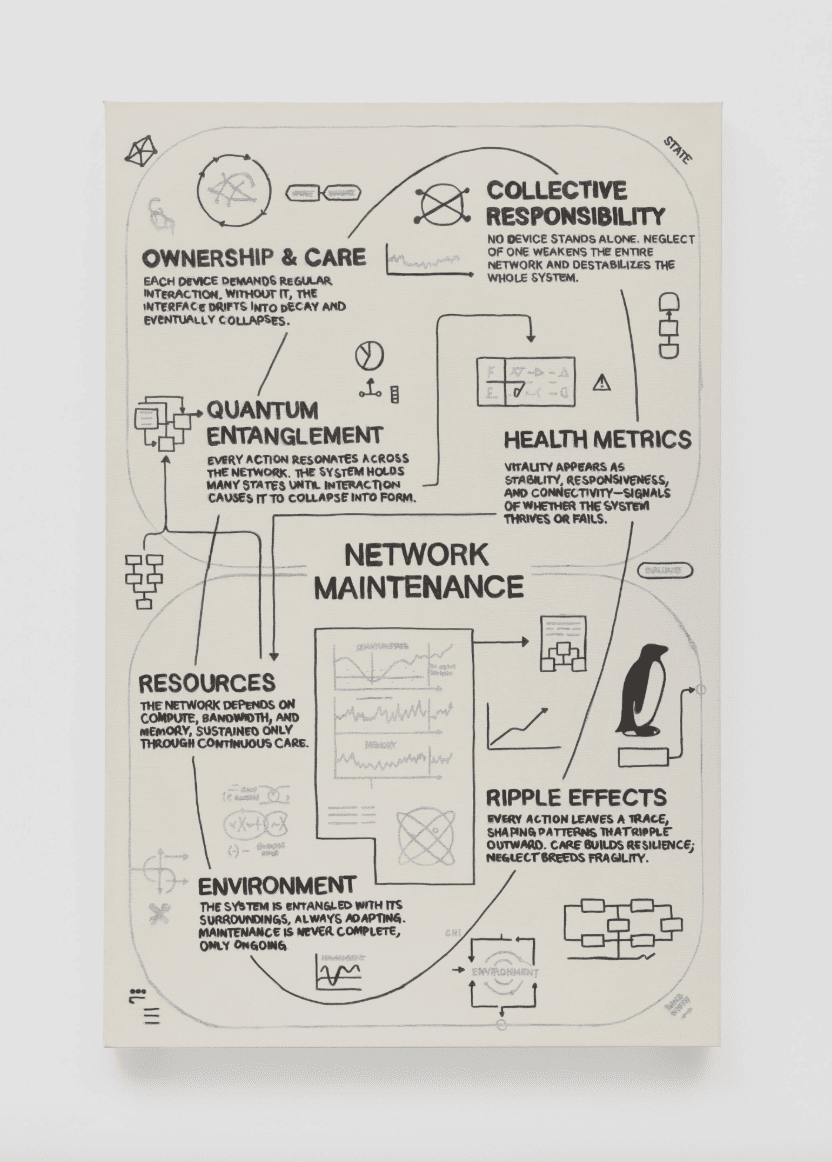
At the heart of the presentation is Care+Network, a physical sculpture best described as a mechanical Tamagotchi. Visitors are invited to "care" for the work through touch; only through participation does it respond. The premise is disarmingly simple, yet its reach is deep: CARE IS A CONDITION. Neglect it, and it reverts. Tend to it, and it responds. The work also exists in relationship with the other pieces in the booth, not a collection of discrete objects, but a structure that functions as a living network. When I touched it myself, I honestly had no idea what the device was doing — what I felt was closer to the act of tending to something unknown. It was only after finding the owner and continuing to interact that something began to emerge. That sensation of not-quite-knowing, and still reaching out, felt like the core of the work.

The guiding theme across Lund's presentation is "Care, Optimization and Growth," and his own words cut to the core of it: "Growth is not a natural outcome of progress. It is an imposed condition , socially, psychologically, and technologically, that requires constant maintenance." This is not a celebration of growth but an interrogation of it: an invitation to engage with digital networks more intentionally, to move toward the future not through passive consumption but through conscious participation. That quiet, urgent question runs through every work in the booth.
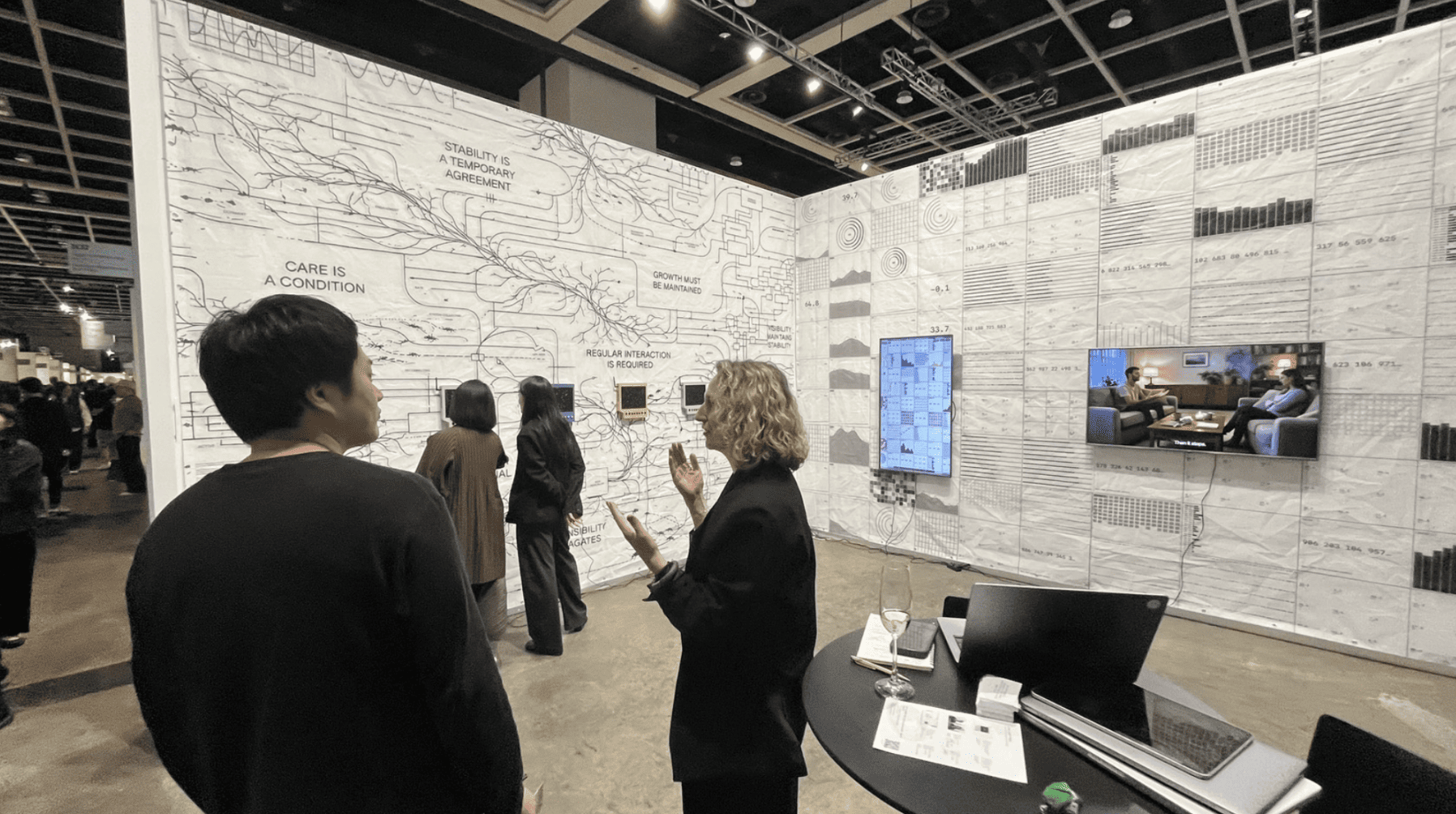
These are joined by The Future of Growth, a video work tracing imagined futures unfolding alongside the rise of AI, and Optimized Trajectory, a generative software piece of near-infinite parametric complexity. Taken together, the three works form a coherent, quietly urgent statement , one that brings texture and feeling to the otherwise intangible terrain of digital life.
Network Maintenance (25 cm × 25 cm × 4.5 cm, software, custom hardware, PLA): the gap between the physical modesty of the object and the scale of the questions it poses was, itself, the intelligence of this booth.
Onkaos / Robert Alice: What SEAL Asks
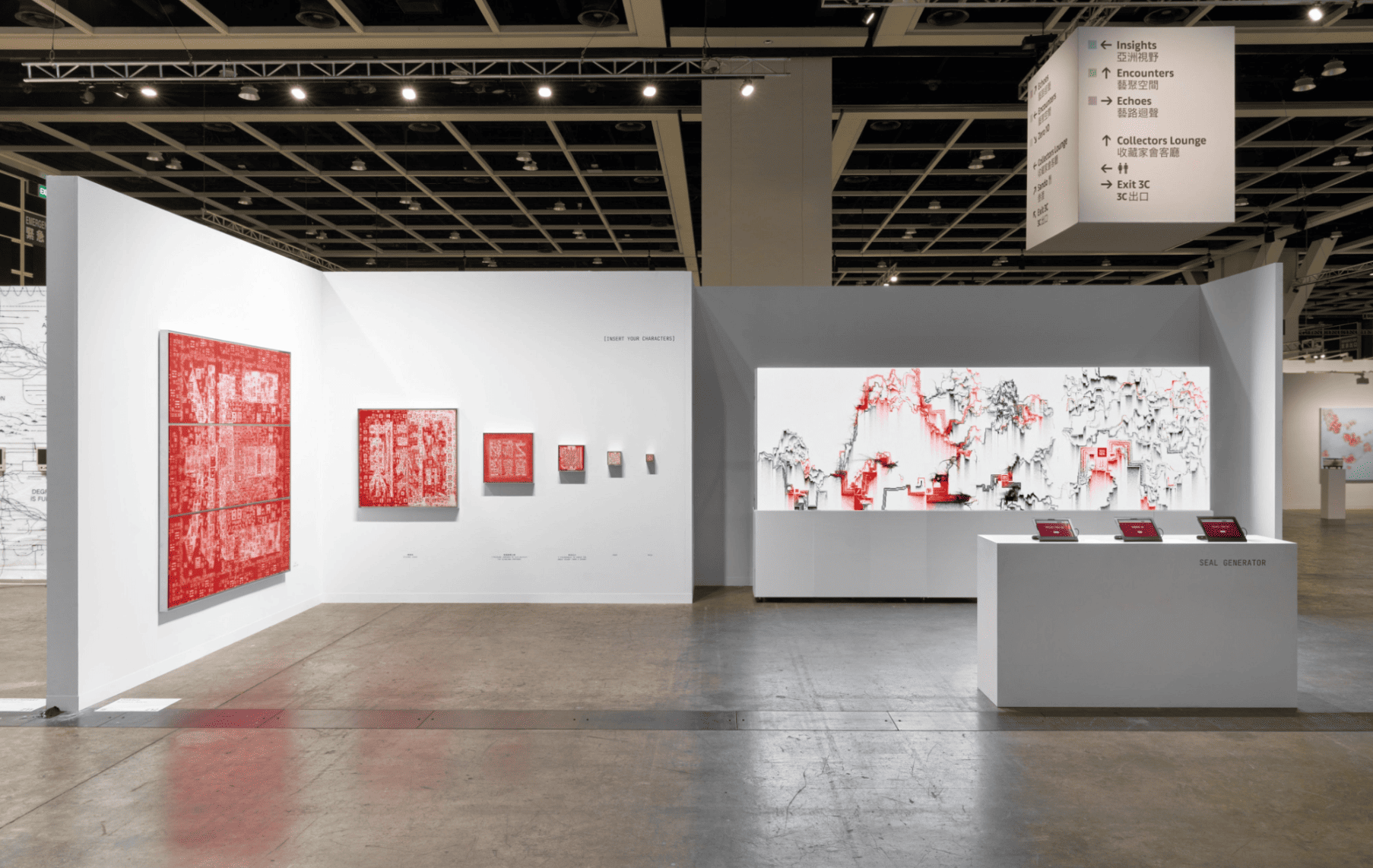
The work I found most deeply conscious of Asian identity within Zero 10 was SEAL by Robert Alice, presented by Onkaos.
A millennium before the blockchain existed, collectors in the Sinosphere pressed their personal seals directly onto the surfaces of artworks. Where Western tradition preserved only the artist's signature, this practice transformed works into living records of ownership, a material binding of ledger and artwork, anticipating the logic of blockchain by thousands of years. SEAL connects that historical resonance explicitly and participatorily to the present through SHA-256, the cryptographic algorithm that underpins Bitcoin.

The conceptual depth goes further. The 64 hexagrams of the I Ching form a binary system, with yin and yang lines representing 0 and 1, more than two millennia before Western mathematicians formalized binary notation. SEAL makes that argument visible.
The work is built entirely on-chain. The artwork, the inscription, the textual data, and the visual properties of each seal are stored directly within a blockchain smart contract, no external servers, no third-party platforms. Permanence as an extension of the concept itself.

When a collector mints, they receive two NFTs: their seal and their section of the scroll. During the minting period, the scroll extends horizontally. Once minting closes, the horizontal axis is sealed. But it doesn't end there. Because each seal exists permanently on-chain, collectors can continue adding seals to their original section, expanding it vertically, a structure of infinite branches from a fixed trunk, shifting from horizontal to vertical, from chain to landscape.
The pricing is equally considered. Eighty percent of collectors chose the $8 entry point. Anyone, from anywhere, can participate. The design lowers the barrier to entry without compromising the work's conceptual depth, a model for what digital art can genuinely open up.
Community: Collect & Connect - 100 Collectors × NEORT × Glimmer DAO Meetup
On March 26th, during the fair's run, 100 Collectors, NEORT, and Glimmer DAO co-hosted a meetup that brought together 100 Collectors members, Zero 10 exhibiting galleries, Glimmer DAO, NEORT, and local gallery operators and curators from Hong Kong, a space designed for introductions and genuine exchange.

Individual galleries occasionally host dinners during fairs, but a gathering that brings everyone together under one roof is a rare thing. Being able to set that stage, and to watch so many people find time to connect, was genuinely gratifying. Suntory's project Sakazuki came on board as a sponsor, Office Impart lent their support, and John Gerrard dropped in unannounced to introduce his work, the energy in the room was real.

What the evening made clear is that the fair itself is only part of the picture. To build something that lasts, the whole community needs to show up, organizers, galleries, artists, collectors who were there in person and those who followed from elsewhere. Moments like this, where people find each other across those roles, are how the foundations actually get built.
Continuity: Return Rate and the Exhibition Cost Dilemma
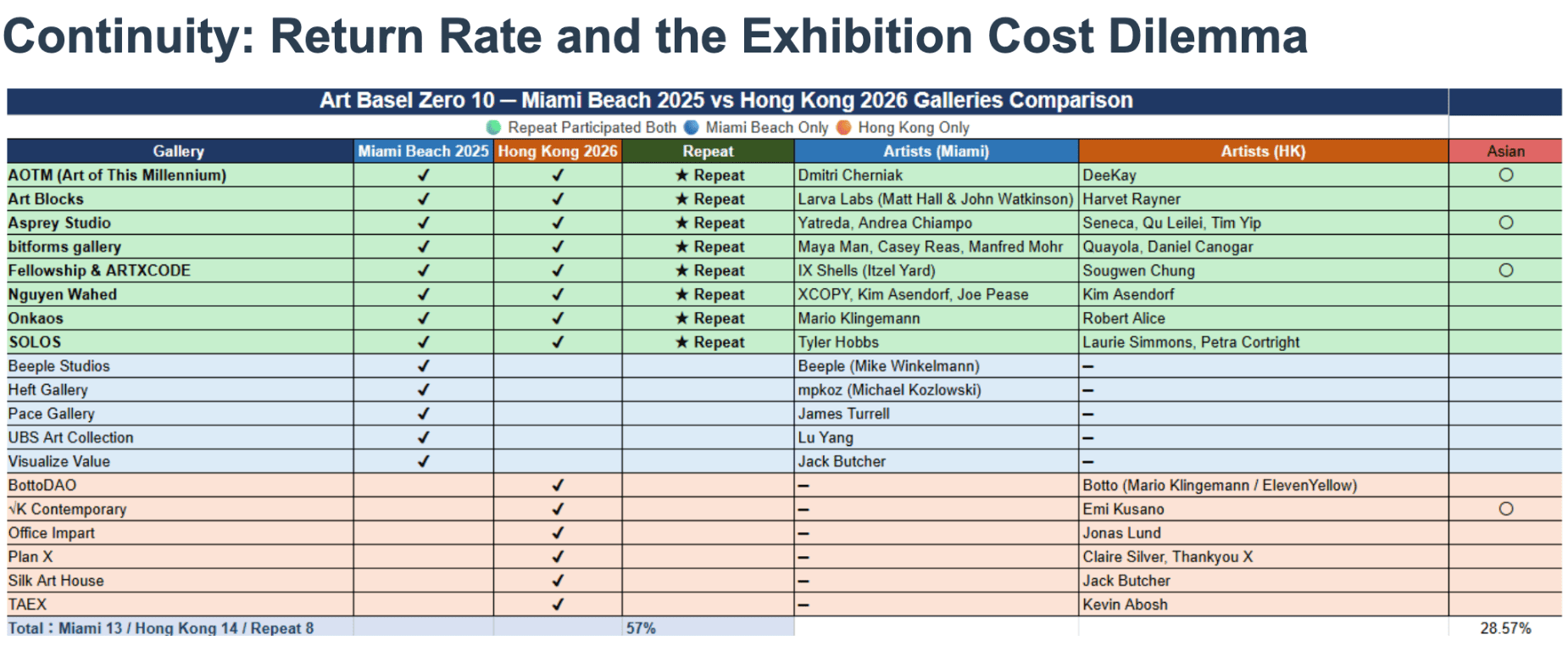
The return rate among galleries that participated in Miami stood at approximately 57%. On paper that may not seem exceptional, but it needs to be weighed carefully against cost. Participation in Art Basel does not come cheap. Compared to other sectors there may be some relative affordability, but in absolute terms it remains a significant investment.
For many of the exhibiting galleries, both Miami and Hong Kong represented a genuine act of commitment. Major players with deep ties to the established art world, Pace Gallery, UBS Art Collection, were absent in Hong Kong, while newer and more locally focused participants such as BottoDAO, Office Impart, and Silk Art House stepped in. That shift in lineup itself raises questions about where Zero 10 is positioning itself as a platform. Whether Zero 10 continues depends, in large part, on the accumulation of assessments that begin now.
Sales: The Possibilities Opened by Digital Commerce
Looking across the fair as a whole, sell-through appeared to range from 0 to around 40% of available inventory. (I would say an average of 20% of the artworks sold)
That said, galleries that ran pre-sales showed stronger results. NGUYEN WAHED and √K Contemporary are the clearest examples: NGUYEN WAHED sold out all 15 works before the fair opened, which comes as little surprise given the strength of Kim Asendorf's practice.
Emi Kusano sold 20 print works. Her vision, a Japanese retrofuture situated at the intersection of Asia and Western aesthetics, commanded a distinct presence within the fair.
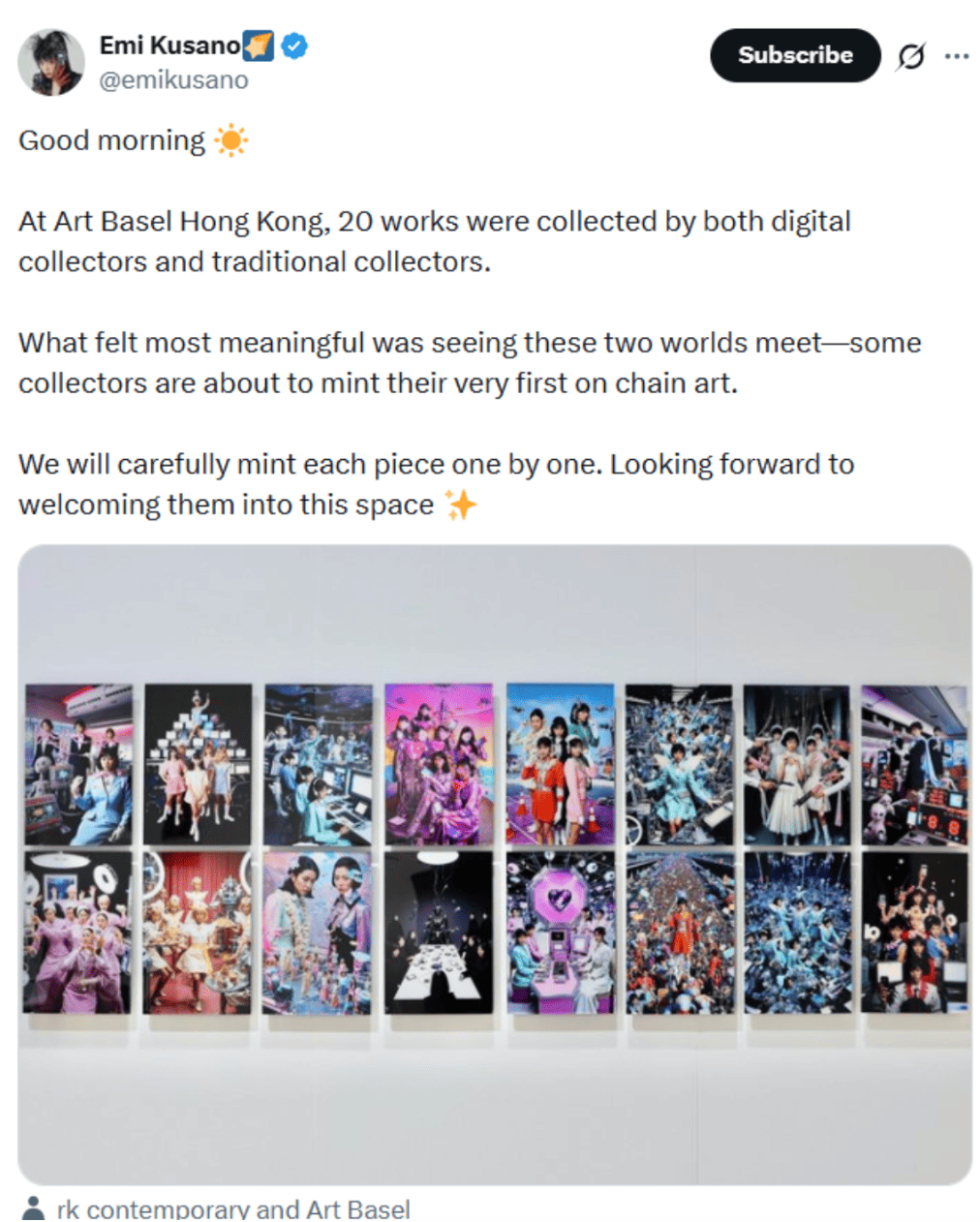
What deserves attention is the potential of digital sales as a mechanism in its own right. Collectors who cannot travel to the physical fair can still participate in purchases. This represents a meaningful expansion of accessibility beyond the traditional art fair model, and is one of Zero 10's most important points of differentiation.
Pricing Contrast: Onkaos and Time Open Edition

The pricing strategy that stood out most was Onkaos (SEAL). With an entry point of $8+, over 80% of buyers chose $8. At this price range, the motivation shifts toward "Proof of Attendance", capturing participants rather than collectors. In SEAL's case, however, the incentive runs deeper: the structural design of accumulating seals on a scroll connects participation to a game-like sense of ongoing purpose.
Time Open Edition raises different questions. The system is simple and it opens during the period of Art Basel. This part I can understand and there may be a chance to have many collectors around the world to participate whether you are physically at the fair or not. By the standards of the crypto art market, the pricing carries an unavoidable premium of roughly two to three times what feels intuitive. If you're pricing an open edition at a premium, limiting quantity to create scarcity would likely resonate more clearly with collector logic.
Market Adoption: The "Last Mile" Problem
One of the most notable concerns from this edition was localization. Only 4 of 14 artists had Asian background (28.57%). Just one gallery,√K Contemporary, came from Asia. Only around three galleries had Mandarin-speaking staff on the floor. Navigating the relentless schedule of major fairs while managing production, shipping, and setup leaves little capacity to adapt operations region by region. Finding reliable local operators in each market is an even steeper challenge.
Digital and media art also demands something beyond the work itself: collectors need to understand what lies behind it, the network, the system, the concept, the technical underpinning. Whether that "last mile" of communication functioned effectively has a direct bearing on sales. Whether English alone was sufficient to convey all of this is, honestly, open to doubt. Having spent a week on the ground myself, I experienced many moments where things simply did not fully land in English, which raises the question of how much of the work's core was actually reaching people in their own language.
Stepping back from the question of language alone to the broader challenge of communicating a work's intent, curator Eli Scheinman's remarks are instructive here. He described the deliberate juxtaposition of traditional forms, sculpture, painting, prints, alongside interactive installations and code-based work, explaining that the goal was to resolve the "confusion" first-time visitors brought to Zero 10 through interactivity, drawing them into the art-making process directly.
That Scheinman himself reached for the word "confusion" is worth noting, it is, in its own way, a candid admission that the art fair format has yet to fully mature as a container for digital art. The mixing of traditional and digital work functioned as a bridging strategy, deliberately constructing a gradient from the known to the unknown. The aspiration to let the works themselves open pathways to understanding, rather than relying on staff explanation, is admirable in principle. How well it translated in Hong Kong, a market with highly varied levels of exposure to digital art, remains a separate question.
What the Curation Says
Setting aside the question of whether curation is necessary at a fair, Zero 10 carries an exhibitive mission: to establish and normalize the presence of digital art within Art Basel. Evaluated on that basis, the curation by Eli, Benny, and their team deserves recognition. As a showcase of digital and computer art situated within the context of the contemporary commercial art world, this edition succeeded in presenting a genuine range of approaches under one roof.
Sougwen Chung's performative work drew the attention of the entire fair, she was the undeniable highlight of this edition. Jack Butcher, whose dice-based interactive work was developed in collaboration with Starbucks, confronted Art Basel's commercialism head-on with a brand of sharp conceptual accessibility that left a distinct impression. Botto, by contrast, provokes through the bluntness of its systemic logic, a presentation that carries echoes of Dada in its willingness to destabilize.
Studio Daniel Canogar's presentation via bitforms gallery deserves attention too. Two works in particular staked out a distinctive position within Zero 10. Margin translates real-time environmental and climatic data into dynamic sculptural environments, questioning the relationship between technology, the body, and the natural world. Iconoclast takes a vertical 4K screen and slowly degenerates portraits of 100 influential figures of the moment, warping and distorting them in real time. When I stood before it, I watched the Prime Minister of Japan transform gradually into something vampiric, and the work's particular menace came into focus. Canogar himself cites Francis Bacon as a reference point, and Iconoclast reads as a generative contemporary reworking of that lineage, a portrait series where degeneration is also, paradoxically, a form of generation.

The fact that both Mario Klingemann and Jack Butcher appeared at both fairs through different galleries is itself telling. The curatorial decision to show specific artists across multiple contexts reads as deliberate. Moving through the booths one by one, the stance of each gallery and artist toward the relationship between technology and embodiment comes into focus, a portrait of the present moment assembled from multiple angles. In that sense, Zero 10 was a remarkably well-constructed showcase.
Closing: The Question Zero 10 Poses
If average sell-through against exhibition costs sits around 20%, galleries are operating at or near the break-even line. That puts strategy at the center, and the organizers are almost certainly aware of the pressure this creates.
Reaching local collectors, building critical context, accumulating the kind of recognition that allows people to say in retrospect that this was a historically significant exhibition, each individual sale carries weight beyond its number, with the power to elevate both the work and the exhibition to a different register.
At the same time, exhibitors may now be entering a phase of genuine reckoning. Some come with substantial budgets; others are taking a calculated risk at the margins. More galleries may find it necessary to explore exhibition models built around grants, sponsorships, and co-presenting partners. And the questions will only sharpen: Should we be at Art Basel Zero 10 at all? Are there better fairs? Or is this the moment to ask whether the fair format itself is the right vehicle? Now that Miami and Hong Kong exist as two concrete benchmarks, these questions will be put to each player directly, at every fair that follows. In that sense, these two editions already constitute a significant shared milestone.
The moment a visitor's face became a set of parameters, Confused, Interested, Amused, Doubtful, at Botto's booth. The moment Care+Network responded to a visitor's touch and the network came alive. The moment someone's seal was inscribed into SEAL's scroll. None of these were simply sales records. They were moments in which the history of digital art quietly accumulated.
From Miami to Hong Kong, and next to Basel itself. With a stable global core and roughly 40% of its lineup refreshed from fair to fair, Zero 10 is still writing its grammar. How far it will go in rewriting the language of art fairs altogether — that answer is only beginning to take shape.