.svg)
I first met Jin Meyerson in the corridors of Loop Lab Busan, a video art festival staged inside a hotel in South Korea. Standing together and watching people move in and out of hotel rooms - each one temporarily transformed into a screening space - we began one of the most eye-opening conversations I had during my time in the country. A few weeks later, the conversation continued in his studio in Seoul, and it is part of that exchange that I share here.
Meyerson’s life story is deeply intertwined with that of Korea itself. Born in Incheon, South Korea, he was abandoned in a public market at around three or four years old, adopted by a Jewish-Swedish family, and raised in Minnesota, in the United States. His official birth date - May 8, celebrated as Parents’ Day in Korea - is shared by many other Korean adoptees, reflecting the lack of accurate records during the country’s period of mass international adoptions. The program began following the Korean War (1950–1953), and peaked during the 1970s and 1980s. During this time, falsified documentation, standardized birth dates, and the systematic separation of children from their families became widespread responses to the social, economic, and political crises of the post-war era in the country.
Later in his life, art became a way for Meyerson to make sense of the world. In the beginning of his career, he worked extensively with images drawn from American popular culture - cars, pop music, bands, brands - as a way of understanding what he was seeing and, in turn, understanding himself. He distorted these images until they began to make sense to him. This approach shifted when a friend introduced him to Photoshop, where a single click could fragment and distort an image without any clear logic. Today, with generative art at its peak, Meyerson transforms data into paintings, paintings into videos, and images back into brushstrokes in an ongoing cycle that reflects on where we come from and where we might be going.
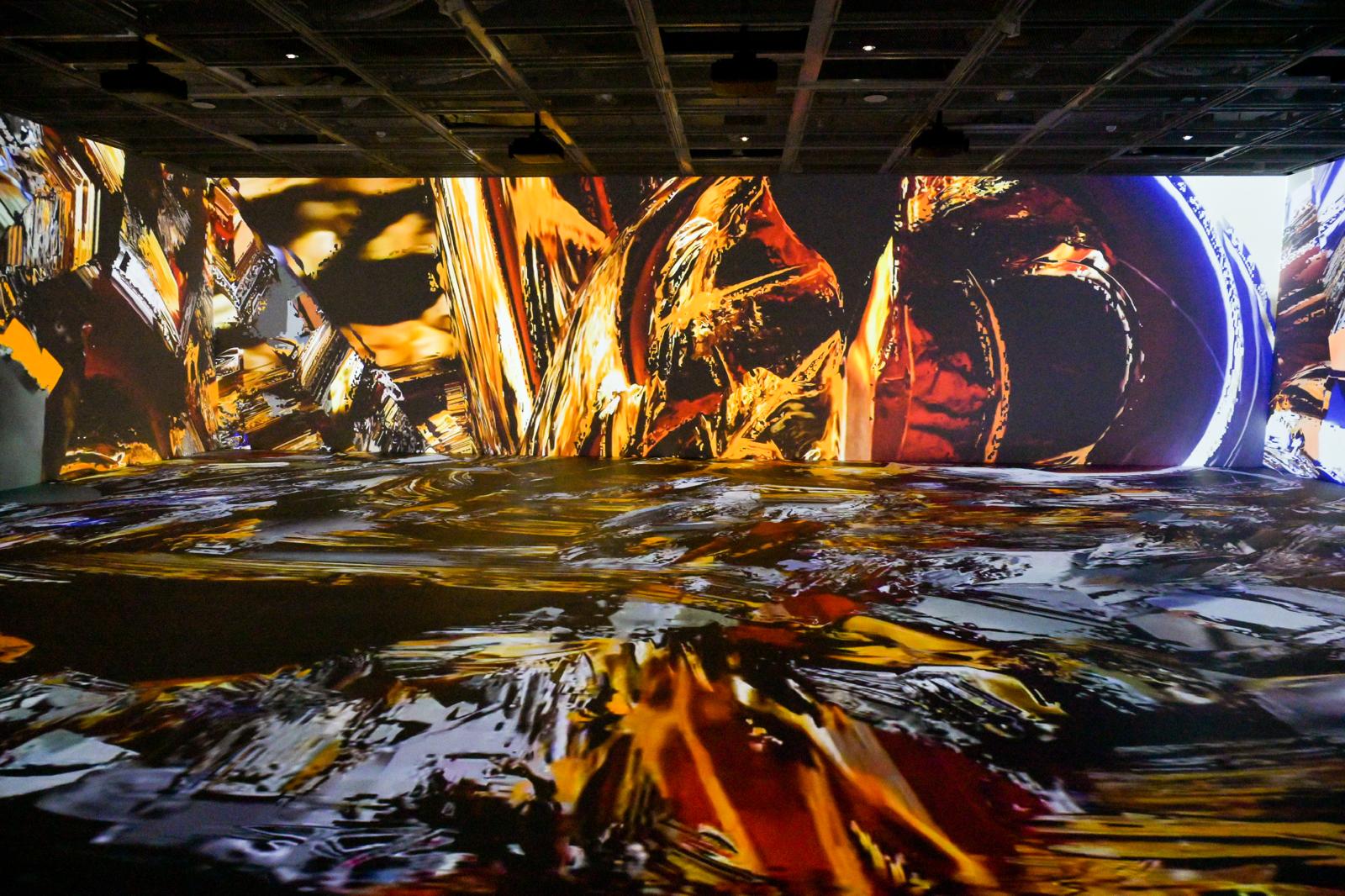
Currently, one of his works is on view at the Korean Cultural Center in Paris as part of the exhibition Colors of Korea: Spotlight on Contemporary Korean Art. Titled Once in a Lifetime, the immersive installation transforms floors and walls into shifting landscapes of colors and textures.
This interview is about Meyerson’s remarkable practice - but also about generation, inheritance, and identity.
Julia Flamingo: Your work moves fluidly between painting, digital experimentation, and video, often looping back into painting again. How did this way of working emerge for you?
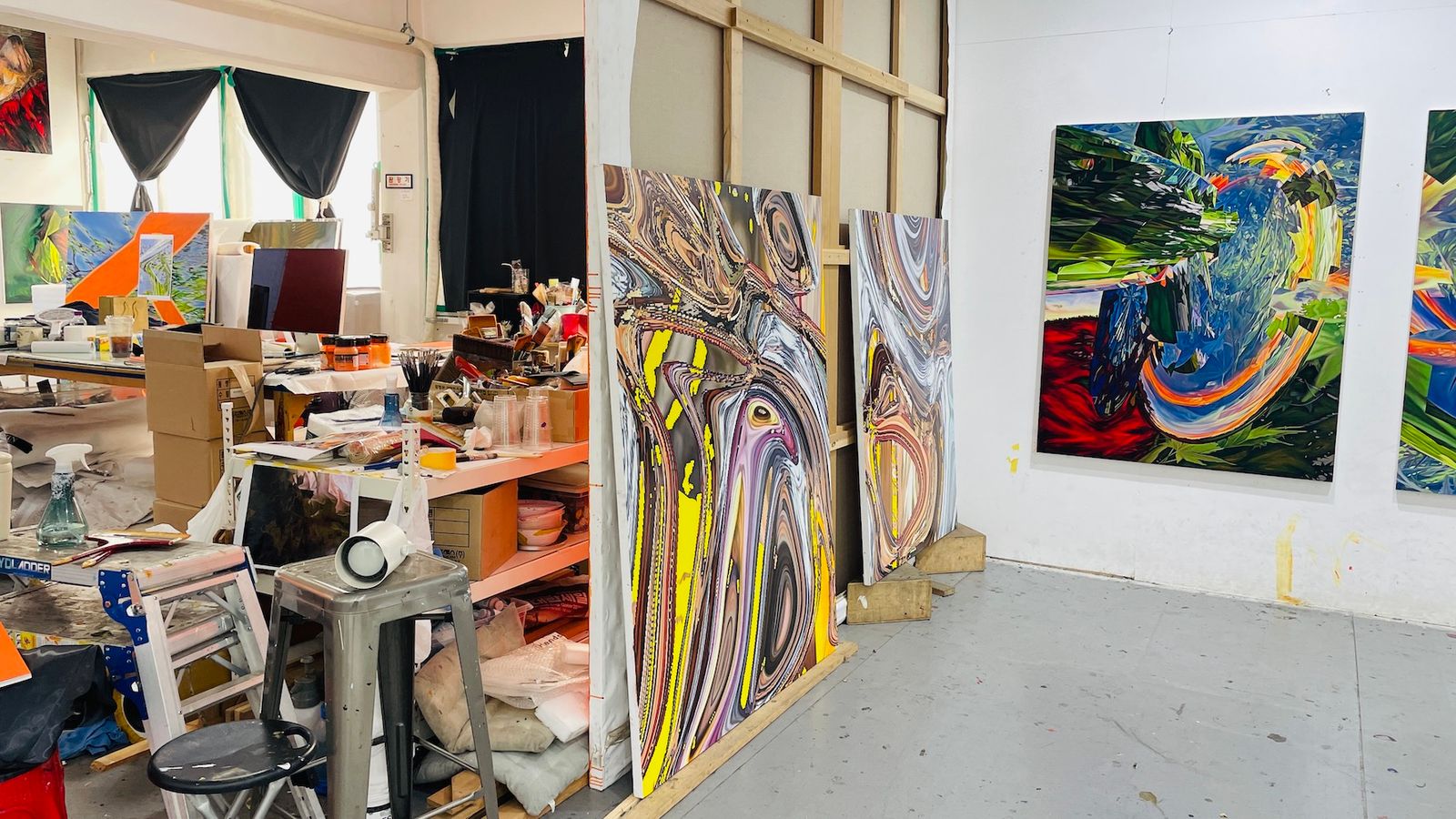
Jin Meyerson: I kind of have two studios. I have a painting studio and then I have a digital studio, which doesn’t exist in real space. It’s basically just three of us [artist and his assistants] that meet and brainstorm about different ideas and things that I want to do.
Once I learned that all my own personal birth records had basically been made up, I started thinking about the sketches as being birth records of the paintings. So I did that.
I had this thought one day about how my daughters are connected to my birth mother. Even though I lost any chance of connecting with her through DNA data - and through their physical appearance even - I got a glimpse of what my birth mother was like. That idea of “back to the future” was right in front of me.
That’s when I started creating these videos that would take the data of the paintings. I used a triple reflection: I put a mirror to reflect the first image, then another mirror that reflected that image. That’s what you’re seeing in the video.
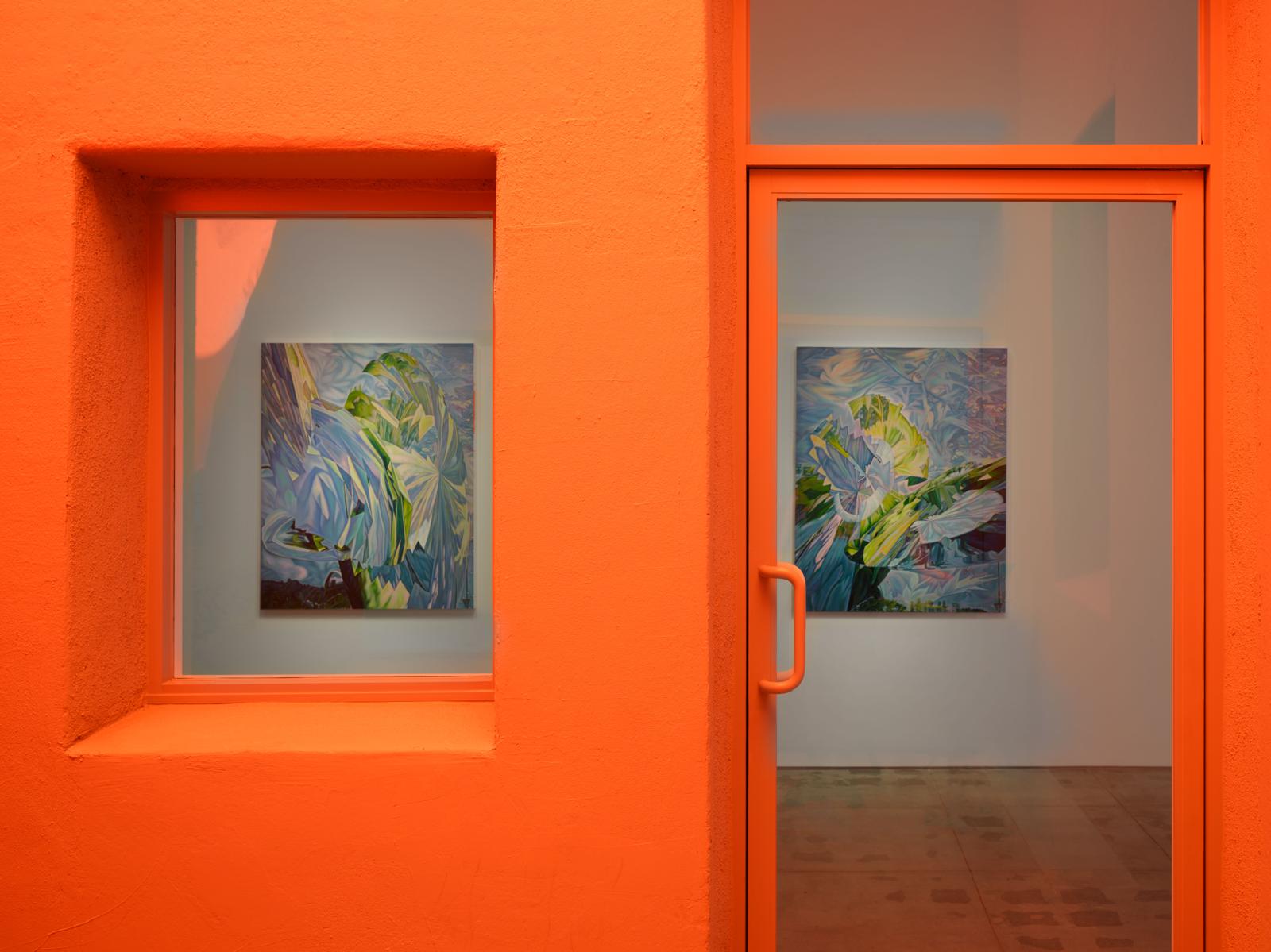
After the videos were made, I made a group of paintings called Descendant. The practice weaves in and out of both digital and analog space. This was shown at Esther Schipper in Berlin, and it was shown at Ulsan City Museum, during my solo show there, which was my first video solo show.
Can you talk about the early uses of radical digital spaces, and how those first experiments, along with new technologies, continue to inform the way you work today?
When I moved to NYC in the mid 1990’s Adorno’s idea that “painting is dead”, meaning a post historical gesture, was getting alot of airtime. Through the dual narrative of being a diaspora person/ korean adoptee and refusing to accept painting was exhausted, I stumbled into very early imaging software and what was radical digital space in 1997. The journey of finding territory that could convey the tender contradiction of absence and belonging. And of course as imaging software was breakthrough technology, engaging with digitalism in that era provided this perfect space. I should mention that this was not something that was accepted even within my own generation of painters. There is this authorship requirement in painting which when handed over to randomization and imaging programs becomes subverted. So when I was hosting studio visits, quite a few dealers and even my own friends openly commented that they felt this was “cheating”. I think the real challenge was that they could not imagine an intimate and personal relationship in digital space. Of course 30 years later there are so many wonderful young artists/ painters who use imaging software as an integral part of their processes, and as a species we are completely integrated with our technologies in our everyday lives and deeply personal ways.
Painting is a technology onto itself and as “painting technology” , painters have always woven imaging technology with painting. Whether through photography or early lens based camera obscura, camera lucida usage we are optical creatures.
Because of my specific life experience, the search for an ambient space, a sort of frontier optics has been instinctual. It is essential for me to venture further out into these unknown territories because this is where I feel real belonging. In terms of both my painting and programming studios, I continue to keep searching for new and novel ways to express this journey of loss, discovery and meaning.
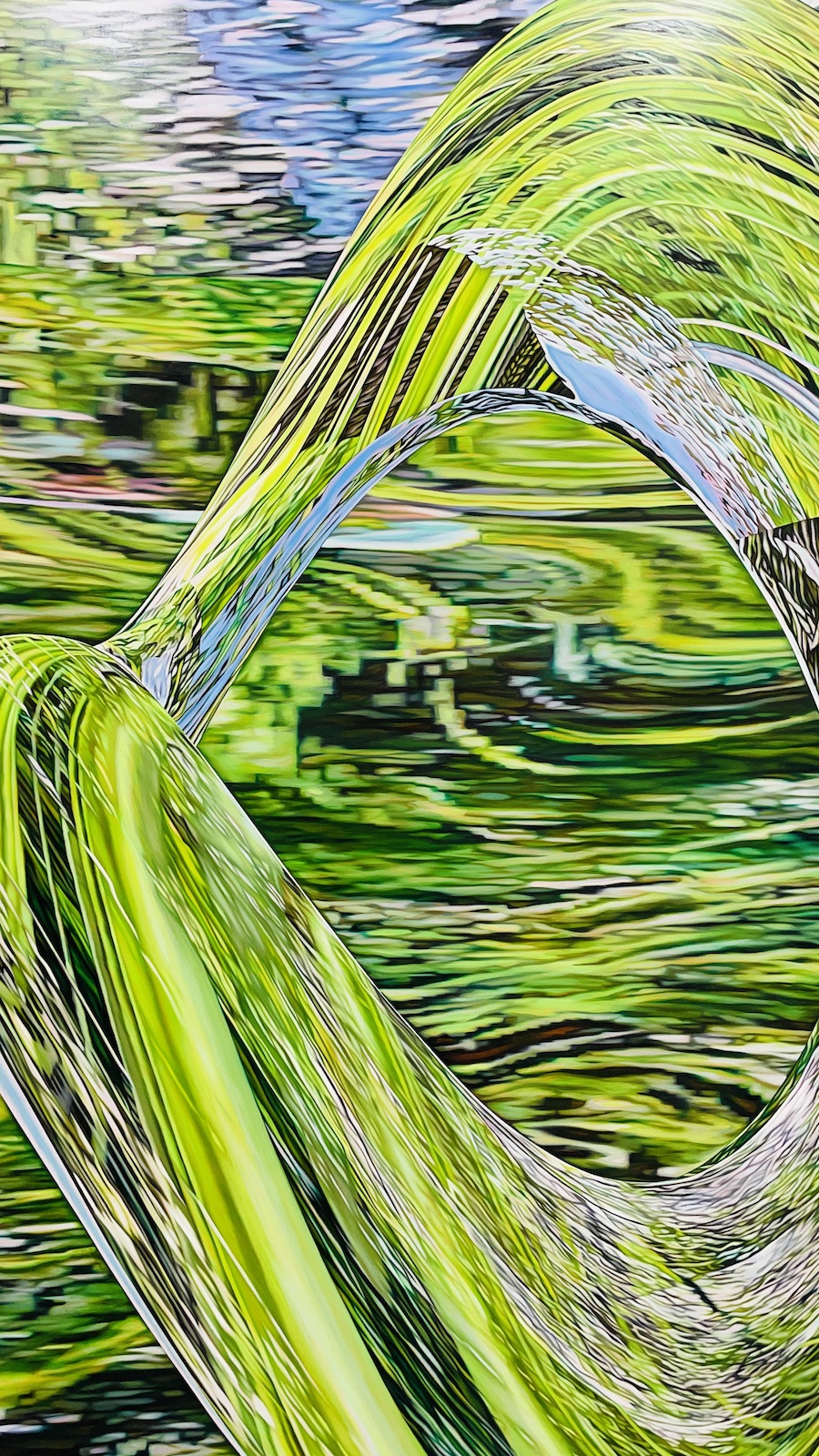
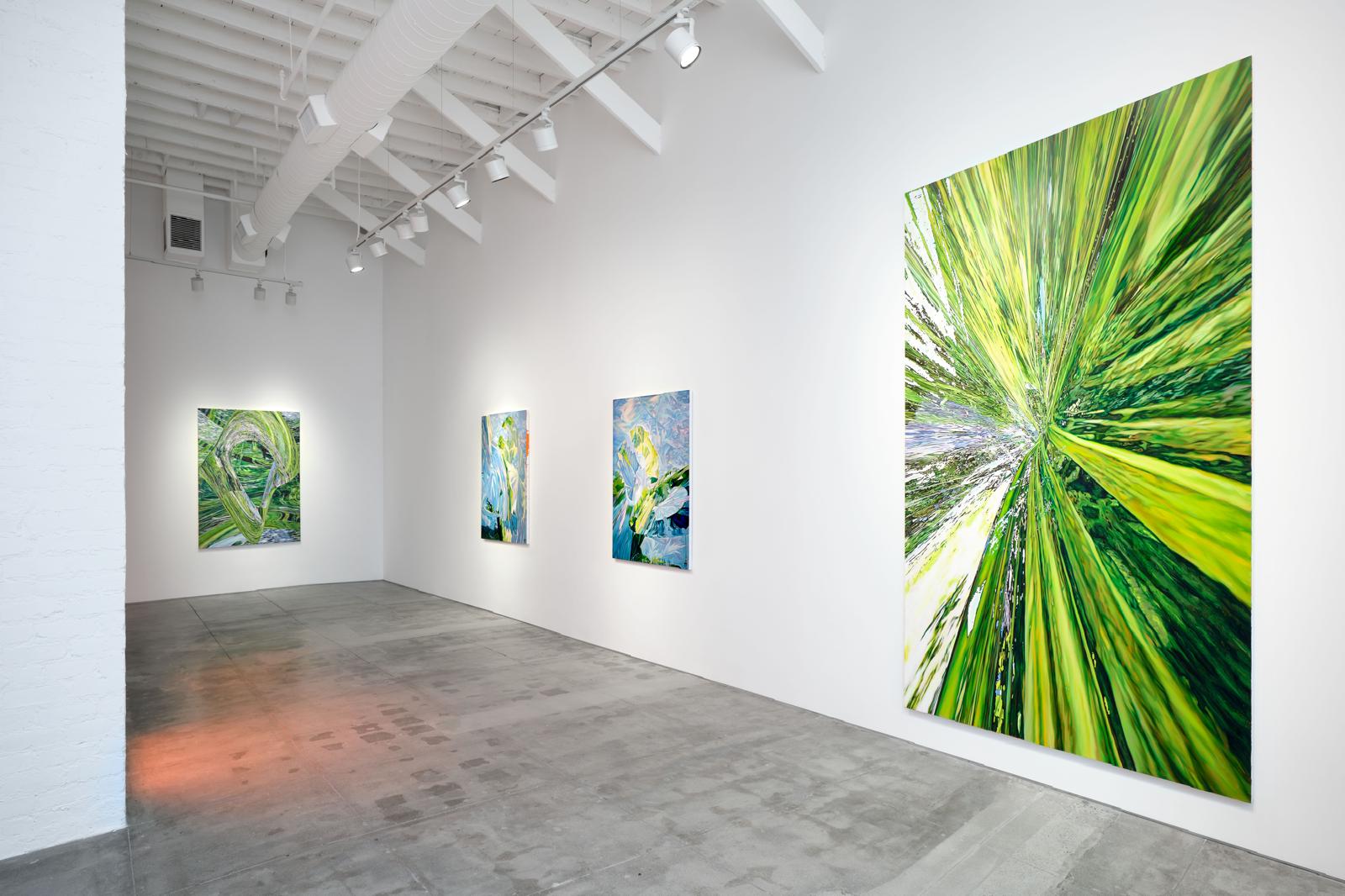
Julia: Your working process follows a circular logic that also appears in the form of the works themselves - paintings that feel like vortices, and videos that resemble black holes, shown in loops where we can no longer tell where they begin or end.
Yes, all the way we experience time is nonlinear. Certain moments can appear endless, other moments we barely remember. The making of the paintings versus the sketches versus the videos - those things happen together. A lot of it is trying to understand what things mean.
In purely abstract ones and smaller ones, the physicality can really have a presence. In others, I want them to relate to the screen - pixelization pushed forward. That’s the great thing about painting: it’s physical and virtual at the same time.
The same white can be thick in one area and so thin in another that it turns into something else. It’s like Korean chefs say: if you cut a vegetable a different thickness, the flavor changes. It’s true. In painting, thickness changes everything.
Your work and your life are deeply intertwined. When you as an artist speak publicly about your own adoption, how do you see your personal story operating within a much larger, collective history?
My story is not singular. Korea exported the largest number of children through adoption in recorded history. There were over 200,000 of us who left in the 70s and 80s that were documented legally - plus many without proper documentation.
Korea is technically still at war with itself - there’s no peace treaty, just a ceasefire. After the war [the Korean war, from 1950-1953], Korea had nothing. It has no natural resources - no oil, gold, diamonds - it’s a manufacturing country. It entered G10 status through hard work, innovation, and industry.
But before that, Korea looked around: how can we get money? One major way was through the presence of foreign soldiers. There are still tens of thousands of U.S. soldiers stationed here because of North Korea.
One of the ways to get soldiers’ money was to create a nationalized prostitution service - hostesses. Mixed-race children were being born outside of wedlock. The government didn’t want these “half-racial babies” and couldn’t support single mothers, so they created the opportunity for adoption. It turned into child trafficking - human trafficking.
My parents adopted me in 1976. My mother said it cost about $9,000 to $10,000 in 1976. Multiply that by 200,000: billions in today’s money.
And some months ago, the Korean government finally apologized to the adoptee community, because what most adoptees found out - including myself - was that the stories we were told, and our adopted parents were told, were totally falsified. Kids were kidnapped. Agents roamed the streets to find kids they could hand to an orphanage, receiving finder’s fees.
The yearly income in Korea at that time was around $3,000. If an orphanage could make $3,000 off a single child, you can see why it became a for-profit business.
It started in the 50s. A lot of children left without proper documentation. But in the 70s and 80s it was massive.

You as well didn’t have proper documentation?
No. I don’t have a birth record. I don’t have a birth certificate. I don’t know what day I was born. The first record of my existence is a police report.
One of the usual stories was: “you were dropped off at the orphanage because you were unwanted.” Even today, there are “baby boxes” in front of Catholic churches. Abortion wasn’t legal until two years ago. Women’s rights were terrible.
There were adoptees who had been kidnapped - birth mothers reported them missing - and the children were processed, given new names and new birth dates, and sold to Western parents.

What did the government say now? Does it change something for you?
They admitted there was massive corruption, that they knew existed and they let it happen because they thought it was the best thing for children and mothers. Now they understand it wasn’t. That was basically the brunt of the apology - the first time anyone from the government.
It changes something for me. But I’m very fortunate. I have a real community here thanks to the art world. My story is miraculous in that I have a real Korean family. I have a wife, I have a daughter. Her parents have accepted me.
Most Korean adoptees come back, they don’t speak Korean, there’s nothing here for them, they face racism here. I did too. I’m still not considered a Korean artist. Adoptees are a target. People are territorial: “you don’t belong here.” But that exists everywhere.
Every adoptee has the urge to come back. It’s like a missing limb.
Your American parents - are they alive?
I just lost my father in January. He was 80 and we had had enough moments. I had gone to tell him I’m so proud to be your son.
For them, parenting was a conscious choice. They knew, to some extent, what they were getting into - although I was not a good, healthy American boy. My first year in American public school, my mom was called into the principal’s office every week. I would hit some kid, or grab a toy - because that’s how it was in the orphanage. Food was scarce; I remember hiding food in my cheeks.
When you suffer that level of trauma, it sticks. Generally, people’s memories start around six or seven. For me, I still carry the transition from the Incheon orphanage to Minneapolis–St. Paul. It’s still immediate.

When someone encounters your work without knowing your story, what do you hope remains or resonates?
Even before I understood what I was doing - just finished grad school, moved to New York, 25, no idea what I was doing - I had urges. An urge is more animal-like and instinctual.
But my work has always been connected and parallel to the history of Korea, and the history of my birth mother - her experience of what Korea was, as I imagine it.
Koreans have suffered these lapses in having intelligent politicians - every country has - but the Korean War devastated everything. Every city was destroyed. To come from that into something sophisticated and technically elegant - my work has followed that, from early abstraction into what I do now. Half of my studio is programming and new imaging technology, and some of the most brilliant people are here in Korea.
When you think about the work and production behind Korean content, it comes from the narrative of Han - a tone specific to loss, longing, and survival. Other cultures have their forms, too. In Korea, that term is Han.
My work is connected to that. Even something seemingly superficial is connected to that. Parasite deals with class; Korean shows have that specific tone - dark, but rooted in longing and loss, and ultimately perseverance and problem-solving toward greater meaning.
That’s ultimately what I’m trying to get for myself, and what I hope viewers get from the work. That’s what I meant - how it’s all interwoven.