.svg)
Wen New Atelier, founded by the duo Kalen Iwamoto and Julien Silvano, approaches language as both a malleable material and a generative device. At the core of their practice lies a position of freedom toward language. Words are not bound to a single meaning and instead unfold across a plurality of interpretations. Polysemy becomes a working principle and reveals the performative and conceptual dimensions of text.
Their work draws on a lineage that includes the Surrealists’ automatic writing, where associations emerge spontaneously, as well as the spirit of Fluxus, with its playful and participatory relationship to language. Their works are often interactive and invite the viewer to become a co author, generating ideas alongside sensory experiences. Through this approach, the artists develop a critical reflection on contemporary modes of circulation and consumption of textual and visual content, especially within the ecosystem of social media. By replaying, fragmenting, and diverting mechanisms of meaning making, they question attention, speed, and saturation as defining conditions of digital flows.
With the exhibition Bar CodeX, presented at the MAC Bar, the bar of the Museum of Contemporary Art in Lyon, the artists draw inspiration from the function of the venue itself, conceived as a space for cultural exchange and a social setting where human connections take shape.
In this context, I spoke with Wen New Atelier about their practice, their relationship to language, and the ideas underpinning this project.
1) Could you speak about the references, artistic, literary, or theoretical—that underpin your practice, and how they position your work within a broader lineage of conceptual and post-conceptual art?
Our practice draws from experimental literature, conceptual and text art, as well as critical cultural and literary theory. We situate ourselves within a lineage that includes Oulipo, Fluxus, Surrealism, computational poetry, concrete and conceptual poetry and other literary art forms. From Oulipo, a movement that presages algorithmic and computational writing, we inherit the process of rule-based writing and generative structures; from Fluxus, an attention to intermedia practices; from cultural theories, including media and literary theories, a critical framework to understand the structure and system of language, as well as its reception and circulation.
There’s a notable French strain in our influences, from writers and artists like Alfred Jarry, Stéphane Mallarmé, Marcel Duchamp, André Breton, Sophie Calle, Raymond Queneau, Georges Perec; movements like Surrealism, Dada, Lettrists, Situationists; and French critical theory, including the works of thinkers like Kristeva, Lacan, Foucault, Derrida, Barthes, and many others.
Positioned within this broader lineage, our work extends these concerns into contemporary technological contexts, our computational systems and networked infrastructures. We are interested in how language operates today, particularly the way in which it’s mediated by technology. Our practice brings aspects of this mediation into relief, while also offering alternative ways of using, imagining and relating to technology. And in this, we feel great affinity with artists like Gianni Motti, who use détournement as a central strategy in their artistic practice.
2) Conceptual poetry appears as a key component of your work. How do you define it in your practice, and how does it intersect with blockchain as a system for inscription, circulation, and validation of language?
Similarly to conceptual art, conceptual writing lays emphasis on the idea or process that gives way to the text or artefact, rather than the text itself. More broadly, we often describe our work as conceptual poetry insofar as it is less concerned with lyrical expressions or the transmission of information than with language per se — the structure and play of language, and what it can be and do. When language is more than a mere vehicle for communication, it can be visual material, sound, a site for games, participation, and aesthetic experience.
We’re also interested in the conditions under which language appears, transforms, and circulates. This includes the use and resampling of pre-existing texts, the creation of algorithmic generators, and the invention of literary systems governed by strict rules. Through these approaches, we produce forms of writing that expose and interrogate their own processes of construction.
Within this framework, blockchain becomes particularly compelling as an infrastructure for inscription, validation, and circulation. In 2022, we created a play co-written with an AI, whose lines were immutably inscribed on the Ethereum blockchain. This gesture was not only technical but conceptual: it allowed a text partially authored by a machine to exist beyond the traditional form of the book, as a decentralised, transactional artefact. More broadly, we are interested in the blockchain as a new kind of publishing space, where writing can be executed, stored, and distributed in ways that challenge traditional literary forms and economies.
3) Your exhibition Bar Code X, presented at the MAC Lyon, engages with the specific context of a bar. How did this spatial and social environment inform the development of the project, both formally and conceptually?
When MAC Lyon invited us to take over the MAC Bar, our first instinct was to integrate the bar as a central component of the exhibition’s concept. Even the title, Bar CodeX, plays on multiple registers: the symbols, rituals and codes of the bar; our own practice as artists working with code (both computational and linguistic); CodeX’s allusion to our contemporary textual context between the physical (codex) and digital (social media platform, X); and the broader dynamics of a social and commercial space. This approach resonates with a Fluxus-inspired vision of the museum that seeks to embed art more firmly and inextricably within everyday life.
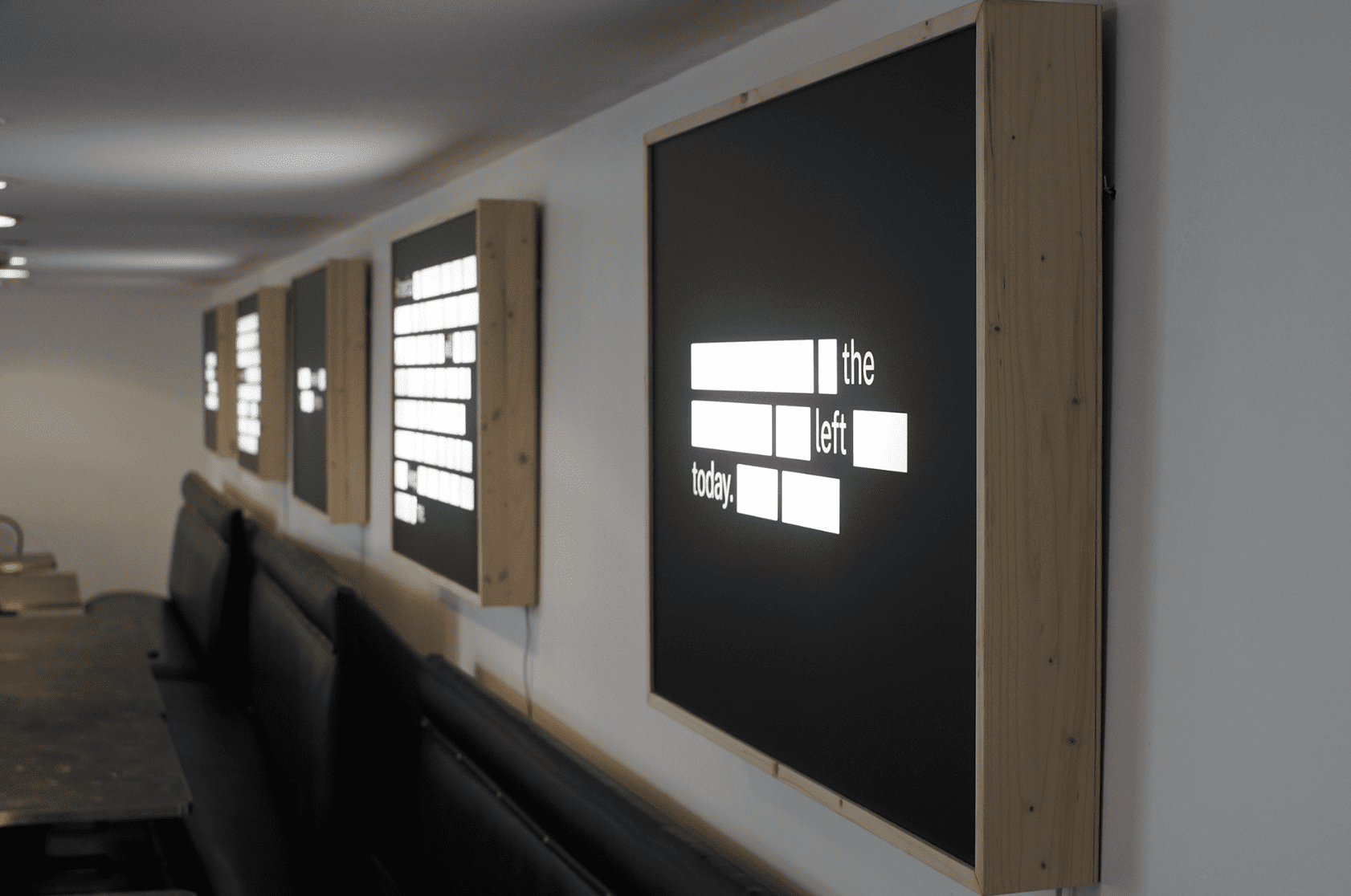
Formally, this context allowed us to appropriate and détourne familiar elements of the bar environment: arcade games, DJ sets, lightboxes, signage, and coasters. A key concern was to create interactive and playful works that could be easily handled by anyone, transforming visitors into participants and allowing meaning to emerge through active engagement rather than passive observation.
The bar setting, with its nightlife, weekend openings, and high foot traffic, introduces a degree of unpredictability. This aligns with our interest in lived experience, contingency, and the idea that the exhibition is not a fixed display but an evolving situation shaped by its users.
4) The exhibition seems to operate between playfulness and critique. How do you negotiate this dynamic, and what role does it play in shaping the viewer’s experience?
The coupling of playfulness and critique is central to Bar CodeX and to our practice more broadly. Language is inherently unstable, ambiguous, excessive, and slippery, and our works intentionally mirror that polysemic structure by offering multiple possible readings and entry points. We also don’t think conceptual art and writing need always be recondite; in fact, by rendering conceptual work more accessible and playful, we open up spaces for deeper inquiry. And besides, play and humour can, in themselves, be powerful sites of resistance.
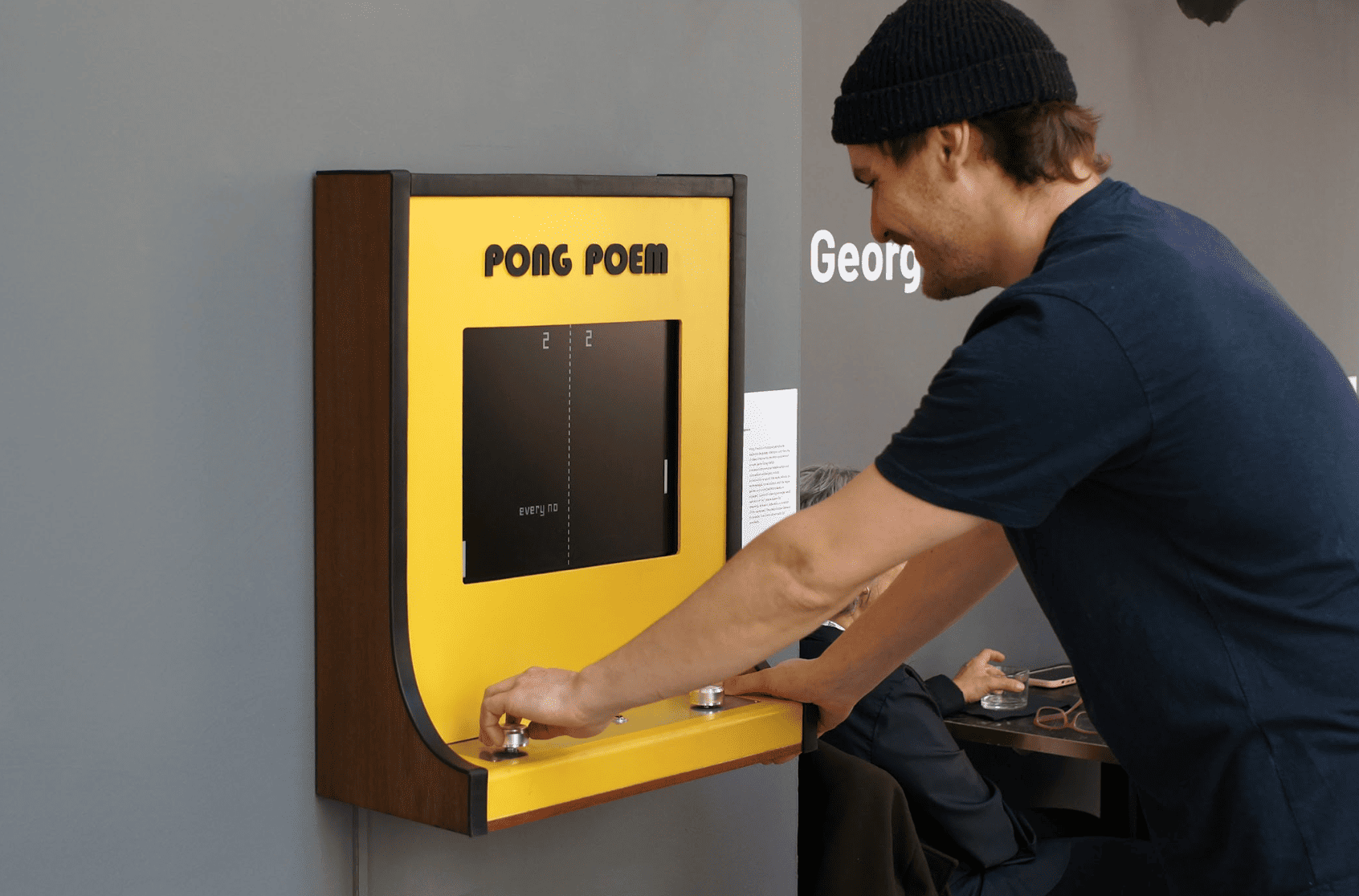
So, our work operates on multiple levels simultaneously, which can create a sense of ambivalence or tension. But, rather than resolving this tension, we aim to sustain it. For example, our arcade video game piece Pong Poem is fun to engage with, and is aesthetically bright and cheery, evoking a sense of technostalgia; it gets a lot of play in the bar. However, this is not neutral: early arcade machines were designed to keep consumers engaged within commercial environments, a logic that echoes contemporary digital platforms’ strategies for capturing and maintaining attention. The work thus invites both enjoyment and critical reflection on systems of engagement and control.
5) Your practice moves fluidly between physical objects, immaterial systems, and machine-based processes. How do you approach this expanded field of media, and what does this fluidity enable in terms of meaning and form?
We do not approach media as fixed categories but as a set of interconnected potentials and constraints. What interests us are the transitions and the in-between spaces, a perspective informed by the notion of “intermedia,” as articulated by Fluxus artist Dick Higgins. We are also interested in the tensions and frictions generated through these passages: between object and system, tangible and immaterial, functional and sculptural, conceptual and affective. An object may oscillate between being a sculpture and a manipulable tool; a system may be both readable and experiential. We think the instability of these layered states are productive and meaningful.
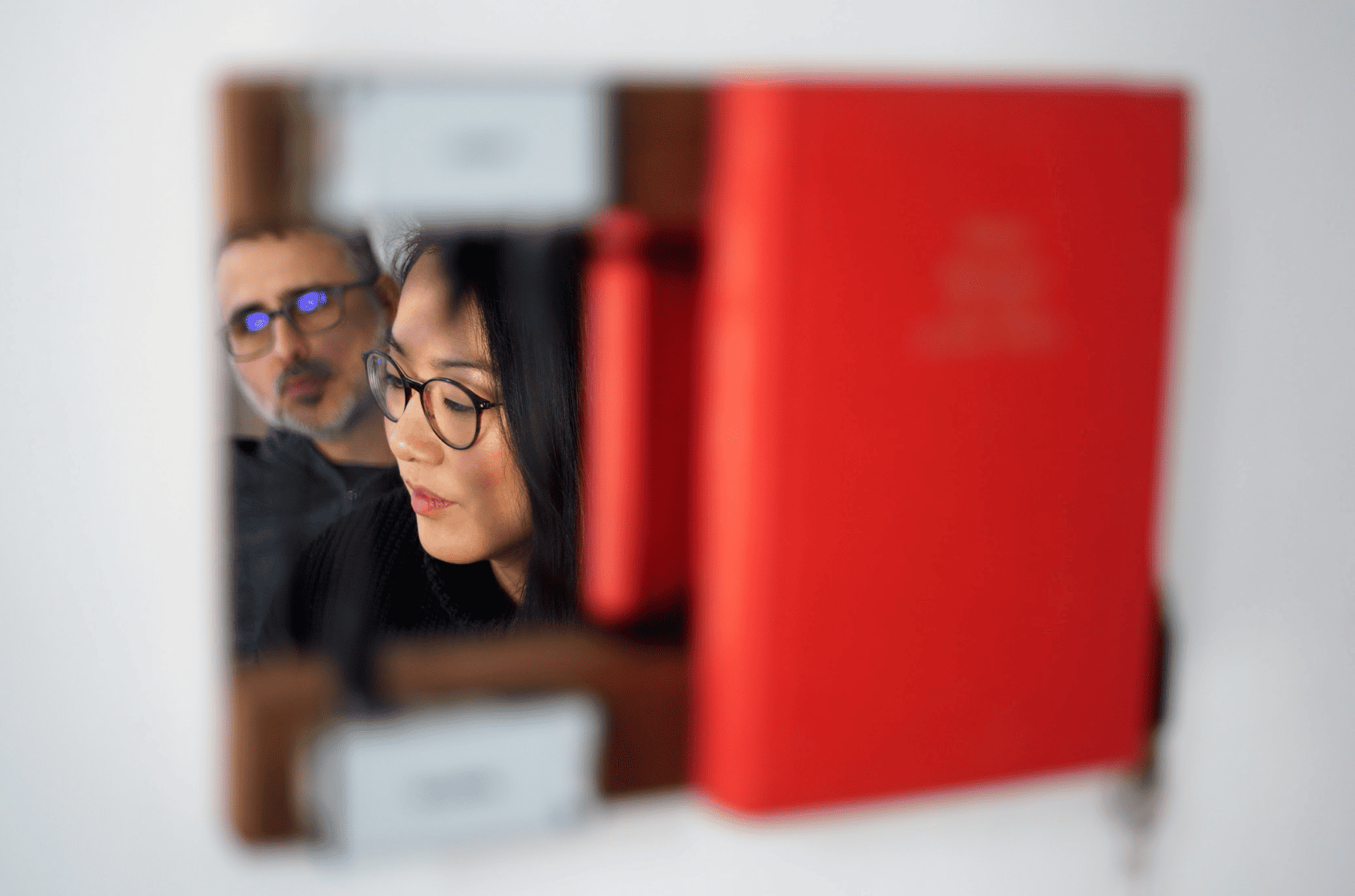
For instance, in our generative literary machine Couple Machine, an unexpected relationship emerges between a Balzac book, a mirror, wood, and nano-computers. This expanded field enables us to reveal translations and frictions between different states of the work and its constituent elements, emphasizing that meaning is not fixed but continuously negotiated across materials, systems, and perceptions.
6) Finally, could you elaborate on your collaboration with Agoria for this project? How did this dialogue influence the sonic, temporal, or immersive dimensions of the exhibition?
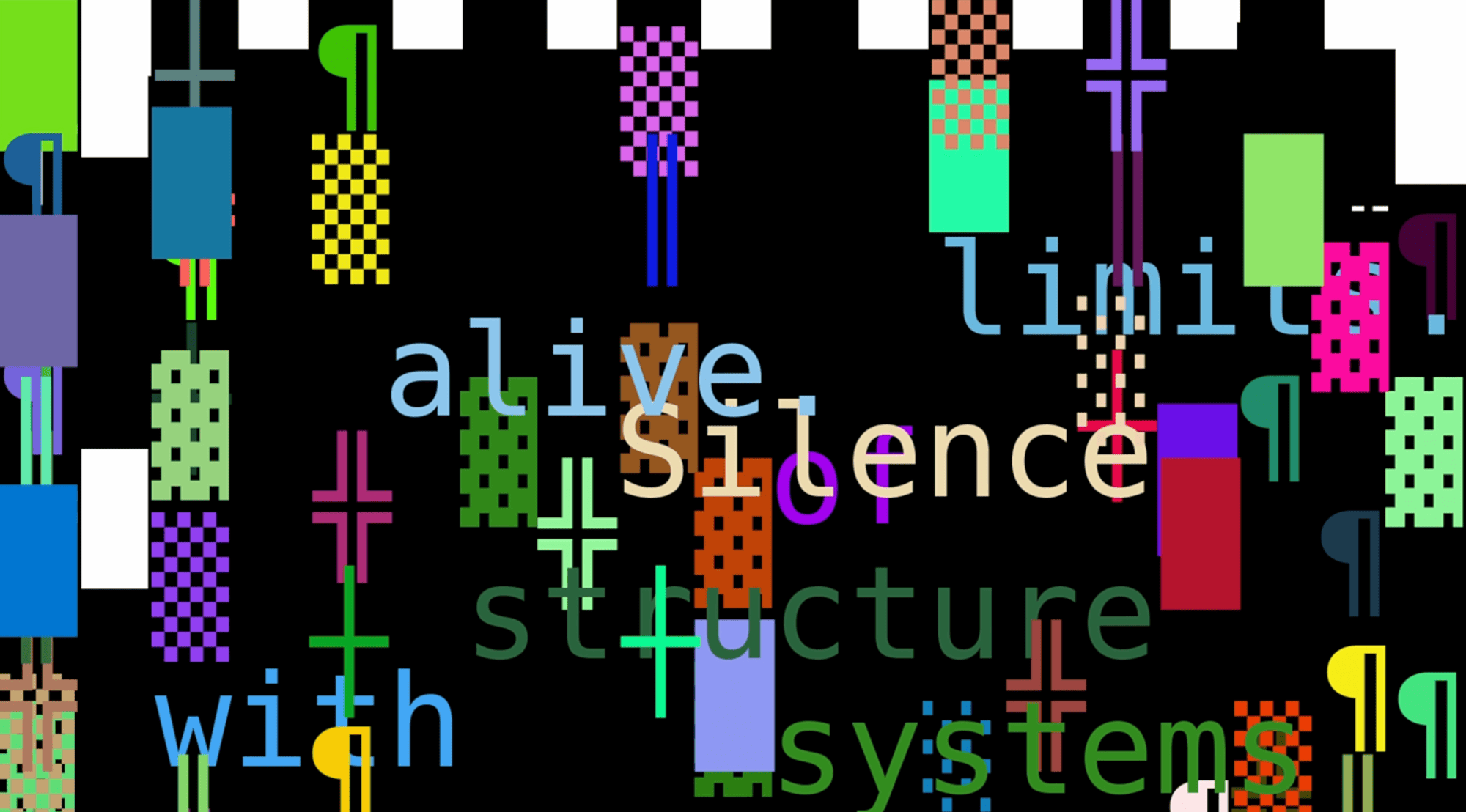
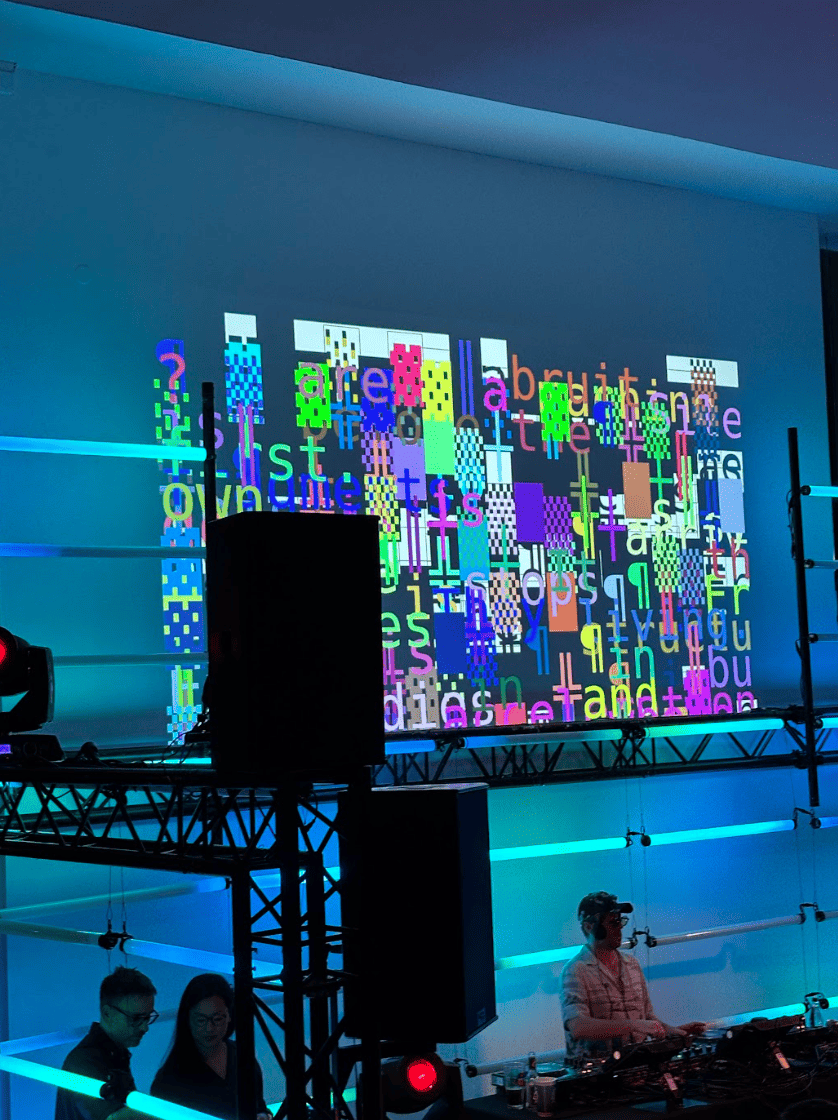
Our collaboration with Agoria played a significant role in the exhibition, resulting in both a shared artwork and a 90-minute performance at the opening. Together, we developed an audio-reactive version of our conceptual poetry synthesizer: the Miniscriber Duo, Agoria Edition.
For this piece, Agoria composed an exclusive track titled Exist in Silence, which is embedded within the Miniscriber and accessible only to the collector of the work. The piece is further enriched by two texts—written by Kalen and Agoria—exploring the theme of silence in literature and music. Visitors are invited to manipulate and explore this interactive system, making the work an active layer of the exhibition that challenges conventional modes of perceiving and consuming music, text, and form.
During the opening night, we used the Miniscriber on a large screen alongside Agoria’s DJ set, creating an immersive and experimental “Language Jockey” performance. In this live context, the usual dynamic is inverted: instead of visitors individually manipulating text and experiencing music through it, the audience encounters music, text, and movement as a continuous, unified flow. This marked an interesting development in our practice, opening new possibilities for live, collective, and performative engagements with language systems.