101 · New to digital art? · First cohort filled · Winter cohort registration now open · Jan-Feb 2027 · 101 · New to digital art? · First cohort filled · Winter cohort registration now open · Jan-Feb 2027 ·
.svg)
Artist Directory
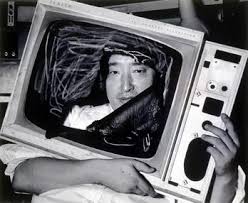
The 'father of video art,' a Korean-American pioneer who transformed television and electronics into sculpture, performance, and installation.
Nam June Paik (1932-2006) was a South Korean-born artist widely regarded as the father of video art and one of the most influential figures in twentieth-century art. Born in Seoul, he fled Korea during the outbreak of the Korean War in 1950, eventually settling in Japan, where he studied aesthetics and music history at the University of Tokyo, writing his thesis on composer Arnold Schoenberg. He later moved to West Germany for further study in music history, where a pivotal meeting with experimental composer John Cage in 1958 redirected his practice toward radical, performance-based art. Paik became associated with the international Fluxus movement led by George Maciunas, blending music, performance, and visual art in irreverent, boundary-pushing ways. In 1963 he staged his influential solo debut in Wuppertal, Germany, exhibiting manipulated television sets whose broadcast signals were distorted using magnets, an early gesture toward what would become his signature medium. After relocating to New York in 1964, recognizing the city as the epicenter of mass media, Paik began a long collaborative partnership with avant-garde cellist Charlotte Moorman, producing landmark performance works. Paik was quick to adopt Sony's Portapak camera upon its release in 1965, and later co-invented the first video synthesizer with engineer Shuya Abe, allowing artists to manipulate electronic imagery freely. His large-scale multi-monitor sculptures, culminating in the celebrated 'Electronic Superhighway,' and his global satellite broadcast projects such as 'Good Morning, Mr. Orwell,' cemented his reputation as a visionary who anticipated today's networked media landscape. Paik continued working until his death in 2006, leaving behind an archive now held largely by the Smithsonian American Art Museum.
Connections to 100 collectors
See more about Nam June Paik on 100 collectors:
Nam June Paik
[Mentioned by Daniel Canogar in Unlocked as an artist they are watching](https://www.100collectors.art/podcast/generative-art-capturing-the-pulse-of-our-times-with-daniel-canogar)
Ready to join?
Not sure yet?
See what membership includes →

