.svg)
Menu
DE SARTHE is pleased to present Workers' Playtime, the first solo exhibition in Asia by Toronto-based conceptual digital media artist Mitchell F. Chan, on view from October 10 to November 21, 2026. The exhibition transforms the gallery into a game center, inviting viewers to interact with a new body of work consisting of interactive sculptures and video games. These new pieces extend Chan’s ongoing practice of using the rules and mechanics of games as a medium for social critique. These works are more than just entertainment; they are also traps. They invite viewers to engage as players, but ultimately lock them into roles as ineffectual laborers. Their rigged mechanisms deny the user’s agency and instead demand relentless work, exposing the inescapable loop of late capitalist labor. These are not metaphors so much as working demonstrations of a system functioning exactly as intended, of how making labor feel like play can reinforce the structure of that labor rather than offer an escape from it.
The exhibition features six distinct interactive sculptural works built from electromechanical pinball components and custom video game graphics pipelines. Each artwork is housed in a thick, colorful shadowbox with backdrops depicting different systems of labor, ranging from corporate, industrial, agricultural, domestic, suggestive live-streaming, to finance. In Cliffhangers (2026), an open-plan office environment seemingly sets no boundaries for the workers. The controllable flippers suggest a skill-based game. The tiny gap between the ball and the target creates false hope. It pushes the player to analyze their own technique, frantically experimenting with different speeds and timing. Only upon relentless attempts do they realize the system is rigged.
This system of extraction extends from the public workplace to the private home. In Daddy’s Home (2026), a woman holding a baby turns her back to the viewer, looking out a window as a man drives toward the house. The interior is set up as a nursery, stripped of items that define her individual identity. An inverted v-track is placed over the image. Two pinballs travel along the track toward one another, but lack the momentum to clear the peak, missing each other every time. The electromechanical playfield is not mere decoration laid over an image. Both layers are different modes of representing the same thing: systems of labor, extraction, and social mobility.
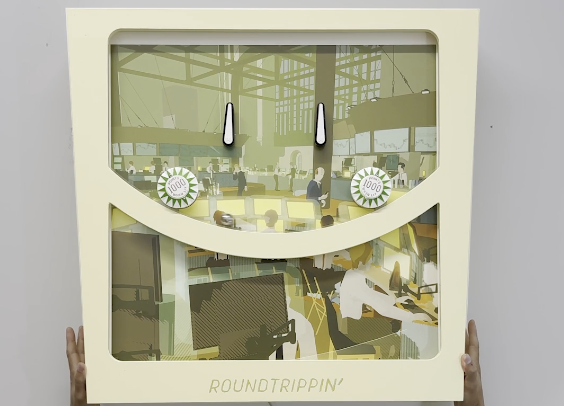
Chan juxtaposes this struggle against Roundtrippin’ (2026), a sculpture depicting the financial sector. Here, the outcome reverses. The pinball bounces back and forth in a closed loop, continuously striking targets, while the player controls nothing. Together, these rigged machines serve to expose the ultimate logic of the system: it entices and panders to players, yet caters only to capital.
At the center of the exhibition is a video game, extending the sculptures' physical mechanisms into the digital realm. The game is a reimagined pinball machine where players are tasked with hitting the digital pinballs toward targets to earn points and advance to the next level. The scoring system, colorful animations and poppy sound effects lure players into a continuous loop. Since the flippers react to the players’ commands, a random, occasional success is instantly rationalized as skill, reinforcing an illusion of control.
The delusion is shattered when the player stops playing, or achieves the level’s goal. At these points, the automated game systems take over. The bumpers, flippers, and balls continue in perpetual motion, and the games true aim is revealed: to make the player obsolete. The worker is now entirely expendable. A cozy sofa is set up alongside the video game. It is designed not purely for comfort, but to entrap the player in the indulgence of the game, an endless labor.
true


