.svg)
Menu
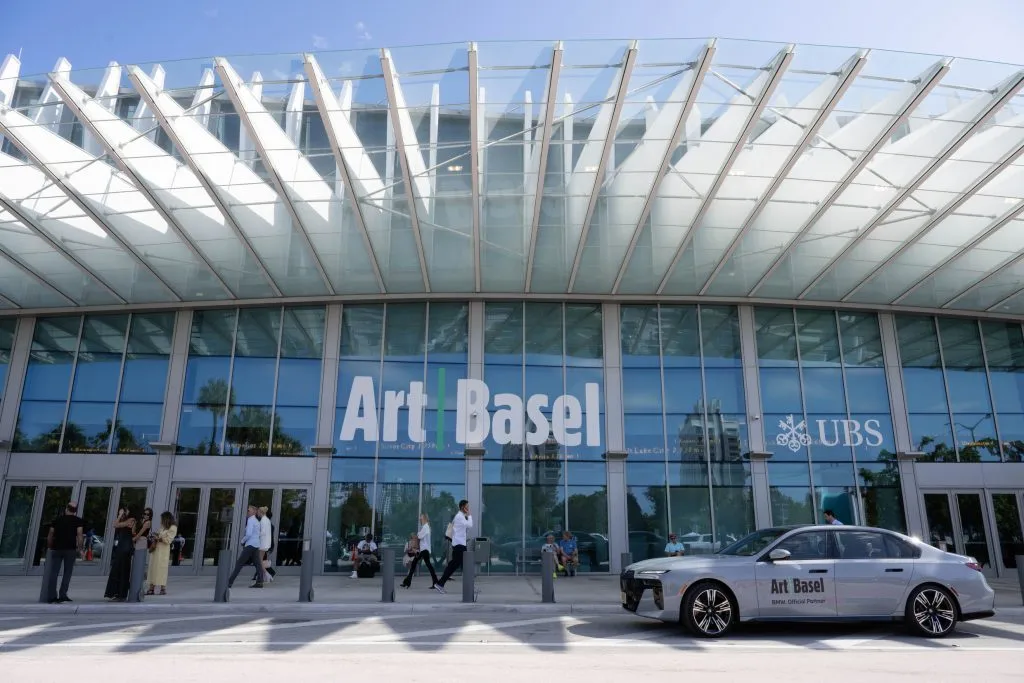
Art Basel Miami Beach closes out the year the way it has for over two decades now: three public days, December 4 through 6, at the Miami Beach Convention Center, preceded by VIP preview days on December 2 and 3 for top collectors, museum directors, and cardholders — and an entire city that spends the surrounding week transforming itself into the Western Hemisphere's most concentrated cultural event. More than 280 galleries from over 40 countries will show work spanning painting, sculpture, installation, photography, film, and digital practice, drawing a crowd that has in recent years pushed past 80,000 visitors across the fair's three-day run.
What distinguishes Miami from Art Basel's other cities is the degree to which the fair itself is only the anchor of a considerably larger week. Miami Art Week runs roughly December 1 through 7, and the constellation of satellite fairs around the main event has become, for many collectors, just as central to the experience as the Convention Center itself: Design Miami, running alongside the main fair at Pride Park with its own focus on historical and contemporary design; NADA Miami, traditionally hosted at Ice Palace Studios in Wynwood and functioning as the week's most reliable barometer for early-career and emerging gallery programming; Untitled Art, staged in a beachfront tent on Ocean Drive; alongside Scope, Aqua Art Miami, and Pinta Miami rounding out a satellite ecosystem that has grown steadily more sophisticated with each passing edition.
For members of 100 collectors with a particular interest in digital art, Miami Art Week has become an increasingly important fixture on its own terms. Recent editions have folded digital programming directly into the main fair's public programme — panels examining how art is made for feeds, algorithms, and platform-native formats have appeared on Art Basel's own Conversations stage in Miami Beach, alongside a growing footprint of dedicated digital art programming across the wider week, from citywide public art interventions to gallery presentations built specifically around blockchain-native and algorithmically generated work. That crossover between the fair's historically painting-and-sculpture-dominated main floor and the digital art conversation happening around its edges is worth tracking closely for members positioning themselves in both categories simultaneously.
Beyond the fairs themselves, Miami's museum and institutional calendar times its most significant openings to the week deliberately. The Rubell Museum's annual new-acquisitions opening has become a fixture collectors build their schedules around, alongside programming at the Pérez Art Museum Miami, ICA Miami, the Bass Museum, and the Margulies Collection — each offering a different register of Miami's own considerable private and institutional collecting history, built over decades by patrons whose engagement with the city's art scene long predates Art Basel's own 2002 arrival.
Logistically, the week is not for the unprepared. Traffic across the causeways connecting the mainland to Miami Beach is, by common agreement, the worst the city sees all year, accommodation across the metro area books out months in advance, and the sheer density of overlapping programming — main fair, satellite fairs, museum openings, gallery activations across Wynwood and the Design District, and an unrelenting schedule of dinners and parties — makes advance planning considerably more valuable here than at almost any other fair on the calendar. Members attending should expect our agenda to prioritize a workable route through the week's density rather than attempting comprehensive coverage of everything happening simultaneously across the city.
For a fair now in its third decade in Miami Beach, marking a significant anniversary this year, the 2026 edition arrives with the confidence of an institution that has thoroughly proven its staying power — and a city around it that has, over more than twenty years, built an entire cultural economy in December around three days at the Convention Center. 100 Ccollectors' Miami Art Week programming reflects that scale: private previews, host dinners, and member-only access designed to move through the week's density efficiently, closing out the year the way it opened — with the work, and the people around it, taking priority over everything else.
true


