.svg)
Menu
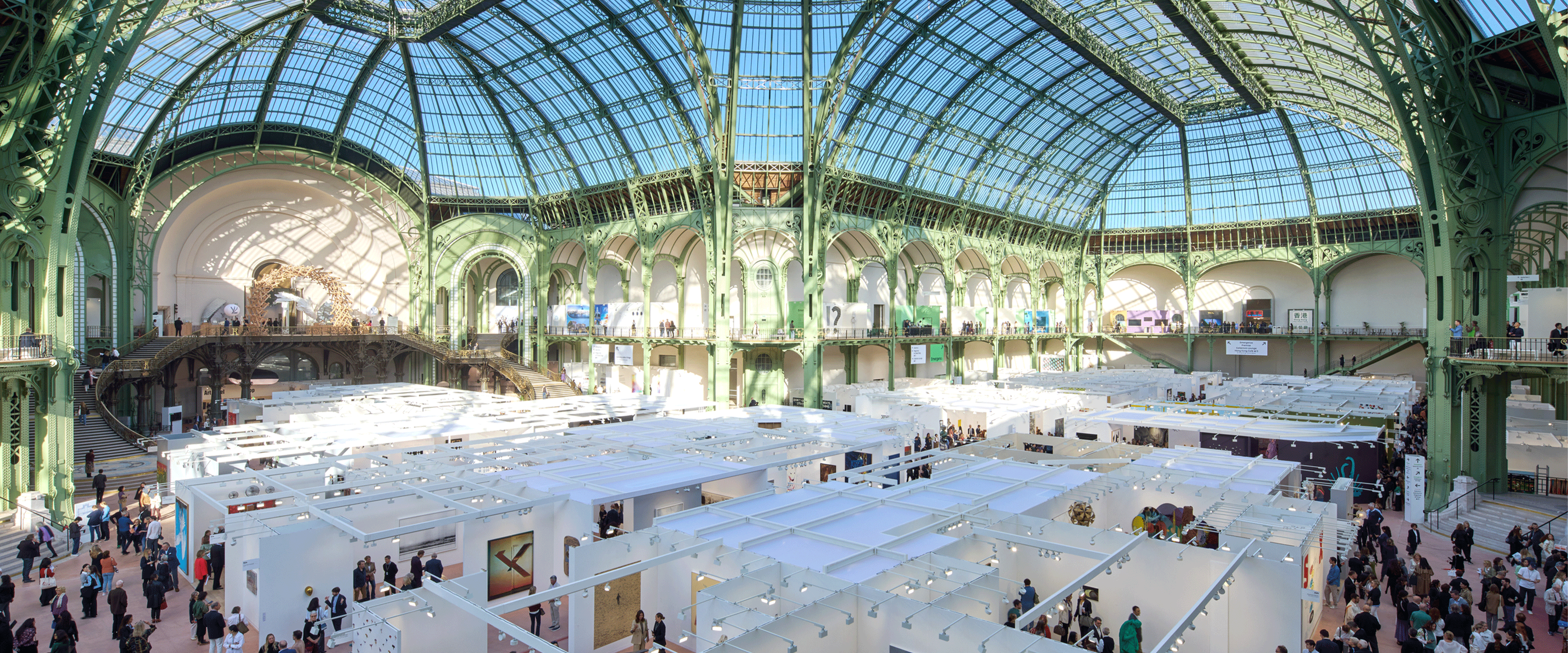
Art Basel Paris returns to the Grand Palais for its fifth edition this October, and for the first time under the direction of Karim Crippa — a changeover worth noting for members who track how incoming directors tend to leave an early mark on a fair's identity within their first one or two editions. The fair itself runs October 23 through 25, preceded by preview days on October 21 and 22 and a public vernissage on the evening of the 22nd, all staged beneath the newly restored glass roof of one of Paris's most recognizable cultural landmarks.
The scale for 2026 is notable even against the fair's own recent history: more than 200 exhibitors from 41 countries and territories, spread across the fair's three sectors — Galeries, the main sector anchoring blue-chip and established programming; Emergence, dedicated to younger galleries and early-career artists; and Premise, the sector for historical and modern positions that gives the fair a temporal range beyond strictly contemporary work. Nearly 30 galleries are joining for the first time this year, and a record 12 joint booth presentations point to a growing appetite among exhibitors for collaborative rather than purely competitive formats — worth watching for members interested in how gallery relationships are shifting more broadly across the European market.
What makes the Paris edition distinct from its counterparts in Basel, Hong Kong, and Miami Beach is how deliberately it is built around the city rather than simply hosted by it. More than 60 of this year's exhibitors operate permanent spaces in France, and the fair's own data — drawn from the Art Basel & UBS Global Art Market Report 2026 — shows French sales reaching USD 4.5 billion in 2025, a 9% increase that returned the market above its 2019 levels after two years of contraction. France now accounts for roughly 8% of the global art market and more than half of the EU's art market by value, positioning Paris as the fourth-largest market worldwide. Crippa has been explicit that his focus for the fair going forward is strengthening that local grounding — "a platform shaped by the city, for the city" — rather than treating Paris as simply another stop on an interchangeable international circuit.
Beyond the booths, Art Basel Paris's public programme has become as central to the week as the fair floor itself. The Conversations series, historically staged at the Petit Palais, brings curators and critics into dialogue on themes ranging from the relationship between art and fashion to contemporary myth-making, and this year's edition folds in a notable crossover with the fashion world through guest curator Edward Enninful's involvement in the Conversations programme, alongside an initiative led by documentary filmmaker Loïc Prigent — a signal of how deliberately the fair is courting the overlap between Paris's art and fashion economies rather than treating them as separate audiences.
For collectors specifically, Art Basel Paris offers a genuinely different texture of encounter than October's earlier fixture in London: less about volume, more about depth within a tighter, more architecturally distinctive footprint. The Grand Palais itself does real work here — its nave and surrounding galleries create sightlines and scale that shape how work gets seen and discussed in ways a conventional convention-center fair cannot replicate, and the week's satellite programming across Paris's own gallery districts has grown correspondingly more confident as the fair has matured through its five editions.
100 collectors members attending should expect our usual member-only programming layered around the public fair days — private previews, host dinners, and access points designed to move members through the week efficiently rather than at the mercy of the general public schedule. Paris in late October, with the Grand Palais at its center and a fair now confidently five editions deep, remains one of the more elegant weeks on the calendar to do exactly that.
true


