.svg)
Menu
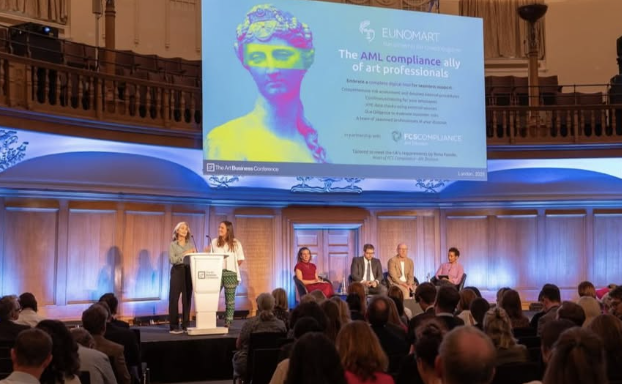
Frieze Week has a way of collapsing the year's most interesting conversation about art and technology into a single half-day, and this is where it happens. The Art & Technology Conference — the 2026 name for what ran for three editions as Art Market 2050 — lands on Friday, October 16, two days after Frieze London opens, at a moment when the fair has already pulled the exact audience this conference wants into the same postcode. Organized by the team behind The Art Business Conference, it has quietly become one of the more essential half-days of Frieze Week for anyone thinking seriously about where collecting, data, and digital infrastructure are actually heading, rather than where the marketing says they're heading.
The format has held steady across its run and gives a reliable sense of what to expect this October: a chaired half-day of panel sessions, presentations, a series of quick-fire pitches from art-tech startups, and a networking lunch that tends to do as much work as the panels themselves. Riah Pryor, the art market journalist writing for The Art Newspaper and the Financial Times, has chaired every edition to date, and her presence has given the conference a consistency of tone — sharp, unsentimental about hype, genuinely interested in what's structurally changing rather than what's simply trending. Past editions have run at the Royal Institute of British Architects and the Royal College of Physicians, both a short walk from Frieze's Regent's Park tents, though the 2026 venue had not been confirmed as of this writing.
The subject matter has evolved with the market it's tracking. Recent editions have moved past the once-obligatory "what is NFT" framing entirely, spending their panel time instead on how AI is reshaping both the creative and the commercial sides of the trade, how data — often still arriving, as one 2024 panelist put it, as "shoeboxes filled with scraps of paper" — needs to be structured before it becomes useful to a gallery or a collector, and how younger collectors across different regions are actually building relationships with art through platforms, communities, and digital-first behavior rather than through the traditional gallery visit. The 2025 edition's Asia Pivot panel, moderated by Vivienne Chow of Artnet with speakers from Animoca Brands, Vadehra Gallery, and Art Collaboration Kyoto, addressed WeChat-based sales, blockchain experimentation, and how differently younger Asian collectors engage with art because of the tools available to them — the kind of granular, region-specific detail that rarely surfaces at a conventional fair panel.
The quick-fire pitch format has become one of the conference's most-discussed elements: shortlisted art-tech companies get a few minutes each to argue how their technology will have changed the art world by 2050, judged by a panel that has previously included figures from AXA XL, Fieldfisher, and independent cultural strategists. It is, in effect, a compressed snapshot of where venture attention in the art-tech space is currently concentrated — useful information for any collector or advisor trying to separate genuine infrastructure from noise.
For 100 collectors members, this conference sits at a genuinely useful intersection: close enough to Frieze to slot directly into the week's existing rhythm, but structured around exactly the kind of forward-looking, tech-and-market conversation that our members with an interest in digital and generative collecting tend to seek out independently of the fair itself. Past speakers have spanned auction houses, insurers, blockchain platforms, and practicing artists working across technology-driven mediums — a mix that tends to produce sharper, more candid exchanges than a purely commercial panel would allow, precisely because no single constituency in the room is simply there to sell.
100 collectors will be tracking the 2026 programme as it's announced and will update members directly once panel themes, speakers, and the confirmed venue go live — expect this to land as one of the week's Collectors Only fixtures if member access is secured, alongside our existing Frieze Week programming.
true


