.svg)
Menu
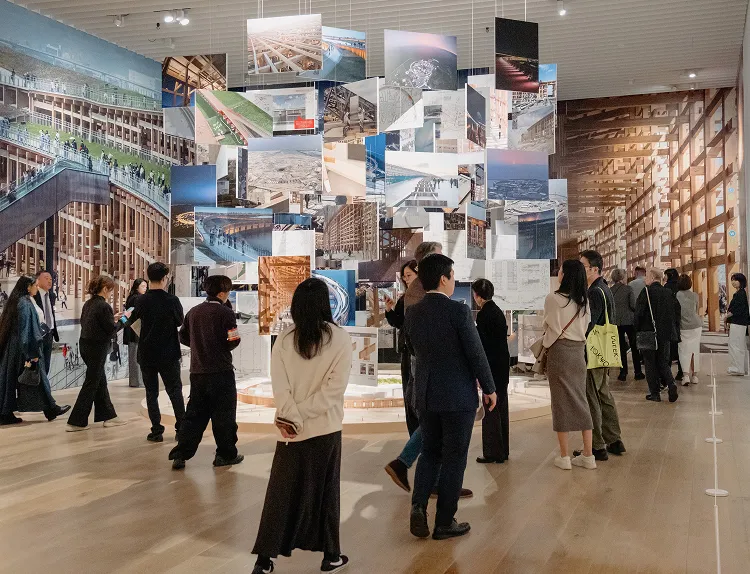
Art Week Tokyo enters its fifth full edition this November, running November 4 through 8 across a record 55 participating venues — and for members who have not yet built Tokyo into their annual circuit, this is very much the edition to start with. Organized by the Japan Contemporary Art Platform in collaboration with Art Basel, with support from Japan's Agency for Cultural Affairs, AWT has spent five years establishing itself as something genuinely distinct from a conventional fair: a citywide showcase rather than a single convention hall, built around the premise that Tokyo's art scene is best understood by moving through the city itself rather than viewing it compressed into booths.
The 2026 edition's headline shift is structural. Where previous years organized the fair's flagship AWT Focus section around a single curator and a single unifying theme — Adam Szymczyk's "What Is Real?" last year, Mami Kataoka's "Earth, Wind, and Fire" the year before — this year's edition invites ten curators to activate ten separate spaces across the city simultaneously, trading a single thematic survey for what cofounder Atsuko Ninagawa describes as a deliberate widening into multiple perspectives and spaces. It is a meaningful departure for a section that has, since its 2023 launch, positioned itself as a curated sales platform with genuine historical scope rather than a straightforward commercial showcase, and this year's expansion suggests AWT is using its own growing confidence to experiment with format rather than simply scaling what already worked.
The wider programme for 2026 features 42 galleries and art spaces alongside 13 institutional exhibitions, with several new international participants — including Espace Louis Vuitton Tokyo on Omotesando Avenue — joining for the first time and signaling AWT's continued reach beyond its original core of Tokyo galleries. Participating institutions in recent years have included the Mori Art Museum, the Museum of Contemporary Art Tokyo, the National Art Center, Artizon Museum, and SCAI The Bathhouse, and the free AWT Bus service connecting venues across the city remains one of the more genuinely useful pieces of fair infrastructure anywhere on the international calendar — a hop-on, hop-off route system that makes a citywide event actually navigable within the compressed timeframe of a working week.
November's timing is not incidental. Tokyo's autumn weather is famously mild and stable, and AWT's founders have been candid that the timing was chosen specifically to make the city an appealing destination for international visitors at a moment when Tokyo's art scene — long admired but historically under-toured relative to its depth — is easiest to experience comfortably. For collectors, that combination of accessible timing and genuinely citywide scope has made AWT an increasingly essential entry point into a market that remains comparatively under-covered by the international collector circuit relative to Hong Kong, Seoul, or Shanghai.
100 collectors members with an interest in Japanese contemporary and digital art specifically should treat AWT as a genuine discovery week rather than a survey of the already-established — the format rewards curiosity and a willingness to move between neighborhoods and formats rather than concentrating time in a single venue. Past editions have paired gallery visits with institutional surveys addressing everything from Okinawan and post-3.11 Tohoku histories to architectural retrospectives, and the AWT Video and AWT Talks components add further layers of programming for members wanting more than a straightforward walkthrough.
true


