.svg)
Menu
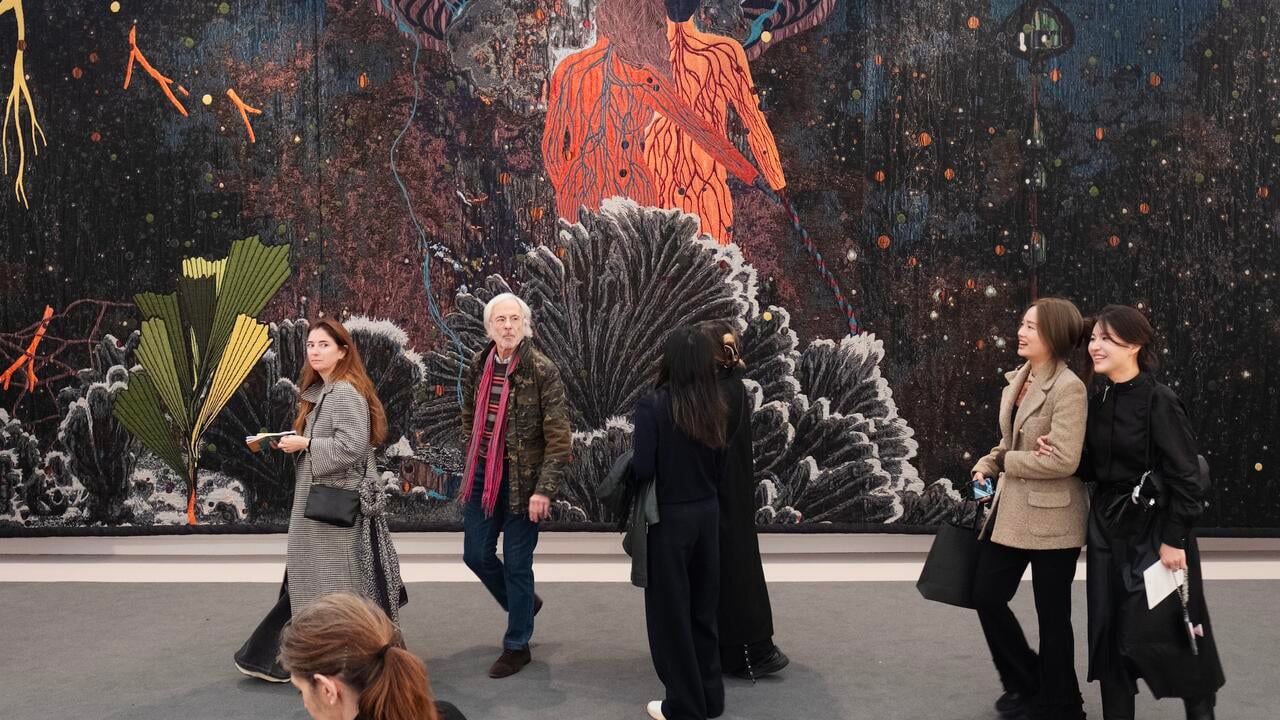
Frieze London returns to The Regent's Park this October for its twenty-third edition. This is not a fair that needs an introduction so much as a briefing: nearly 300 galleries from 48 countries will show across two tents — Frieze London for contemporary practice, Frieze Masters a short walk away for work spanning antiquity to the late twentieth century — and the week around them has become its own ecosystem of auctions, satellite fairs, and gallery openings across Mayfair and beyond.
What distinguishes the 2026 edition is less about scale than about curatorial ambition. Frieze London's new section, The Code Universe, curated by Carol Yinghua Lu, sits inside the main fair and signals a deliberate widening of what the fair considers central rather than peripheral — a useful data point for anyone tracking where institutional and collector attention is heading next. Frieze Masters, meanwhile, introduces Queering Modernism, a curatorial thread developed by Anke Kempkes that runs across multiple booths rather than confining itself to a single section, tracing queer experience and representation from early twentieth-century experimentation through to the postmodern scene of the 1980s. It is the kind of thread that rewards slow walking rather than a single afternoon.
The gallery list reads as it always does — Gagosian, Hauser & Wirth, David Zwirner, Sprüth Magers, Pace, Thaddaeus Ropac, Sadie Coles HQ, Lisson, Victoria Miro, White Cube — alongside a strong cohort of London's own galleries anchoring the fair from the inside: The Approach, Carlos/Ishikawa, Emalin, Herald St, Maureen Paley, Pippy Houldsworth, Alison Jacques, Kate MacGarry. For members interested in where London's next generation of dealers is building its reputation, that local anchor is often more instructive than the international roster around it. Frieze Masters' Spotlight section, now under new curators Devika Singh and Sofia Gotti of the Courtauld Institute, returns in its largest form yet, foregrounding mid-century work from South Asia, South America, and West and North Africa — a corrective to a canon that has historically underrepresented these geographies, and a section worth building time around rather than treating as a footnote.
Outside the tents, Frieze Sculpture opens six weeks before the fair and stays open two weeks after it, running September 16 through November 1 across The Regent's Park's English Gardens, curated this year by Fatoş Üstek around the idea of sculpture as a porous, hybrid ecology responding to both natural and urban context. It is free, unticketed, and arguably the most relaxed way to experience the week — worth a visit on its own terms, either before the crowds arrive or after they've thinned.
For collectors, Frieze Week functions as much through its evening sales as through its booths. Christie's, Sotheby's, and Phillips each stage their major London Modern & Contemporary evening auctions during the fair, and the momentum between the primary and secondary markets during this week tends to set the tone for London's art market through the rest of the year. Last year's editions drew record institutional attendance and a notable uptick in significant acquisitions by museum groups — a sign that the fair's role as a market barometer, not just a viewing occasion, continues to strengthen.
true


