.svg)
Menu
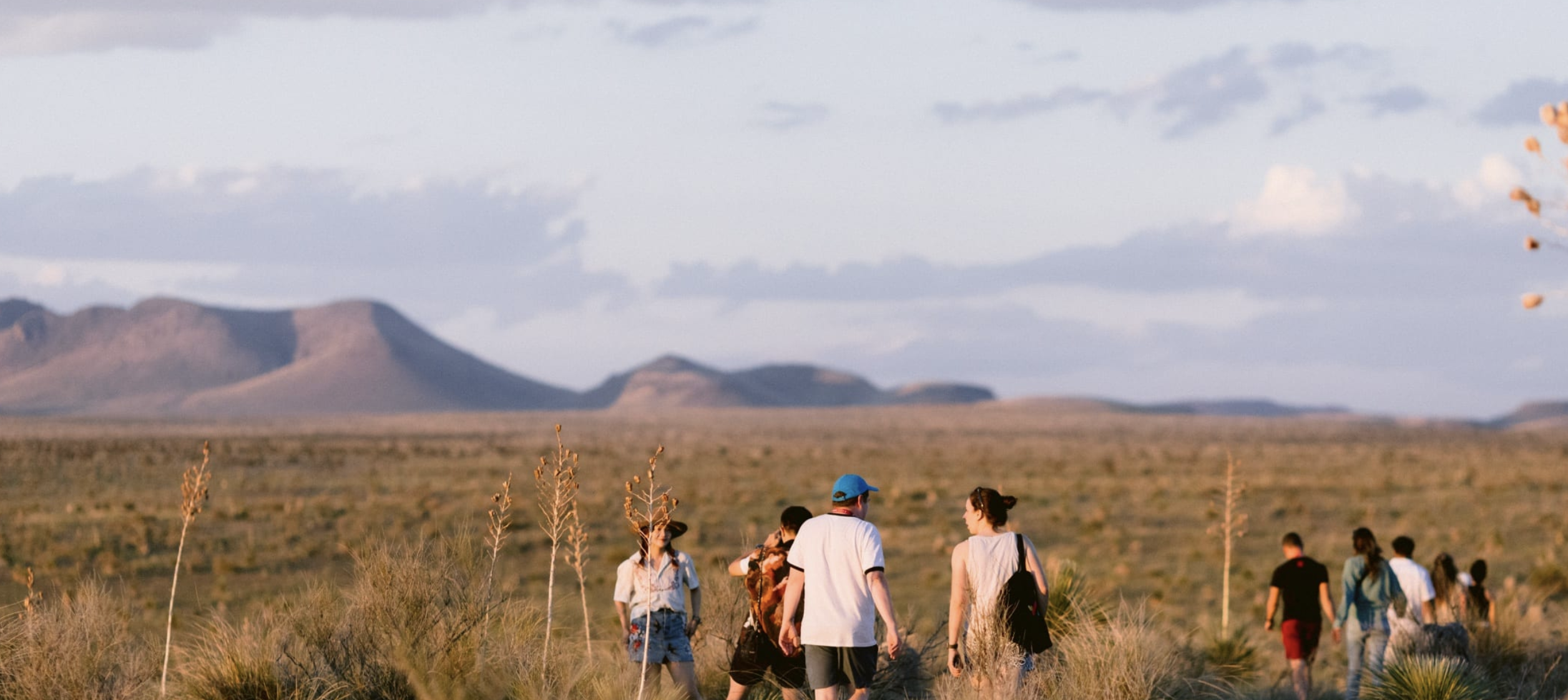
There is no other fixture on the digital art calendar quite like Marfa Weekend, and that is precisely the point. Once a year, Art Blocks — the platform that effectively created the category of onchain generative art when it launched Chromie Squiggle in 2020 — turns its gallery headquarters in a town of fewer than two thousand people into the unofficial capital of a global community that otherwise exists almost entirely online. This year's edition runs October 22 through 25, marking the sixth annual gathering since Art Blocks first opened its doors in the high desert of West Texas.
The appeal of Marfa as a setting is not incidental. This is the town Donald Judd chose, deliberately, as a rebuke to the art world's centralization in cities — a place where scale, silence, and the surrounding landscape do something to the way work gets seen that a white cube in a capital city cannot replicate. Art Blocks' founder Erick Calderon, known in the community as Snowfro, has built the annual weekend around that same instinct: strip away the noise, put the work and the people who make it in the same room, in the middle of nowhere, for four days.
What actually happens across those four days has evolved into something closer to a science fair than a conventional art fair — deliberately so. Expect live coding demonstrations, generative art running on loop across gallery windows and pop-up screens throughout downtown Marfa, artist talks that move fluidly between technical and conceptual registers, and an atmosphere that owes as much to a hackathon as to a vernissage. The headquarters at 109 W. San Antonio Street anchors the weekend, but the programming spills across the town — into local galleries, event spaces, and businesses that have, over five prior editions, become fluent in hosting an audience that arrives fluent in blockchains and leaves talking about Donald Judd.
The weekend's format has grown more ambitious each year without losing the improvisational, community-built character that distinguishes it from the standard fair circuit. Recent editions have folded in collaborative artist experiments, audio-reactive installations set to live DJ sets, and cross-institutional programming with the Chinati Foundation and Judd Foundation, both of which report meaningful spikes in visitor interest during the weekend as the crossover audience between contemporary art tourism and digital art collecting continues to grow.
Practically speaking: general programming is free, travel and lodging are self-funded, and Marfa's limited hotel stock means booking early is not optional — accommodation across the town tends to sell out well ahead of the weekend, particularly once the schedule of official events goes live. For members planning to attend, 100 collectors typically coordinates around the headline programming rather than trying to compete with it — this is very much an event to experience on its own terms, in its own town, at its own unhurried pace.
Marfa Weekend is not a fair you attend to buy quickly or transact efficiently. It is a fair you attend because the work, the desert, and the community that built both are, once a year, in the same place at the same time — and that convergence has become, in its own understated way, one of the more significant dates on the digital art calendar.
true


