.svg)
The Grid has been the obsession of many through decades, even centuries. The grid has always helped painters and architects find their bearings and represent our reality. The same grid returns as the underlying structure of every space in the artificial, coded, digital world. The grid is the foundation, but it is also the subject of a great many works, like Vera Molnár's drawings with her 1% of disorder, which lets the structure live instead of staying rigid. The grid is a way of seeing, perceiving, producing, creating, existing. What if there were a new way to approach this grid, to look at it for what it is, where it comes from, how it exists?
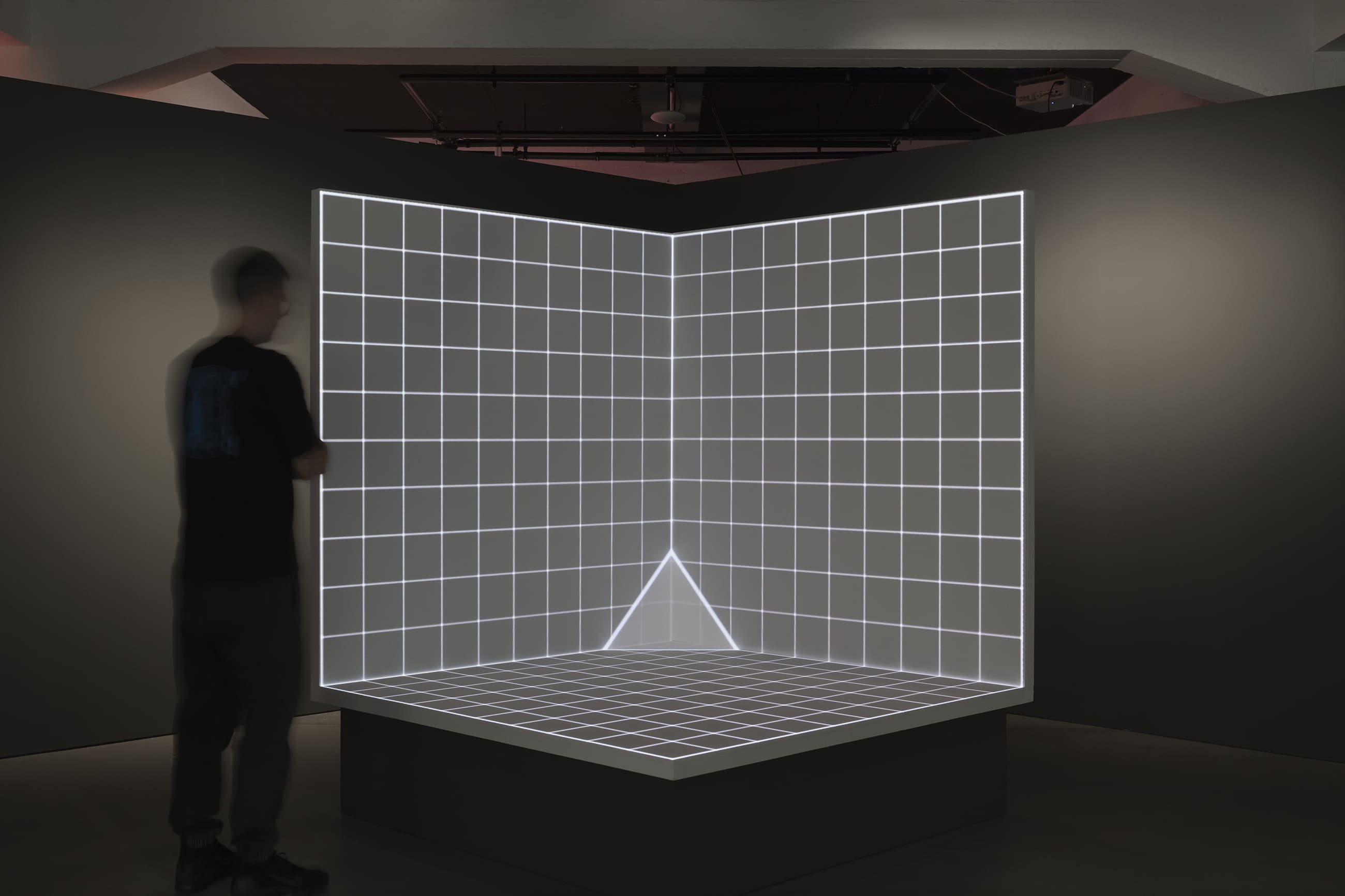
For a long time, Studio Lemercier, an artist and curator duo composed of artist Joanie Lemercier and curator Juliette Bibasse, worked with the grid, inside the same visual language as the floor to ceiling immersive rooms that define so much digital art right now, the Refik Anadol school of scale and awe. Spectacle first, always bigger, always longer, with more data and the most powerful computers and graphics cards. Behind it sits an idea of the Sublime that places the visitor as an observer. Nature becomes a subject to contemplate, and the emotions it produces sit at the center of the visitor's experience. It's easy to think of the sublime, almost Dantesque landscapes of Gustave Doré or Caspar David Friedrich, where the desire to dominate what draws us in, or what frightens us, sits at the heart of our relationship with nature.
But today, that's no longer enough. The very concept of nature is being questioned, and a post-natural era is emerging. Today we are part of this so-called nature, and our existence affects it, for better or worse. Today we move from observer to collaborator, and it's with this shift in mind that Studio Lemercier changed how they saw the grid.
"The sublime carries the position of the observer. You're not inside it at all."
It took a voyage, a long Atlantic crossing by sailboat, to leave the grid behind and confront years of imagined landscapes with the reality of the ocean (read here Joanie Lemercier’s memories of the trip). At sea, something else took over, something closer to what the philosopher Romain Rolland called the oceanic feeling (1927). It's an ultimate feeling of wellbeing that invites us to let go and be present, to feel part of the whole. On that sailboat, in the middle of the ocean, with only a handful of humans aboard, the oceanic feeling reached its peak, explained Juliette Bibasse.
"I never once felt afraid. I think we need that fear of nature to feel truly small, and then, once you feel like a grain of dust, a grain of sand, you tell yourself: you're part of all of this."
Out in the open ocean, the data grid couldn't be trusted as a source of truth. Every morning, explained Joanie Lemercier, the crew gathered to decide on the route. The nine available weather models contradicted each other fairly regularly, and the data shared by satellites wasn't precise enough to navigate by. In the end, it was the sail officer who steered the ship, reading and understanding the wind and the sound in the sails. A reminder that the world runs on other rules.
"In the end they'd look at the clouds on the horizon. They couldn't trust the data."

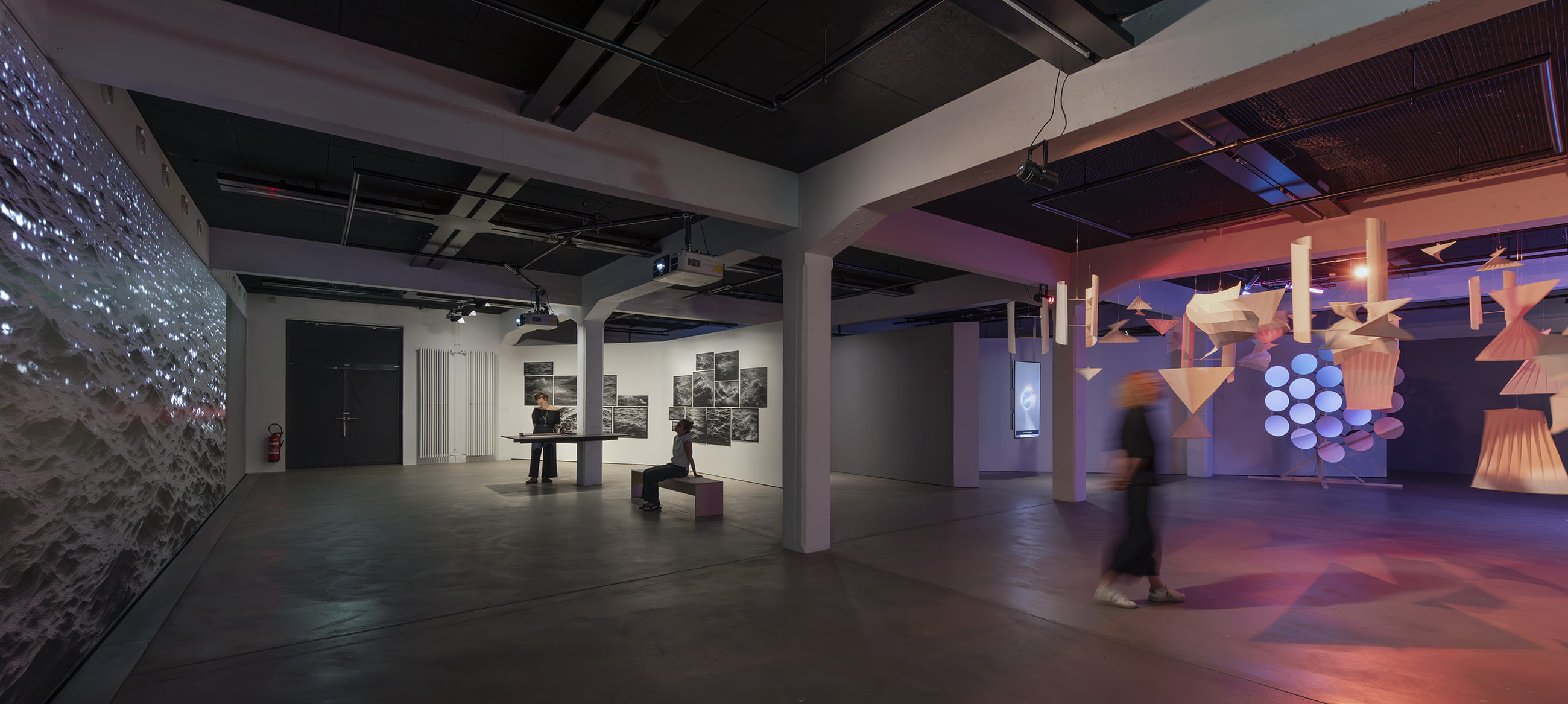
This shift is what is being told in their current solo show, Thresholds, On the values we set and the limits we cross, curated by Juliette Bibasse & Sabine Himmelsbach at House of Electronic Arts (HEK) in Basel, Switzerland.
The exhibition's title carries a double meaning the studio is careful to hold onto. There's the threshold as passage, the ordinary sense of a door you walk through. And there's the threshold as it exists in code, the value a programmer sets to decide when something switches state. Both readings matter to the show, but the studio pushes past both toward something more active. A threshold stops being a metaphor and becomes a decision.
"A threshold isn't just something you pass through passively, like a door. It can also be something we define ourselves, through political choices, life choices, choices as a society: which limit we want to cross, and which one we don't."
The exhibition begins with the geometric abstraction of Edges and Room_00, signature artworks showcasing the composition of the grid made of planes, a sort of statement showing the essence of artificial space and questioning it at the same time. But quickly, the discourse brings us elsewhere, moving the visual grid to a visual representation of the data grid, the energy grid and the resource grid, the copper and electricity that power any digital image.
Visitors move from abstract to beautiful and then to meaningful, while they start becoming witnesses of what is behind the grid.
In the show, “Data aesthetics chapter 1, Infrastructure” and “Data aesthetics chapter 2, Extraction” the best representations of the physical scale of data centers and networks connecting them, with a drone capture of Bingham Canyon Mine, a copper mine overlooking Salt Lake City.
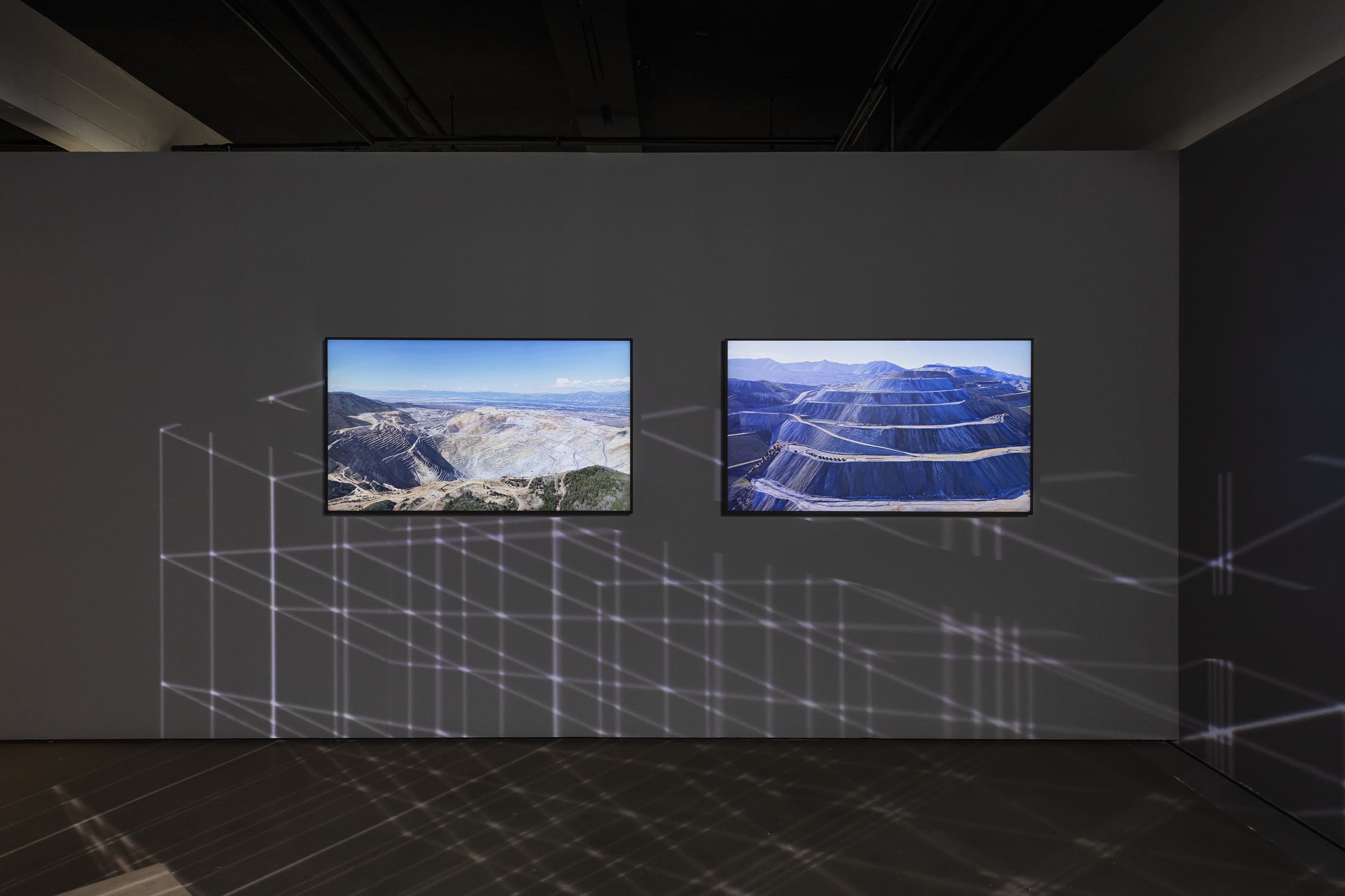
With “Slow Violence”, centered on the Hambach lignite mine in Germany, we go for the material, the matter behind it all, to understand the impact our immaterial space can have on our planet. The scale of it is the message: the hole on the map, the non-stop extractive activity, the resources that are forever gone. Joanie Lemercier’s first visit in 2019 has been a turning point in the studio's practice, after which he began taking part in demonstrations and supporting environmental groups.
Juliette Bibasse and Joanie Lemercier decided to stop using and start collaborating with the force of nature. They founded the Solar lab in 2023 as a playground to experiment with the sun, the wind, the light, and more.
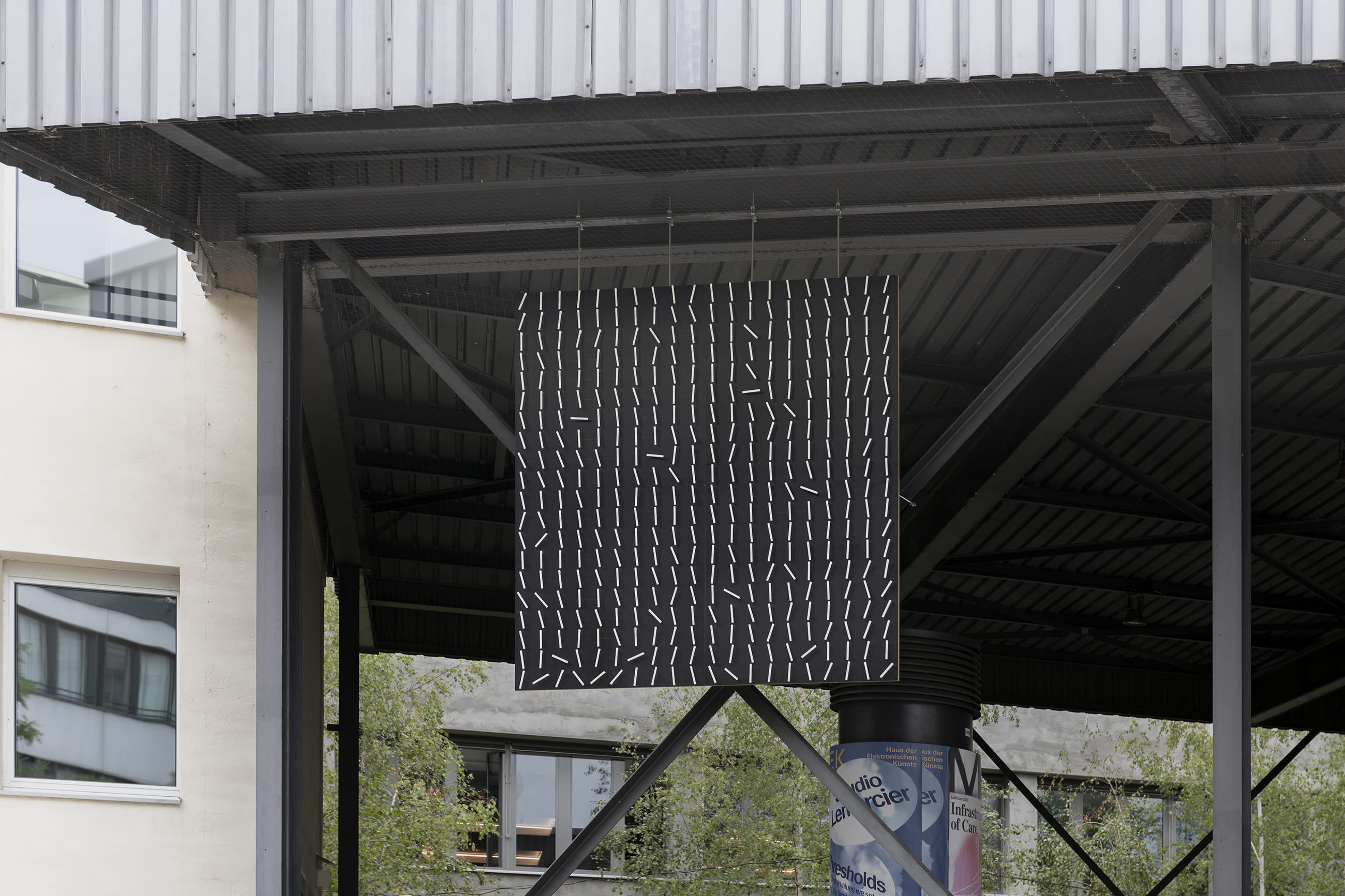
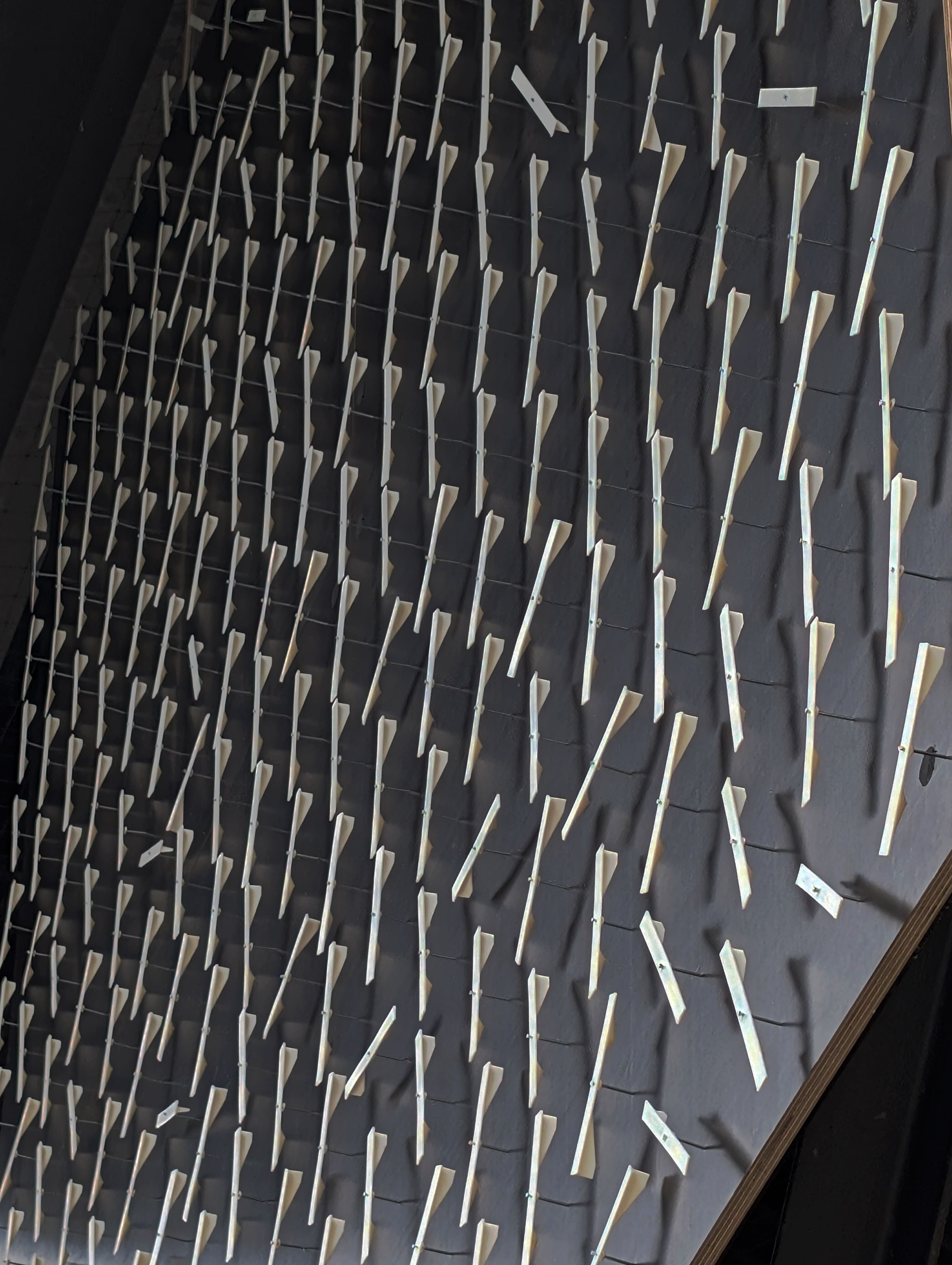
Exhibited outside of the museum, “Wind flow” is a wind-powered version of the grid with no motor nor electricity. As an homage to Sol LeWitt and Vera Molnár's Inclinaisons (1971) while giving it an ecology-responsible twist, “Wind flow” is a grid of 3D printed modules on nails responding to air.
On a similar track, “Color Machine”, the show's closing work, was born from a repurposed solar concentrator. It is a composition of nineteen mirrors blending two coloured light sources into nineteen shifting gradients as the viewer moves through the room.
"What's maddening about a sunset is you look at it for a minute and the next minute everything has changed. There's nothing less exciting than trying to freeze it."
The show is to be experienced, but not to be in awe, but to learn and be the witness of a message carried by the force of nature. As their journey on the Atlantic, Thresholds is an invitation to shift.
—
Thresholds runs 22 August to 15 November 2026 at HEK (House of Electronic Arts), Freilager-Platz 9, Basel. Read more.
During MESH Festival, Juliette Bibasse leads two curatorial tours through the show, Friday 16 October at 4pm, and Saturday 17 October at 3pm, in English. Free. Registration required via this link.
Artworks are available to collect from the ”The Ocean Exceeds All Memory” exhibition at Heft Gallery that presented pen plots and animated video made directly from the March 2026 Atlantic crossing, via this link.